
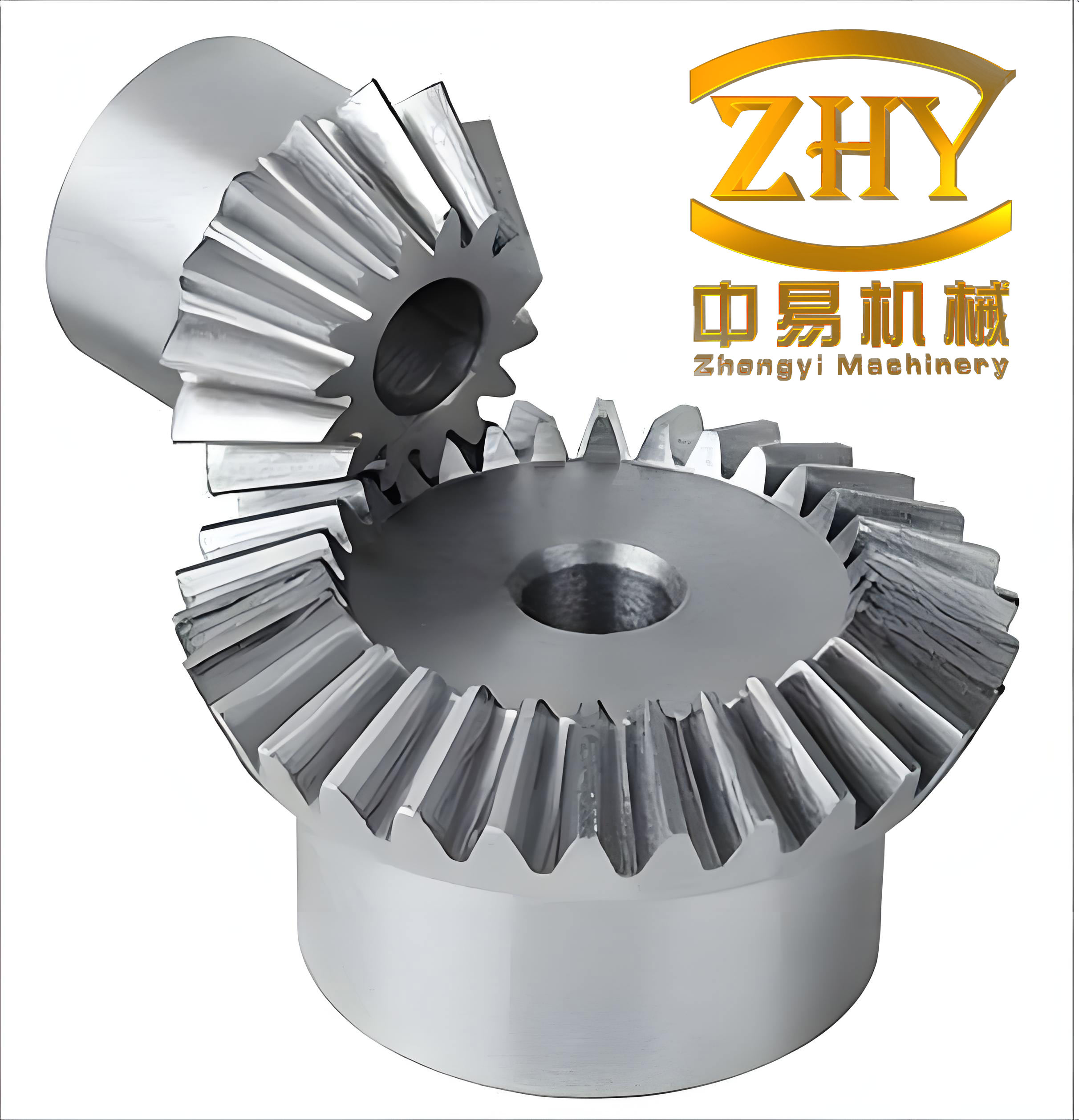
In the field of mechanical transmission, gear drives are fundamental, and among them, straight bevel gears play a critical role in transmitting power and motion between intersecting axes. Due to their simple geometry, straight bevel gears are widely used in industries such as aerospace. However, traditional manufacturing methods like gear planing, form milling, and circular broaching often result in poor accuracy, typically around grade 8-9 according to GB 11365-1989 (equivalent to B9 in AGMA 2009), and low efficiency. These methods produce straight bevel gears with linear tooth profiles, leading to full-length contact along the tooth width in theory. In practice, however, factors like machining errors, heat treatment distortions, assembly inaccuracies, and load-induced deformations cause contact patterns to shift, potentially resulting in edge contact at the toe, heel, tip, or root. This concentration of stress can lead to premature failure. The complex spherical involute tooth surfaces of straight bevel gears make precise manufacturing and inspection challenging, as process parameters are not unique, and deviations can compromise functionality. Moreover, errors in straight bevel gears are interdependent, often necessitating selective pairing and lapping in mass production, which hinders interchangeability due to inconsistent part quality.
To address these issues, I have developed a high-precision numerical control (NC) milling approach for straight bevel gears using the Phoenix II 275HC gear milling machine, which features six-axis, five-coordinate联动 control. This method achieves machining accuracy up to grade 5 in GB 11365-1989 (equivalent to B5 in AGMA 2009) and introduces controlled crowning along the tooth length. This crowning mitigates the drawbacks of full-length contact by ensuring that the contact pattern remains in an optimal position under various conditions. Additionally, I have established a standardized development and manufacturing process for straight bevel gears, incorporating master control gears and inspection control gears to record machining states, digitize inspection programs, and ensure consistency across production batches. This not only enhances accuracy but also improves efficiency in batch production.
The NC milling process for straight bevel gears begins with software-based design and analysis. Using specialized software like Straight Bevel, I calculate the gear dimensions and cutter parameters based on design drawings. For instance, the gear data includes module, number of teeth, pressure angle, and pitch cone angle. The cutter parameters, such as diameter and blade angle, are derived to suit the gear geometry. Next, I employ Unical software for tooth contact analysis (TCA) to simulate the contact pattern under load. A first-order correction, typically involving adjustments to the spiral angle, is applied to shift the contact pattern toward the toe (small end) by 1–2 mm, anticipating post-heat treatment shifts. The TCA results generate an adjustment card that configures the 275HC milling machine for machining.
The Phoenix II 275HC machine operates with six axes (X, Y, Z, A, B, C) and utilizes an intermittent generating method for milling. In this process, the cutter, positioned above the workpiece, rotates about the C-axis and oscillates about the B-axis, while the workpiece rotates about the A-axis and translates linearly along the X and Z axes. This coordinated motion generates the left tooth flank through a series of discrete movements. After completing one tooth flank, the cutter retracts, the workpiece indexes to the next tooth, and the process repeats for all left flanks. Subsequently, the cutter moves below the workpiece to machine the right flanks. This method ensures precise control over the tooth profile and introduces crowning—a convex curvature along the tooth length—which is influenced by the cutter diameter and dish angle. Specifically, a smaller cutter diameter or larger dish angle increases crowning and reduces the contact area size. Since the machine typically uses a standard 9-inch diameter cutter, adjustments are made primarily through the dish angle to achieve the desired contact pattern.
The crowning effect is crucial for optimizing contact under real-world conditions. It prevents edge contact by localizing the contact area centrally, even under load variations. The relationship between crowning (C), cutter diameter (D), and dish angle (α) can be approximated by the formula: $$ C = k \cdot \frac{1}{D} \cdot \sin(\alpha) $$ where k is a machine-specific constant. For example, with D = 9 inches, varying α between 15° and 25° adjusts C to control contact width. After rough milling the first part, I use a coordinate measuring machine (CMM) to perform单项 inspections, measuring parameters like tooth thickness, depth, and flank form. Based on the CMM data, I apply corrections using G-AGE software to refine the machining program, iterating until the gear meets specifications. Finally, a pair of straight bevel gears is tested on a 360T rolling tester under light load to verify contact pattern size, position, and backlash, ensuring they align with design requirements.
Contact pattern analysis is integral to quality assurance. In TCA, I model the gear pair under load to predict the contact ellipse’s dimensions and location. The contact pattern should be elliptical or rectangular, centered between the tip and root, and positioned away from the edges. The spiral angle correction (Δβ) is calculated to translate the pattern toward the toe: $$ \Delta\beta = \arctan\left(\frac{\delta}{L}\right) $$ where δ is the desired shift (e.g., 1–2 mm) and L is the face width. This adjustment compensates for thermal and mechanical distortions, ensuring stable contact in service. For a straight bevel gear with a face width of 20 mm, a Δβ of 0.5° might shift the pattern by approximately 1.5 mm, as verified through simulation and testing.
To ensure consistency in straight bevel gear production, I have developed a rigorous development and manufacturing流程 that involves master and control gears. These gears serve as references for inspection and process validation. The master control gear is the most accurate pair from the development batch, used to establish CMM digital inspection programs and validate other gears. Control gears, produced under the same conditions, are employed for routine checks and rolling tests. The purposes of these gears are summarized in the table below:
| Gear Type | Purpose and Requirements |
|---|---|
| Master Control Gear | Meets all drawing specifications; the most precise pair in the batch; never used for rolling tests after designation; only one set exists as a standard. |
| Control Gear | Manufactured to master standards; has correct backlash; contact pattern matches the master; tooth flank profile within 50% of CMM grid tolerance; typically two sets for inspection. |
The development process for master gears involves multiple stages to achieve optimal geometry and contact. Initially, I machine a single tooth and use CMM to measure key parameters like midpoint chordal tooth thickness, tooth depth, and flank form. The midpoint chordal thickness (s_m) is calculated as: $$ s_m = m \cdot z \cdot \cos(\delta) $$ where m is the module, z is the number of teeth, and δ is the pitch cone angle. CMM inspections cover 45 grid points on the tooth flank to compare actual and theoretical profiles, enabling corrections in pressure angle and spiral angle. After iterative adjustments, the full gear is milled, and CMM checks confirm compliance with standards for tooth thickness, pitch deviation, and runout. The gear pair is then tested on the 360T rolling tester under light load (e.g., 20 N·m) to validate contact pattern and backlash. For a straight bevel gear with a module of 2 mm and 20 teeth, the backlash should be 0.05–0.10 mm, and the contact pattern should cover 30–50% of the tooth surface, centered away from edges.
Once the master control gear is approved, I digitize its CMM inspection program, using it as a benchmark for subsequent gears. In batch production, this streamlined process ensures that all straight bevel gears are manufactured consistently. The workflow includes rough milling, CMM-based反调, finishing, and final inspection against the master. For heat-treated gears, I account for distortions by pre-adjusting the machining parameters based on historical data. For example, a shrinkage factor of 0.2% might be applied to tooth dimensions to compensate for hardening effects.
In assembly validation, I test a gear pair in the actual housing under various loads—light, normal, and maximum—to evaluate contact pattern behavior. Under load, the contact area typically expands by 5–40% and shifts toward the heel by a similar percentage. The contact pattern must not reach the toe, heel, tip, or root; a minimum clearance of 2.5% of tooth height is maintained. If issues arise, I revise the machining process or design drawings. This closed-loop approach, integrating design, manufacturing, heat treatment, and assembly, ensures that straight bevel gears meet performance requirements across batches.
The advantages of this NC milling method for straight bevel gears are significant. It not only achieves high precision and efficiency but also enables tooth flank modifications that enhance durability. By implementing a standardized process with master gears, I have overcome the limitations of traditional methods, ensuring interchangeability and reducing the need for selective pairing. Future work may focus on optimizing cutter paths and incorporating real-time monitoring for adaptive control. Overall, this approach represents a substantial advancement in the production of straight bevel gears, with applications in aerospace, automotive, and other high-precision industries.