
As a researcher specializing in gear transmission systems, I have extensively studied the meshing behavior of planar internal gear single-enveloping crown worm drives. These drives represent a significant advancement in worm gear technology, combining the benefits of internal gear configurations with the high load-capacity and compact design of crown worm systems. In this article, I will delve into the error analysis of these drives, focusing on how manufacturing and assembly errors impact their real meshing conditions. The insights gained are crucial for internal gear manufacturers aiming to optimize performance and reliability in applications such as aerospace and marine engineering, where internal gears must operate under strict weight and volume constraints.
The meshing geometry of internal gear single-enveloping crown worm drives involves a complex interaction between a crown worm and an internal gear, where the worm is enveloped by the internal gear’s tooth surface. Understanding this interaction requires a detailed mathematical model that accounts for various error sources. For internal gear manufacturers, it is essential to grasp how errors in center distance, inclination angle, base circle radius, shaft angle, and axial displacement affect the instantaneous contact lines and overall meshing performance. These errors can lead to issues like improper contact, increased wear, and even jamming, which are critical concerns in the production of high-precision internal gears.
To begin, I established a comprehensive meshing geometry theory that incorporates common errors encountered during the manufacturing and assembly of internal gears. This theory is based on coordinate systems that describe the relative motion between the worm and the internal gear. Let me define the key parameters and equations used in this analysis. The fixed coordinate systems are denoted as σm and σn for the worm and internal gear, respectively, while the moving coordinate systems σ1 and σ2 are attached to the worm and internal gear, rotating with angular velocities ω1 and ω2. The relationship between their rotations is given by the transmission ratio i12 = Z2 / Z1, where Z1 is the number of worm threads and Z2 is the number of teeth on the internal gear. The primary error sources include center distance error Δa, shaft angle error Δδ, inclination angle error Δβ, base circle radius error Δrb, and worm axial displacement error Δl.
The tooth surface of the internal gear, which serves as the enveloping surface, can be expressed in coordinate system σ2 as follows:
$$ \mathbf{r}_2 = x_2 \mathbf{i}_p + y_2 \mathbf{j}_p + z_2 \mathbf{k}_p $$
where the components are defined by:
$$ x_2 = r_b + \Delta r_b – v \sin(\beta + \Delta\beta) $$
$$ y_2 = -u $$
$$ z_2 = v \cos(\beta + \Delta\beta) $$
Here, u and v are parameters defining the planar surface, rb is the base circle radius, β is the inclination angle, and Δ denotes the respective errors. The unit normal vector to this surface in the moving coordinate system σp is:
$$ \mathbf{n}_2 = n_x \mathbf{i}_p + n_y \mathbf{j}_p + n_z \mathbf{k}_p $$
$$ n_x = 0, \quad n_y = 0, \quad n_z = 1 $$
The relative velocity vector between the worm and internal gear during meshing, considering errors, is derived as:
$$ \mathbf{v}^{(12)}_p = v^{(12)}_{px} \mathbf{i}_p + v^{(12)}_{py} \mathbf{j}_p + v^{(12)}_{pz} \mathbf{k}_p $$
with components:
$$ v^{(12)}_{px} = -x_2 i_{21} \sin(\delta + \Delta\delta) + z_2 \cos(\delta + \Delta\delta) \cos \phi_2 + (a + \Delta a) \sin(\delta + \Delta\delta) \sin \phi_2 $$
$$ v^{(12)}_{py} = -x_2 \cos(\delta + \Delta\delta) \sin \phi_2 \cos(\beta + \Delta\beta) + y_2 \left[ i_{21} \sin(\beta + \Delta\beta) + \sin(\delta + \Delta\delta) \sin(\beta + \Delta\beta) + \cos(\delta + \Delta\delta) \cos \phi_2 \cos(\beta + \Delta\beta) \right] – z_2 \cos(\delta + \Delta\delta) \sin \phi_2 \sin(\beta + \Delta\beta) + \sin(\delta + \Delta\delta) \cos \phi_2 \sin(\beta + \Delta\beta) + (a + \Delta a) \cos(\delta + \Delta\delta) \cos(\beta + \Delta\beta) $$
$$ v^{(12)}_{pz} = x_2 \cos(\delta + \Delta\delta) \sin \phi_2 \sin(\beta + \Delta\beta) + y_2 \left[ i_{21} \cos(\beta + \Delta\beta) + \sin(\delta + \Delta\delta) \cos(\beta + \Delta\beta) – \cos(\delta + \Delta\delta) \cos \phi_2 \sin(\beta + \Delta\beta) \right] – z_2 \cos(\delta + \Delta\delta) \sin \phi_2 \cos(\beta + \Delta\beta) – \cos(\delta + \Delta\delta) \sin(\beta + \Delta\beta) + (a + \Delta a) \sin(\delta + \Delta\delta) \cos \phi_2 \cos(\beta + \Delta\beta) $$
The meshing condition, which ensures proper contact between the worm and internal gear, is given by the equation Φ = 0, where:
$$ \Phi = M_1 \sin \phi_2 + M_2 \cos \phi_2 + M_3 $$
and the coefficients are:
$$ M_1 = -v \cos(\delta + \Delta\delta) + (r_b + \Delta r_b) \cos(\delta + \Delta\delta) \sin(\beta + \Delta\beta) $$
$$ M_2 = (a + \Delta a) \sin(\delta + \Delta\delta) \cos(\beta + \Delta\beta) + u \cos(\delta + \Delta\delta) \sin(\beta + \Delta\beta) $$
$$ M_3 = -u \sin(\delta + \Delta\delta) \cos(\beta + \Delta\beta) – i_{21} u \cos(\beta + \Delta\beta) – (a + \Delta a) \cos(\delta + \Delta\delta) \sin(\beta + \Delta\beta) $$
This equation is fundamental for determining the instantaneous contact lines under error conditions. The tooth surface of the crown worm in its coordinate system σ1 can then be derived as:
$$ \mathbf{r}_1 = x_1 \mathbf{i}_1 + y_1 \mathbf{j}_1 + z_1 \mathbf{k}_1 $$
with:
$$ x_1 = -x_2 \left[ \sin(\delta + \Delta\delta) \sin \phi_1 \cos \phi_2 + \cos \phi_1 \sin \phi_2 \right] + y_2 \left[ \cos \phi_1 \cos \phi_2 – \sin(\delta + \Delta\delta) \sin \phi_1 \sin \phi_2 \right] + z_2 \sin(\delta + \Delta\delta) \sin \phi_1 + (a + \Delta a) \cos \phi_1 $$
$$ y_1 = x_2 \left[ -\sin(\delta + \Delta\delta) \cos \phi_1 \cos \phi_2 + \sin \phi_1 \sin \phi_2 \right] – y_2 \left[ \sin \phi_1 \cos \phi_2 + \sin(\delta + \Delta\delta) \cos \phi_1 \sin \phi_2 \right] + z_2 \sin(\delta + \Delta\delta) \cos \phi_1 – (a + \Delta a) \sin \phi_1 $$
$$ z_1 = x_2 \cos(\delta + \Delta\delta) \cos \phi_2 + y_2 \cos(\delta + \Delta\delta) \sin \phi_2 + z_2 \sin(\delta + \Delta\delta) – \Delta l $$
subject to Φ = 0. These equations form the basis for analyzing the meshing behavior under ideal and error conditions.
In the ideal state, where all errors are zero, the meshing of internal gear single-enveloping crown worm drives exhibits multiple tooth contacts simultaneously. For instance, with typical parameters such as a center distance of 100 mm, transmission ratio of 63, and inclination angle of 28°, my analysis shows that at least five pairs of teeth are in contact at any given time. The instantaneous contact lines are straight and parallel along the tooth height, ensuring uniform load distribution. This ideal behavior is crucial for internal gear manufacturers to achieve high efficiency and durability in their products. To visualize this, I developed a precise 3D model using the derived equations, which confirmed the theoretical predictions. The model’s accuracy was verified by measuring deviations at various points on the worm tooth surface, with maximum errors on the order of 10^{-3} mm, demonstrating its reliability for further analysis.
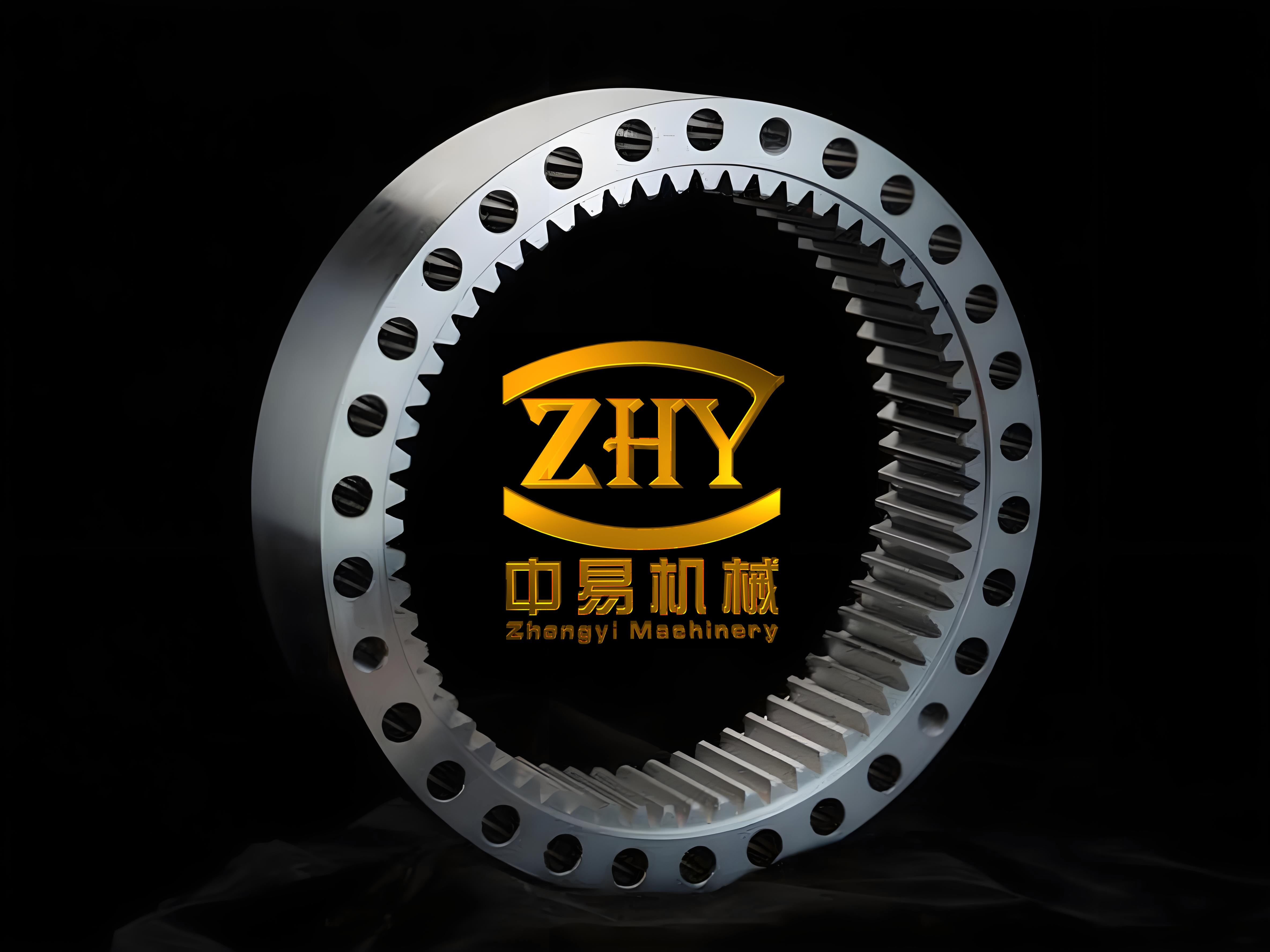
However, in real-world scenarios, errors introduced during manufacturing and assembly significantly alter the meshing characteristics. As an internal gear manufacturer, it is vital to understand how each error type affects performance. I conducted a detailed error analysis by varying one error parameter at a time while keeping others zero, using the 3D model to simulate the meshing conditions. The results are summarized in the table below, which highlights the impact on the number of contacting teeth and contact pattern.
| Error Type | Error Value | Number of Contacting Teeth | Contact Pattern Description |
|---|---|---|---|
| Center Distance Error (Δa) | +0.5 mm | 2 | Contact mainly at worm tooth tip, reduced engagement |
| Center Distance Error (Δa) | -0.5 mm | 4 | Better contact at entry, partial tip engagement |
| Inclination Angle Error (Δβ) | +0.25° | 3 | Reduced contact at exit, uneven distribution |
| Inclination Angle Error (Δβ) | -0.25° | 2 | Contact concentrated at entry, similar impact |
| Base Circle Radius Error (Δrb) | +0.5 mm | 2 | Tip contact dominant, poor meshing |
| Base Circle Radius Error (Δrb) | -0.5 mm | 2 | Root contact issues, severe impact |
| Shaft Angle Error (Δδ) | +0.25° | 1 | Single tooth contact, high stress concentration |
| Shaft Angle Error (Δδ) | -0.25° | 1 | Similar single contact, critical for performance |
| Axial Displacement Error (Δl) | +0.5 mm | 5 | Full contact but degrading from root to tip |
| Axial Displacement Error (Δl) | -0.5 mm | 4 | Improved entry contact, acts as relief |
From this analysis, I observed that center distance errors have an asymmetric effect: negative errors (Δa < 0) result in more teeth in contact compared to positive errors, making them preferable for internal gear manufacturers seeking to minimize meshing issues. For example, with Δa = -0.5 mm, four teeth are in contact, whereas with Δa = +0.5 mm, only two teeth engage, leading to higher stress and potential failure. This is because negative center distance errors effectively increase the engagement depth, compensating for minor misalignments in internal gears.
Inclination angle errors, whether positive or negative, reduce the number of contacting teeth to two or three, indicating a high sensitivity. This underscores the need for precision in setting the inclination angle during the manufacturing of internal gears. Similarly, base circle radius errors significantly degrade meshing, with negative errors causing root contact problems that can lead to premature wear. For internal gear manufacturers, controlling these errors through tight tolerances is essential to maintain the integrity of the gear system.
Shaft angle errors are particularly critical, as they reduce the contact to a single tooth pair, drastically increasing the load per tooth and risking rapid failure. This highlights the importance of accurate alignment in assemblies involving internal gears. On the other hand, axial displacement errors have a milder impact; negative errors (Δl < 0) can even improve meshing by providing a relief effect at the entry point, which enhances lubrication and reduces noise. This insight can guide internal gear manufacturers in designing systems with intentional axial adjustments to optimize performance.
To further quantify the impact of errors, I derived sensitivity coefficients based on the meshing equations. For instance, the sensitivity of the meshing function Φ to center distance error can be expressed as:
$$ \frac{\partial \Phi}{\partial \Delta a} = \sin(\delta + \Delta\delta) \cos \phi_2 \cos(\beta + \Delta\beta) – \cos(\delta + \Delta\delta) \sin(\beta + \Delta\beta) $$
This partial derivative indicates how changes in center distance affect the meshing condition. Similarly, for inclination angle errors:
$$ \frac{\partial \Phi}{\partial \Delta\beta} = -v \cos(\beta + \Delta\beta) \cos(\delta + \Delta\delta) + (r_b + \Delta r_b) \cos(\beta + \Delta\beta) \cos(\delta + \Delta\delta) – u \sin(\beta + \Delta\beta) \sin(\delta + \Delta\delta) – i_{21} u \sin(\beta + \Delta\beta) – (a + \Delta a) \cos(\beta + \Delta\beta) \cos(\delta + \Delta\delta) $$
These equations allow internal gear manufacturers to predict the effect of errors and implement corrective measures during production. For example, by minimizing Δβ and Δδ, the meshing quality can be preserved, ensuring that internal gears operate smoothly under load.
In conclusion, my analysis reveals that internal gear single-enveloping crown worm drives are highly sensitive to certain errors, such as shaft angle, inclination angle, and base circle radius errors. Internal gear manufacturers must prioritize controlling these parameters through advanced machining techniques and quality assurance processes. Negative values for center distance and axial displacement errors can be beneficial, offering a form of passive compensation that enhances meshing. As the demand for compact and efficient gear systems grows, particularly in industries reliant on internal gears, this error analysis provides a foundation for improving design and manufacturing practices. Future work could explore real-time monitoring and adaptive control to mitigate error effects in dynamic operating conditions.
Throughout this study, I have emphasized the importance of error analysis in achieving optimal performance for internal gears. By integrating mathematical modeling with practical insights, internal gear manufacturers can enhance the reliability and longevity of their products, meeting the stringent requirements of modern applications. The continued advancement in this field will undoubtedly contribute to the evolution of gear technology, solidifying the role of internal gears in innovative transmission systems.