
As an internal gear manufacturer, I often explore advanced gear designs to enhance performance and durability. Internal gears, particularly high contact ratio cycloid internal gear pairs, offer significant advantages such as high重合度, minimal root bending stress, and improved load distribution. In this article, I delve into the tooth surface contact strength of these gear pairs, leveraging analytical models and finite element analysis. The study focuses on calculating time-varying mesh stiffness, load sharing among teeth, and contact stress using energy methods and Hertz theory. Additionally, I address the critical issue of zero curvature radius at the pitch point by optimizing tooth profile modifications and analyze the impact of machining errors on load-bearing characteristics. This work provides valuable insights for internal gear manufacturers aiming to optimize gear design and ensure reliability.
High contact ratio cycloid internal gear pairs are characterized by their unique tooth profiles, composed of epicycloids and hypocycloids. These gears achieve重合度 values exceeding traditional designs, leading to smoother operation and higher load capacity. For internal gears, the contact ratio can reach several times the module, reducing sliding rates and increasing efficiency. As an internal gear manufacturer, I emphasize the importance of accurate strength calculations to prevent failures and extend service life. The primary concern here is tooth surface contact strength, as root bending stress is negligible due to multi-tooth engagement. This study builds on improved energy methods and Hertz elastic theory to develop models for mesh stiffness, load distribution, and contact stress under ideal conditions.
The tooth profile equations for the external and internal gears are derived from gear meshing principles. For the external gear, the tooth tip (epicycloid) and root (hypocycloid) profiles are given by parametric equations. Similarly, the internal gear profiles are defined, ensuring no interference and minimal sliding. The transition curves, influenced by manufacturing processes, are also considered. For instance, the external gear’s transition curve is an extended involute, while the internal gear’s is a shortened hypocycloid, accounting for tool geometry. These equations form the basis for stiffness and stress calculations.
To compute the time-varying mesh stiffness, I use an improved energy method that considers bending, shear, compression, gear body deformation, and Hertz contact effects. The stiffness for each tooth pair is derived by integrating energy components over the tooth height. For example, the bending stiffness \( k_{b} \) for a tooth is calculated as:
$$ \frac{1}{k_{b}} = \int_{x_f}^{x_i} \frac{(L \cos \beta – y \sin \beta)^2}{EI} dx $$
where \( E \) is the elastic modulus, \( I \) is the moment of inertia, \( L \) is the distance from the load point, and \( \beta \) is the load angle. Similar expressions are used for shear and compression stiffness. The Hertz contact stiffness \( k_h \) is given by:
$$ k_h = \frac{\pi E B}{4(1-\nu^2) \ln\left(\frac{2h}{a}\right)} $$
where \( \nu \) is Poisson’s ratio, \( B \) is the face width, \( h \) is the distance to the load line, and \( a \) is the contact half-width. The comprehensive mesh stiffness \( k_i \) for the \( i \)-th tooth pair is the series combination of these components:
$$ \frac{1}{k_i} = \sum_{l=1}^{2} \left( \frac{1}{k_{b,il}} + \frac{1}{k_{s,il}} + \frac{1}{k_{a,il}} + \frac{1}{k_{f,il}} + \frac{1}{k_{h,il}} \right) $$
Load distribution among multiple teeth is determined by solving deformation compatibility equations. The total torque \( T_c \) applied to the internal gear must balance the sum of moments from all engaged tooth pairs. The force on each tooth pair \( F_{ij} \) is related to the stiffness and displacement along the line of action. For ideal conditions without errors, the load sharing is uniform, but in practice, errors alter this distribution. I model errors as offsets on the theoretical tooth profile normal line, converting machining inaccuracies and backlash into displacement terms. This approach simplifies sensitivity analysis without requiring detailed error measurements.
A key challenge is the pitch point, where the curvature radius approaches zero, leading to infinite Hertz stress. To address this, I optimize the tooth profile by excluding a region around the pitch point from meshing. The length of this non-meshing region is varied, and its effect on load distribution and contact stress is analyzed. For instance, excluding a segment of length \( \Delta \epsilon = 1.0 \) times the unit length (πm) reduces peak contact stress significantly without compromising load capacity. This modification is implemented in both analytical and finite element models.
To validate the analytical models, I conduct finite element analysis (FEA) in ABAQUS. The gear pair is modeled as a plane strain problem to reduce computational cost while maintaining accuracy. The mesh is refined at the tooth surfaces to capture contact stresses accurately. The FEA results show good agreement with analytical predictions for load distribution and contact stress. For example, the root bending stress remains low, confirming that contact strength is the limiting factor. The impact of errors is also simulated by introducing uniform offsets on the tooth profiles. As errors increase, the actual重合度 decreases, and load fluctuations intensify, highlighting the sensitivity of internal gears to manufacturing precision.
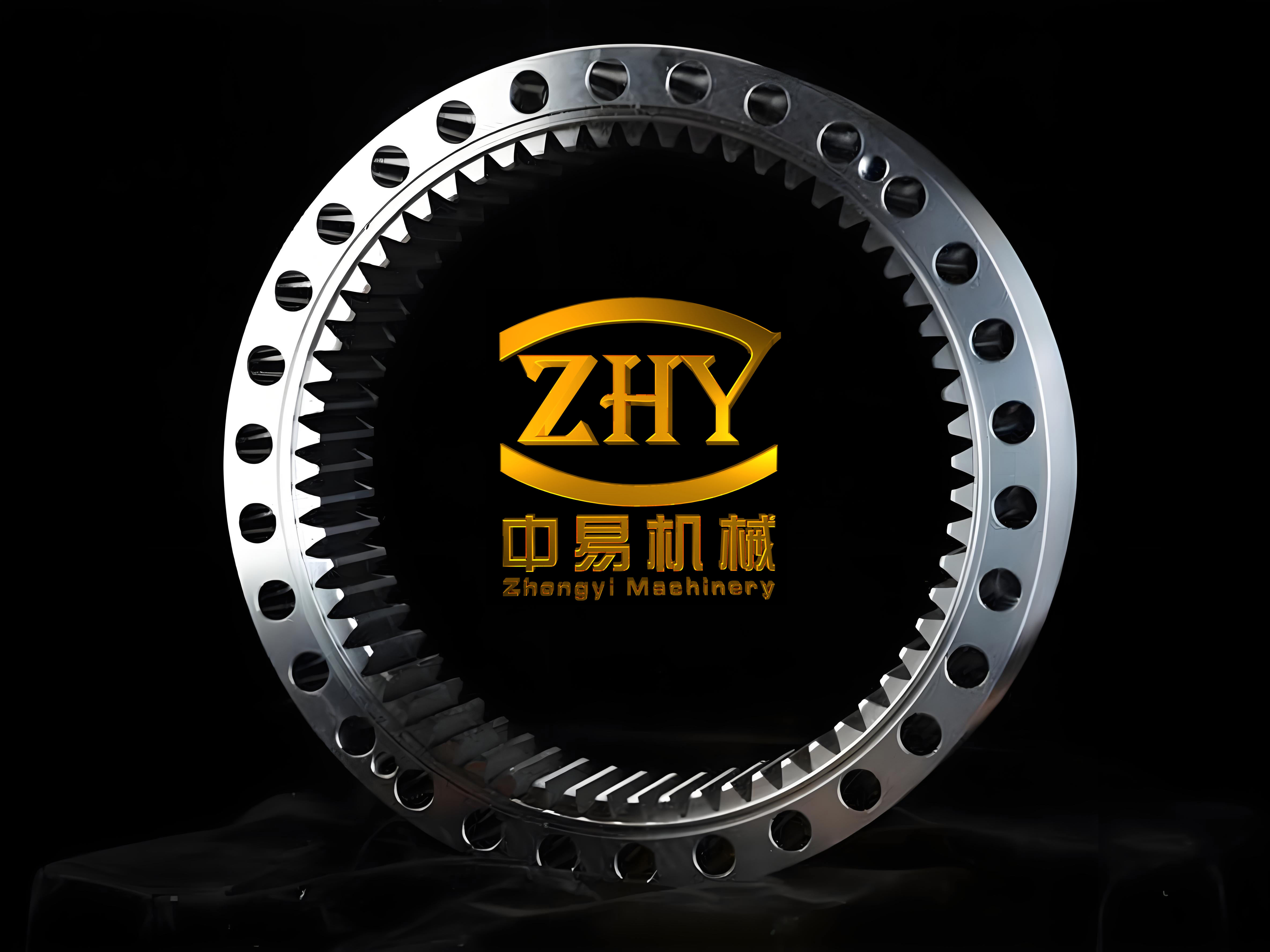
The following table summarizes the design parameters used in this study for high contact ratio cycloid internal gear pairs. These parameters are typical for internal gear manufacturers aiming to achieve high performance.
| Parameter | External Gear | Internal Gear |
|---|---|---|
| Number of Teeth | 30 | 36 |
| Module (mm) | 2.5 | 2.5 |
| Addendum Coefficient | 1 | 1 |
| Dedendum Coefficient | 0.12 | 0.12 |
| Contact Ratio (Total) | 6.450 | 6.450 |
Another table compares the effects of different non-meshing region lengths on peak contact stress and load fluctuation. This data assists internal gear manufacturers in selecting optimal profile modifications.
| Non-Meshing Length (Δε) | Peak Contact Stress (MPa) | Load Fluctuation (%) |
|---|---|---|
| 0.2 | 1200 | 15 |
| 0.6 | 950 | 20 |
| 1.0 | 900 | 25 |
| 1.4 | 880 | 30 |
| 1.8 | 870 | 35 |
The Hertz contact stress \( \sigma_H \) for each tooth pair is calculated using:
$$ \sigma_H = \sqrt{\frac{F}{\pi B} \cdot \frac{E}{2(1-\nu^2)} \cdot \frac{1}{\rho_v}} $$
where \( \rho_v \) is the composite curvature radius. For the engaging period, \( \rho_v \) is derived based on the gear geometry. For example, during engagement, the curvature radius varies along the path of contact, and the stress peaks near the pitch point. By excluding this region, the effective \( \rho_v \) increases, reducing stress concentrations.
In error analysis, I model the initial gaps \( \xi_{ij} \) due to machining errors. The geometric rotation angle \( \Delta \beta_e \) is found from the minimum gap, and the load distribution under torque is solved iteratively. The actual force on each tooth pair \( F_{ij} \) is zero if the deformed gap \( d_{ij} \) is non-positive, indicating no contact. This model shows that even small errors (e.g., 0.01 mm) can reduce the number of engaged teeth, increasing stress on remaining pairs. Internal gear manufacturers must thus maintain tight tolerances to exploit the full benefits of high重合度 designs.
Finite element results corroborate the analytical findings. The stress contours from ABAQUS reveal that the maximum contact stress occurs during the engaging phase, and the root stress is minimal. For error cases, the load distribution becomes uneven, and the重合度 drops, leading to higher per-tooth loads. This underscores the importance of precision in manufacturing internal gears. As an internal gear manufacturer, I recommend using these models during the design phase to predict performance and set error limits.
In conclusion, this study provides a comprehensive framework for analyzing tooth surface contact strength in high contact ratio cycloid internal gear pairs. The models for mesh stiffness, load distribution, and contact stress, combined with profile optimization and error analysis, offer practical tools for internal gear manufacturers. The findings emphasize the sensitivity of these gears to machining errors, necessitating high precision in production. Future work could explore dynamic effects and thermal influences to further enhance gear reliability and efficiency.