
In the field of precision manufacturing, internal gears are critical components used in high-speed trains, aerospace, engineering machinery, and marine applications. The demand for high-precision internal gears has grown significantly, driving the need for advanced machining techniques. Form grinding is one of the most effective methods for producing high-accuracy internal gears due to its efficiency, versatility, and precision. As an internal gear manufacturer, we focus on optimizing the grinding process to enhance gear quality and performance. The grinding head, particularly the grinding wheel rack, plays a pivotal role in maintaining stability during internal gear form grinding. However, the confined space for internal gear machining imposes strict size constraints on the grinding wheel rack, which is often designed as a cantilever structure. This leads to challenging force conditions and potential vibrations that can compromise machining accuracy. In this study, we investigate the vibration characteristics of the grinding wheel rack through finite element analysis and experimental validation, aiming to improve the dynamic performance for internal gears production.
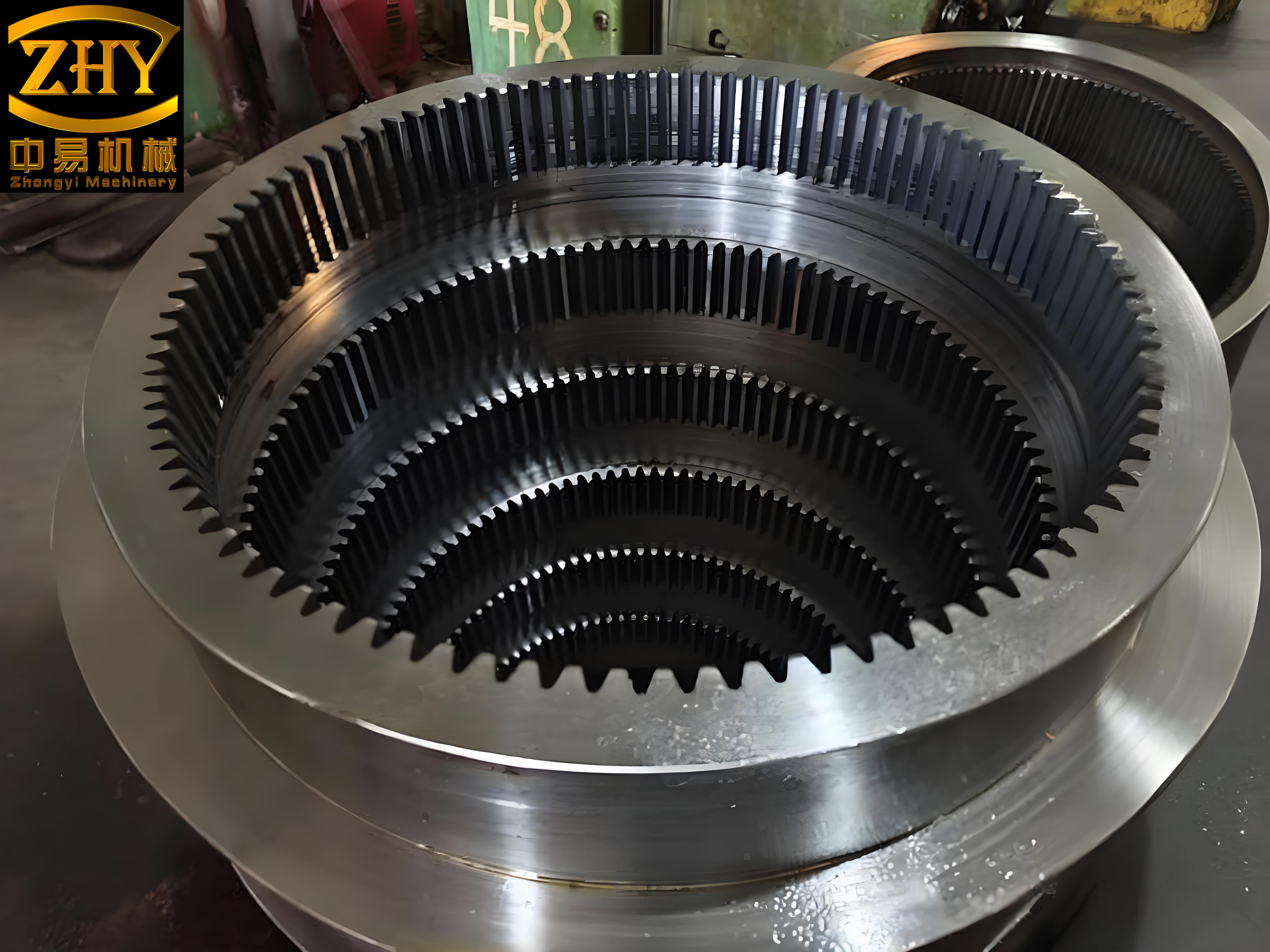
The grinding head assembly of a CNC internal gear form grinding machine consists of several key components, including the grinding wheel rack, motorized spindle, spindle support, grinding head connection seat, bearings, grinding wheel, belt, and pulleys. The grinding wheel rack serves as the main body for installing the grinding wheel, ensuring stable high-speed rotation and minimizing vibrations and noise. Its structural integrity directly impacts the grinding precision and surface finish of internal gears. To illustrate the setup, we include a visual reference of internal gears used in such applications.
We begin by constructing a finite element model of the grinding head using SolidWorks and ANSYS Workbench. The materials assigned include QT450-10 for the grinding wheel rack, connection seat, and spindle support, with a density of 7100 kg/m³, elastic modulus of 182 GPa, and Poisson’s ratio of 0.3. For components like bearings and shafts, 20CrMnTi is used, with a density of 7800 kg/m³, elastic modulus of 207 GPa, and Poisson’s ratio of 0.25. The mesh model comprises 275,624 nodes and 142,781 elements, employing hexahedral elements for accuracy. Contact definitions include bonded contacts for bolted connections and frictional contacts for rotating parts, with a contact stiffness factor of 1.5 and damping set to 0.1%–1.0% of the stiffness value.
Modal analysis is performed to determine the natural frequencies and mode shapes of the grinding head. The first six natural frequencies are listed in Table 1, which are crucial for avoiding resonance during internal gear manufacturing. The mode shapes depict deformations in various directions, such as bending along the Y-axis and X-axis, and torsional deformations. For instance, the first mode at 280.9 Hz shows bending in the Y-direction, while higher modes involve more complex deformations in the spindle support and rack. These results highlight the importance of structural dynamics in ensuring the stability of internal gears grinding processes.
| Mode | 1 | 2 | 3 | 4 | 5 | 6 |
|---|---|---|---|---|---|---|
| Frequency (Hz) | 280.9 | 311.5 | 423.0 | 659.0 | 1052.0 | 1160.0 |
Harmonic response analysis is conducted to assess the steady-state response under sinusoidal loading, which simulates the grinding forces encountered during internal gear production. The grinding forces include tangential force \( F_t \) and normal force \( F_n \), derived from empirical grinding force formulas. In our analysis, we set \( F_t = 50 \, \text{N} \) and \( F_n = 130 \, \text{N} \), applied at critical deformation points. The frequency range is set from 0 to 2000 Hz. The stress and displacement response curves reveal peak responses in specific frequency intervals, such as 200–500 Hz and 800–1200 Hz. The maximum stress values in the X, Y, and Z directions are 11.42 MPa, 2.094 MPa, and 14.545 MPa, respectively, with the Z-direction showing the highest stress. Similarly, displacement peaks are observed at 2.07 μm (X), 0.37 μm (Y), and 3.19 μm (Z). These findings indicate that operating within these frequency ranges could adversely affect the accuracy and reliability of internal gears machining, necessitating structural improvements.
To optimize the grinding wheel rack, we employ response surface optimization (RSO) in ANSYS Workbench. The design variables are parameters of the rack’s geometry, as shown in Figure 8 of the original study, labeled P1 to P6, representing dimensions of grooves and slots. The initial values and constraints are summarized in Table 2. The objective is to minimize the mass \( M(x) \), maximum deformation \( \text{Def}_{\text{max}}(x) \), and maximum stress \( \text{Stf}_{\text{max}}(x) \) of the rack, which are critical for internal gear manufacturer requirements. The optimization problem is formulated as follows:
$$ \mathbf{x} = [x_1, x_2, x_3, x_4, x_5, x_6]^T = [P1, P2, P3, P4, P5, P6]^T $$
with constraints:
$$ u_i \leq x_i \leq v_i, \quad i = 1, 2, \ldots, 6 $$
and objective functions:
$$ f_1(\mathbf{x}) = \min M(\mathbf{x}) $$
$$ f_2(\mathbf{x}) = \min \text{Def}_{\text{max}}(\mathbf{x}) $$
$$ f_3(\mathbf{x}) = \min \text{Stf}_{\text{max}}(\mathbf{x}) $$
Sensitivity analysis identifies the most influential parameters on the rack’s performance. As shown in the sensitivity histogram, P1 and P4 have high sensitivity to total displacement and stress, meaning increases in these parameters lead to higher deformation and stress. P4 and P5 significantly affect mass, with larger values reducing weight. This analysis guides the optimization focus for internal gears applications.
Response surface analysis further explores the relationships between key parameters and performance metrics. For example, the response surface of P1 and P4 versus equivalent stress shows a gradual increase in stress with larger P1 and P4 values. Similarly, P1 and P4 versus total displacement indicate a rising trend in deformation. In contrast, P4 and P5 versus mass demonstrate a rapid decrease in mass with increasing parameters. These insights are visualized through 3D surfaces and 2D curves, aiding in the selection of optimal values for internal gear manufacturer standards.
After optimization, three candidate designs are evaluated, and the best one is selected with modified dimensions, as listed in Table 3. The optimized parameters result in improved dynamic performance, as verified through subsequent modal and harmonic analyses. For instance, the first natural frequency increases by 4.97%, enhancing anti-vibration capabilities for internal gears grinding. A comparison of dynamic performance before and after optimization is presented in Table 4, showing frequency improvements across all modes.
| Parameter | Initial Value (mm) | Constraint Range (mm) |
|---|---|---|
| P1 | 15 | 10–20 |
| P2 | 20 | 15–25 |
| P3 | 125 | 115–140 |
| P4 | 50 | 45–55 |
| P5 | 23 | 18–28 |
| P6 | 155 | 140–170 |
| Parameter | Initial Value (mm) | Optimized Value (mm) | Adjusted Value (mm) |
|---|---|---|---|
| P1 | 15 | 10.415 | 11 |
| P2 | 20 | 20.786 | 21 |
| P3 | 125 | 131.550 | 132 |
| P4 | 23 | 21.285 | 21 |
| P5 | 50 | 61.032 | 61 |
| P6 | 155 | 160.050 | 160 |
| Mode | Before Optimization (Hz) | After Optimization (Hz) | Change (%) |
|---|---|---|---|
| 1 | 280.9 | 294.89 | +4.97 |
| 2 | 311.5 | 320.35 | +2.84 |
| 3 | 423.0 | 431.79 | +1.90 |
| 4 | 659.0 | 706.42 | +7.05 |
| 5 | 1052.0 | 1064.84 | +1.16 |
| 6 | 1160.0 | 1175.15 | +1.31 |
Harmonic response analysis of the optimized model shows significant reductions in stress and displacement. The maximum stress in X, Y, and Z directions decreases by 35.0%, 57.3%, and 35.8%, respectively, while displacement reductions are 36%, 20%, and 16%. These improvements are critical for internal gear manufacturer processes, as they enhance machining stability and prolong tool life.
To validate the optimization, we conduct vibration tests under actual grinding conditions. The experimental setup includes a CNC internal gear form grinding machine, vibration acceleration sensors with a sensitivity of 1000 mV/g and a range of 0.01–49.99g, a multi-channel data acquisition card, and a computer for data analysis. Sensors are placed near the rotation support points to capture vibration signals accurately. Two grinding conditions are tested: Condition 1 with a spindle speed of 4800 rpm, grinding depth \( a_p = 0.02 \, \text{mm} \), and feed rate of 2400 rpm; Condition 2 with a spindle speed of 6000 rpm, same grinding depth, and feed rate. Time-domain and frequency-domain analyses are performed on the vibration signals.
In Condition 1, the vibration acceleration before optimization ranges within ±0.06g, while after optimization, it reduces to ±0.03g. Similarly, in Condition 2, the acceleration range improves from ±0.09g to ±0.06g. Frequency spectrum analysis confirms these reductions, with lower amplitude peaks in the optimized structure. This demonstrates that the optimized grinding wheel rack exhibits better dynamic performance, reducing vibrations during internal gears production and validating the effectiveness of the finite element model and optimization approach for internal gear manufacturer applications.
In conclusion, our study comprehensively analyzes the vibration characteristics of the grinding wheel rack for internal gear form grinding. Through finite element analysis, we identify critical natural frequencies and response behaviors that impact machining precision. The optimization using response surface methodology successfully enhances the rack’s dynamic performance, as evidenced by increased natural frequencies and reduced stress and displacement. Experimental vibration tests under realistic grinding conditions confirm that the optimized structure significantly lowers vibration acceleration, improving stability for internal gears machining. This research provides a validated framework for designing high-performance grinding systems, benefiting internal gear manufacturers in achieving higher accuracy and efficiency. Future work could explore additional parameters or advanced materials to further optimize the grinding process for internal gears.