
In modern manufacturing, the gear hobbing process plays a critical role in producing high-precision gears for various industrial applications. As a gear hobbing machine is a primary source of energy consumption and carbon emissions in gear production, optimizing its process parameters is essential for achieving sustainable manufacturing. Traditional methods often rely on empirical formulas or large historical datasets, which may not be feasible in practical scenarios where data is limited. This article presents a novel approach that combines experimental design, neural networks, and multi-objective optimization to address the challenges of small sample data in gear hobbing. By focusing on key parameters such as spindle speed and feed rate, we aim to minimize both carbon emissions and processing time while maintaining product quality.
The gear hobbing process involves complex interactions between the gear hobbing machine, tooling, and workpiece materials. Factors like spindle speed, feed rate, and cutting conditions significantly influence energy consumption and environmental impact. In this study, we utilize a data-driven framework to model these relationships with limited samples. The core of our method lies in integrating Box-Behnken experimental design with a backpropagation neural network to predict carbon emissions and processing efficiency accurately. This allows us to overcome the limitations of small datasets commonly encountered in real-world manufacturing environments.
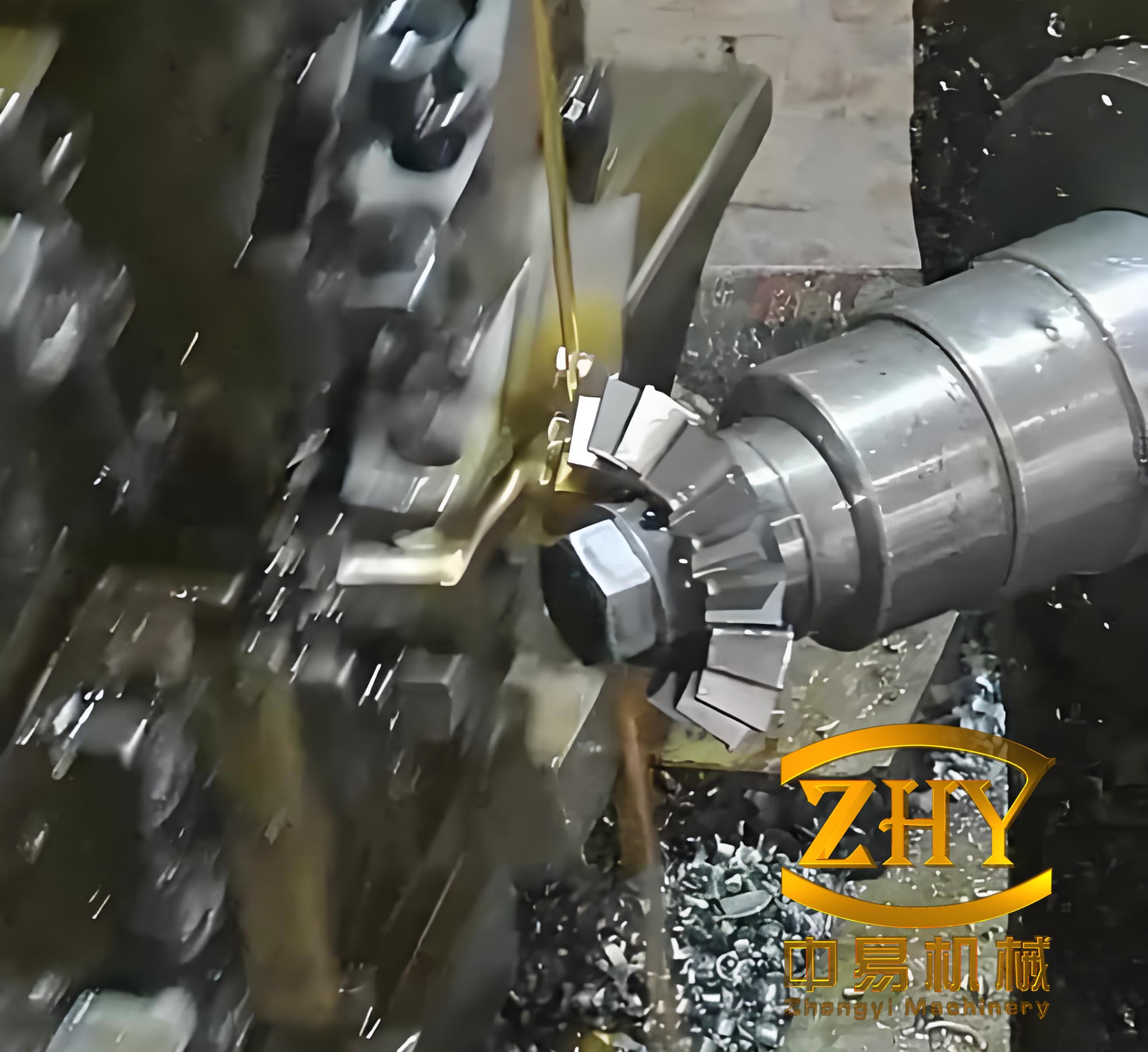
Carbon emissions in gear hobbing primarily stem from electricity consumption and tool usage. The total carbon emission \( C \) can be expressed as:
$$ C = C_{elec} + C_{tool} $$
where \( C_{elec} \) represents emissions from electricity use, calculated as:
$$ C_{elec} = F_{elec} \times E $$
Here, \( F_{elec} \) is the carbon emission factor for electricity (e.g., 0.8042 kg CO₂/kWh for certain regions), and \( E \) is the total energy consumed by the gear hobbing machine during operation. Tool-related emissions \( C_{tool} \) account for the carbon footprint of tool manufacturing,分摊 over the tool’s lifespan:
$$ C_{tool} = \frac{t_{ct} \times m_{tool} \times F_{tool}}{T_{tool}} $$
In this equation, \( t_{ct} \) is the cutting time, \( m_{tool} \) is the tool mass, \( F_{tool} \) is the tool emission factor (e.g., 29.6 kg CO₂/kg), and \( T_{tool} \) is the tool life, which can be modeled empirically as:
$$ T_{tool} = k_0 \times n^{k_1} \times f^{k_2} $$
where \( n \) is the spindle speed, \( f \) is the feed rate, and \( k_0, k_1, k_2 \) are life coefficients. The total processing time \( T \) includes standby, air-cutting, and cutting times:
$$ T = t_{st} + t_{airc} + t_{ct} $$
To optimize these objectives, we formulate a multi-objective problem with constraints on machine capabilities and surface quality. For a gear hobbing machine, the optimization model is:
$$ \min \, F(n_1, f_1, n_2, f_2) = (C, T) $$
$$ \text{subject to:} \quad n_{min} \leq n \leq n_{max} $$
$$ f_{min} \leq f \leq f_{max} $$
$$ 0.312 \frac{f^2}{r} \leq R_a $$
where \( n_1, f_1 \) are the spindle speed and feed rate for rough hobbing, \( n_2, f_2 \) for semi-finishing, \( r \) is the tool tip radius, and \( R_a \) is the surface roughness.
Collecting sufficient data for modeling can be challenging in small sample scenarios. We employ Box-Behnken experimental design to efficiently gather data points that cover the parameter space uniformly. This design reduces the number of required experiments while capturing nonlinear relationships. For instance, with four parameters (spindle speeds and feed rates for two stages), we set three levels per parameter, as shown in the table below:
| Parameter | Symbol | Level -1 | Level 0 | Level 1 |
|---|---|---|---|---|
| Rough Spindle Speed (rpm) | \( n_1 \) | 280 | 320 | 360 |
| Rough Feed Rate (mm/min) | \( f_1 \) | 3.5 | 4.0 | 4.5 |
| Semi-finish Spindle Speed (rpm) | \( n_2 \) | 360 | 390 | 420 |
| Semi-finish Feed Rate (mm/min) | \( f_2 \) | 4 | 6 | 8 |
Using this design, we conduct experiments on a gear hobbing machine, measuring energy consumption and time. The data is then used to train a backpropagation neural network with one hidden layer containing five nodes. The network architecture includes input parameters (spindle speeds and feed rates) and output targets (carbon emissions and processing time). We apply Bayesian regularization to prevent overfitting, ensuring robust predictions even with small samples. The prediction accuracy is evaluated using correlation coefficients, achieving values above 0.98, as summarized below:
| Method | Max Relative Error (%) | Correlation Coefficient R |
|---|---|---|
| Box-Behnken with BP Neural Network | 2.02 | 0.98192 |
| Standard BP Neural Network | 14.03 | 0.84292 |
| Support Vector Regression | 15.40 | 0.84052 |
| Random Forest | 18.50 | 0.83162 |
The neural network model serves as the fitness function in our multi-objective optimization. We employ an improved Multi-Objective Gray Wolf Optimization algorithm (MOGWO) to find Pareto-optimal solutions. The gray wolf algorithm mimics social hierarchy and hunting behavior, with alpha, beta, and delta wolves guiding the search. To enhance exploration, we modify the control parameter \( a \) and introduce autonomous exploration for each wolf. The position update equations are:
$$ D = | H \otimes X_p(t) – X(t) | $$
$$ X(t+1) = X_p(t) – A \otimes D $$
$$ A = 2a r_1 – a E $$
$$ H = 2 r_2 $$
where \( a \) decreases non-linearly from 2 to 0 over iterations:
$$ a = 2 – \frac{2}{I-1} \left( \frac{i}{i_{max}} – 1 \right) $$
Here, \( I \) is a control coefficient, \( i \) is the current iteration, and \( i_{max} \) is the maximum iterations. Wolves update their positions based on the leaders:
$$ X_1 = X_{\alpha} – A_1 | H_1 \otimes X_{\alpha} – X | $$
$$ X_2 = X_{\beta} – A_2 | H_2 \otimes X_{\beta} – X | $$
$$ X_3 = X_{\delta} – A_3 | H_3 \otimes X_{\delta} – X | $$
$$ X_{t+1} = \frac{X_1 + X_2 + X_3}{3} $$
Additionally, wolves explore nearby positions randomly to avoid local optima. The algorithm uses an external archive to store non-dominated solutions and a leader selection strategy to maintain diversity.
After optimization, we obtain a set of Pareto solutions. To select the best compromise, we apply the entropy-weighted TOPSIS method. This approach calculates the weighted Euclidean distances to ideal solutions, considering the entropy of each objective to determine weights objectively. The steps involve normalizing the decision matrix, computing entropy weights, and ranking solutions based on closeness to the positive ideal solution. For example, the best solution might have parameters like rough spindle speed of 314 rpm, rough feed rate of 4.5 mm/min, semi-finish spindle speed of 360 rpm, and semi-finish feed rate of 8 mm/min.
Experimental validation on a gear hobbing machine shows that our optimized parameters reduce total processing time by 20.4% and carbon emissions by 11% compared to conventional empirical settings. The table below compares the results:
| Optimization Method | Total Carbon Emission (kg CO₂) | Total Processing Time (s) |
|---|---|---|
| Empirical Parameters | 3.879 | 1699.9 |
| Improved MOGWO with Entropy-TOPSIS | 3.496 | 1412.3 |
The improved MOGWO algorithm demonstrates faster convergence and better diversity in Pareto solutions compared to traditional methods like NSGA-II. For instance, after 100 iterations, MOGWO achieves lower average carbon emissions and processing times, as shown below:
| Algorithm | Average Carbon Emission (kg CO₂) | Average Processing Time (s) |
|---|---|---|
| Improved MOGWO | 3.5049 | 1410.0 |
| NSGA-II | 3.5091 | 1411.3 |
In conclusion, the integration of Box-Behnken experimental design, BP neural networks, and improved MOGWO provides an effective framework for optimizing gear hobbing process parameters under small sample conditions. This approach not only enhances the sustainability of gear manufacturing by reducing carbon emissions but also improves efficiency through shorter processing times. Future work could explore the impact of tool wear and dynamic cutting conditions on the optimization of gear hobbing machine operations.