
In modern manufacturing, gear hobbing is a critical process for producing high-precision gears, especially in automotive transmission systems. The increasing demand for efficient and accurate gear production has driven the development of advanced optimization techniques to enhance process parameters. This study focuses on optimizing gear hobbing parameters under high-speed conditions to minimize energy consumption and maximize tool life. By integrating a genetic algorithm-optimized backpropagation (GABP) neural network with the non-dominated sorting genetic algorithm II (NSGA-II), we establish a robust multi-objective optimization model. The goal is to achieve Pareto-optimal solutions that balance conflicting objectives, such as reducing energy usage while extending tool durability. Through iterative simulations and experimental validation, we demonstrate the effectiveness of this approach in improving the performance of gear hobbing machines.
Gear hobbing involves complex interactions between parameters like cutting speed, feed rate, and tool geometry, which directly influence machining outcomes. Traditional methods often rely on trial-and-error or single-objective optimizations, leading to suboptimal results. In contrast, our methodology leverages machine learning and evolutionary algorithms to handle multiple objectives simultaneously. This article details the formulation of the GABP-based prediction model, the NSGA-II optimization framework, and the empirical results from applying this to a gear hobbing machine. Key aspects include the mathematical modeling of process parameters, the structure of the neural network, and the analysis of Pareto fronts. By emphasizing terms like gear hobbing and gear hobbing machine throughout, we highlight the practical applications in industrial settings.
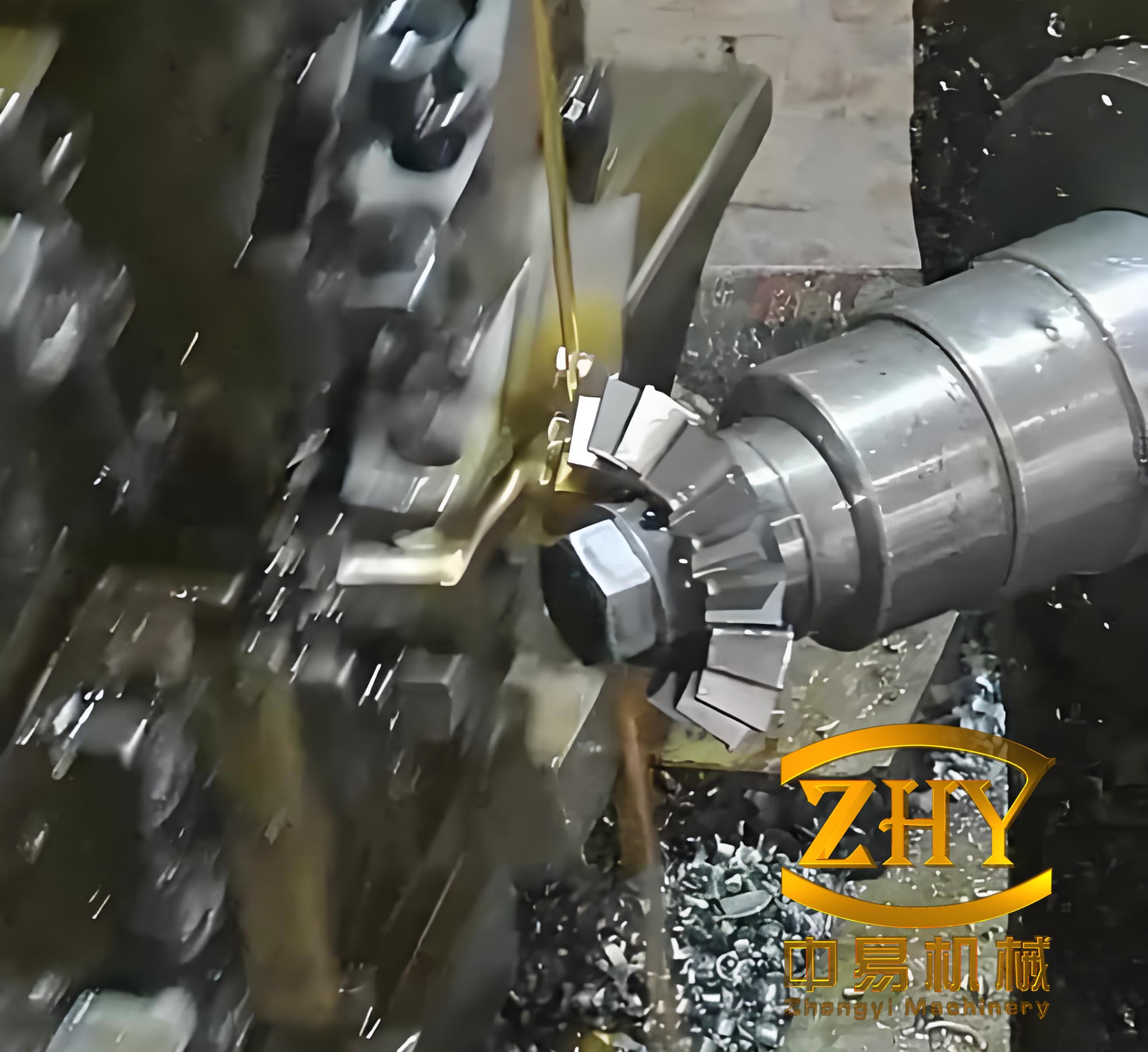
The gear hobbing process is highly dependent on parameters such as the number of hob heads, cutting speed, axial feed rate, and spindle speed. These factors affect critical outcomes like tool wear, energy consumption, and product quality. In high-speed gear hobbing, excessive heat generation can lead to thermal stresses and reduced accuracy, making parameter optimization essential. Our approach begins with defining the optimization problem mathematically. Let the parameter set be represented as a vector $\mathbf{P} = [p_{i1}, p_{i2}, p_{i3}, p_{i4}]$, where $p_{i1}$ denotes the number of hob heads, $p_{i2}$ the cutting speed (in m/min), $p_{i3}$ the axial feed rate (in mm/min), and $p_{i4}$ the spindle speed (in rpm). The objectives are to minimize energy consumption $W$ and maximize tool life $T$, subject to constraints such as maximum allowable processing time and quality thresholds.
To model the relationship between input parameters and output responses, we employ a GABP neural network. This hybrid algorithm combines the global search capability of genetic algorithms (GA) with the local refinement of backpropagation (BP) networks, addressing limitations like local minima in traditional BP. The neural network architecture consists of an input layer, a single hidden layer, and an output layer. The number of neurons in the hidden layer is determined based on the sample size to ensure adequate representation. For a given dataset with $N$ input neurons and $K$ samples, the hidden layer neuron count $C_M$ satisfies the inequality:
$$ \sum_{i=0}^{N} C_M > K $$
Data normalization is crucial to handle dimensional disparities among input variables. We apply min-max scaling to transform raw data $d$ into normalized values $d’$ using the formula:
$$ d’ = 2 \left( \frac{d – d_{\text{min}}}{d_{\text{max}} – d_{\text{min}}} \right) – 1 $$
This ensures all inputs fall within a consistent range, improving network training stability. The GABP algorithm optimizes parameters including connection weights and thresholds between layers. Binary encoding is used for these parameters, and the fitness function is defined as the Euclidean norm of the prediction errors for energy consumption and tool life:
$$ \| \mathbf{X} \|_2 = \sqrt{x_1^2 + x_2^2} $$
where $x_1$ and $x_2$ are the deviations between predicted and actual values for energy consumption and tool life, respectively. This fitness measure guides the genetic algorithm toward solutions with minimal prediction error.
The NSGA-II algorithm is then applied for multi-objective optimization, leveraging its low computational complexity and ability to maintain population diversity. We enhance NSGA-II by incorporating dynamic crowding distance and elite preservation strategies to avoid local optima. The optimization process involves initializing a population, evaluating fitness using the GABP model, and iteratively applying selection, crossover, and mutation operators. The Pareto-optimal front is derived from non-dominated sorting, providing a set of solutions where no objective can be improved without worsening another. The overall optimization problem is formulated as:
$$ \min \, F(\mathbf{P}) = \left[ W(\mathbf{P}), -T(\mathbf{P}) \right] $$
$$ \text{subject to:} \quad p_{ij}^{\text{min}} \leq p_{ij} \leq p_{ij}^{\text{max}}, \quad j = 1, 2, 3, 4 $$
$$ s_{i1} \leq \text{MAX}_T, \quad s_{i2} = \text{ELI}_Q $$
Here, $s_{i1}$ and $s_{i2}$ represent processing time and product quality, with $\text{MAX}_T$ and $\text{ELI}_Q$ as their respective constraints. This formulation ensures that optimized parameters meet practical machining requirements while achieving dual objectives.
For experimental validation, we utilized a CNC high-speed gear hobbing machine and implemented the models in MATLAB. The dataset comprised 50 training samples and 12 testing samples, with input parameters covering variations in hob head count, cutting speed, axial feed, and spindle speed. The GABP network was configured with 12 input neurons (corresponding to the four parameters and their interactions), 23 hidden neurons, and 2 output neurons for energy consumption and tool life. Training involved 5 epochs, resulting in a mean squared error (MSE) of $10^{-5}$ and an optimal value of 0.000425, indicating high stability and accuracy. Comparative analysis with a standard BP network showed that GABP reduced tool life prediction error by 16% and energy consumption error by 36%, demonstrating superior convergence and predictive capability.
The following table summarizes a subset of the工艺样本集 used for training and testing the model:
| Sample ID | Hob Heads ($p_{i1}$) | Cutting Speed ($p_{i2}$, m/min) | Axial Feed ($p_{i3}$, mm/min) | Spindle Speed ($p_{i4}$, rpm) | Tool Life ($T$, min) | Energy Consumption ($W$, kWh) |
|---|---|---|---|---|---|---|
| U3 | 2 | 800 | 580 | 75 | 303.85 | 0.0952 |
| U17 | 2 | 850 | 720 | 74 | 308.18 | 0.0950 |
| U21 | 3 | 850 | 700 | 73 | 319.21 | 0.0878 |
| U49 | 3 | 850 | 700 | 79 | 320.94 | 0.0897 |
| U57 | 2 | 850 | 720 | 74 | 309.57 | 0.0933 |
To further illustrate the parameter relationships, we define the energy consumption model based on cutting dynamics. The total energy $W$ during gear hobbing can be expressed as a function of cutting force and time:
$$ W = \int_{0}^{t_c} F_c(t) \cdot v_c(t) \, dt $$
where $F_c(t)$ is the cutting force and $v_c(t)$ is the cutting speed. For simplification, we assume steady-state conditions, leading to:
$$ W = F_c \cdot v_c \cdot t_c $$
Tool life $T$ is modeled using Taylor’s tool life equation, adapted for gear hobbing:
$$ T = \frac{C}{v_c^a \cdot f^b \cdot d^c} $$
where $C$, $a$, $b$, and $c$ are constants derived from empirical data, $f$ is the feed rate, and $d$ is the depth of cut. In our optimization, depth of cut is held constant, so the equation simplifies to focus on $v_c$ and $f$.
The NSGA-II optimization was configured with a population size of 100, 200 generations, crossover rate of 0.7, mutation rate of 0.2, and an elite ratio of 0.14. The DBSCAN clustering algorithm preprocessed the sample set to identify similar工艺条件, with parameters set to a minimum points value of 4. This ensured that the optimization started from a relevant subset of data, improving convergence speed. The resulting Pareto front revealed trade-offs between energy consumption and tool life, with optimal solutions achieving energy values around $66.5 \times 10^{-3}$ kWh and tool life exceeding 328 minutes. Comparative results are shown in the table below:
| Parameter Set | Energy Consumption ($W$, kWh) | Tool Life ($T$, min) |
|---|---|---|
| Similar Process Sample Set (Best) | 0.08780 | 320.94 |
| Optimized Pareto Solution (Lower Bound) | 0.08588 | 328.04 |
The convergence behavior of the GABP algorithm was analyzed by plotting the prediction error over iterations. The error decreased rapidly within the first 50 generations and stabilized, indicating efficient learning without overfitting. In contrast, standard BP networks exhibited higher errors and slower convergence. This underscores the advantage of GABP in handling non-linear relationships in gear hobbing parameters.
In conclusion, the integration of GABP neural networks with NSGA-II provides a powerful framework for multi-objective optimization in gear hobbing. The model achieves significant improvements in reducing energy consumption and extending tool life for gear hobbing machines. Future work could explore real-time adaptive control and integration with IoT-based monitoring systems for dynamic parameter adjustment. This research contributes to sustainable manufacturing by enhancing the efficiency and longevity of gear production processes.