
In modern manufacturing, high-speed dry gear hobbing has emerged as a prominent green technology for gear production, offering advantages such as elimination of cutting fluids and reduced machining time. However, optimizing process parameters in gear hobbing operations presents challenges due to the large number of variables and potential conflicts between parameters. This study addresses these issues by employing Sobol’s method for sensitivity analysis of parameters affecting machining time and cost in gear hobbing processes. We extend the traditional first-order sensitivity analysis to include second-order and total-order indices, providing a comprehensive understanding of parameter interactions. Based on the sensitivity results, we utilize genetic algorithms to optimize key parameters, demonstrating significant improvements in efficiency and cost-effectiveness for gear hobbing applications.
The gear hobbing process involves complex interactions between various parameters that influence overall performance. In high-speed dry gear hobbing, the absence of cutting fluids necessitates careful parameter selection to manage heat accumulation and ensure tool life. Our approach focuses on identifying the most sensitive parameters through global sensitivity analysis, which helps prioritize variables during optimization. This methodology provides valuable insights for manufacturers seeking to enhance their gear hobbing operations while maintaining quality and sustainability standards.
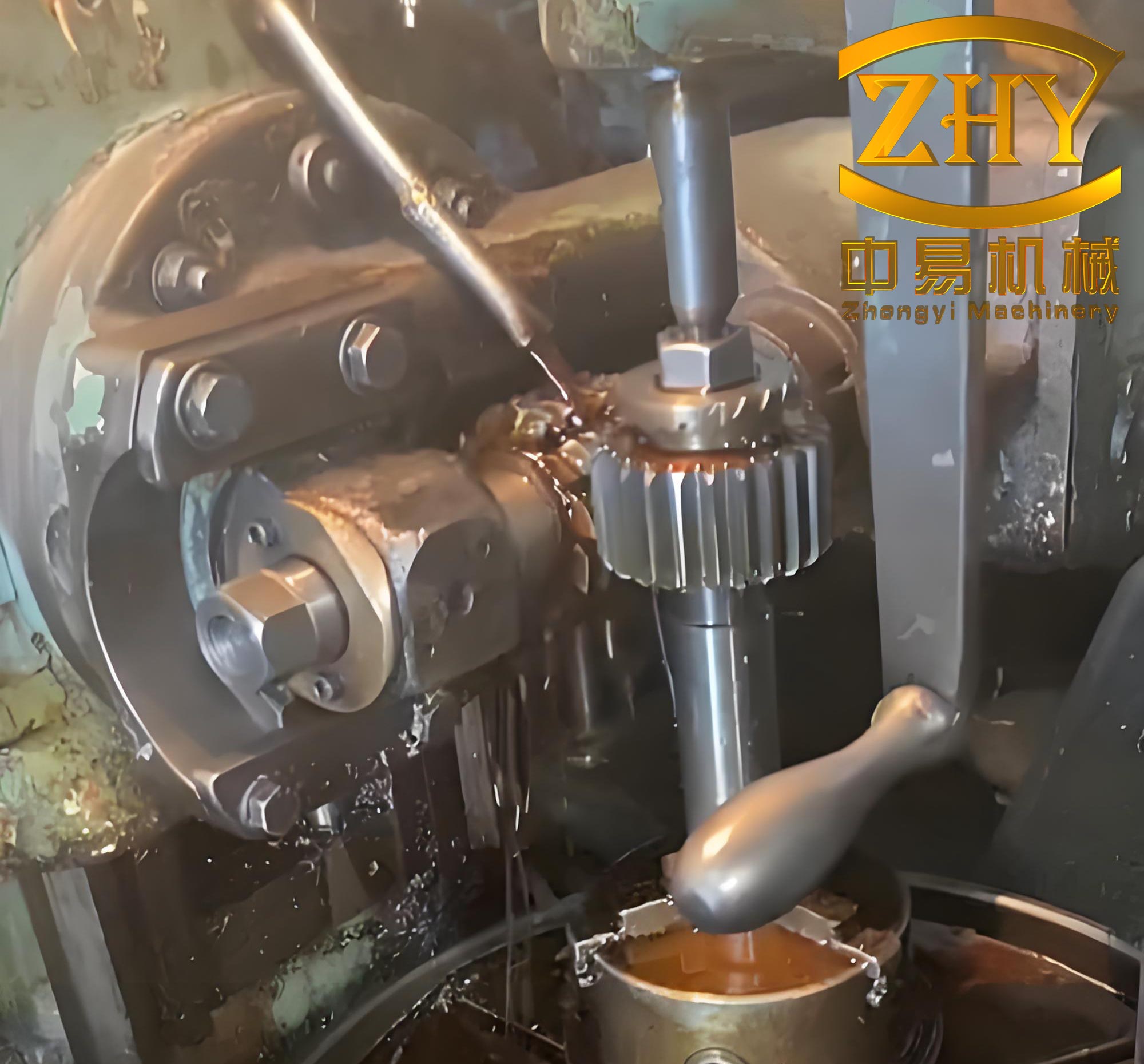
Mathematical modeling forms the foundation of our sensitivity analysis for gear hobbing processes. We develop comprehensive models for machining time and cost that incorporate key parameters of the gear hobbing operation. The machining time model accounts for preparation time, actual cutting time, and tool replacement time, while the cost model includes operational expenses and tool-related costs. These models enable us to quantitatively assess how variations in process parameters affect the overall efficiency of gear hobbing operations.
The machining time for a single gear in gear hobbing can be expressed as:
$$T = t_p + t_m + t_c \frac{t_m}{t}$$
where $T$ represents the total machining time per gear, $t_p$ denotes preparation time, $t_m$ is the actual machining time, $t_c$ represents tool change time, and $t$ indicates tool life. The machining time $t_m$ is further defined as:
$$t_m = \frac{L_1 + B + L_2}{f_a \cdot n_0} \times \frac{z_2}{k \cdot i}$$
where $f_a$ represents feed rate, $n_0$ denotes hob rotational speed, $L_1$ and $L_2$ are approach and overrun travels respectively, $B$ is gear width, $z_2$ is number of gear teeth, $k$ represents number of hob starts, and $i$ indicates number of passes.
Tool life in gear hobbing operations follows the relationship:
$$t = \left( \frac{C_v}{v \cdot f_a^{y_v} \cdot m^{x_v} \cdot k_v} \right)^{\frac{1}{m_v}}$$
where $m$ represents gear module, $C_v$, $m_v$, $x_v$, and $y_v$ are material-dependent coefficients, and $k_v$ is a correction factor accounting for various conditions. The cutting speed $v$ relates to hob speed through:
$$v = \frac{\pi n_0 d_{a0}}{1000}$$
where $d_{a0}$ represents hob diameter. The correction factor $k_v$ incorporates multiple elements:
$$k_v = k_{mv} \cdot k_{ZT} \cdot k_{NDv} \cdot k_{Fv} \cdot k_{wv} \cdot k_{iv}$$
accounting for material properties, hob characteristics, and process conditions in gear hobbing.
For machining cost analysis in gear hobbing, we consider:
$$C = C_m + M \cdot t_p + M \cdot t_m + (M \cdot t_c + C_c) \frac{t_m}{t}$$
where $C$ represents total cost per gear, $C_m$ denotes material cost, $M$ indicates machine and overhead rate, and $C_c$ represents tool cost. After simplification and focusing on optimizable parameters, we obtain the final models for sensitivity analysis in gear hobbing processes.
| Parameter | Symbol | Range |
|---|---|---|
| Feed Rate | $f_a$ | 68-92 mm/min |
| Hob Rotational Speed | $n_0$ | 650-780 rpm |
| Hob Diameter | $d_{a0}$ | 78-89 mm |
| Number of Hob Starts | $k$ | 2-3 |
| Approach Travel | $L_1$ | >2 mm |
| Overrun Travel | $L_2$ | >2 mm |
| Parameter | Symbol | Value |
|---|---|---|
| Material Factor | $k_{mv}$ | 1.0 |
| Hob Start Factor | $k_{ZT}$ | 0.85 |
| Pass Number Factor | $k_{NDv}$ | 1.1 |
| Hob Accuracy Factor | $k_{Fv}$ | 0.8 |
| Helix Angle Factor | $k_{wv}$ | 1.0 |
| Pass Factor | $k_{iv}$ | 1.0 |
| Gear Module | $m$ | 3 mm |
| Material Constant | $C_v$ | 364 |
| Tool Life Exponent | $m_v$ | 0.5 |
| Module Exponent | $x_v$ | -0.5 |
| Feed Exponent | $y_v$ | 0.85 |
| Number of Gear Teeth | $z_2$ | 35 |
Sobol’s method provides a robust framework for global sensitivity analysis in gear hobbing parameter optimization. This approach decomposes the variance of model outputs into contributions from individual parameters and their interactions. For a model function $f(x)$ with parameters $x_1, x_2, …, x_k$, the Sobol decomposition expresses the function as:
$$f(x) = f_0 + \sum_{i=1}^k f_i(x_i) + \sum_{1 \leq i < j \leq k} f_{ij}(x_i, x_j) + \cdots + f_{1,2,\ldots,k}(x_1, x_2, \ldots, x_k)$$
where $f_0$ represents the constant term, $f_i(x_i)$ denotes first-order effects, $f_{ij}(x_i, x_j)$ represents second-order interactions, and higher-order terms capture more complex interactions. Each component satisfies the orthogonality condition:
$$\int_0^1 f_{i_1 \ldots i_s} dx_{i_t} = 0$$
ensuring unique decomposition. The sensitivity indices are derived from variance components:
$$D = \int f^2(x)dx – f_0^2 = \sum_{i=1}^k D_i + \sum_{1 \leq i \leq j \leq k} D_{ij} + \cdots + D_{12 \ldots k}$$
where $D$ represents total variance, $D_i$ denotes partial variance of $f_i(x_i)$, and $D_{ij}$ represents partial variance of $f_{ij}(x_i, x_j)$. The sensitivity indices are calculated as:
$$S_i = \frac{D_i}{D}, \quad S_{ij} = \frac{D_{ij}}{D}, \quad S_{Ti} = S_i + \sum_{i \neq j}^k S_{ij} + \cdots + S_{12 \ldots k}$$
where $S_i$ represents first-order sensitivity, $S_{ij}$ denotes second-order sensitivity, and $S_{Ti}$ indicates total-order sensitivity for parameter $i$.
Our implementation of Sobol’s method for gear hobbing parameter analysis follows a systematic procedure. We begin by defining the mathematical models for machining time and cost, then establish parameter ranges based on practical gear hobbing machine constraints. Sample generation employs the Saltelli sampler, which efficiently explores the parameter space while maintaining statistical properties necessary for accurate sensitivity estimation. We determine that a sample size of 5000 provides stable results for our gear hobbing analysis, balancing computational efficiency with result reliability.
The sensitivity analysis reveals crucial insights into parameter influences in gear hobbing operations. For machining time, feed rate ($f_a$) and hob rotational speed ($n_0$) demonstrate the highest first-order sensitivity indices, indicating their dominant individual effects. Approach travel ($L_1$) and overrun travel ($L_2$) show moderate sensitivity, while hob diameter ($d_{a0}$) and number of hob starts ($k$) exhibit lower sensitivity values. The second-order analysis identifies significant interaction between feed rate and hob rotational speed, suggesting that simultaneous optimization of these parameters can yield substantial improvements in gear hobbing efficiency.
| Parameter | First-Order Sensitivity | Total-Order Sensitivity |
|---|---|---|
| Feed Rate ($f_a$) | 0.42 | 0.48 |
| Hob Speed ($n_0$) | 0.38 | 0.41 |
| Hob Diameter ($d_{a0}$) | 0.05 | 0.06 |
| Hob Starts ($k$) | 0.08 | 0.09 |
| Approach Travel ($L_1$) | 0.12 | 0.13 |
| Overrun Travel ($L_2$) | 0.10 | 0.11 |
| Parameter Pair | Second-Order Sensitivity |
|---|---|
| ($f_a$, $n_0$) | 0.028 |
| ($f_a$, $d_{a0}$) | 0.003 |
| ($f_a$, $k$) | 0.004 |
| ($f_a$, $L_1$) | 0.005 |
| ($f_a$, $L_2$) | 0.004 |
| ($n_0$, $d_{a0}$) | 0.002 |
| ($n_0$, $k$) | 0.003 |
| ($n_0$, $L_1$) | 0.004 |
| ($n_0$, $L_2$) | 0.003 |
| ($L_1$, $L_2$) | 0.002 |
For machining cost in gear hobbing, similar patterns emerge with feed rate and hob rotational speed showing the highest sensitivity. The total-order sensitivity indices reveal that feed rate exhibits significant higher-order interactions with other parameters, emphasizing its central role in gear hobbing optimization. The second-order sensitivity between feed rate and hob speed remains prominent for cost optimization, reinforcing the importance of coordinated adjustment of these parameters in gear hobbing operations.
| Parameter | First-Order Sensitivity | Total-Order Sensitivity |
|---|---|---|
| Feed Rate ($f_a$) | 0.39 | 0.45 |
| Hob Speed ($n_0$) | 0.35 | 0.38 |
| Hob Diameter ($d_{a0}$) | 0.04 | 0.05 |
| Hob Starts ($k$) | 0.07 | 0.08 |
| Approach Travel ($L_1$) | 0.11 | 0.12 |
| Overrun Travel ($L_2$) | 0.09 | 0.10 |
Based on the sensitivity analysis results, we implement genetic algorithm optimization for the gear hobbing process parameters. The optimization formulation considers both machining time and cost as objective functions, with feed rate and hob rotational speed as primary decision variables. We define the multi-objective optimization problem as:
$$U(f_a, n_0) = \alpha_1 (\min T) + \alpha_2 (\min C)$$
where $\alpha_1$ and $\alpha_2$ represent weighting coefficients for time and cost objectives respectively. The genetic algorithm parameters include population size of 100 individuals, binary encoding, 100 generations, 100% crossover probability, and 10% mutation probability. The optimization constraints reflect practical limitations of the gear hobbing machine and process requirements.
The genetic algorithm implementation for gear hobbing parameter optimization follows standard procedures with customized fitness evaluation. Each individual in the population represents a potential solution with specific values for feed rate and hob rotational speed. The fitness function evaluates solutions based on their ability to minimize both machining time and cost while satisfying operational constraints. Selection, crossover, and mutation operations ensure exploration of the solution space while maintaining population diversity.
| Parameter | Value |
|---|---|
| Machine Hourly Rate | 75 $/hour |
| Tool Resharpening Cost | 150 $/instance |
| Tool Coating Cost | 800 $/instance |
| Preparation Time | 2 minutes |
| Tool Change Time | 3 minutes |
The optimization results demonstrate significant improvements in gear hobbing performance. Compared to conventional parameter settings, the optimized parameters reduce machining time by 9.3% and decrease machining cost by 9.5%. The optimal solution identifies feed rate of 72.65 mm/min and hob rotational speed of 780 rpm as the most efficient combination for the specified gear hobbing conditions. These results validate the effectiveness of sensitivity-guided optimization for enhancing gear hobbing operations.
| Parameter | Initial Value | Optimized Value |
|---|---|---|
| Feed Rate ($f_a$) | 68 mm/min | 72.65 mm/min |
| Hob Rotational Speed ($n_0$) | 750 rpm | 780 rpm |
| Machining Time | 28.2 minutes | 25.8 minutes |
| Machining Cost | 2.98 $ | 2.72 $ |
The sensitivity analysis approach presented in this study offers several advantages for gear hobbing parameter optimization. By identifying the most influential parameters, manufacturers can focus their optimization efforts on variables that yield the greatest improvements. The comprehensive sensitivity indices provide insights not only into individual parameter effects but also into parameter interactions, enabling more effective optimization strategies. This methodology can be extended to other objective functions and constraint scenarios in gear hobbing applications.
Implementation considerations for gear hobbing optimization include practical constraints of the gear hobbing machine, tool limitations, and quality requirements. While feed rate and hob rotational speed emerge as primary optimization variables, other parameters such as approach and overrun travels should be maintained at minimum practical values to reduce non-cutting time. The number of hob starts and hob diameter, while less sensitive, should be selected based on availability and gear specifications.
Future research directions in gear hobbing parameter optimization include incorporating additional objective functions such as surface quality, tool wear, and energy consumption. Advanced sensitivity analysis techniques could explore time-dependent parameter effects and non-linear interactions. Integration of real-time monitoring and adaptive control could further enhance gear hobbing efficiency by dynamically adjusting parameters based on process conditions.
In conclusion, our study demonstrates the effectiveness of Sobol’s sensitivity analysis for identifying key parameters in high-speed dry gear hobbing operations. The results highlight feed rate and hob rotational speed as the most sensitive parameters for both machining time and cost objectives. The significant second-order interaction between these parameters underscores the importance of coordinated optimization. Genetic algorithm implementation based on sensitivity findings achieves substantial improvements in gear hobbing performance, reducing both time and cost by approximately 9%. This approach provides a systematic framework for parameter optimization in gear hobbing processes, offering practical benefits for manufacturers seeking to enhance their production efficiency and competitiveness in gear manufacturing industries.
The methodology developed in this research has broad applicability across various gear hobbing scenarios and machine configurations. By prioritizing parameters based on sensitivity analysis, engineers can develop more efficient optimization strategies tailored to specific production requirements. The integration of sensitivity analysis with evolutionary optimization algorithms represents a powerful approach for addressing complex multi-objective problems in gear hobbing and similar manufacturing processes. As gear hobbing technology continues to evolve, such systematic optimization approaches will play increasingly important roles in achieving sustainable and efficient manufacturing operations.