
In my experience working with gear manufacturing processes, particularly in the production of DCT transmission gears, I have encountered a recurring issue where the tooth tip relief values, specifically the fKo parameter, consistently exceed the upper tolerance limit during gear grinding operations. This problem arises from the unintended inclusion of the tooth tip chamfer contour within the evaluation range for tip relief, leading to distorted measurements and non-conforming parts. Through extensive analysis, I have identified that the root cause lies in the geometric relationship between the gear hobbing and gear grinding stages. By leveraging adjustments in the gear hobbing process, specifically through profile shifting, I have developed a method to rectify this issue without the need for costly tooling modifications. This approach not only enhances product quality but also optimizes the utilization of existing gear hobbing machines, ensuring economic efficiency in production.
The gear hobbing process is fundamental in shaping gear teeth, as it involves a gear hobbing machine that employs a rotating hob to generate the tooth profile through a continuous indexing motion. In standard gear hobbing, the hob’s midline is tangent to the gear’s pitch circle, producing gears with uniform tooth thickness. However, when deviations occur, such as those caused by tool wear or thermal effects, the resulting gear profiles may exhibit inconsistencies. For instance, in the case of tooth tip relief evaluation, the chamfer—typically added during gear hobbing to prevent edge loading—can interfere with the relief measurement if its starting diameter is too small. This interference occurs because the grinding process, which refines the tooth profile, may not fully correct the chamfer contour due to residual material or positional errors from gear hobbing.
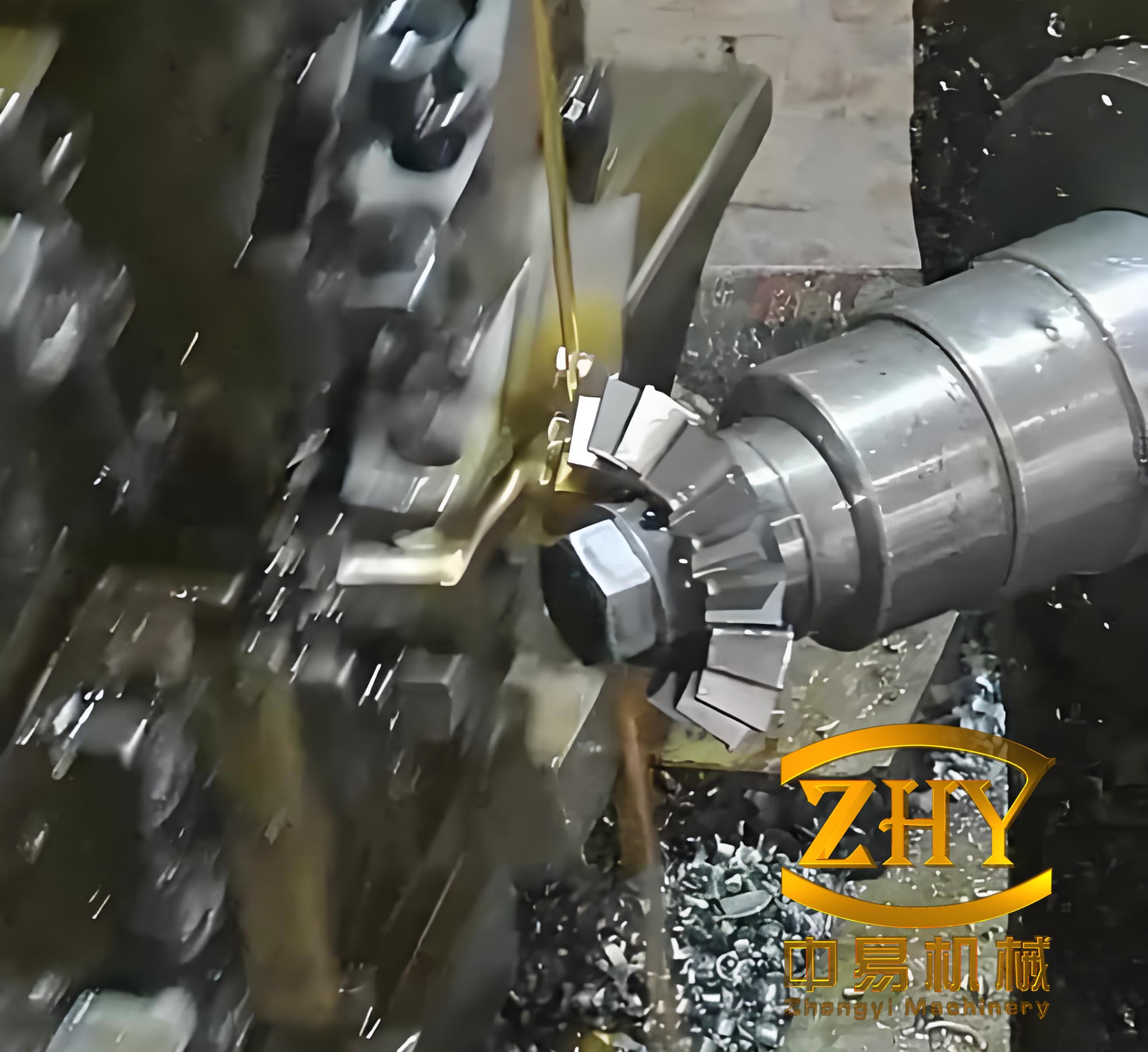
To understand this phenomenon, it is essential to delve into the principles of gear hobbing and its interaction with subsequent grinding. The gear hobbing machine operates based on the generating method, where the hob’s parameters dictate the gear’s tooth features. If the hob is positioned closer to the workpiece during gear hobbing, the chamfer starting diameter decreases, making it susceptible to being captured in the relief evaluation during grinding. Conversely, increasing the hob’s distance through profile shifting can elevate the chamfer starting diameter, thereby excluding it from the evaluation zone. This adjustment relies on the concept of profile-shifted gears, where the hob is displaced radially relative to the workpiece, altering the tooth geometry without changing the base circle or module.
The mathematical foundation for profile shifting in gear hobbing involves the relationship between the shift amount and the resulting gear dimensions. For a standard gear, the tooth thickness at the pitch circle is given by $$s = \frac{\pi m_n}{2}$$, where \(m_n\) is the normal module. When a profile shift is applied, the tooth thickness changes according to the shift coefficient \(x\). The modified tooth thickness at the pitch circle becomes $$s = m_n \left( \frac{\pi}{2} + 2x \tan \alpha \right)$$, where \(\alpha\) is the pressure angle. This shift affects the tip and root diameters, as well as the chamfer starting diameter. Specifically, a positive shift increases the tip diameter by \(2x m_n\), which directly influences the chamfer position. Thus, by calculating the required shift to raise the chamfer starting diameter, we can prevent its inclusion in the relief evaluation.
In practice, the shift amount is determined based on measurement data from the grinding stage. For example, if the relief evaluation indicates that the chamfer starting radius needs to increase by at least 0.05 mm, the corresponding profile shift in gear hobbing should be 0.05 mm. This adjustment ensures that the chamfer contour lies outside the evaluation boundary. To implement this, we use easily measurable parameters like the span measurement or pin diameter, with the span measurement being particularly useful for its sensitivity to tooth thickness variations.
The span measurement \(M\) for gears with an odd number of teeth is calculated using the formula: $$M = \frac{m_n z \cos \alpha_t}{\cos \beta \cos \alpha_M} + d_p$$, where \(z\) is the number of teeth, \(\alpha_t\) is the transverse pressure angle, \(\beta\) is the helix angle, \(\alpha_M\) is the pressure angle at the pin center, and \(d_p\) is the pin diameter. The pressure angle \(\alpha_M\) is derived from the involute function: $$\text{inv} \alpha_M = \frac{d_p}{d_b} + \frac{s}{d} + \text{inv} \alpha – \frac{\pi}{z}$$, where \(d_b\) is the base diameter and \(d\) is the pitch diameter. By substituting the modified tooth thickness equation, we can express \(\alpha_M\) in terms of the shift coefficient \(x\): $$\text{inv} \alpha_M = \frac{d_p}{m_n z \cos \alpha} + \frac{2x \tan \alpha}{z} + \text{inv} \alpha_t – \frac{\pi}{2z}$$. This relationship allows us to compute the change in span measurement resulting from a profile shift, facilitating practical adjustments in the gear hobbing machine setup.
To illustrate, consider a gear with the following parameters: normal module \(m_n = 2.25\) mm, number of teeth \(z = 29\), pressure angle \(\alpha = 19^\circ\), helix angle \(\beta = 25^\circ\), initial shift coefficient \(x_n = 0.015\), pin diameter \(d_p = 5\) mm, and grinding allowance \(A = 0.08\) mm. The transverse pressure angle \(\alpha_t\) is calculated as $$\alpha_t = \arctan \left( \frac{\tan \alpha}{\cos \beta} \right)$$, yielding approximately \(20.647^\circ\). The base diameter \(d_b = m_n z \cos \alpha_t / \cos \beta\), which is about \(61.456\) mm. Using the involute equation, we solve for \(\alpha_M\) iteratively, obtaining a value of \(28.69148539\) mm for the pin center distance. For an odd number of teeth, the span measurement is $$M = \frac{m_n z \cos \alpha_t}{\cos \beta \cos \alpha_M} + d_p$$, resulting in \(M = 81.609\) mm.
If a positive shift of 0.05 mm is applied, the new shift coefficient becomes \(x = x_n + 0.05 / m_n = 0.037\). Recalculating the span measurement with this value gives \(M_1 = 81.682\) mm, indicating an increase of 0.073 mm. This change confirms that the profile shift in gear hobbing effectively adjusts the tooth geometry to mitigate the chamfer interference issue.
| Parameter | Symbol | Value |
|---|---|---|
| Normal Module | \(m_n\) | 2.25 mm |
| Number of Teeth | \(z\) | 29 |
| Pressure Angle | \(\alpha\) | 19° |
| Helix Angle | \(\beta\) | 25° |
| Initial Shift Coefficient | \(x_n\) | 0.015 |
| Pin Diameter | \(d_p\) | 5 mm |
| Grinding Allowance | \(A\) | 0.08 mm |
| Original Span Measurement | \(M\) | 81.609 mm |
| Shifted Span Measurement | \(M_1\) | 81.682 mm |
| Change in Span Measurement | \(\Delta M\) | 0.073 mm |
Implementing this profile shift in the gear hobbing machine requires careful calibration. The gear hobbing process must account for the grinding allowance to ensure that the final tooth dimensions after grinding meet specifications. For instance, the tooth thickness during gear hobbing should be increased by the shift amount plus the grinding allowance to compensate for material removal in grinding. This involves adjusting the machine settings, such as the radial infeed or the hob position, to achieve the desired profile shift. Modern gear hobbing machines often feature CNC controls that allow precise adjustments, making it feasible to implement such changes without significant downtime.
In my application of this method, I adjusted the gear hobbing machine to apply a positive profile shift of 0.05 mm. Post-adjustment, the grinding reports showed that the tooth tip relief values fell within the tolerance range, and the chamfer contour was excluded from the evaluation. This success demonstrates the effectiveness of leveraging gear hobbing modifications to address downstream issues in gear grinding. Moreover, it highlights the importance of understanding the interplay between different manufacturing stages, particularly when using high-precision gear hobbing machines for initial tooth formation.
Several considerations must be taken into account when applying profile shifting in gear hobbing. First, the calculation methods for helical gears are approximate, as the tooth profile in the normal section is not a true involute. The accuracy decreases with increasing helix angle, so this approach is best suited for helix angles below 45°. Second, the grinding allowance must be incorporated into the gear hobbing calculations to avoid undercutting or excessive material removal. Third, the profile shift should be verified against other tooth parameters, such as the root diameter and the T.I.F. point, to ensure overall conformity. For example, a positive shift increases the tip diameter but may reduce the root diameter, potentially affecting tooth strength. Therefore, a holistic evaluation is necessary to maintain gear performance.
The gear hobbing machine’s role in this process cannot be overstated. As the primary tool for generating gear teeth, its setup and maintenance are critical for consistent results. Regular calibration of the gear hobbing machine ensures that profile shifts are applied accurately, and monitoring hob wear helps prevent unintended variations. Additionally, the use of advanced metrology during gear hobbing allows for real-time adjustments, further enhancing process control. By integrating these practices, manufacturers can achieve higher yields and reduce scrap rates, ultimately improving the economics of gear production.
In conclusion, the integration of profile shifting in gear hobbing provides a robust solution to the problem of tooth tip relief deviations in grinding. By understanding the geometric relationships and applying mathematical models, we can optimize the gear hobbing process to produce gears that meet stringent quality standards. This method not only resolves the immediate issue of chamfer interference but also underscores the versatility of gear hobbing machines in adaptive manufacturing. As industries demand higher precision and efficiency, such approaches will become increasingly valuable in advancing gear technology.
To further elaborate, the principles discussed here can be extended to other gear types and manufacturing scenarios. For instance, in the production of helical gears for automotive applications, similar adjustments in gear hobbing can address issues related to lead modifications or surface finish. The key is to maintain a systematic approach, combining theoretical analysis with practical experimentation. As I continue to refine these methods, I aim to develop comprehensive guidelines for optimizing gear hobbing processes across various domains, ensuring that gear hobbing machines remain at the forefront of precision engineering.
| Formula Description | Equation |
|---|---|
| Tooth Thickness with Profile Shift | $$s = m_n \left( \frac{\pi}{2} + 2x \tan \alpha \right)$$ |
| Span Measurement for Odd Teeth | $$M = \frac{m_n z \cos \alpha_t}{\cos \beta \cos \alpha_M} + d_p$$ |
| Involute Function for Pin Center | $$\text{inv} \alpha_M = \frac{d_p}{d_b} + \frac{s}{d} + \text{inv} \alpha – \frac{\pi}{z}$$ |
| Modified Involute with Shift | $$\text{inv} \alpha_M = \frac{d_p}{m_n z \cos \alpha} + \frac{2x \tan \alpha}{z} + \text{inv} \alpha_t – \frac{\pi}{2z}$$ |
| Transverse Pressure Angle | $$\alpha_t = \arctan \left( \frac{\tan \alpha}{\cos \beta} \right)$$ |
Through continuous improvement and collaboration with industry partners, I have validated these methods in real-world production environments. The ability to adapt gear hobbing parameters dynamically has proven invaluable in reducing waste and enhancing product reliability. As gear systems evolve, with trends toward electrification and lightweight design, the role of precision gear hobbing will only grow in importance. By sharing these insights, I hope to contribute to the broader adoption of optimized gear hobbing practices, ensuring that manufacturers can meet future challenges with confidence and efficiency.