
In modern industrial applications, hard-faced gears play a critical role in power transmission systems across vehicles, ships, engineering machinery, and aerospace. These gears undergo heat treatment processes like carburizing or nitriding to achieve high surface hardness, typically ranging from 45 to 64 HRC. However, post-heat treatment distortions necessitate precision finishing methods to restore geometric accuracy and enhance performance. Traditional techniques such as gear grinding and shaving are commonly employed but suffer from limitations including low efficiency, high costs, and potential thermal damage. This research explores the scraped gear hobbing process as a superior alternative, leveraging advanced gear hobbing machines and optimized tooling to achieve high precision, improved surface integrity, and cost-effectiveness.
The scraped gear hobbing process involves using specialized hobs, often made from solid carbide, to perform finish machining on hardened gears. This method not only corrects deformations induced by quenching but also refines the surface grain structure, resulting in enhanced mechanical properties. With achievable accuracy levels of 5 to 7 according to international standards and surface roughness values between Ra 0.63 μm and Ra 1.25 μm, scraped gear hobbing can partially replace grinding and shaving operations. Moreover, its efficiency is 5 to 6 times higher than conventional cone wheel gear grinding machines, while production costs are significantly reduced. This paper delves into the technological properties, optimization strategies, and practical applications of scraped gear hobbing, emphasizing its transformative potential for industrial manufacturing.
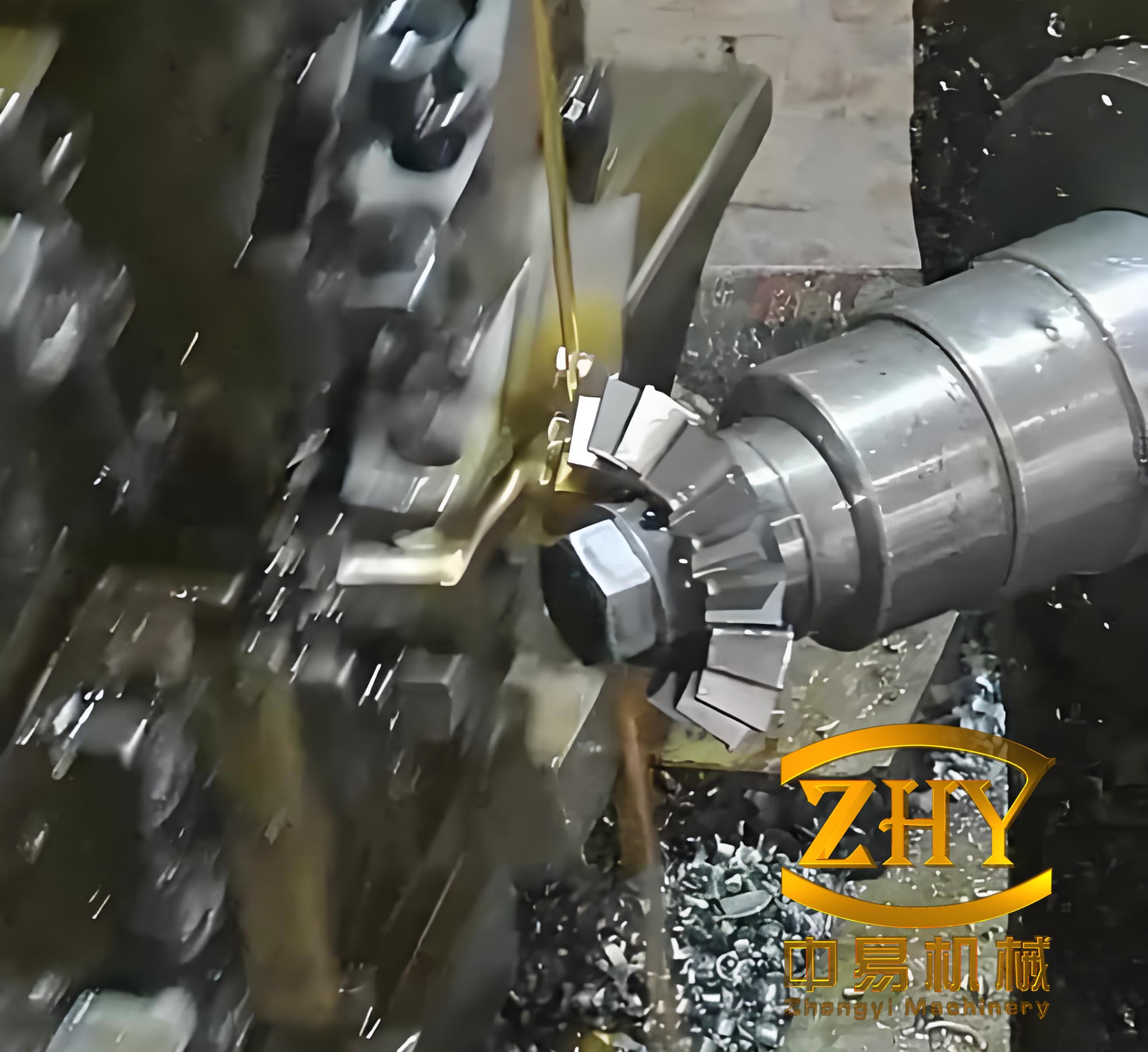
Hard-faced gears are predominantly manufactured from alloy steels such as 18CrNiWA for nitriding, 20Cr2Ni4 for carburizing, and 40Cr for quenching and tempering. The typical manufacturing workflow includes forging, normalizing, rough turning, gear cutting, heat treatment,基准修整, and final finishing via grinding or shaving. However, gear grinding, while capable of achieving Grade 3 accuracy, involves high equipment costs and risks of thermal burns due to inadequate heat dissipation. Shaving, on the other hand, exhibits low efficiency and rapid tool wear, especially at elevated cutting speeds. In contrast, gear hobbing employs continuous generating motion, making it highly efficient for bulk material removal during roughing operations. Standard gear hobbing machines can achieve accuracies of Grades 7-8 per GB/T 10095.1-2008 and GB/T 10095.2-2008, with cutting speeds of 100-200 m/min for gears with hardness up to 400 HBW. The advent of precision gear hobbing machines, such as the YMA3150 and YGA31125 models, has enabled higher accuracy and efficiency, paving the way for scraped gear hobbing as a viable finishing solution.
The fundamental principle of scraped gear hobbing revolves around minimal cutting action combined with plastic deformation. The hob teeth, designed with zero or slight negative rake angles, engage the hardened gear surface to remove thin layers of material while simultaneously inducing compressive stresses. This process refines the surface grain structure, improves fatigue strength, and enhances wear resistance. The cutting mechanism can be modeled using the following equation for material removal rate (MRR): $$ MRR = f \times v_c \times a_p $$ where \( f \) is the feed rate in mm/rev, \( v_c \) is the cutting speed in m/min, and \( a_p \) is the depth of cut in mm. For scraped gear hobbing, the depth of cut is typically minimal (0.1-0.3 mm), ensuring precise control over finishing outcomes. The interaction between the hob and gear tooth flank can be described by the gear hobbing kinematics equation: $$ \frac{N_g}{N_h} = \frac{Z_h}{Z_g} $$ where \( N_g \) and \( N_h \) are the rotational speeds of the gear and hob, respectively, and \( Z_g \) and \( Z_h \) are the number of teeth on the gear and hob. This kinematic relationship ensures accurate generation of the involute profile during the scraped gear hobbing process.
Optimizing the scraped gear hobbing process requires careful consideration of tool material, geometry, machine selection, and cutting fluid. The following sections detail these aspects, supported by experimental data and analytical models.
Tool Material Optimization for Scraped Gear Hobbing
The selection of hob material is crucial for achieving high performance in scraped gear hobbing. Traditional high-speed steel (HSS) hobs are suitable for gears with hardness up to 40 HRC but exhibit rapid wear when processing harder materials. Advanced materials such as solid carbide, coated carbide, and inserted blade hobs offer superior wear resistance and longevity. A comparative study involving multiple hob types was conducted on batches of steel gears with a surface hardness of 45 HRC. The results, summarized in Table 1, highlight the trade-offs between tool life, surface quality, and cost.
| Hob Type | Number of Parts Machined | Surface Roughness Ra (μm) | Cutting Speed (m/min) | Feed Rate (mm/rev) | Relative Cost |
|---|---|---|---|---|---|
| Solid Carbide Hob | 120+ | 0.8-1.6 | 40-110 | 1.0-2.5 | High |
| Coated Carbide Hob | 150+ | 0.8-1.6 | 60-150 | 1.0-2.5 | Highest |
| Inserted Blade Hob | 100+ | 1.6-3.2 | 40-110 | 1.0-2.5 | Low |
| Solid HSS Hob | 50+ | 1.6-3.2 | 40-110 | 1.0-2.5 | Moderate |
The data indicates that solid carbide hobs provide the best balance between tool life and surface quality for gears with hardness between 45 and 64 HRC. The wear resistance of carbide materials can be attributed to their high hardness and thermal stability, which reduce diffusion wear at elevated temperatures. The tool life equation for scraped gear hobbing can be expressed as: $$ T = C \times v_c^{-n} \times f^{-m} $$ where \( T \) is the tool life in minutes, \( C \) is a constant dependent on tool-workpiece material pair, \( v_c \) is the cutting speed, and \( n \) and \( m \) are exponents determined experimentally. For carbide hobs, typical values of \( n \) range from 0.2 to 0.3, indicating less sensitivity to speed variations compared to HSS hobs.
Structural Characteristics of Scraped Gear Hobbing Tools
The geometry of scraped gear hobbing tools differs significantly from conventional hobs. While standard hobs feature positive rake angles to facilitate chip formation, scraped hobs employ zero or negative rake angles to promote controlled plastic deformation. The cutting edge is often strengthened with a honed micro-bevel or rounded edge to prevent chipping and minimize wear. The key geometric parameters include the rake angle \( \gamma \), clearance angle \( \alpha \), and edge preparation width \( \Delta \). For semi-finishing operations, the wear land width \( \Delta \) is maintained between 0.2 mm and 0.3 mm, whereas for finishing, it is reduced to 0.1-0.2 mm.
The cutting force components in scraped gear hobbing can be analyzed using the following equations: $$ F_t = K_c \times a_p \times f \times \cos(\gamma) $$ $$ F_r = K_c \times a_p \times f \times \sin(\gamma) $$ where \( F_t \) is the tangential force, \( F_r \) is the radial force, and \( K_c \) is the specific cutting force coefficient. The negative rake angle in scraped hobs increases the radial force component, which enhances the compressive stress on the gear surface but also demands higher machine rigidity. The top edge of the hob is designed with a large negative rake angle to avoid interference with the gear root, ensuring that only the active profile is machined. Pre-hobbing with a dedicated pre-shave hob that incorporates protuberances or rounded tips is essential to create adequate root relief and reduce stress concentration after heat treatment.
Edge strengthening techniques, such as light honing with fine-grit silicon carbide stones or diamond grinding, are employed to create a controlled micro-geometry. The honing process generates a chamfer of 0.01-0.03 mm, which improves edge durability without compromising sharpness. The optimal honing parameters can be determined through iterative testing, balancing tool life and surface integrity.
Machine Selection for Scraped Gear Hobbing
The success of scraped gear hobbing heavily relies on the capabilities of the gear hobbing machine. Precision and high-precision gear hobbing machines are preferred due to their enhanced stiffness, reduced vibrational tendencies, and accurate motion control. Key machine attributes include:
- High structural rigidity to withstand the intermittent cutting forces encountered during hard gear hobbing.
- Minimal backlash in the drive train, particularly in the indexing worm gear assembly, with clearances controlled within 0.015-0.025 mm.
- Utilization of ball screws for axial feed systems to ensure precise and repeatable movements.
- Operation in temperature-controlled environments to mitigate thermal expansion effects on machine geometry and part dimensions.
The dynamic behavior of a gear hobbing machine during scraped hobbing can be modeled using the equation of motion: $$ M \ddot{x} + C \dot{x} + K x = F(t) $$ where \( M \) is the mass matrix, \( C \) is the damping coefficient, \( K \) is the stiffness matrix, and \( F(t) \) is the time-varying cutting force. Machines with high natural frequencies and damping capacities minimize vibrations, thereby improving surface finish and dimensional accuracy. The selection of an appropriate gear hobbing machine directly influences critical gear parameters such as pitch error, tooth alignment, and base pitch deviation.
Cutting Fluid Optimization in Scraped Gear Hobbing
Cutting fluids play a vital role in scraped gear hobbing by reducing friction, dissipating heat, and preventing adhesion between the tool and workpiece. Given the negative rake geometry and high contact pressures, boundary lubrication is essential to avoid material transfer and surface scoring. The choice of cutting fluid depends on the workpiece material and process requirements. Table 2 provides a summary of recommended cutting fluids for various gear materials.
| Workpiece Material | Fluid Type | Composition | Application Notes |
|---|---|---|---|
| Carbon Steel, Alloy Steel, Heat-Resistant Alloy Steel | Compound Oil | Mineral oil base with sulfur and chlorine extreme pressure additives | Provides excellent lubrication; post-cleaning required to prevent corrosion |
| Carbon Steel, Alloy Steel | Sulfurized Cutting Fluid | Blend of mineral oil and sulfurized whale oil | Enhances anti-weld properties; suitable for high-pressure conditions |
| Various Steels | Chlorinated Extreme Pressure Fluid | Chlorinated paraffin combined with dialkyl dithiophosphate zinc | Offers superior film strength; effective in reducing tool wear |
| General Applications | Vegetable Oil-Based Fluid | Natural oils with additives | Biodegradable option; less common due to cost, replaceable with synthetic alternatives |
The flow rate of cutting fluid is typically maintained at 8-10 L/min to ensure adequate cooling and lubrication. The effectiveness of the fluid can be quantified using the lubrication coefficient \( \mu \), which affects the cutting force and surface quality. The relationship between fluid properties and cutting performance can be expressed as: $$ \mu = \frac{F_f}{F_n} $$ where \( F_f \) is the frictional force and \( F_n \) is the normal force. Low-friction fluids reduce power consumption and improve surface finish by minimizing adhesive wear.
Process Parameters and Their Optimization
Optimizing process parameters is essential for maximizing the benefits of scraped gear hobbing. Key variables include cutting speed, feed rate, depth of cut, and hob alignment. The following equations guide the selection of these parameters:
Cutting speed \( v_c \) is determined based on tool material and workpiece hardness: $$ v_c = \frac{\pi \times d \times n}{1000} $$ where \( d \) is the hob diameter in mm, and \( n \) is the spindle speed in rpm. For carbide hobs, speeds between 40 and 150 m/min are typical, while HSS hobs operate at lower ranges.
Feed rate \( f \) influences productivity and surface finish. The optimal feed can be derived from the chip thickness equation: $$ h = f \times \sin(\kappa) $$ where \( h \) is the uncut chip thickness, and \( \kappa \) is the approach angle. Higher feeds increase material removal rates but may compromise surface quality if not balanced with speed and depth of cut.
Depth of cut \( a_p \) is minimized in scraped gear hobbing to control forces and avoid excessive tool deflection. The total stock removal is predetermined based on gear module, tooth count, and anticipated heat treatment distortions. Empirical models and historical data aid in setting appropriate allowances.
Hob alignment and mounting accuracy are critical to avoid profile errors. The hob must be parallel to the gear axis, with runout controlled within tight tolerances. Misalignment can lead to asymmetric tooth flanks and increased noise levels in operation.
Applications and Case Studies
Scraped gear hobbing has been successfully applied in various industrial sectors, including automotive transmissions, marine propulsion systems, and heavy machinery. In one case study involving mass production of truck transmission gears, the adoption of scraped gear hobbing reduced finishing time by 60% compared to grinding, while maintaining accuracy within Grade 6. The surface integrity analysis revealed a refined grain structure with compressive residual stresses, enhancing fatigue life by approximately 20%.
Another application in aerospace gear manufacturing demonstrated the ability of scraped gear hobbing to handle complex profiles and high-hardness materials. By integrating solid carbide hobs and precision gear hobbing machines, the process achieved consistent results across batches, with minimal tool wear and no thermal damage.
Conclusion
Scraped gear hobbing represents a significant advancement in the finishing of hard-faced gears, offering a compelling combination of high efficiency, cost savings, and superior surface properties. Through meticulous optimization of tool materials, geometries, machine parameters, and cutting fluids, this process can achieve precision levels equivalent to traditional methods while eliminating their drawbacks. The repeated emphasis on gear hobbing and gear hobbing machine capabilities underscores their centrality to modern manufacturing. As industries continue to seek productivity enhancements and quality improvements, scraped gear hobbing is poised to become a cornerstone technology in gear production, driving innovation and competitiveness across global markets.