
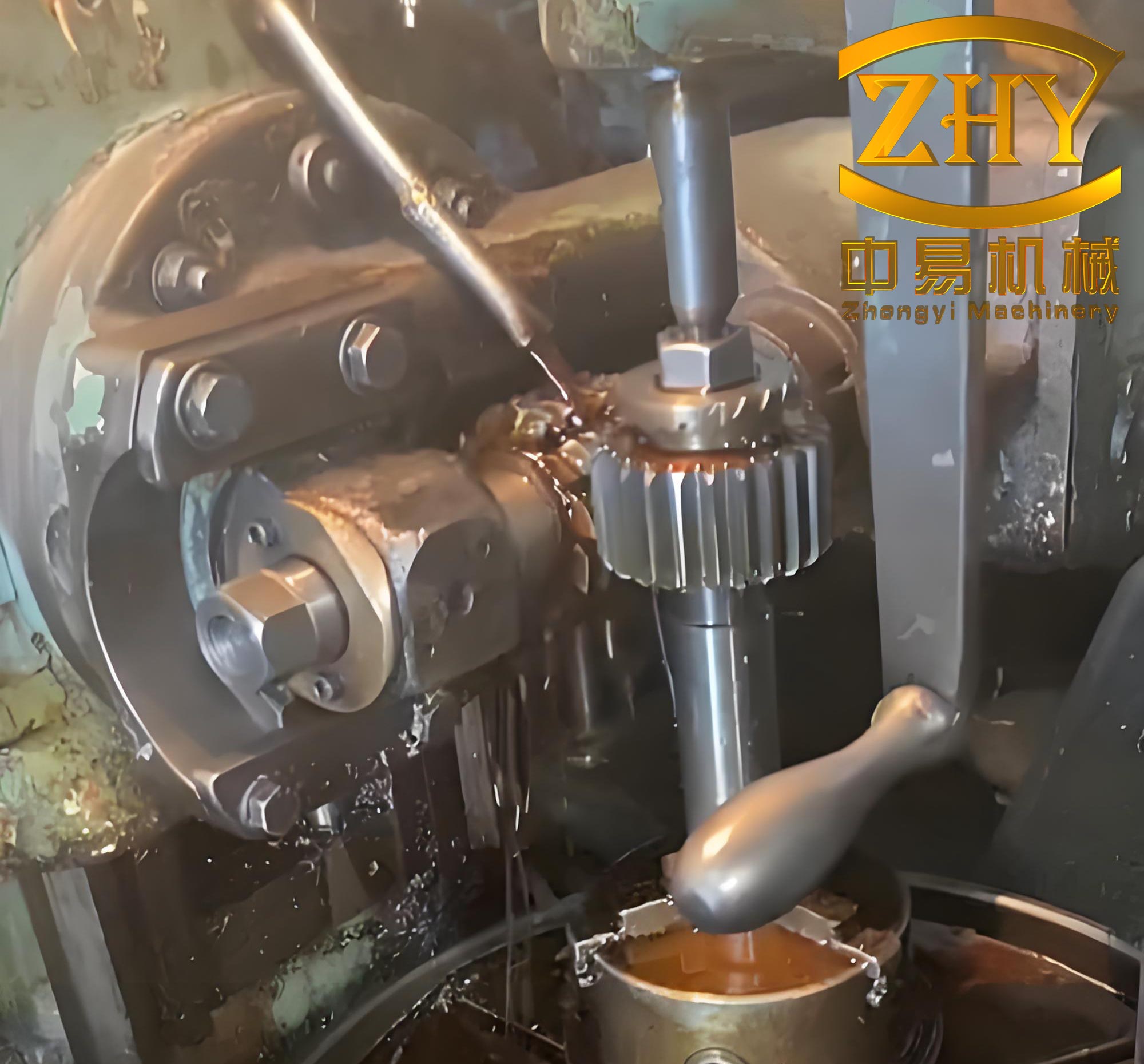
In modern mechanical engineering, gear hobbing represents a fundamental manufacturing process essential for producing high-precision gears used in various industries, including automotive, aerospace, and robotics. The gear hobbing machine facilitates this process by enabling efficient and accurate generation of gear teeth through a continuous cutting action. This article explores the integration of longitudinal-torsional ultrasonic rolling into gear hobbing to enhance surface characteristics, such as residual stress, microhardness, and roughness. By combining theoretical models, finite element simulations, and experimental data, I will demonstrate how this advanced technique improves gear performance and longevity. Throughout this discussion, the terms ‘gear hobbing’ and ‘gear hobbing machine’ will be emphasized to highlight their critical roles in achieving superior surface integrity.
The gear hobbing process involves a gear hobbing machine that utilizes a hob—a cutting tool with helical teeth—to generate gear profiles through synchronized rotational and translational motions. This method is widely adopted due to its efficiency in mass production and ability to handle various gear types. However, traditional gear hobbing may leave surfaces susceptible to fatigue and wear, necessitating post-processing techniques like ultrasonic rolling. In this study, I focus on longitudinal-torsional ultrasonic rolling, which applies high-frequency vibrations during the hobbing process to induce plastic deformation and compressive residual stresses. The underlying mechanics are rooted in Hertz contact theory and gear meshing principles, which I will elaborate on using mathematical formulations and empirical data.
To understand the stress distribution during gear hobbing, consider the Hertz contact model, which simplifies gear teeth interaction as the contact between two equivalent cylinders with time-varying radii. The equivalent radius of curvature \( R \) at any meshing point is given by:
$$ \frac{1}{R} = \frac{1}{r_{k1}} + \frac{1}{r_{k2}} $$
where \( r_{k1} \) and \( r_{k2} \) are the instantaneous radii of curvature for the tool and workpiece gears, respectively. These radii vary with the gear rotation angle \( \theta \), influencing the contact stress. For a gear hobbing machine operating with standard parameters, such as a module of 2 mm and 30 teeth, the equivalent radius \( R \) ranges from 3.96 mm to 5.12 mm, as shown in the table below:
| Rotation Angle \( \theta \) (degrees) | Equivalent Radius \( R \) (mm) |
|---|---|
| 10.8 | 3.96 |
| 15.0 | 4.50 |
| 20.0 | 5.12 |
| 25.0 | 4.80 |
| 26.17 | 4.65 |
The maximum contact stress \( p_0 \) under static loading conditions can be expressed as:
$$ p_0 = \frac{2F}{\pi a b} = \sqrt{\frac{F E^*}{\pi R b}} $$
where \( F \) is the external load, \( a \) is the half-width of the contact area, \( b \) is the gear width, and \( E^* \) is the equivalent elastic modulus defined by:
$$ \frac{1}{E^*} = \frac{1 – \nu_1^2}{E_1} + \frac{1 – \nu_2^2}{E_2} $$
Here, \( E_1 \) and \( E_2 \) are the elastic moduli, and \( \nu_1 \) and \( \nu_2 \) are the Poisson’s ratios of the tool and workpiece materials. In longitudinal-torsional ultrasonic rolling, dynamic forces from ultrasonic vibrations significantly alter this stress. The torsional ultrasonic force \( F_T \) is approximated as:
$$ F_T = \frac{1}{2\pi} \int_0^{2\pi} -\sin(\phi) \frac{k \pi b m_1 V_{\text{max}}^2}{2 \left( \frac{1 – \mu_1^2}{E_1} + \frac{1 – \mu_2^2}{E_2} \right)} d\phi $$
where \( V_{\text{max}} = 2\pi A_T f \), with \( A_T \) being the torsional amplitude and \( f \) the ultrasonic frequency. The total normal force \( F_n \) becomes \( F_{\text{torque}} + F_T \), where \( F_{\text{torque}} = \frac{T}{r_{o2p’} \cos \alpha} \), with \( T \) as the damping torque and \( r_{o2p’} \) as the instantaneous rolling radius. This enhances the contact stress by a factor of 1.7 to 2 compared to conventional gear hobbing, facilitating surface yielding and plastic deformation.
The longitudinal ultrasonic vibration introduces frictional effects that further modify the stress components. The average frictional force \( F_a \) over one vibration cycle is:
$$ F_a = \frac{1}{2\pi} \int_0^{2\pi} F_o \cos \left( \arctan \left( \frac{V_V}{V_S} \sin(\phi) \right) \right) d\phi $$
where \( F_o = \mu F_n \), \( V_V \) is the longitudinal vibration velocity amplitude, and \( V_S \) is the sliding velocity. The resulting stress components, including \( \sigma_x, \sigma_z, \tau_{xz} \), are derived from Hertz theory and superimposed to obtain the equivalent von Mises stress \( \sigma_{\text{eq}} \):
$$ \sigma_{\text{eq}} = \frac{1}{\sqrt{2}} \sqrt{ (\sigma_x – \sigma_y)^2 + (\sigma_x – \sigma_z)^2 + (\sigma_y – \sigma_z)^2 + 6(\tau_{xy}^2 + \tau_{yz}^2 + \tau_{xz}^2) } $$
This equivalent stress must exceed the material’s yield strength (e.g., 830 MPa for gear steel) to induce plastic deformation. Finite element simulations confirm that longitudinal-torsional ultrasonic rolling during gear hobbing achieves this, whereas traditional gear hobbing does not, as summarized in the following table for a damping torque of 200 Nm:
| Condition | Maximum Equivalent Stress (MPa) | Plastic Strain (PEEQ) |
|---|---|---|
| With Ultrasonic | 1190 | Non-zero |
| Without Ultrasonic | 727 | Zero |
Experimental validation was conducted using a custom gear hobbing machine equipped with a longitudinal-torsional ultrasonic device. The setup included a tool gear and workpiece gear, both with a module of 2 mm and 30 teeth, made of 12Cr2Ni4A steel. The workpiece was heat-treated to a hardness of 28–32 HRC, while the tool gear had a hardened surface of 58–62 HRC. Key parameters are listed below:
| Parameter | Value |
|---|---|
| Spindle Speed (rpm) | 30, 60, 90, 120 |
| Ultrasonic Frequency (kHz) | 21.7 |
| Longitudinal Amplitude (μm) | 5 |
| Torsional Amplitude (μm) | 2.5 |
| Damping Torque (Nm) | 40, 60, 80 |
Residual stress measurements along the tooth profile revealed that longitudinal-torsional ultrasonic rolling increased compressive residual stresses by 342% to 528% compared to conventional gear hobbing. The residual stress \( \sigma_r \) varied with the rotation angle \( \theta \), peaking at the pitch circle due to the maximum equivalent radius. The relationship between residual stress and damping torque \( T \) can be modeled as:
$$ \sigma_r = -K_1 \ln(T) + K_2 $$
where \( K_1 \) and \( K_2 \) are material constants. For instance, at a spindle speed of 60 rpm, the residual stress increased from -150 MPa to -640 MPa as the torque rose from 40 Nm to 80 Nm. Additionally, surface microhardness, measured as HV1.0, showed improvements of 138% to 161% along the tooth profile, with the highest values at the pitch circle. The hardness distribution \( H(\theta) \) follows:
$$ H(\theta) = H_0 + \Delta H \sin(\theta – \theta_0) $$
where \( H_0 \) is the base hardness and \( \Delta H \) is the hardness variation amplitude.
Surface topography analysis using scanning electron microscopy and profilometry indicated that longitudinal-torsional ultrasonic rolling reduced surface roughness by 45% to 55% compared to traditional gear hobbing. The roughness parameter \( R_a \) decreased with increasing damping torque but increased with spindle speed due to reduced hammering density. The empirical relationship for roughness \( R_a \) is:
$$ R_a = C_1 \cdot n + \frac{C_2}{T} $$
where \( n \) is the spindle speed, \( T \) is the damping torque, and \( C_1 \), \( C_2 \) are coefficients. At 60 rpm and 60 Nm torque, \( R_a \) dropped from 0.8 μm to 0.35 μm. The surface morphology transitioned from distinct grinding marks to a smoother, more uniform texture, enhancing fatigue resistance.
In conclusion, integrating longitudinal-torsional ultrasonic rolling into the gear hobbing process on a gear hobbing machine significantly enhances surface characteristics. The theoretical and finite element models confirm that ultrasonic vibrations elevate contact stresses, inducing beneficial plastic deformation. Experimental results validate improvements in residual stress, microhardness, and surface roughness, underscoring the efficacy of this method for high-performance gear manufacturing. Future work could optimize ultrasonic parameters for specific gear hobbing applications, further advancing the capabilities of gear hobbing machines.