
In modern manufacturing, the demand for high-precision gear components, particularly worm gears, has driven the need for advanced CNC solutions. Worm gears are essential in applications requiring compact design, high reduction ratios, and smooth operation, such as automotive systems and industrial machinery. The gear hobbing process, a primary method for producing worm gears, involves complex kinematic relationships between the hob cutter and the workpiece. Traditional gear hobbing machines rely on manual programming, which is time-consuming and prone to errors. To address this, we developed an automated software solution integrated with the SINUMERIK ONE CNC system, focusing on worm gear hobbing. This software streamlines parameter input, generates NC code automatically, and visualizes gear tooth surfaces, enhancing efficiency and accuracy in gear hobbing operations.
The foundation of our software lies in the mathematical modeling of the gear hobbing process. A six-axis CNC gear hobbing machine typically includes three linear axes (X, Y, Z) and three rotational axes (A, B, C). The X-axis controls radial feed, the Y-axis handles tangential feed or hob shifting, and the Z-axis manages axial feed along the workpiece. The A-axis adjusts the hob head angle, the B-axis drives the hob rotation, and the C-axis controls workpiece rotation. During worm gear hobbing, the hob and workpiece must maintain a strict kinematic relationship to generate the correct tooth profile. The coupling between the hob shaft (B-axis) and workpiece shaft (C-axis) is described by the following equation:
$$ n_C = \frac{Z_B}{Z_C} n_B \pm \frac{360^\circ \cos \gamma}{\pi m_n Z_C} v_Y \pm \frac{360^\circ \sin \beta}{\pi m_n Z_C} v_Z $$
Here, \( n_C \) and \( n_B \) represent the rotational speeds of the workpiece and hob in rpm, respectively; \( Z_B \) and \( Z_C \) denote the number of hob starts and worm gear teeth; \( m_n \) is the normal module in mm; \( \gamma \) is the hob lead angle in degrees; \( \beta \) is the workpiece helix angle in degrees; and \( v_Y \) and \( v_Z \) are the feed rates along the Y and Z axes in mm/min. The “±” sign depends on the hob helix direction and feed direction: for climb hobbing, it is negative when the workpiece and hob helices are identical, and positive otherwise; for conventional hobbing, it is positive when helices match and negative when they differ. This equation ensures synchronized motion during gear hobbing, critical for accurate tooth generation.
We analyzed two primary gear hobbing strategies: radial feed and tangential feed hobbing. In radial feed hobbing, the hob approaches the workpiece radially until the center distance matches the theoretical worm gear pair value. The toolpath follows a sequence: start point (hob engagement) → cutting depth → retraction → safe point. For tangential feed hobbing, a conical hob is used, and the hob feeds tangentially while maintaining a constant center distance. The path includes: start point → tangential engagement → full-depth cutting → retraction. These trajectories are optimized to minimize tool wear and ensure efficient material removal in gear hobbing machines. The following table summarizes key parameters for hobbing strategies:
| Hobbing Type | Feed Direction | Hob Type | Key Motion Axes |
|---|---|---|---|
| Radial | X-axis | Cylindrical | B, C, X |
| Tangential | Y-axis | Conical | B, C, Y |
To model the worm gear tooth surface, we derived the mathematical equations based on gear meshing theory. The tooth surface is a complex 3D shape generated by the envelope of hob cutter positions. We established four coordinate systems: \( S_1 \) (hob coordinate system), \( S_2 \) (workpiece coordinate system), \( S_p \) (fixed reference system), and \( S \) (global system). The transformation from the hob to the workpiece coordinate system is given by:
$$ \mathbf{r}_2 = \mathbf{M}_{12} \mathbf{r}_1(u, \theta) $$
Here, \( \mathbf{r}_1(u, \theta) \) is the hob tooth surface equation, with \( u \) as the cutting edge parameter and \( \theta \) as the rotation angle. The matrix \( \mathbf{M}_{12} \) represents the coordinate transformation. The normal vector \( \mathbf{n} \) in the fixed system \( S \) is expressed as:
$$ \mathbf{n} = \begin{bmatrix} n_x \\ n_y \\ n_z \end{bmatrix} = \begin{bmatrix} n_{x1} \cos \phi_1 – n_{y1} \sin \phi_1 \\ n_{x1} \sin \phi_1 + n_{y1} \cos \phi_1 \\ n_{z1} \end{bmatrix} $$
where \( \phi_1 \) and \( \phi_2 \) are the rotation angles of the hob and workpiece, related by the gear ratio \( i_{12} = \phi_1 / \phi_2 \). The meshing condition requires that the relative velocity \( \mathbf{v}_{12} \) is perpendicular to the common normal, leading to the equation:
$$ \mathbf{n} \cdot \mathbf{v}_{12} = 0 $$
Combining these, the worm gear tooth surface equation in the workpiece system is:
$$ \begin{cases} \mathbf{r}_1 = \mathbf{r}_1(u, \theta) \\ \mathbf{n} \cdot \mathbf{v}_{12} = 0 \\ \mathbf{r}_2 = \mathbf{M}_{12} \mathbf{r}_1(u, \theta) \end{cases} $$
For tooth surface modeling, we discretized the surface into grid points. The projection on the \( X_2O_2Z_2 \) plane was divided into 5 radial segments (from root to tip) and 9 angular segments (across the tooth width), resulting in 45 grid points. Each point \( N(x_{ij}, y_{ij}, z_{ij}) \) satisfies:
$$ \begin{cases} z_{ij} = r_i \tan \beta_j \\ \mathbf{n} \cdot \mathbf{v}_{12} = 0 \\ x_{ij}^2 + y_{ij}^2 = (A_0 – r_i \cos \beta_j)^2 \end{cases} $$
where \( r_i \) and \( \beta_j \) are radial and angular parameters, and \( A_0 \) is the center distance. We solved these equations iteratively using least squares methods in MATLAB to compute the grid points. Subsequently, we applied non-uniform rational B-spline (NURBS) interpolation to reconstruct the tooth surface, enabling accurate visualization and analysis for gear hobbing applications.
The software development leverages the SINUMERIK ONE CNC system’s open architecture. The SINUMERIK Operate programming package, integrated with the Qt framework, allows for custom HMI development. We used Qt Designer for interface design and Visual Studio 2017 for C++ coding, compiling the software into the CNC system. This approach facilitates seamless integration of automated gear hobbing functionalities, such as parameter input, NC code generation, and real-time monitoring. The key advantage is the reduction in manual programming effort, which is crucial for optimizing gear hobbing machine operations.
Our software includes four main modules: user input, system output, automatic programming, and database management. The user input module covers hob parameters (e.g., type, helix direction, number of starts), workpiece parameters (e.g., module, number of teeth, helix angle), and hobbing parameters (e.g., feed type, spindle speed, feed rates). The system output module displays calculated parameters and generated NC code. The automatic programming module converts inputs into G-code using predefined algorithms, while the database module stores and retrieves historical data. The following table outlines the input parameters:
| Parameter Category | Examples | Units |
|---|---|---|
| Hob Parameters | Type (ZN1), starts, lead angle | – |
| Workpiece Parameters | Module, teeth, helix angle | mm, – |
| Hobbing Parameters | Spindle speed, feed rates | rpm, mm/min |
In the implementation, users input parameters through dedicated interfaces. For instance, the hobbing parameters interface includes selections for radial or tangential hobbing, spindle speed, A-axis angle, and feed rates for X, Y, Z axes. A key feature is hob shifting (Y-axis movement) to distribute tool wear evenly, extending hob life in gear hobbing machines. Upon parameter confirmation, the software generates NC code automatically. The code includes commands for spindle control, coolant activation, electronic gearbox synchronization, and axis movements. Additionally, the tooth surface drawing function visualizes the gear profile using Qt’s PaintEvent interface, based on the computed grid points. This allows users to preview the outcome before actual gear hobbing.
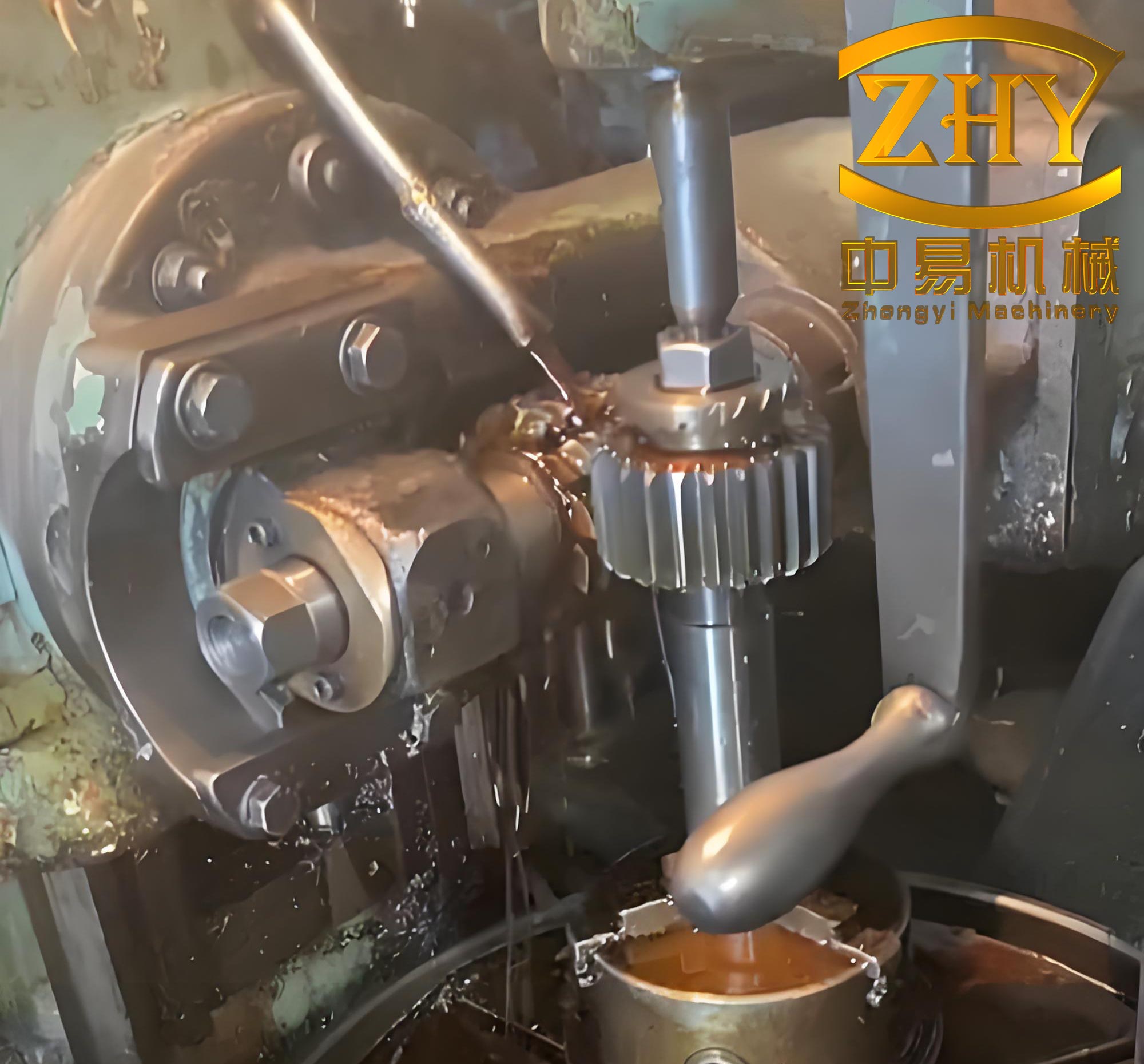
We validated the software on a Gleason-Pfaunter P2800 CNC gear hobbing machine, equipped with the SINUMERIK ONE system. The test involved machining a worm gear with 180 teeth, a module of 10 mm, and a pitch diameter of 1800 mm. The hob was a ZN1 type with one start, and radial hobbing was employed with a spindle speed of 35 rpm and a feed rate of 0.035 mm/min. The software generated the NC code, which controlled the machine axes to perform the gear hobbing process. After machining, the gear was inspected and met ISO grade 4 accuracy, demonstrating the software’s effectiveness. This validation underscores the practicality of our solution for industrial gear hobbing applications, reducing programming time and improving consistency.
In conclusion, our development of CNC worm gear hobbing software based on the SINUMERIK ONE system addresses key challenges in gear manufacturing. By integrating mathematical models for kinematics and tooth surface generation, along with an intuitive HMI, the software automates NC code generation and enhances operational efficiency. The gear hobbing machine benefits from reduced setup times and higher precision, making it suitable for mass production of worm gears. Future work could extend this approach to other gear types or incorporate adaptive control for real-time optimization in gear hobbing processes.