
As global energy demands rise and environmental concerns intensify, the development of sustainable energy solutions has become a critical focus. In the transportation sector, traditional speed bumps, while effective for traffic calming, often lead to energy waste and vehicle damage due to their rigid design. This paper introduces a novel energy storage speed bump that leverages rack and pinion gear mechanisms to convert kinetic energy from vehicles into electrical energy, thereby addressing both safety and energy efficiency. The system not only enhances driver comfort but also contributes to renewable energy goals by storing and repurposing wasted energy. Through modular design and integration of data analysis capabilities, this innovation offers a multifaceted approach to modern urban infrastructure.
The energy storage industry has seen rapid growth, driven by policies promoting non-fossil energy sources. For instance, national strategies aim for non-fossil energy to constitute over 50% of total energy consumption by 2050. Key indicators highlight this transition, as shown in the table below.
| Indicator | 2030 Target | 2050 Target |
|---|---|---|
| Primary Energy Consumption (billion tons of standard coal) | 60.0 | 55.0 |
| Share of Non-Fossil Energy in Primary Energy (%) | 28.6 | 61.0 |
| Share of Renewable Energy in Primary Energy (%) | 23.3 | 47.7 |
Such targets underscore the importance of innovations like energy-harvesting speed bumps, which align with broader energy transformation goals. Traditional speed bumps, typically made of rubber or metal, cause significant vehicle vibration and noise, leading to discomfort and potential damage. In contrast, the proposed system utilizes a rack and pinion gear setup to absorb impact and generate electricity, reducing these drawbacks. The rack and pinion mechanism is central to this design, enabling efficient energy conversion through linear-to-rotational motion transfer.
The primary design objective is to create a speed bump that controls vehicle speed while minimizing impact and recovering energy. This involves a modular approach, allowing for customization with additional features like speed detection and weight measurement. The rack and pinion gear system ensures smooth operation by converting vertical vehicle force into rotational motion, which drives a generator. This process not only cushions the vehicle’s passage but also captures energy that would otherwise be lost. The use of a rack and pinion arrangement provides a reliable and scalable solution, as it can be easily integrated into existing road infrastructures.
The working structure comprises three main components: the energy generation mechanism, the transmission system, and the energy storage unit. The energy generation mechanism includes a push rod, fixed columns, a rack, and an input gear, all coordinated through springs for resetting. When a vehicle passes over the speed bump, the push rod is depressed, driving the rack in a linear motion. This engages with the input gear, initiating rotational movement. The rack and pinion gear interaction is crucial here, as it transforms the linear displacement into torque. The transmission system consists of a multi-stage gear set that amplifies the input speed to optimize generator performance. Finally, the energy storage unit, comprising a DC generator, conditioning circuit, and battery, stores the electricity for later use.
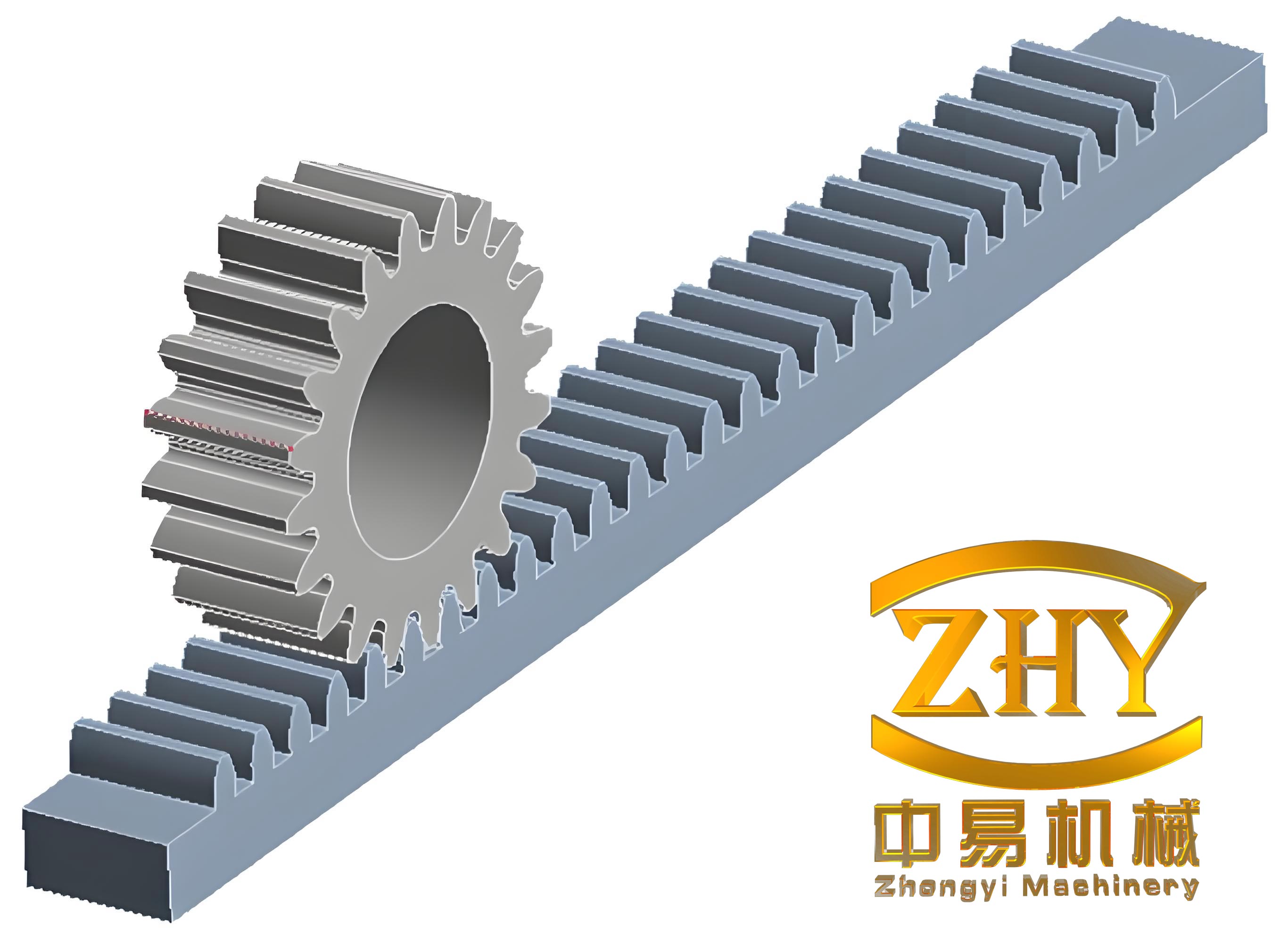
The principle of operation relies on the rack and pinion gear to efficiently transfer energy. As the vehicle applies force, the rack moves horizontally, turning the pinion gear. The gear ratio in the rack and pinion system can be expressed mathematically to illustrate speed amplification. For instance, the relationship between linear velocity of the rack and angular velocity of the pinion is given by:
$$ v = r \omega $$
where \( v \) is the linear velocity of the rack, \( r \) is the pitch radius of the pinion, and \( \omega \) is the angular velocity. This equation highlights how the rack and pinion gear facilitates motion conversion. Additionally, the energy harvested per vehicle pass can be approximated using kinetic energy formulas, considering vehicle mass and speed. The total energy converted, \( E \), is:
$$ E = \frac{1}{2} m v^2 \eta $$
where \( m \) is the effective mass contribution, \( v \) is the vehicle speed, and \( \eta \) is the efficiency factor of the rack and pinion system and generator. This underscores the importance of optimizing the rack and pinion design for higher efficiency.
In terms of product functionality, the energy storage speed bump serves multiple roles. As a fixed energy source, it powers nearby utilities like streetlights, reducing grid dependency. The table below summarizes its core functions and benefits.
| Function | Description | Benefit |
|---|---|---|
| Fixed Energy Supply | Converts vehicle kinetic energy to electricity for local use | Lowers operational costs and supports green energy |
| Emergency Power Source | Provides stored energy during outages or disasters | Enhances community resilience and safety |
| Speed Detection | Analyzes energy patterns to estimate vehicle speed | Improves traffic management and reduces accidents |
| Weight Measurement | Uses energy data to calculate vehicle load | Prevents road damage from overloaded vehicles |
| Traffic Flow Analysis | Collects data on vehicle counts and patterns | Aids in urban planning and congestion reduction |
Each function leverages the rack and pinion gear mechanism to enhance performance. For example, speed detection relies on the correlation between the force applied to the rack and the resulting generator output, which varies with vehicle velocity. Similarly, weight measurement uses the same principle, where heavier vehicles exert greater force on the rack and pinion, producing more electricity. This modularity allows cities to deploy the system according to specific needs, such as high-traffic areas or zones requiring enhanced safety measures.
Design innovations center on the rack and pinion gear’s ability to provide a buffering effect and efficient energy conversion. Unlike conventional speed bumps, which cause abrupt stops, this system uses the rack and pinion to gradually absorb impact, reducing wear on vehicles and improving ride comfort. The gear train includes a three-stage增速齿轮组 to multiply the input speed, ensuring the generator operates at optimal RPM. The efficiency of the rack and pinion transmission can be modeled using mechanical advantage formulas. For instance, the force transmission in a rack and pinion system is governed by:
$$ F_{\text{output}} = F_{\text{input}} \times \frac{d_{\text{rack}}}{d_{\text{pinion}}} $$
where \( F_{\text{output}} \) is the force on the generator, \( F_{\text{input}} \) is the vehicle-induced force on the rack, and \( d_{\text{rack}} \) and \( d_{\text{pinion}} \) are the respective pitch diameters. This equation demonstrates how the rack and pinion gear amplifies force for better energy harvest. Moreover, the use of standard components in the rack and pinion assembly simplifies maintenance and reduces costs, making it feasible for widespread adoption.
Another key innovation is the integration of data analysis modules that utilize the rack and pinion system’s output. For speed detection, the voltage generated by the generator correlates with the rack’s linear velocity, which is derived from the pinion’s rotation. By calibrating this relationship, the system can estimate vehicle speed accurately. Similarly, for weight measurement, the current output relates to the force on the rack, allowing for load calculations. These features make the rack and pinion-based speed bump a smart infrastructure tool, capable of real-time traffic monitoring.
In conclusion, the novel energy storage speed bump utilizing rack and pinion gear transmission represents a significant advancement in sustainable transportation infrastructure. By harnessing wasted kinetic energy, it supports renewable energy targets while improving road safety and comfort. The rack and pinion mechanism ensures efficient energy conversion and modular functionality, enabling applications ranging from emergency power to traffic data collection. As cities worldwide strive for carbon neutrality, such innovations will play a pivotal role in creating intelligent, eco-friendly urban environments. Future work could focus on optimizing the rack and pinion design for higher efficiency and exploring large-scale deployments in smart city projects.
The potential impact of this technology extends beyond energy savings. For instance, in scenarios with high traffic volume, the cumulative energy harvested could power entire streetlight networks, as shown in the following energy estimation table. Assuming an average vehicle mass and speed, the daily energy output can be calculated based on the rack and pinion system’s efficiency.
| Parameter | Value | Unit |
|---|---|---|
| Average Vehicle Mass | 1500 | kg |
| Average Speed | 30 | km/h |
| Energy per Vehicle Pass | 0.05 | kWh |
| Daily Vehicle Count | 1000 | vehicles |
| Total Daily Energy | 50 | kWh |
This table illustrates how the rack and pinion gear system can contribute significantly to local energy needs. Furthermore, the mechanical advantage of the rack and pinion allows for customization based on traffic conditions; for example, in areas with heavier vehicles, the gear ratios can be adjusted to maximize energy capture. The durability of the rack and pinion components also ensures long-term reliability, reducing maintenance frequency and costs.
Overall, the integration of rack and pinion technology into speed bumps not only addresses immediate traffic safety concerns but also aligns with global sustainability initiatives. By continuously refining the rack and pinion design, we can enhance energy conversion rates and expand the system’s applications, paving the way for smarter, greener cities. The rack and pinion gear remains a cornerstone of this innovation, demonstrating its versatility in modern engineering solutions.