
In recent years, with the increasing demand for retrofitting old residential buildings, the installation of lifts in such structures has become a priority. However, traditional elevator systems often face challenges like obstructing light and ventilation for lower-floor residents, leading to conflicts. To address this, corridor lifts equipped with a rack and pinion gear system have emerged as an innovative solution. These systems utilize rails installed along staircases, allowing for vertical transportation without altering the building’s structure. As a key component, the rack and pinion gear transmission must ensure reliable strength to prevent failures. In this analysis, I focus on evaluating the bending strength of the rack and pinion gear under various conditions, including straight and curved sections, using theoretical calculations and finite element simulations.
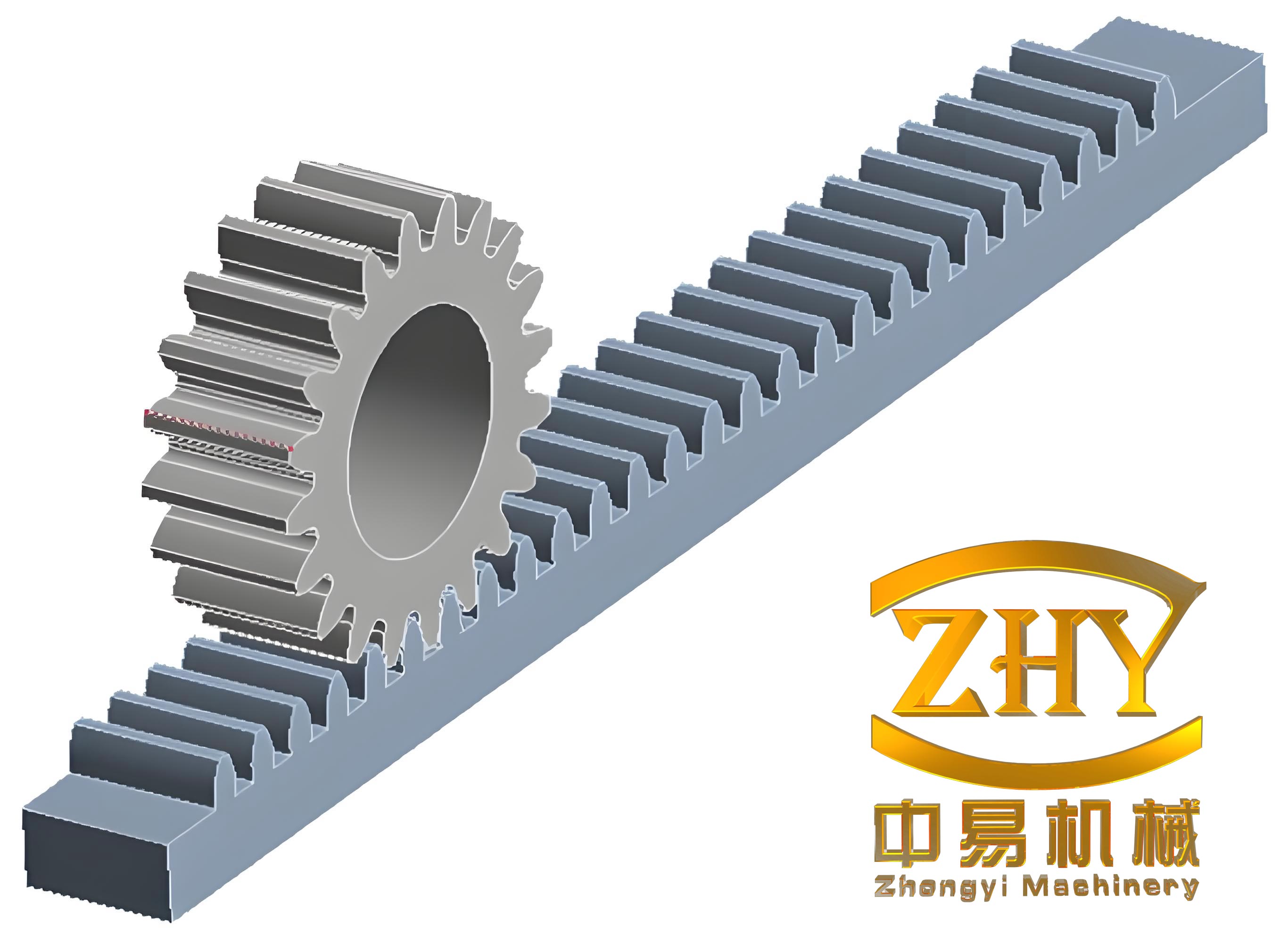
The rack and pinion gear system in corridor lifts consists of a pinion gear mounted on the seat mechanism and a rack fixed along the guide rail. For open gear transmissions like this, the primary design criterion is the bending fatigue strength at the tooth root, as wear resistance calculations are less established. I assume the pinion gear is made of 40Cr steel, heat-treated to a hardness of HRC48-55, with a module of 3.5 mm, pressure angle of 20°, addendum coefficient of 1, dedendum coefficient of 0.25, 19 teeth, width of 15.5 mm, and pitch diameter of 66.5 mm. The rack is made of 45 steel, heat-treated to HRC43-50, with the same module and pressure angle, but a width of 10 mm. Since the pinion has a greater width, its resistance to bending fatigue is higher, so I emphasize the rack’s tooth root stress analysis.
To compute the bending stress at the rack tooth root, I use the standard formula for open gear transmissions. The maximum bending stress \(\sigma_F\) is given by:
$$\sigma_F = \frac{2 K_F T Y_{Fa} Y_{sa} Y_{\epsilon} \phi_d}{m^3 z_1^2}$$
where \(K_F\) is the load factor, \(T\) is the maximum torque on the pinion in N·mm, \(Y_{Fa}\) is the form factor, \(Y_{sa}\) is the stress correction factor, \(Y_{\epsilon}\) is the contact ratio factor, \(\phi_d\) is the width factor, \(m\) is the module in mm, and \(z_1\) is the number of pinion teeth. Based on reference data, I set \(Y_{Fa} = 2.86\) and \(Y_{sa} = 1.54\). The load factor \(K_F\) is derived from:
$$K_F = K_A K_V K_{F\alpha} K_{F\beta}$$
with \(K_A = 1.0\) for uniform operation, \(K_V = 1.05\) for an 8-precision grade and pitch line velocity of 0.1 m/s, \(K_{F\alpha} = 1.2\) for hard-faced spur gears, and \(K_{F\beta} = 1.099\), resulting in \(K_F = 1.385\). The maximum torque \(T\) is calculated as:
$$T = (F_g \sin \alpha + \mu F_g \cos \alpha) \frac{d_1}{2}$$
where \(F_g\) is the combined force of seat weight and maximum load (100 kg and 115 kg, respectively, with gravity acceleration 9.81 m/s²), \(\mu = 0.25\) is the rolling friction factor, \(\alpha = 45^\circ\) is the staircase inclination, and \(d_1 = 66.5\) mm is the pitch diameter. This gives \(T = 61,986.07\) N·mm. The contact ratio factor \(Y_{\epsilon}\) is:
$$Y_{\epsilon} = 0.25 + \frac{0.75}{\epsilon_{\alpha}}$$
with \(\epsilon_{\alpha} = 1.76\), yielding \(Y_{\epsilon} = 0.68\). The width factor \(\phi_d = b / d_1 = 10 / 66.5 = 0.15\). Substituting these values, the theoretical bending stress is \(\sigma_F = 221.46\) MPa.
For finite element analysis, I employ ANSYS Workbench to perform static simulations on the rack and pinion gear model. The materials are defined with densities of 7.72 g/cm³ for the pinion (40Cr steel, elastic modulus 211 GPa, Poisson’s ratio 0.277) and 7.89 g/cm³ for the rack (45 steel, elastic modulus 209 GPa, Poisson’s ratio 0.269), and a friction coefficient of 0.1 between them. The mesh is generated using tetrahedral elements with a global size of 1 mm, refined to 0.2 mm at contact surfaces and tooth roots, resulting in 563,697 elements and 823,649 nodes. Constraints include fixed support at the rack base and displacement constraints on the pinion’s center hole to allow only rotation, with the applied torque.
In straight sections of the corridor, where the rack is linear, the simulation shows the maximum stress at the pinion tooth root is 96.54 MPa, while for the rack, it is 228.47 MPa, which is 3.2% higher than the theoretical value. This confirms that the rack experiences higher stress, and both values are within the yield limits of 500 MPa for the pinion and 360 MPa for the rack. The close agreement validates the finite element model for straight rack and pinion gear configurations.
For curved sections, such as corridor turns, the rack is bent with varying radii, and I analyze multiple cases. The finite element setup remains the same, but the rack geometry is modified to different bend radii. The results indicate that stress concentrations occur, and the maximum stresses differ from straight sections. Below is a table summarizing the maximum tooth root stresses for the pinion and rack at different bend radii:
| Bend Radius (mm) | Pinion Root Stress (MPa) | Rack Root Stress (MPa) |
|---|---|---|
| 200 | 221.43 | 226.31 |
| 300 | 136.75 | 236.83 |
| 400 | 189.90 | 355.55 |
| 500 | 204.19 | 400.46 |
| 600 | 192.40 | 390.25 |
| 700 | 188.67 | 382.81 |
| 800 | 180.29 | 374.87 |
| ∞ (Straight) | 96.54 | 228.47 |
The data shows that for curved rack and pinion gear systems, the maximum stresses initially increase and then decrease with larger bend radii. At a radius of 500 mm, the stresses peak at 204.19 MPa for the pinion and 400.46 MPa for the rack, which are 2.12 and 1.75 times the straight section values, respectively. This non-linear trend is due to changes in meshing behavior: at smaller radii, the pinion engages more with the rack’s inner side, shifting stress to the inner tooth root, while at larger radii, the outer side dominates, and the contact area increases, but the pressure rise slows. Although the rack stress exceeds the yield limit in some cases, the actual torque in horizontal sections is lower (about 28% of inclined sections for a 45° angle), so the design remains acceptable. However, for very small radii, interference may require tooth grinding on the rack edges to ensure smooth rack and pinion gear operation.
In conclusion, the rack and pinion gear transmission in corridor lifts demonstrates that the rack’s tooth root bears higher stress than the pinion, as confirmed by both theory and simulation. For straight sections, theoretical calculations align well with finite element results, providing a reliable estimate. In curved sections, the rack and pinion gear system exhibits a complex stress pattern that peaks at specific bend radii, necessitating careful design to avoid failures. This analysis underscores the importance of considering geometric variations in rack and pinion gear systems for safe and efficient lift operation.