
In modern industrial applications, large-scale gear transmissions are critical components in aerospace, wind power, heavy machinery, and marine engineering due to their high transmission efficiency, compact structure, and longevity. Gear profile grinding, as an efficient method for processing large-diameter and large-modulus gears, offers advantages such as uniform force distribution and high precision. However, challenges in controlling grinding accuracy, achieving precise modifications, and implementing in-machine measurements persist. In this review, I explore the research and developments in tooth surface error control for gear profile grinding, focusing on error sources from the grinding wheel dressing system, the gear grinding system, and the in-machine detection system. I emphasize key aspects like gear grinding, grinding cracks, and gear profile grinding to provide a holistic perspective on error mitigation strategies.
The foundation of gear profile grinding lies in the precise mapping between the grinding wheel’s profile and the gear’s tooth flank. Any deviations in this relationship lead to tooth surface errors, which can propagate into functional failures, including grinding cracks caused by thermal or mechanical stresses. I begin by examining the grinding wheel dressing system, where errors originate from theoretical profile calculations and dressing motions. The dressing process involves generating the wheel’s axial profile based on the gear’s tooth geometry. For spur gears, the wheel profile corresponds directly to the gear’s transverse section, while helical gears require complex transformations due to their helical nature. Analytical methods, such as those derived from conjugate surface theory, involve solving contact equations iteratively, but this introduces computational errors. Alternatively, digital methods discretize the tooth profile into point vectors, which are then projected and fitted to approximate the wheel profile. Although digital methods avoid iterative solutions, fitting errors remain a concern. For modified gears, where tooth profiles vary across sections, optimizing the wheel profile or incorporating multi-axis motions is necessary to minimize inherent errors.
To quantify the relationship between the wheel profile and gear tooth, I use a mathematical model based on homogeneous coordinate transformations. The wheel’s axial profile can be represented as a function of the gear’s transverse profile parameters. For instance, the contact condition between the wheel and gear tooth can be expressed as:
$$ \mathbf{N}_w \cdot \mathbf{v}_r = 0 $$
where $\mathbf{N}_w$ is the normal vector of the wheel surface, and $\mathbf{v}_r$ is the relative velocity vector. Solving this equation for helical gears involves accounting for the helix angle $\beta$, leading to a series of nonlinear equations. In digital methods, the discrete points of the gear tooth profile are transformed using rotation matrices and projected onto a calculation plane. The envelope of these points defines the wheel profile, but the fitting error $\epsilon_f$ can be modeled as:
$$ \epsilon_f = \sqrt{\frac{1}{n} \sum_{i=1}^{n} (d_i – \hat{d}_i)^2} $$
where $d_i$ are the actual distances, and $\hat{d}_i$ are the fitted values. Table 1 summarizes common errors in wheel dressing systems and their impacts on tooth surface quality.
| Error Source | Description | Impact on Tooth Surface |
|---|---|---|
| Theoretical Profile Calculation | Inaccuracies in solving contact equations or fitting discrete points | Increased profile deviation and grinding cracks |
| Dressing Tool Alignment | Misalignment of diamond rollers or tools due to geometric errors | Non-uniform wear and localized stress concentrations |
| Wheel Wear | Progressive degradation of wheel profile during grinding | Reduced accuracy and potential for thermal-induced cracks |
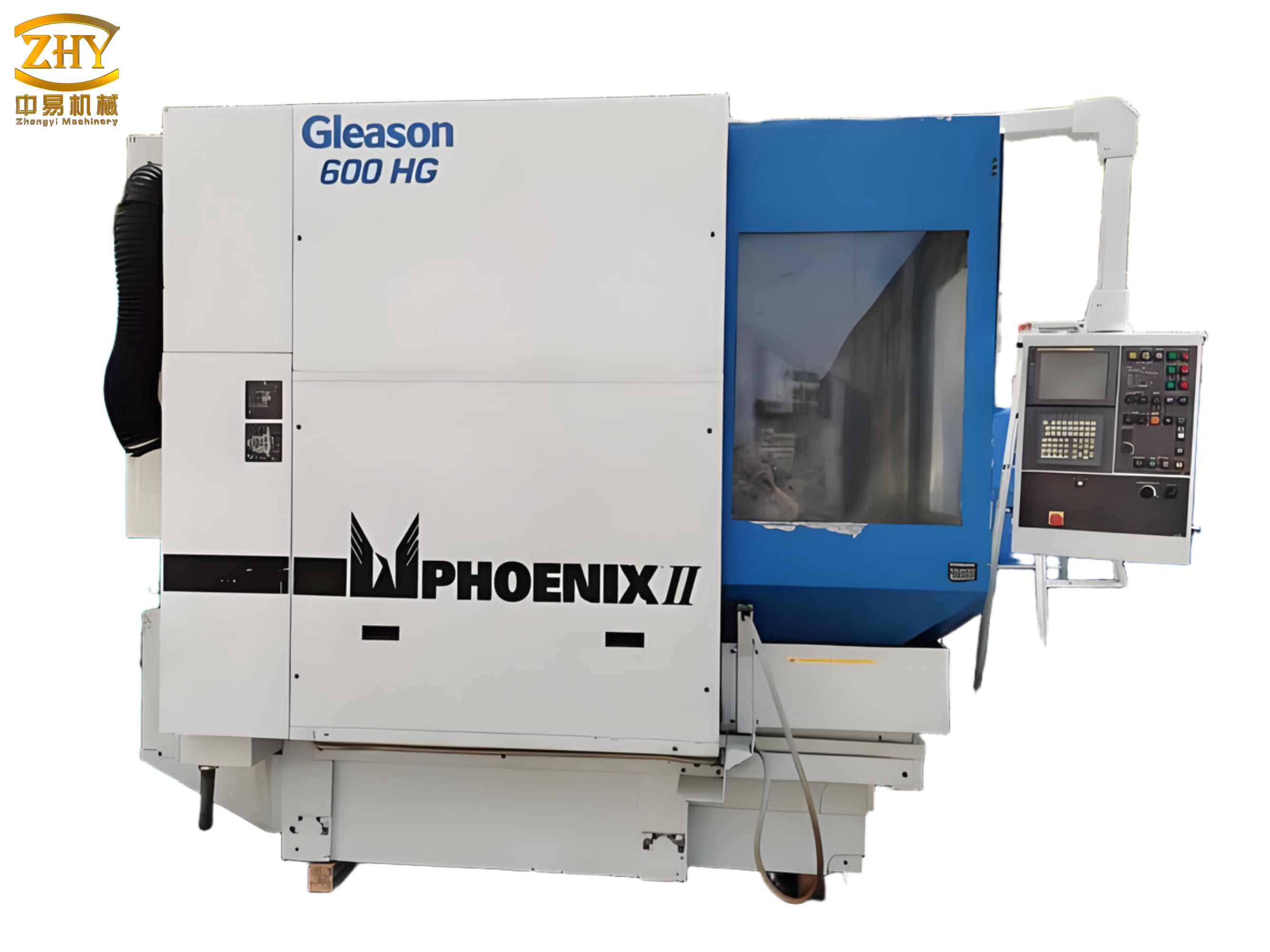
Moving to the gear grinding system, errors arise from machine tool inaccuracies, thermal effects, and installation misalignments. CNC gear profile grinding machines are essentially five-axis systems, and their errors can be categorized into geometric, thermal, and force-induced errors. Geometric errors include positional inaccuracies of linear and rotary axes, which can be modeled using multi-body system theory. For example, the volumetric error $\mathbf{E}_v$ at the tool center point can be expressed as:
$$ \mathbf{E}_v = \sum_{i=1}^{n} \mathbf{J}_i \cdot \delta_i $$
where $\mathbf{J}_i$ is the Jacobian matrix for axis $i$, and $\delta_i$ is the error vector. Thermal errors, caused by heat sources like motors and friction, lead to spindle drift and structural deformations. These are particularly critical as they can induce grinding cracks due to excessive temperatures. A common model for thermal error compensation is based on temperature measurements at sensitive points, using a regression approach:
$$ \Delta T = \alpha_0 + \sum_{j=1}^{m} \alpha_j T_j $$
where $\Delta T$ is the thermal displacement, $T_j$ are temperature readings, and $\alpha_j$ are coefficients determined experimentally. Force errors, though less significant in grinding due to small feed rates, can still contribute to dynamic instabilities. Installation errors, such as wheel eccentricity or gear misalignment, introduce periodic deviations. For instance, wheel eccentricity $\epsilon_e$ affects the tooth profile error $\Delta p$ as:
$$ \Delta p = \epsilon_e \cdot \sin(\theta) $$
where $\theta$ is the rotational angle. Table 2 outlines key error sources in the gear grinding system and their effects on gear quality.
| Error Type | Source | Effect on Gear |
|---|---|---|
| Geometric Errors | Axis misalignments, guideway inaccuracies | Tooth profile deviations and increased noise |
| Thermal Errors | Spindle heating, environmental changes | Dimension shifts and grinding cracks |
| Installation Errors | Wheel tilt, gear eccentricity | Periodic errors in pitch and profile |
In-machine detection systems play a vital role in error control by providing real-time feedback on tooth surface quality. These systems typically use contact probes or non-contact methods like laser trackers. However, errors in detection arise from probe positioning inaccuracies, calibration issues, and pre-travel errors due to system inertia. For example, the pre-travel error $\delta_p$ can be modeled using neural networks based on historical data. The detection process involves transforming measured points from the machine coordinate system to the workpiece system, which requires precise knowledge of the probe’s position. Any geometric errors in the machine axes will affect this transformation, leading to measurement inaccuracies. Optimization of detection points is crucial; uniformly distributed points often suffice, but adaptive sampling based on curvature can improve efficiency. The overall measurement error $\epsilon_m$ can be expressed as:
$$ \epsilon_m = \sqrt{\epsilon_g^2 + \epsilon_c^2 + \epsilon_p^2} $$
where $\epsilon_g$ is geometric error, $\epsilon_c$ is calibration error, and $\epsilon_p$ is pre-travel error. To enhance accuracy, iterative compensation methods are used, but they may reduce efficiency. Future systems should integrate error models directly into the detection algorithm to minimize iterations.
Error control strategies involve both prevention and compensation techniques. Prevention focuses on design improvements, such as using thermally stable materials or enhancing structural stiffness. Compensation, however, is more widely adopted and includes offline and online methods. Offline compensation uses periodic error measurements to update machine parameters, while online compensation adjusts in real-time but faces challenges in feedback latency. For geometric errors, decoupling the error sources is essential. Using inverse kinematics, the compensation values for each axis can be derived without assuming small errors. For instance, the actual axis movements $\mathbf{q}_a$ can be computed from the desired tool path $\mathbf{p}_d$ and the error model $\mathbf{E}$:
$$ \mathbf{q}_a = \mathbf{K}^{-1}(\mathbf{p}_d + \mathbf{E}) $$
where $\mathbf{K}$ is the kinematic transformation matrix. Sensitivity analysis helps identify critical errors, such as those with high Sobol indices, allowing for focused compensation. For thermal errors, fuzzy logic or gray system models can predict displacements based on temperature inputs. However, coupling between thermal and geometric errors complicates compensation, necessitating integrated models.
Error traceability is the process of linking tooth surface errors back to specific machine error sources. This is challenging due to the multitude of error parameters. Sensitivity analysis provides a way to prioritize errors, but full traceability requires solving underdetermined systems. Advanced methods, such as genetic algorithms, can optimize error identification. For example, minimizing the difference between measured and simulated tooth surfaces leads to error estimates. The traceability process can be formulated as an optimization problem:
$$ \min_{\delta} \| \mathbf{e}_m – \mathbf{e}_s(\delta) \|^2 $$
where $\mathbf{e}_m$ is the measured error, $\mathbf{e}_s$ is the simulated error, and $\delta$ is the error vector. Implementing this in practice requires robust algorithms and extensive data.
Looking ahead, several areas demand further research. First, a comprehensive error model that integrates both wheel dressing and grinding systems is needed. Current models often treat these separately, neglecting interactions. Second, in-machine detection can be optimized by adopting Cartesian coordinate measurements instead of polar methods, reducing iterative errors. Third, error traceability should advance from qualitative to quantitative analysis, enabling dynamic updates of error parameters. For instance, incorporating real-time data from sensors could allow for continuous compensation, reducing the risk of grinding cracks. Additionally, the development of closed-loop systems that combine dressing, grinding, detection, traceability, and compensation will enhance precision. In such systems, adaptive control algorithms could adjust grinding parameters based on real-time error feedback, minimizing deviations and preventing defects like grinding cracks.
In conclusion, gear profile grinding is a sophisticated process where error control is paramount for achieving high-quality gears. By addressing errors from dressing, grinding, and detection systems, and by advancing compensation and traceability methods, manufacturers can improve accuracy and efficiency. Emphasizing key aspects like gear grinding, grinding cracks, and gear profile grinding throughout the process ensures that critical issues are mitigated. As technology evolves, the integration of intelligent systems will pave the way for more reliable and precise gear production, supporting industries that rely on high-performance gear transmissions.