
In the context of carbon peak and carbon neutrality goals, the new energy vehicle market has experienced rapid growth, with production and sales leading globally for eight consecutive years. However, the driving range of these vehicles remains a significant concern, posing a major bottleneck for development. The efficiency of the transmission system in new energy vehicles directly impacts power loss during transmission, thereby determining the overall range. Enhancing this efficiency can effectively reduce operational energy consumption and extend driving range. Additionally, as new energy vehicles are powered by electric motors, they are more sensitive to NVH (Noise, Vibration, and Harshness) issues in the transmission system. The gearbox is a critical component, and high-precision gears play a vital role in improving transmission efficiency, extending range, and mitigating NVH problems. Consequently, new energy vehicles demand higher precision and quality in gear manufacturing. Gear grinding machines are the primary tools for producing high-precision gears, as they correct errors from pre-grinding processes and achieve superior accuracy through gear profile grinding. Grinding oil, as a process lubricant, is essential in high-precision gear grinding, facilitating heat dissipation, reducing temperatures in the grinding zone, extending wheel life, flushing away metal chips and wheel debris, and improving surface quality. High-quality grinding oil also exhibits good anti-mist properties, enhancing the workshop environment and reducing health risks. However, premium grinding oils have long relied on imported brands, which are costly and have long lead times.
In 2021, a large professional gear manufacturing enterprise in Guangdong expanded into new energy vehicle heavy-duty truck transmission business, introducing multi-speed AMT transmission assemblies. To meet production needs, the gear processing workshop equipped 15 high-precision gear grinding machines from brands like German Kappa, Japanese Mitsubishi, and Shaanxi Qinchuan, primarily for gear profile grinding in new energy vehicle transmissions. The gears required an accuracy level above ISO standard grade 6 and surface roughness of 0.3–0.4 μm, using an imported grinding oil. Although this oil performed well, it was expensive and had long procurement cycles. In January 2022, to reduce costs and shorten supply times, the enterprise collaborated with Sinopec Lubricant Co., Ltd. to explore substitutes for the grinding oil in high-precision gear grinding machines.
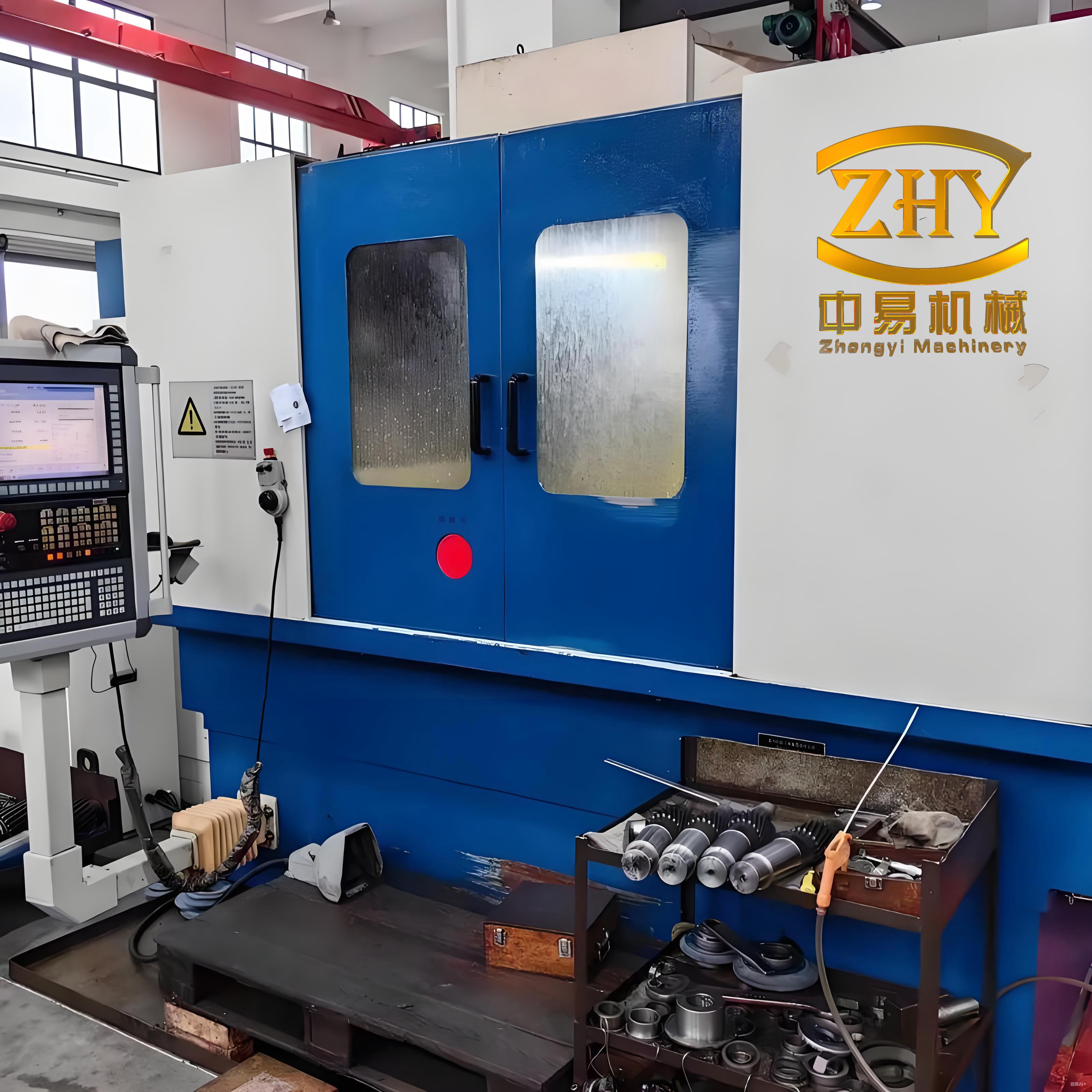
The substitution trial was conducted on a newly purchased Shaanxi Qinchuan YKZ7230 CNC worm wheel gear grinding machine, with key parameters summarized in Table 1. The gear material was primarily SAE 8620H gear steel, and post-processing parameters are listed in Table 2. After process analysis and discussions, Sinopec’s M0016B grinding oil was selected as a substitute, as its basic parameters met the equipment and process requirements. This oil is formulated from high-quality hydro-refined mineral oils and multiple performance additives, offering excellent cooling and lubrication for high-efficiency machining, extended tool life, and superior surface accuracy. It also boasts good health, safety, and environmental properties, with no irritants, odors, or toxicity, along with oxidation resistance and effective chip separation to prolong oil life.
| Parameter | Value |
|---|---|
| Workpiece Outer Diameter (mm) | 20–300 |
| Workpiece Module (mm) | 1–6 |
| Workpiece Number of Teeth | 9–560 |
| Maximum Tooth Width (Spur Gear, mm) | 300 |
| Workpiece Helix Angle (°) | ±45 |
| Maximum Wheel Linear Speed (m/s) | 63 |
| Maximum Wheel Spindle Speed (r/min) | 7,500 |
| Maximum Workpiece Weight (Including Fixture, kg) | 100 |
| Grinding Accuracy | Stable at GB10095.1(2)—2008 Standard Grade 4 |
| Parameter | Value |
|---|---|
| Module m (mm) | 4.233 |
| Number of Teeth Z | 29 |
| Pressure Angle α (°) | 20 |
| Modification Coefficient | 0.0651 |
| Surface Roughness Requirement (μm) | 0.3–0.4 |
| Accuracy Grade | Above ISO1328-1:2013 Standard Grade 6 |
A comparison of typical data between the imported grinding oil and Sinopec M0016B grinding oil is shown in Table 3. The results indicate that Sinopec M0016B has higher maximum non-seizure load PB and flash point, suggesting better lubrication performance and safety, while other parameters are comparable. This confirms the feasibility of substitution in gear grinding applications.
| Parameter | Imported Grinding Oil | Sinopec M0016B Grinding Oil | Test Method |
|---|---|---|---|
| Appearance | Light Brown Transparent Liquid | Uniform Transparent Liquid | Visual Inspection |
| Kinematic Viscosity at 40 °C (mm²/s) | 9.430 | 11.74 | GB/T 265 |
| Flash Point (Open Cup, °C) | 174 | 186 | GB/T 3536 |
| Pour Point (°C) | -30 | -31 | GB/T 3535 |
| Water Content (%) | Trace | Trace | GB/T 260 |
| Maximum Non-Seizure Load PB (N) | 510 | 755 | GB/T 12583 |
Compatibility tests were conducted by mixing Sinopec M0016B grinding oil with the imported brand in mass ratios of 1:9, 5:5, and 9:1. Parameters such as kinematic viscosity, maximum non-seizure load PB, and copper corrosion were evaluated, as summarized in Table 4. The mixtures remained transparent without precipitation, and all tested parameters were within normal ranges, indicating good compatibility. The mixed oils even showed improved lubricity in some cases, which is beneficial for preventing grinding cracks during intensive gear profile grinding operations.
| Parameter | 100:0 (M0016B) | 90:10 | 50:50 | 10:90 | 0:100 (Imported) | Test Method |
|---|---|---|---|---|---|---|
| Appearance (Room Temperature) | Transparent | Transparent | Transparent | Transparent | Transparent | Visual Inspection |
| Kinematic Viscosity at 40 °C (mm²/s) | 11.74 | 11.50 | 10.54 | 9.729 | 9.430 | GB/T 265 |
| Maximum Non-Seizure Load PB (N) | 755 | 755 | 667 | 510 | 510 | GB/T 12583 |
| Copper Strip Corrosion (50 °C, 3 h) Grade | 1b | 1b | 1b | 1b | 1b | GB/T 5096 |
The application trial began in March 2022 on the YKZ7230 CNC worm wheel gear grinding machine. Initially, 2,400 L of Sinopec M0016B grinding oil was added to the tank, and the oil system was circulated and filtered. After running for a period, a sample was taken for analysis to check for contaminants; the results met quality standards, allowing normal production to commence. The initial oil sample data are shown in Table 5. Subsequent samples were taken at intervals of 7, 14, 25, 33, 46, 54, 60, 69, and 116 days during normal production to monitor changes in kinematic viscosity (40 °C), copper strip corrosion, acid value, water content, and maximum non-seizure load PB. The tracking results are detailed in Table 6.
| Parameter | M0016B Grinding Oil Quality Standard | Test Data After Circulation | Test Method |
|---|---|---|---|
| Appearance | Transparent Liquid | Uniform Transparent Liquid | Visual Inspection |
| Kinematic Viscosity at 40 °C (mm²/s) | 8–14 | 12.04 | GB/T 265 |
| Flash Point (Open Cup, °C) | ≥160 | 186 | GB/T 3536 |
| Pour Point (°C) | ≤-9 | -27 | GB/T 3535 |
| Water Content (%) | ≤Trace | Trace | GB/T 260 |
| Maximum Non-Seizure Load PB (N) | ≥726 | 755 | GB/T 12583 |
| Parameter | 7 d | 14 d | 25 d | 33 d | 46 d | 54 d | 60 d (After Make-up) | 69 d | 116 d (After Make-up) | Test Method |
|---|---|---|---|---|---|---|---|---|---|---|
| Kinematic Viscosity at 40 °C (mm²/s) | 12.71 | 12.63 | 11.93 | 11.72 | 11.60 | 11.17 | 12.31 | 11.37 | 11.81 | GB/T 265 |
| Maximum Non-Seizure Load PB (N) | 755 | 618 | 726 | 726 | 726 | 726 | 667 | 667 | 667 | GB/T 12583 |
| Copper Strip Corrosion (50 °C, 3 h) Grade | 1b | 1b | 1b | 1b | 1b | 1b | 1b | 1b | 1b | GB/T 5096 |
| Water Content (%) | 0.03 | 0.03 | 0.03 | 0.03 | 0.06 | 0.08 | 0.10 | 0.06 | 0.06 | GB/T 260 |
Throughout the trial, Sinopec M0016B grinding oil demonstrated stable performance in all monitored parameters. The kinematic viscosity, maximum non-seizure load PB, copper strip corrosion, acid value, and water content remained consistent, indicating no significant degradation. The workshop operated under full load, and the processed gears consistently achieved accuracy levels above ISO1328-1:2013 standard grade 6 with surface roughness of Ra 0.3–0.4 μm. This confirms that Sinopec M0016B meets the requirements for high-precision gear grinding, effectively supporting gear profile grinding processes and minimizing risks such as grinding cracks. The oil’s performance in heat dissipation and lubrication contributed to maintaining gear quality, which is critical in preventing defects like grinding cracks that can arise from excessive temperatures or inadequate lubrication during gear grinding.
To quantitatively assess the grinding process, we can consider the following formula for specific grinding energy, which relates to the efficiency of gear grinding: $$ U = \frac{F_t \cdot v_s}{Q_w} $$ where \( U \) is the specific grinding energy, \( F_t \) is the tangential grinding force, \( v_s \) is the wheel speed, and \( Q_w \) is the material removal rate. High-quality grinding oils reduce \( F_t \) and enhance \( U \), leading to lower heat generation and reduced risk of grinding cracks. Additionally, the heat transfer during gear profile grinding can be modeled using: $$ q = h \cdot (T_g – T_o) $$ where \( q \) is the heat flux, \( h \) is the heat transfer coefficient, \( T_g \) is the grinding zone temperature, and \( T_o \) is the oil temperature. Superior grinding oils like M0016B improve \( h \), thereby lowering \( T_g \) and mitigating thermal damage in gear grinding operations.
Economically, the substitution yielded significant benefits. Based on data from the enterprise, the monthly make-up oil consumption for a single gear grinding machine using Sinopec M0016B decreased by 120 L compared to the imported brand. Calculations showed an annual cost reduction of approximately 33.3% per machine, highlighting the efficiency gains in gear grinding processes. This cost-effectiveness, combined with stable performance, supports the scalability of this substitute in high-precision applications.
In conclusion, the application trial demonstrated that Sinopec M0016B grinding oil maintains stable performance across key parameters, meets the precision requirements for gear grinding in new energy vehicles, and effectively supports gear profile grinding without inducing grinding cracks. The enterprise has since expanded the use of M0016B, gradually replacing the imported oil through mixing and full substitution. All gear grinding machines operating with M0016B have performed normally, with products meeting surface quality and accuracy standards. This substitution not only reduced oil consumption and procurement costs but also enhanced overall operational efficiency, delivering direct economic benefits while maintaining high standards in gear manufacturing for new energy vehicles.