
In modern gear manufacturing, achieving uniform gear grinding allowances is critical to prevent defects such as grinding cracks and ensure the integrity of carburized layers. Traditional methods for gear profile grinding often rely on experience-based adjustments, which are inefficient and prone to errors, especially for complex deformations in thin-walled gear rings after heat treatment. This paper presents an intelligent calculation method using MATLAB to optimize gear grinding allowances under multiple constraints, including minimum allowance requirements, carburized layer depth preservation, and uniform allowance distribution. By leveraging full-tooth scanning data and spatial transformation models, the method efficiently computes optimal adjustment parameters, enhancing the gear grinding process’s accuracy and reliability.
The gear grinding process involves removing excess material from tooth surfaces to achieve precise geometries. However, non-uniform allowances can lead to localized stress concentrations, increasing the risk of grinding cracks. In gear profile grinding, maintaining consistent allowances is essential to avoid such issues. Existing techniques, such as in-machine measurement and acoustic emission sensors, focus on planar adjustments but struggle with three-dimensional deformations. Our approach addresses this by integrating radial and end-face adjustments, modeled through transformation matrices and enveloping tooth surface equations. The MATLAB implementation iteratively searches for optimal parameters, ensuring compliance with engineering constraints.
Mathematical Modeling for Gear Grinding Allowance Adjustment
To model the gear grinding allowance adjustment, we consider the spatial transformations resulting from radial and end-face adjustments. Let the gear coordinate system be defined with the origin at the bottom face of the gear. The transformation involves rotations and translations based on adjustment parameters: end-face adjustment amplitude \( t_h \) and phase \( x_{wj} \), and radial adjustment amplitude \( t_r \) and phase \( x_{wj1} \). The support circle diameter is denoted as \( d_a \).
The transformation matrix for end-face adjustment involves rotating the coordinate system around the z-axis by \( x_{wj} \), followed by a tilt around the y-axis by angle \( \theta \), where \( \theta = \arcsin(t_h / d_a) \). The inverse rotation is then applied. The composite transformation matrix for a point \( P \) on the tooth surface is derived as follows:
Step 1: Rotation around z-axis:
$$ T_1 = \begin{bmatrix} \cos x_{wj} & \sin x_{wj} & 0 \\ -\sin x_{wj} & \cos x_{wj} & 0 \\ 0 & 0 & 1 \end{bmatrix} $$
Step 2: Tilt around y-axis:
$$ T_2 = \begin{bmatrix} \cos \theta & 0 & -\sin \theta \\ 0 & 1 & 0 \\ \sin \theta & 0 & \cos \theta \end{bmatrix} $$
Step 3: Inverse rotation:
$$ T_3 = T_1^{-1} $$
Step 4: Translation due to tilt:
$$ T_4 = \begin{bmatrix} \frac{d_a (\cos \theta – 1) \cos \alpha}{2} \\ \frac{d_a (\cos \theta – 1) \sin \alpha}{2} \\ \frac{t_h}{2} \end{bmatrix} $$
Step 5: Radial translation:
$$ T_5 = \begin{bmatrix} t_r \cos x_{wj1} \\ t_r \sin x_{wj1} \\ 0 \end{bmatrix} $$
The transformed tooth surface equation for the left or right flank of the i-th tooth, denoted as \( L_{G,i} \), becomes:
$$ L’_{G,i} = T_3 T_2 T_1 \begin{bmatrix} x_i \\ y_i \\ z_i \end{bmatrix} + T_4 + T_5 $$
This transformation accounts for the nonlinear effects of adjustments on gear grinding allowances, enabling precise control over the tooth surface geometry.
Enveloping Tooth Surface Model for Allowance Calculation
The enveloping tooth surface model represents the maximum and minimum boundaries of the actual tooth surface after heat treatment, derived from full-tooth scanning data. For the i-th tooth flank, let \( \sigma_{i,\text{max}} \) and \( \sigma_{i,\text{min}} \) be the maximum and minimum allowance values from the scan report. A tolerance margin \( \delta \) is introduced to avoid surface intersections. The base circle radius is \( r_b \), and the tooth parameters include helix angle \( \beta \), pressure angle \( \alpha \), and number of teeth \( Z \).
The ideal tooth surface equation \( L_{G,i} \) for a finished gear is given by:
$$ X_{1i} = r_b \cos(x_1 + x_2 + d_{t,i}) + r_b x_2 \sin(x_1 + x_2 + d_{t,i}) $$
$$ Y_{1i} = r_b \sin(x_1 + x_2 + d_{t,i}) – r_b x_2 \cos(x_1 + x_2 + d_{t,i}) $$
$$ Z_{1i} = p x_3 + B_b $$
where \( d_{t,i} = 2i\pi / Z + \omega – \pi / Z \), \( p = r / \tan \beta \) (positive for right-hand helix, negative for left-hand), \( r \) is the pitch radius, and \( B_b \) is the distance from the start of the helix to the base plane.
The maximum enveloping surface \( L_{G,i,\text{max}} \) incorporates the maximum allowance:
$$ X_{2i} = r_b \cos(x_4 + x_5 + d_{t,i,\text{max}}) + r_b x_5 \sin(x_4 + x_5 + d_{t,i,\text{max}}) $$
$$ Y_{2i} = r_b \sin(x_4 + x_5 + d_{t,i,\text{max}}) – r_b x_5 \cos(x_4 + x_5 + d_{t,i,\text{max}}) $$
$$ Z_{2i} = p x_6 + B_b $$
with \( d_{t,i,\text{max}} = d_{t,i} + (\sigma_{i,\text{max}} + \delta) / (r \cos \alpha \cos \beta) \).
The minimum enveloping surface \( L_{G,i,\text{min}} \) is similarly defined:
$$ X_{3i} = r_b \cos(x_7 + x_8 + d_{t,i,\text{min}}) + r_b x_8 \sin(x_7 + x_8 + d_{t,i,\text{min}}) $$
$$ Y_{3i} = r_b \sin(x_7 + x_8 + d_{t,i,\text{min}}) – r_b x_8 \cos(x_7 + x_8 + d_{t,i,\text{min}}) $$
$$ Z_{3i} = p x_9 + B_b $$
where \( d_{t,i,\text{min}} = d_{t,i} + (\sigma_{i,\text{min}} + \delta) / (r \cos \alpha \cos \beta) \).
The minimum allowance for the i-th tooth flank after transformation is computed as the minimum distance between the transformed minimum enveloping surface and the ideal surface:
$$ \lambda_{i,\text{min}} = \left\| T_3 T_2 T_1 L_{G,i,\text{min}} + T_4 + T_5 – L_{G,i} – \delta \right\| $$
For a set of adjustments, the overall minimum allowance \( d_{j,\text{min}} \) is the minimum of \( \lambda_{i,\text{min}} \) across all teeth. The optimization aims to maximize \( d_{j,\text{min}} \) while ensuring the carburized layer depth is maintained after grinding the maximum allowance.
The maximum allowance calculation requires identical parameter values for both surfaces to avoid diagonal extremes:
$$ \lambda_{i,\text{max}} = \left\| T_3 T_2 T_1 L_{G,i,\text{max}} + T_4 + T_5 – L_{G,i} – \delta \right\| $$
with \( x_1 = x_7 \), \( x_2 = x_8 \), and \( x_3 = x_9 \). The overall maximum allowance \( d_{j,\text{max}} \) is the maximum of \( \lambda_{i,\text{max}} \). The method selects adjustment parameters that minimize the variance in allowances, promoting uniformity in gear grinding.
MATLAB Implementation for Multi-Constraint Optimization
The MATLAB program implements an iterative optimization algorithm to find the best adjustment parameters. The constraints include: (1) each tooth flank must have at least the minimum required gear grinding allowance, (2) the carburized layer depth must meet design specifications after grinding the maximum allowance, and (3) the allowance fluctuation should be as uniform as possible to prevent grinding cracks. The program flow involves nested loops for adjustment variables—radial adjustment amplitude \( t_r \), radial phase \( x_{wj1} \), end-face amplitude \( t_h \), and end-face phase \( x_{wj} \).
For each combination, the transformation is applied, and the minimum and maximum allowances are computed using constrained minimization routines. The objective function for the minimum allowance is \( \lambda_{i,\text{min}} \), solved via large-scale optimization algorithms like the interior-point method. For the maximum allowance, the negative of \( \lambda_{i,\text{max}} \) is minimized to find the peak value. The following table summarizes the key parameters and their roles in the optimization:
| Parameter | Symbol | Description |
|---|---|---|
| End-face adjustment amplitude | \( t_h \) | Vertical lift at support points |
| End-face adjustment phase | \( x_{wj} \) | Angular position for lift |
| Radial adjustment amplitude | \( t_r \) | Horizontal displacement |
| Radial adjustment phase | \( x_{wj1} \) | Angular position for displacement |
| Base circle radius | \( r_b \) | Fundamental gear geometry parameter |
| Tolerance margin | \( \delta \) | Safety buffer to avoid surface interference |
The optimization process evaluates thousands of combinations, storing those that satisfy the constraints. The best solution is selected based on the highest minimum allowance and the smallest variance in allowances across teeth. This approach significantly reduces the risk of grinding cracks by ensuring even material removal during gear profile grinding.
Three-Dimensional Model Verification
To validate the MATLAB model, a 3D gear model was created in UG software with parameters listed in the table below. The model simulates a helical gear with 20 teeth, module 10 mm, pressure angle 20°, and helix angle 20°. The tooth width is 200 mm, and the support circle diameter is 232 mm. The initial allowance for all tooth flanks was set to 5.5 mm, including a 5 mm tolerance margin.
| Parameter | Value |
|---|---|
| Number of teeth | 20 |
| Module (mm) | 10 |
| Pressure angle (°) | 20 |
| Helix angle (°) | 20 |
| Tooth width (mm) | 200 |
| Support circle diameter (mm) | 232 |
For a test case with \( t_h = 2 \) mm, \( x_{wj} = 0 \), \( t_r = 0.5 \) mm, and \( x_{wj1} = 0.5\pi \), the minimum and maximum allowances were measured in the 3D model and compared to MATLAB results. The errors for minimum allowances were within 0.06 mm, and for maximum allowances, within 0.05 mm, demonstrating the model’s accuracy. This level of precision is acceptable for gear grinding applications, where adjustments are typically in 0.1 mm increments.
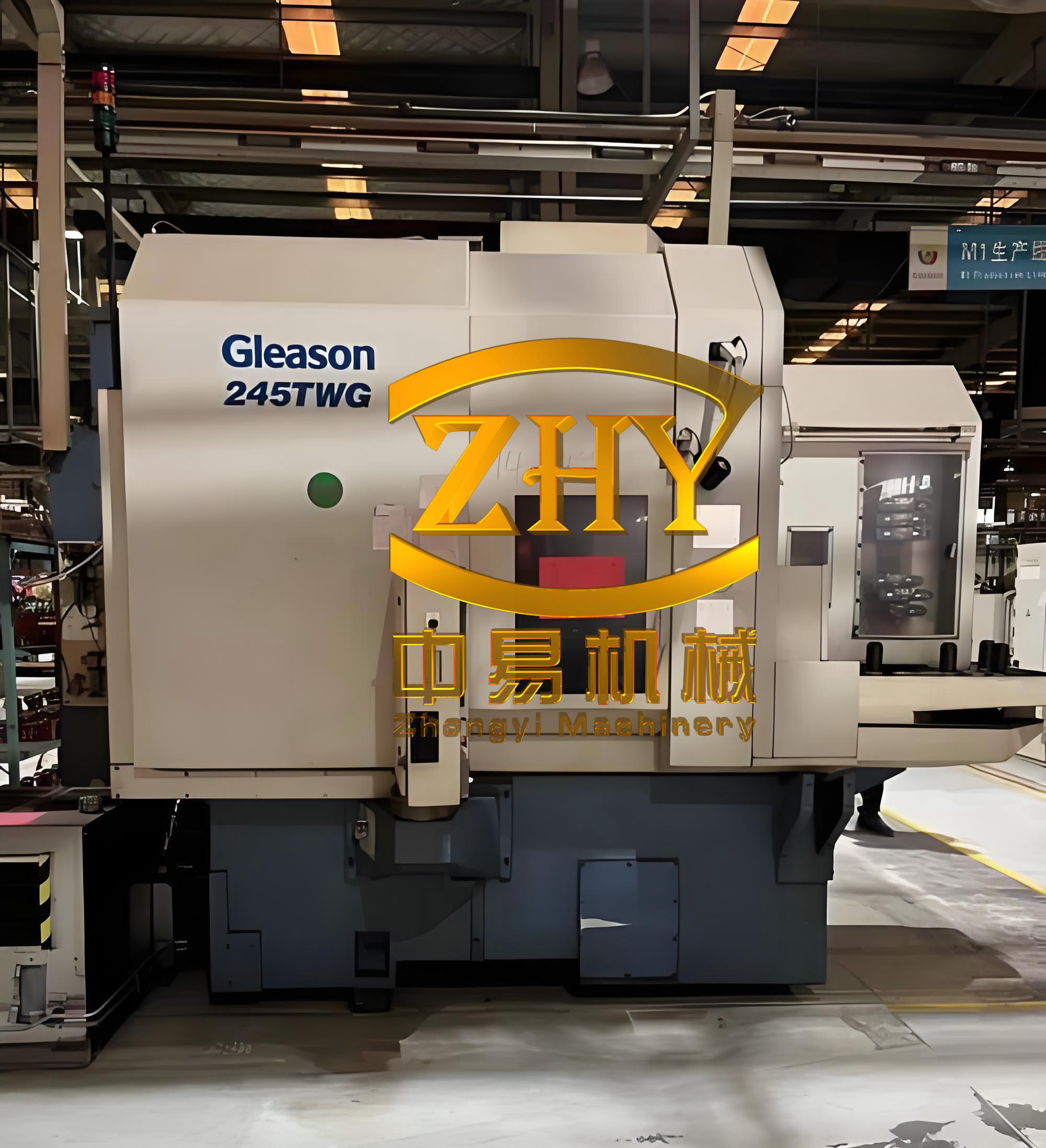
Non-uniform gear grinding allowances can lead to localized overheating and grinding cracks, which compromise gear performance. The image below illustrates typical grinding cracks resulting from improper allowance distribution, highlighting the importance of our method in mitigating such defects.
The MATLAB program’s ability to predict allowance distributions accurately ensures that gear profile grinding processes minimize the risk of cracks and maintain carburized layer integrity. By optimizing adjustment parameters, the method enhances the efficiency of gear grinding operations, reducing reliance on trial-and-error approaches.
Error Analysis and Discussion
The discrepancies between the 3D model and MATLAB results arise from two main sources: (1) the enveloping surface equations assume allowances are constant along the tooth profile, based on the pitch circle, which introduces principle errors at other points, and (2) the MATLAB optimization algorithms, such as the interior-point method and sequential quadratic programming, have inherent numerical tolerances. However, the errors are within 0.06 mm, which is acceptable for industrial gear grinding applications.
The table below compares the minimum and maximum allowance values for selected tooth slots from the 3D model and MATLAB, highlighting the errors:
| Tooth Slot | 3D Model Min (mm) | MATLAB Min (mm) | Error (mm) | 3D Model Max (mm) | MATLAB Max (mm) | Error (mm) |
|---|---|---|---|---|---|---|
| 0 | 4.6206 | 4.6080 | 0.0126 | 5.3471 | 5.3970 | 0.0500 |
| 4 | 7.4622 | 7.4930 | -0.0308 | 8.6207 | 8.6257 | 0.0050 |
| 12 | 3.3809 | 3.4390 | 0.0581 | 10.5357 | 10.5257 | 0.0100 |
The multi-constraint approach ensures that all tooth flanks have sufficient material for gear grinding, while the maximum allowance is controlled to preserve the carburized layer. This is crucial for preventing grinding cracks, as excessive material removal can expose underlying layers to thermal damage. The uniformity of allowances achieved through this method reduces the likelihood of stress concentrations during gear profile grinding, enhancing the overall quality of the gear manufacturing process.
Conclusion
The MATLAB-based multi-constraint method for gear grinding allowance adjustment provides an efficient and accurate solution to address complex deformations in gears after heat treatment. By modeling spatial transformations and enveloping surfaces, the method optimizes radial and end-face adjustments to achieve uniform allowances, minimizing the risk of grinding cracks and ensuring carburized layer depth requirements. The verification with 3D models confirms the practicality of the approach, with errors within acceptable limits for industrial applications. This methodology advances gear profile grinding by replacing empirical adjustments with data-driven optimization, improving productivity and product reliability in gear manufacturing.