
In modern manufacturing, gear grinding processes are critical for achieving high-precision gear profiles, but the presence of complex vibrations during operation can lead to issues such as grinding cracks and reduced surface quality. As a researcher focused on advanced manufacturing technologies, I have extensively studied the dynamic behavior of gear grinding machine spindles under service conditions. The spindle’s vibrations, influenced by multiple excitation sources, directly impact the gear profile grinding accuracy and may induce grinding cracks if not properly controlled. Traditional modal analysis methods often fail to accurately identify structural modes due to interference from random noise and harmonic components generated by rotating parts. In this article, I present a novel approach combining adaptive noise complete ensemble empirical mode decomposition (CEEMDAN) with wavelet threshold grading and cepstrum editing to effectively isolate and identify modal parameters in gear grinding applications. This method addresses the challenges of nonlinear, non-stationary vibration signals and harmonic disturbances, ensuring reliable modal identification for optimizing gear grinding processes and preventing defects like grinding cracks.
The core of our methodology lies in preprocessing vibration signals to remove noise and harmonic interference before applying operational modal analysis. We start by decomposing the raw vibration signal using CEEMDAN, which adaptively adds white noise to overcome mode mixing issues in empirical mode decomposition. The signal \( x(t) \) is decomposed into intrinsic mode functions (IMFs) as follows:
$$ x(t) = \sum_{k=1}^{K} \text{IMF}_k + r_K $$
where \( \text{IMF}_k \) represents the k-th mode component and \( r_K \) is the residual. The correlation coefficient (CC) between each IMF and the original signal is calculated to filter out noise-dominant components:
$$ CC = \frac{\sum (x_i – \bar{x})(x – \bar{x})}{\sqrt{\sum (x_i – \bar{x})^2 \sum (x – \bar{x})^2}} $$
IMFs with CC below 0.3 are discarded, and the remaining components are reconstructed. Next, we apply wavelet threshold grading within a frequency band defined by finite element analysis (e.g., 60–260 Hz for a gear grinding spindle). The signal is decomposed into approximation and detail coefficients using db4 wavelet, and hard thresholding is applied to levels outside the key modal band:
$$ D = \begin{cases}
\text{cd}_i & \text{if } |\text{cd}_i| \geq \lambda \\
0 & \text{if } |\text{cd}_i| < \lambda
\end{cases} $$
This step preserves critical modal information while eliminating random noise. For harmonic removal, we employ cepstrum editing. The real cepstrum \( C_v \) is obtained by:
$$ C_v = \mathcal{F}^{-1} \left\{ \ln \left( \left| \mathcal{F} \{ x(t) \} \right| \right) \right\} $$
where \( \mathcal{F} \) denotes the Fourier transform. A comb-shaped window function is used to filter periodic harmonics related to rotor dynamics, such as those from the spindle motor in gear grinding. The edited signal is reconstructed by combining the modified magnitude spectrum with the original phase. Finally, the random subspace method (SSI) is applied for modal parameter identification, fitting state-space models to the preprocessed data to extract natural frequencies and damping ratios.
To validate our approach, we first tested it on a simulated two-degree-of-freedom system with known modal parameters and added harmonic excitations. The system matrices were defined as:
$$ M = \begin{bmatrix} 1 & 0 \\ 0 & 1 \end{bmatrix}, \quad C = \begin{bmatrix} 13.53 & -9.02 \\ -9.02 & 22.55 \end{bmatrix}, \quad K = \begin{bmatrix} 80000 & -28000 \\ -28000 & 56000 \end{bmatrix} $$
Natural frequencies of 30.835 Hz and 49.932 Hz were embedded, along with harmonic noise at 30 Hz and 20 Hz multiples. The table below summarizes the identified parameters before and after cepstrum editing:
| Parameter | Before Editing | After Editing | Actual Value |
|---|---|---|---|
| 1st Frequency (Hz) | 30.84 | 30.88 | 30.835 |
| 2nd Frequency (Hz) | 49.94 | 49.95 | 49.932 |
| 1st Damping Ratio (%) | 1.02 | 1.01 | 1.0 |
| 2nd Damping Ratio (%) | 2.01 | 2.00 | 2.0 |
The results show that cepstrum editing effectively removed harmonic peaks, reducing errors to below 0.15%. The stabilization diagram from SSI analysis confirmed clear, stable poles after processing, whereas untreated data exhibited spurious modes.
We then applied the method to a YS7232H worm gear grinding machine spindle during gear profile grinding operations. Vibration data was acquired under typical grinding conditions: spindle speed of 1376 rpm, axial feed of 80 mm/min, and radial feed of 0.16 mm. The sampling frequency was set to 1024 Hz over 60 seconds. Finite element analysis of the spindle assembly indicated a modal band of 60–260 Hz, with dominant modes at 97.264 Hz, 178.522 Hz, and 221.521 Hz. Experimental modal analysis under stationary conditions validated these values, as shown in the table below:
| Mode Order | Frequency (Hz) | Damping Ratio (%) |
|---|---|---|
| 1 | 96.178 | 1.02 |
| 2 | 179.633 | 0.45 |
| 3 | 225.873 | 0.64 |
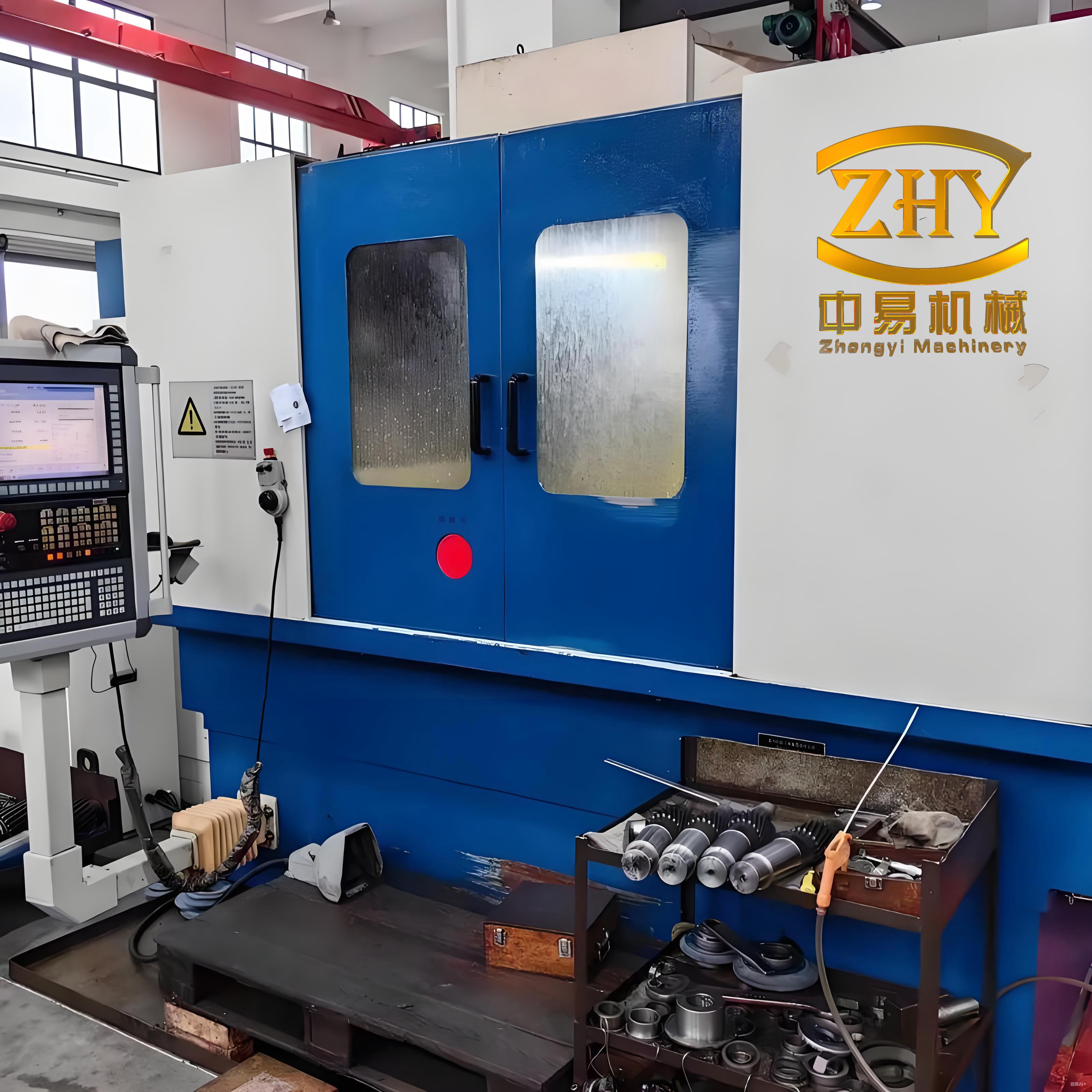
For operational data, CEEMDAN decomposition yielded 14 IMFs, and correlation analysis selected IMFs 1–3 for reconstruction (CC > 0.3). Wavelet threshold grading was applied with level 4 decomposition, filtering coefficients outside the 60–260 Hz band. The processed signal showed significant noise reduction, particularly in regions prone to inducing grinding cracks during gear profile grinding. Cepstrum editing targeted harmonics at the spindle rotational frequency (22.93 Hz) and its multiples, removing false modes that could mask true structural responses. The figure below illustrates a typical gear profile grinding setup, highlighting the importance of precise vibration control to avoid defects.
We compared our method with conventional techniques like standalone wavelet thresholding and CEEMDAN without grading. The table below presents modal identification results for the spindle’s first three modes:
| Method | 1st Freq (Hz) | 2nd Freq (Hz) | 3rd Freq (Hz) | Max Error (%) |
|---|---|---|---|---|
| Raw Signal | 45.86 | 132.01 | 196.51 | 52.31 |
| Wavelet Only | 91.51 | 160.82 | 240.22 | 6.42 |
| Proposed Method | 97.46 | 178.83 | 227.01 | 1.31 |
Our approach reduced the maximum frequency error to 1.31%, compared to 52.31% for untreated data. Additionally, the damping ratio errors dropped from over 300% to below 22%. The stabilization diagram from SSI analysis required lower model orders for pole stability—31 for the first mode versus 133 in raw data—indicating enhanced efficiency and accuracy. This improvement is crucial for monitoring gear grinding processes, as it enables early detection of dynamic instabilities that could lead to grinding cracks or deviations in gear profile grinding accuracy.
In conclusion, the integration of CEEMDAN-wavelet threshold grading and cepstrum editing provides a robust solution for operational modal analysis in complex gear grinding environments. By effectively separating structural modes from noise and harmonics, this method facilitates precise identification of spindle dynamics, ultimately contributing to higher-quality gear production and reduced incidence of grinding cracks. Future work will focus on real-time implementation for adaptive control in gear profile grinding applications.