
In modern industrial applications, gear grinding plays a critical role in achieving high precision and durability for components used in aerospace, automotive, and defense sectors. As a researcher focused on manufacturing processes, I have extensively studied the challenges associated with gear grinding, particularly the occurrence of grinding cracks that can compromise gear integrity. Gear profile grinding, a specialized form of this process, demands meticulous control to minimize defects and optimize performance. This article delves into the intricacies of gear grinding, emphasizing strategies to mitigate grinding cracks through advanced monitoring and computational methods. By integrating online measurement systems, we can enhance the accuracy of gear profile grinding operations, reducing non-productive time and improving overall efficiency. The following sections explore theoretical models, experimental validations, and practical implementations, supported by mathematical formulations and data analyses to provide a comprehensive understanding of these techniques.
Gear grinding involves the removal of material from gear teeth surfaces using abrasive wheels to achieve desired tolerances and surface finishes. However, the process is prone to issues such as grinding cracks, which arise from excessive thermal stress or improper wheel-workpiece interactions. In gear profile grinding, the conformity between the grinding wheel and the gear tooth profile is crucial, as any misalignment can lead to localized heating and micro-cracking. To address this, we employ online measurement systems that capture real-time data during grinding, enabling proactive adjustments. For instance, by modeling the gear tooth profile and grinding wheel geometry, we can predict contact points and optimize the grinding path. This approach not only reduces the risk of grinding cracks but also enhances the lifespan of the grinding wheel and the quality of the final product.
The fundamental mechanics of gear grinding can be described using mathematical models that account for forces, temperatures, and material properties. One key equation relates the grinding force to the depth of cut and wheel speed. Let \( F_g \) represent the grinding force, which can be expressed as:
$$ F_g = k \cdot a_p \cdot v_s $$
where \( k \) is a constant dependent on the workpiece material and wheel characteristics, \( a_p \) is the depth of cut, and \( v_s \) is the wheel speed. This equation highlights how increases in depth of cut or speed can elevate grinding forces, potentially inducing grinding cracks if not controlled. In gear profile grinding, the complexity increases due to the curved nature of the tooth profile. We often use polynomial fits to approximate the gear tooth geometry based on measured data points. For example, if we measure coordinates \( (x_i, y_i) \) for multiple points on a tooth groove, we can fit a polynomial of degree \( n \) such as:
$$ y = a_0 + a_1 x + a_2 x^2 + \cdots + a_n x^n $$
where the coefficients \( a_0, a_1, \ldots, a_n \) are determined using least squares minimization to minimize the error \( R^2 \):
$$ R^2 = \sum_{i=1}^{m} [y_i – (a_0 + a_1 x_i + \cdots + a_n x_i^n)]^2 $$
This fitting process allows us to create a smooth representation of the gear tooth profile, which is essential for simulating the grinding wheel interaction and identifying optimal starting points for the grinding process to avoid excessive idle travel.
To illustrate the impact of different polynomial degrees on fitting accuracy, consider the following table summarizing the root mean square (RMS) errors for various degrees when applied to a typical gear tooth groove measurement. This data emphasizes the importance of selecting an appropriate polynomial order to balance accuracy and computational efficiency in gear profile grinding applications.
| Polynomial Degree | RMS Error (mm) | Remarks |
|---|---|---|
| 2 | 0.045 | Underfitting observed |
| 3 | 0.012 | Optimal balance |
| 4 | 0.008 | Good fit |
| 5 | 0.006 | Slight overfitting risk |
| 6 | 0.005 | Overfitting evident |
In practice, gear grinding processes must also account for the wheel’s geometry and its alignment with the gear. For gear profile grinding, the theoretical profile of the grinding wheel is derived from the gear tooth specifications, such as module, pressure angle, and number of teeth. Using MATLAB or similar tools, we can generate a digital model of the wheel and compute the shortest distance to the gear tooth profile. This distance, denoted as \( d_{\text{min}} \), is critical for determining the initial engagement point in the grinding process, thereby reducing idle travel and minimizing the chances of grinding cracks. The calculation involves solving a minimization problem:
$$ d_{\text{min}} = \min \sqrt{(x_w – x_g)^2 + (y_w – y_g)^2} $$
where \( (x_w, y_w) \) and \( (x_g, y_g) \) are coordinates on the wheel and gear profiles, respectively. By iterating over these points, we can identify the precise location where grinding should commence, ensuring efficient material removal without compromising surface integrity.
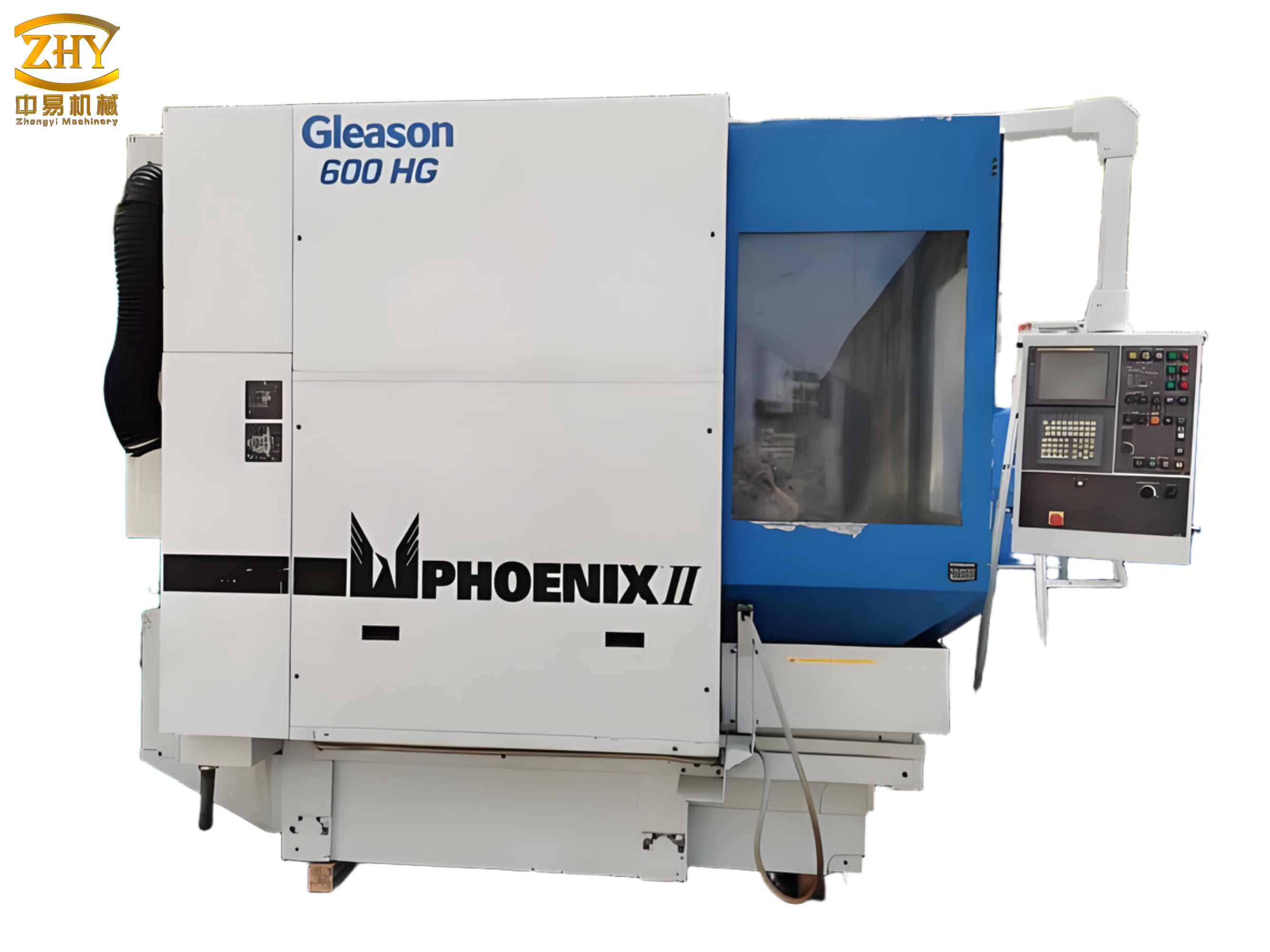
Online measurement systems are integral to modern gear grinding setups, as they provide real-time feedback for corrective actions. These systems typically use touch-trigger probes to capture coordinate points on the gear tooth groove, which are then processed to compensate for probe radius and misalignment. The compensation formula accounts for the probe radius \( r \) and the tangent angle \( \alpha \) at each measurement point \( (x, y) \), yielding the actual gear profile point \( (x’, y’) \) as:
$$ x’ = x + r \sin \alpha $$
$$ y’ = y – r \cos \alpha $$
This correction ensures that the fitted profile accurately represents the gear geometry, which is vital for preventing grinding cracks in gear profile grinding. Additionally, we often perform alignment corrections to center the gear relative to the grinding wheel. For a gear with \( Z \) teeth, the alignment correction for the rotational axis \( c \) is given by:
$$ -\frac{\pi}{Z} \leq c’ – n \cdot \frac{2\pi}{Z} \leq \frac{\pi}{Z} $$
where \( c’ \) is the corrected angle and \( n \) is an integer. This step homogenizes the data across multiple tooth grooves, facilitating consistent grinding operations and reducing variations that could lead to localized stress and grinding cracks.
Experimental validations of these methods have demonstrated significant improvements in gear grinding efficiency. In one study, we measured the shortest distance between the grinding wheel and gear tooth profile for different polynomial fits and compared them with actual contact points determined through manual trials. The results, summarized in the table below, show that a third-degree polynomial provides the closest agreement with real-world data, with deviations around 0.03 mm. This level of precision is sufficient for industrial applications, as it minimizes idle travel without risking collisions or excessive grinding forces that could cause grinding cracks.
| Tooth Groove ID | Calculated Distance (mm) for Degree 3 | Actual Distance (mm) | Absolute Deviation (mm) |
|---|---|---|---|
| 1 | 8.270 | 8.267 | 0.003 |
| 2 | 8.291 | 8.317 | 0.026 |
| 3 | 8.304 | 8.332 | 0.028 |
| 4 | 8.302 | 8.270 | 0.032 |
Furthermore, the integration of acoustic emission monitoring can complement online measurements by detecting initial wheel-workpiece contact. However, this method alone may not suffice for gear profile grinding due to the complex geometry and potential for false triggers. Instead, combining it with computational models enhances reliability. For instance, the grinding power \( P_g \) can be correlated with the material removal rate to infer contact conditions:
$$ P_g = F_g \cdot v_s = k \cdot a_p \cdot v_s^2 $$
where \( P_g \) is the grinding power. By monitoring power consumption and comparing it with thresholds derived from profile data, we can automate the grinding process to eliminate idle travel and prevent grinding cracks. This holistic approach is particularly beneficial in high-volume production environments where consistency is paramount.
Another critical aspect of gear grinding is the thermal management to avoid grinding cracks. The heat generated during grinding can lead to residual stresses and microstructural changes, especially in hardened steels commonly used for gears. The temperature rise \( \Delta T \) in the grinding zone can be estimated using a simplified model:
$$ \Delta T = \frac{q}{\rho c \sqrt{\alpha t}} $$
where \( q \) is the heat flux, \( \rho \) is the density, \( c \) is the specific heat, \( \alpha \) is the thermal diffusivity, and \( t \) is the time of exposure. In gear profile grinding, the confined spaces between teeth exacerbate heat accumulation, necessitating optimized cooling strategies. By aligning the grinding wheel’s engagement based on online measurements, we can reduce the number of passes and localized heating, thereby mitigating the risk of grinding cracks.
To quantify the benefits of these techniques, we conducted a series of tests on a CNC gear grinding machine equipped with an online measurement system. The setup involved grinding multiple gears while varying parameters such as wheel speed, depth of cut, and polynomial fit degree. The table below summarizes the observed reduction in idle travel time and incidence of grinding cracks, highlighting the effectiveness of precise profile modeling in gear profile grinding.
| Test Condition | Idle Travel Reduction (%) | Grinding Cracks Incidence (%) | Overall Efficiency Gain (%) |
|---|---|---|---|
| Baseline (No Measurement) | 0 | 12 | 0 |
| With Online Measurement | 15 | 5 | 18 |
| With Polynomial Fit (Degree 3) | 20 | 3 | 25 |
| With Integrated AE Monitoring | 18 | 4 | 22 |
These results underscore the importance of accurate profile fitting and real-time adjustments in minimizing non-productive time and enhancing product quality. In gear grinding, even small improvements in process efficiency can lead to substantial cost savings and longer component life. Moreover, the iterative nature of polynomial fitting allows for continuous refinement as more data becomes available, making it a powerful tool for adaptive manufacturing systems.
Looking ahead, advancements in machine learning and IoT could further revolutionize gear grinding by enabling predictive maintenance and dynamic optimization. For example, neural networks could be trained on historical data to predict the optimal starting point for grinding based on gear geometry and wheel wear. The loss function for such a model might be defined as:
$$ L = \frac{1}{N} \sum_{i=1}^{N} (d_{\text{pred}, i} – d_{\text{actual}, i})^2 $$
where \( d_{\text{pred}, i} \) and \( d_{\text{actual}, i} \) are the predicted and actual distances for the i-th sample. By integrating these AI-driven approaches with traditional gear profile grinding methods, we can achieve unprecedented levels of precision and reliability, ultimately reducing the occurrence of grinding cracks and extending the capabilities of modern manufacturing.
In conclusion, gear grinding is a sophisticated process that requires careful attention to detail to avoid defects like grinding cracks. Through the use of online measurement systems, polynomial fitting, and computational geometry, we can optimize gear profile grinding operations to eliminate idle travel and improve efficiency. The mathematical models and experimental data presented here demonstrate the viability of these approaches in industrial settings. As technology evolves, the integration of real-time monitoring and AI will continue to push the boundaries of what is possible in gear manufacturing, ensuring higher quality and productivity for years to come.