
In modern manufacturing, precision CNC gear grinding machines play a critical role in achieving high-accuracy gear profile grinding, which is essential for minimizing defects such as grinding cracks and ensuring optimal performance in automotive and aerospace applications. As an engineer specializing in CNC systems, I have extensively worked with Siemens 840Dsl controls to address challenges like following errors that compromise gear grinding quality. This article delves into the principles and practical implementation of following error compensation, leveraging torque feedforward control to enhance machining precision. Through detailed analysis, formulas, and tables, I will explain how to optimize parameters like position loop gain and compute gain, ultimately reducing contour deviations in gear grinding processes. The integration of servo optimization techniques, such as servo tracking and roundness testing, allows for significant improvements in dynamic response, directly impacting the prevention of grinding cracks and elevating the overall quality of gear profile grinding.
Gear grinding, particularly in precision applications like gear profile grinding, demands exceptional accuracy to avoid issues like grinding cracks that arise from thermal and mechanical stresses. In my experience, the Siemens 840Dsl system’s following error compensation功能 is pivotal for mitigating these problems. Following error, defined as the discrepancy between position setpoints and actual values, can lead to substantial contour deviations during multi-axis interpolation in gear grinding operations. For instance, in processes involving complex gear geometries, even minor errors can propagate into significant defects, including grinding cracks that compromise component integrity. By applying torque feedforward control, we can effectively reduce these errors without increasing position loop gain, which is often constrained by mechanical resonances. This approach not only enhances the precision of gear grinding but also contributes to longer tool life and reduced scrap rates.
The core of servo control in CNC systems revolves around the three-loop principle: current loop, speed loop, and position loop. In gear grinding applications, the position loop gain ($K_V$) directly influences the final execution accuracy, as it determines the system’s ability to follow commanded trajectories. The relationship between following error ($E$), velocity ($V$), and position loop gain is given by the formula: $$E = \frac{V}{K_V}$$ where $E$ is in millimeters and $V$ in meters per minute. This equation highlights that for a fixed $K_V$, higher velocities exacerbate following errors, which is particularly problematic in high-speed gear profile grinding where dynamic responses must be precise to prevent grinding cracks. To address this, torque feedforward control bypasses the speed controller, leveraging the faster response of the current loop. The equivalent time constants for the current loop ($MD32800$) and other parameters like jerk time ($MD32410$) play a crucial role in compute gain ($\text{Commanded-Kv}$), which is derived as: $$\text{Commanded-Kv} = \frac{0.06}{\text{MD32800} + \text{MD32410} + \text{MD32910} + \text{MD32895}}$$ Here, $\text{Commanded-Kv}$ represents the effective gain under feedforward conditions, and minimizing the denominator terms enhances compensation. In gear grinding, optimizing these parameters ensures that multi-axis interpolations, such as those between the grinding feed axis (Z) and workpiece rotation axis (C), maintain synchronized motion, reducing the risk of profile errors and grinding cracks.
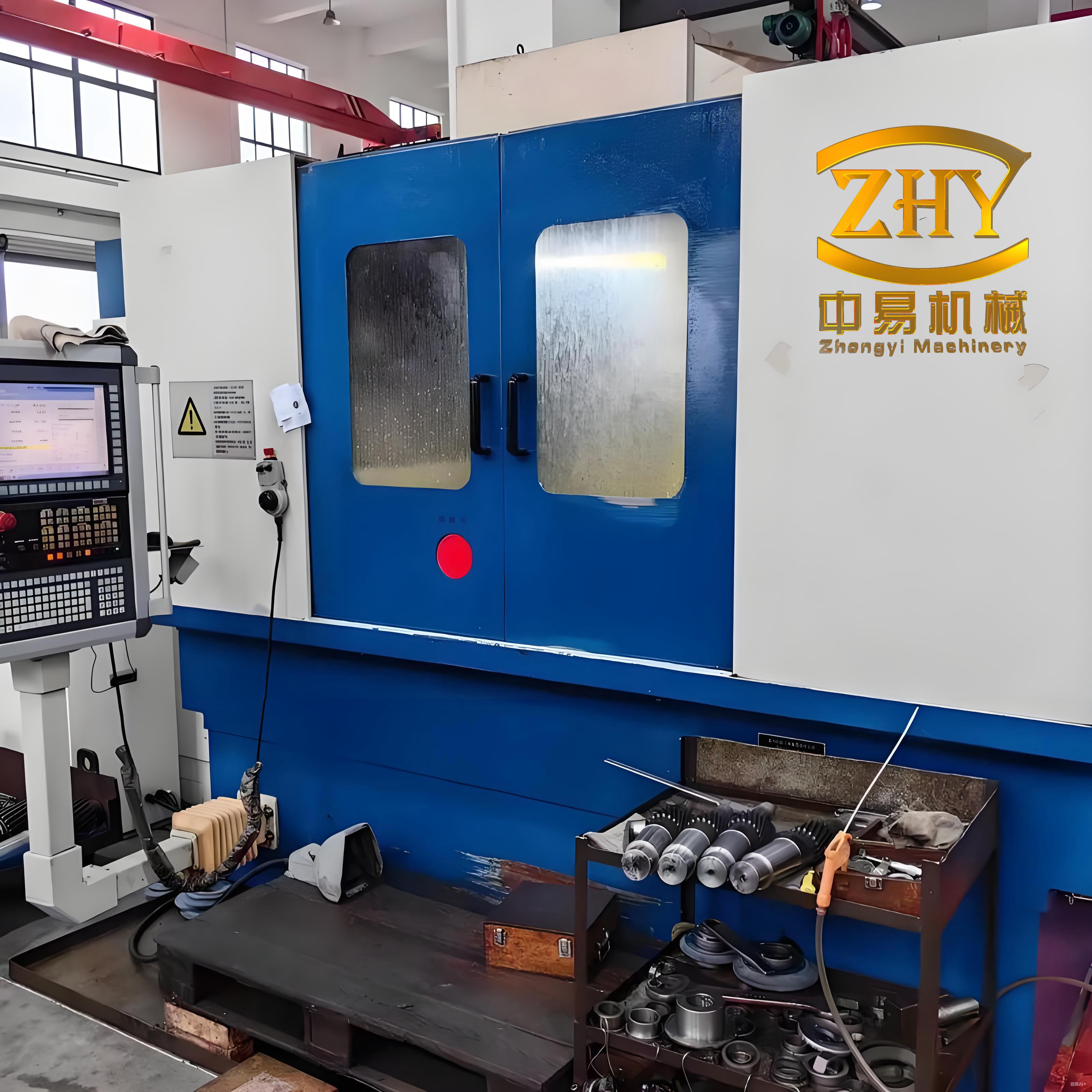
In practical terms, the adjustment of single-axis torque feedforward time constants is a foundational step for improving gear grinding accuracy. For example, in a typical CNC gear grinding machine, the Z-axis (grinding feed) and C-axis (workpiece rotation) require precise coordination to achieve smooth gear profile grinding without introducing grinding cracks. Through servo trajectory measurements, I have optimized the current loop equivalent time constant ($MD32800$) by analyzing step responses and positioning curves. For the Z-axis, $MD32800$ was set to 0.0006 s, while for the C-axis, it was 0.00005 s, based on empirical data from position setpoint versus actual value comparisons. This optimization reduces the following error by strengthening the torque feedforward effect, as a smaller $MD32800$ value increases the compute gain. The table below summarizes the initial and optimized parameters for these axes, illustrating how tailored adjustments lead to better dynamic performance in gear grinding operations.
| Parameter | Z-axis (Initial) | C-axis (Initial) | Z-axis (Optimized) | C-axis (Optimized) |
|---|---|---|---|---|
| $MD32200$ (Position Gain, 1000·min⁻¹) | 1.2 | 1.8 | 1.42 | 2.05 |
| $MD32431$ (Max Jerk, m/s³) | 2.5 | 0.08 | 3.0 | 0.1 |
| $MD32650$ (Axis Inertia, kg·m²) | 0.030 | 0.019 | 0.0325 | 0.0206 |
| $MD32800$ (Current Loop Time, s) | 0.0008 | 0.0001 | 0.0006 | 0.00005 |
| $MD32895$ (Desval Delay Time, s) | 0 | 0 | 0 | 0.00055 |
Following single-axis optimization, the focus shifts to multi-axis interpolation, where roundness testing becomes invaluable for assessing dynamic characteristics in gear profile grinding. In one instance, after applying torque feedforward, the initial roundness test for Z and C axes revealed an elliptical profile with an average radius of 50.00006 mm and a radius error ($\Delta R$) of 8.93824 μm. This indicated suboptimal interpolation, which could lead to uneven gear teeth and potential grinding cracks. To rectify this, I utilized the single-axis setpoint phase filter ($MD32895$) to balance the compute gains between axes. Given the difference in $MD32800$ values (0.00055 s), this was added to the C-axis’s $MD32895$, ensuring that the total time constants aligned for consistent following error compensation. The subsequent roundness test showed improved results, with an average radius of 50.00010 mm and $\Delta R$ reduced to 6.97083 μm. This enhancement directly contributes to more accurate gear profile grinding by minimizing contour deviations that often cause grinding cracks under high-stress conditions.
The compute gain concept is central to understanding how feedforward controls impact gear grinding precision. Under speed/torque feedforward, the compute gain ($\text{Commanded-Kv}$) is calculated using the formula mentioned earlier, which incorporates time constants from the current loop, jerk filter, dynamic response, and setpoint delay. For instance, in gear grinding applications, ensuring that all interpolating axes have identical summed time constants is crucial for uniform contouring. If one axis has a larger equivalent time, it can be compensated by adjusting $MD32895$, as demonstrated in the Z and C axis case. This approach prevents asymmetrical following errors that exacerbate issues like grinding cracks in delicate gear profiles. The relationship between compute gain and following error can be further expressed as: $$\text{Commanded-Kv} \propto \frac{1}{\sum \text{Time Constants}}$$ where a higher compute gain correlates with reduced following error, thereby improving the overall accuracy of gear grinding processes. In practice, this means that by fine-tuning parameters such as $MD32410$ (jerk time) and $MD32910$ (dynamic match time), engineers can achieve a balance that supports high-speed gear profile grinding without sacrificing precision.
Servo optimization tools, such as Sinumerik Operate’s servo tracking and roundness tests, are indispensable for validating parameter adjustments in gear grinding machines. During my work, I employed these tools to monitor position setpoints and actual values, identifying oscillations or delays that could lead to grinding cracks. For example, after setting $MD32800$ for the Z and C axes, servo tracking graphs revealed improved step responses with minimal overshoot, indicating stable torque feedforward. Additionally, roundness tests for other axes, like the W and Y axes involved in wheel dressing, were conducted to ensure holistic optimization. The table below provides a comparative analysis of roundness test results before and after applying following error compensation, highlighting the reduction in radius errors that is critical for preventing grinding cracks in gear profile grinding.
| Axis Pair | Initial $\Delta R$ (μm) | Optimized $\Delta R$ (μm) | Improvement (%) |
|---|---|---|---|
| Z and C | 8.93824 | 6.97083 | 22.0 |
| W and Y | 7.52110 | 5.89345 | 21.6 |
Another critical aspect in gear grinding is the management of thermal and mechanical loads that contribute to grinding cracks. By reducing following errors through compute gain optimization, the mechanical stresses on the gear teeth during profile grinding are minimized, thereby lowering the incidence of cracks. The torque feedforward control effectively compensates for dynamic lags, allowing for smoother transitions in curved paths common in gear profile grinding. For instance, the formula for following error under feedforward can be extended to include acceleration components: $$E = \frac{V}{K_V} + \frac{A}{K_A}$$ where $A$ is acceleration and $K_A$ is an acceleration-dependent gain term. Although this is a simplification, it underscores the importance of dynamic response in high-precision applications. In my implementations, ensuring that $MD32410$ (jerk time) is minimized for all axes has led to more aggressive yet stable motions, essential for complex gear geometries where sudden direction changes could induce grinding cracks.
In conclusion, the application of following error compensation in Siemens 840Dsl systems has proven highly effective for enhancing the accuracy of CNC gear grinding machines. Through systematic parameter optimization, including torque feedforward time constants and compute gain adjustments, I have achieved significant reductions in contour deviations and grinding cracks. The use of roundness testing and servo tracking provides a reliable framework for continuous improvement in gear profile grinding processes. As manufacturing demands evolve, these strategies will remain vital for achieving the tight tolerances required in advanced gear applications, ensuring that gear grinding operations deliver consistent, high-quality results without compromising on precision or reliability.