
In the machining industry, many CNC machines suffer from outdated mechanical structures and aging control systems, leading to inefficiencies and poor precision that fail to meet modern production demands. As production scales expand, the need for high-precision CNC equipment grows. Upgrading older CNC machines with新一代 systems not only reduces procurement costs but also saves time, aligning with national manufacturing development goals. I will discuss the实践 of upgrading a German NILES ZP08 gear profile grinding machine, which had been in high-load operation for over 20 years, from its obsolete D300 CNC system to the domestically mainstream Siemens 840D sl CNC system. This upgrade focused on electrical control enhancements, mechanical accuracy restoration, and the development of custom grinding software packages, ultimately improving加工精度 and reducing failure rates. Through this project, I verified the feasibility of retrofitting old imported equipment, providing a reference for similar technical upgrades in related enterprises. The成功 of this initiative offers new insights for modernizing aging systems in China while lowering operational costs.
The original NILES ZP08 gear profile grinding machine, installed in 2001, was equipped with a D300 CNC system and Rexroth drive components. After decades of intensive use, the machine exhibited severe aging in wiring and electrical elements, resulting in frequent failures such as drive board capacitor breakdowns, column vibrations, PLC program losses, memory card issues, screen failures, and inability to load programs. Additionally, spare parts for the electrical components were discontinued, making repairs and procurement challenging. The machine’s downtime far exceeded its operational time, severely impacting production. The outdated D300 system had weak computational capabilities and slow response times, causing delays in gear grinding, measurement, and inspection functions compared to modern machines with Siemens 840D sl systems. This situation underscored the urgency for an upgrade to enhance gear grinding efficiency and address grinding cracks issues common in high-precision applications.
The upgrade plan centered on two main aspects: electrical control improvements and mechanical accuracy restoration. For the electrical part, I replaced the CNC system with Siemens 840D sl, which offers high configuration, fast response, and superior anti-interference capabilities compared to analog servo systems. This system is widely used by leading machine tool manufacturers globally and has ample spare parts availability in China. I integrated a Siemens S7-300 PLC for peripheral device control and developed custom software packages based on the new CNC system to enable users to select appropriate gear grinding processes based on production needs. The mechanical accuracy restoration involved inspecting and rehabilitating the precision of various axes affecting machining accuracy, along with repairing peripheral auxiliary equipment. Key components like the worktable, column, and spindle slide were equipped with high-precision hydrostatic guides, and the grinding wheel spindle and dressing wheel spindle were fitted with new high-precision bearings to ensure axial and radial errors below 0.002 mm. Hydraulic, pneumatic, filtration, and cooling systems were thoroughly checked, with damaged parts replaced or repaired to ensure normal operation.
In the mechanical accuracy detection and restoration phase, I conducted comprehensive inspections to ensure the machine could grind DIN6-level gears. The hydrostatic guide surfaces were in good condition, allowing for precision recovery. I replaced the grinding wheel spindle and dressing wheel spindle with new high-precision bearings, confirming that axial and radial errors were minimized. The following table summarizes the key mechanical inspections and actions taken:
| Component | Inspection Result | Restoration Action |
|---|---|---|
| Worktable Hydrostatic Guide | Surface intact, minor wear | Adjusted pressure and clearance |
| Column Guide | Good condition, no damage | Cleaned and lubricated |
| Grinding Wheel Spindle | Radial error: 0.003 mm | Replaced with new bearings (error < 0.002 mm) |
| Dressing Wheel Spindle | Axial error: 0.004 mm | Replaced with new bearings (error < 0.002 mm) |
| Hydraulic System | Leaks detected | Replaced seals and hoses |
For the CNC system upgrade, I selected Siemens 840D sl for its enhanced performance and compatibility. I redefined the machine’s CNC axes as follows: A-axis for rotary table rotation, B-axis for grinding head rotation, X-axis for vertical linear movement of the stroke slide parallel to the work axis, Y-axis for horizontal linear movement of the column, Z-axis for linear movement of the grinding spindle parallel to the main axis, W-axis for linear movement of the grinding spindle in the parallel direction, U-axis for vertical linear movement of the dressing spindle perpendicular to the grinding spindle, C-axis for the grinding wheel spindle, and CA-axis for the dressing wheel spindle. The X, Y, A, B, U, W, and KA axis motors were replaced with 1FT7 series servo motors, and the C-axis grinding wheel spindle motor was upgraded to a TSE200G imported water-cooled spindle motor with an encoder. New connection flanges were fabricated to ensure reliable coupling between servo motors and machine components. Additionally, the grinding wheel spindle was equipped with a new DITTEL built-in balancing head matched with M5000 parameters to maintain balance vibration speed below 2 μm/s, reducing the risk of grinding cracks. The drive system was replaced with Siemens SINAMICS S120 digital servo control units, and the electrical cabinet was reconfigured to house SINAMICS 120S drive modules, circuit breakers, contactors, relays, fuses, transformers, and safety integration relays. An IPC427E industrial embedded PC was used for the operator panel, with OP015A and MCP 483CPN panels and an HHU handwheel.
The electrical transformation involved rewiring the machine’s signal lines, including pressure sensors, temperature sensors, and limit switches, and connecting them to I/O interface modules to save control circuit cables. I programmed the PLC control program to achieve bus control and maintained the original machine’s operation logic, such as lighting and hydraulic switches, to facilitate operator familiarity. The table below outlines the key electrical components upgraded:
| Component Type | Original Specification | Upgraded Specification |
|---|---|---|
| CNC System | D300 | Siemens 840D sl |
| Drive System | Rexroth Analog | Siemens SINAMICS S120 Digital |
| Servo Motors | Obsolete Models | 1FT7 Series |
| Grinding Spindle Motor | Aging Water-Cooled | TSE200G with Encoder |
| Control Panel | Proprietary | OP015A and MCP 483CPN |
A critical part of the upgrade was the development of a custom grinding software package based on Siemens 840D sl. This package features a graphical human-machine interface and integrates functions for automatic programming, processing, residual measurement, allowance distribution calculation, alignment, automatic tooth surface modification, and online measurement for cylindrical spur and helical external gears. The software decomposes the gear grinding process into “function-motion-action” logic, where grinding is the top-level function composed of motions like spindle rotation and feed movements. The parameter input module allows operators to enter gear parameters, such as tooth number, module, base tangent length, tooth tip and root treatment, and tooth profile and lead modifications. For instance, the tooth profile modification can be defined using mathematical equations to prevent grinding cracks and ensure precision. The basic formula for tooth profile deviation in gear grinding can be expressed as: $$ \Delta P = k \cdot \frac{F}{E} $$ where $\Delta P$ is the profile deviation, $k$ is a material constant, $F$ is the grinding force, and $E$ is the modulus of elasticity. This helps in optimizing parameters to minimize errors.
The grinding process module includes operations such as gear probe positioning, alignment, layered gear measurement at the tooth tip and root, and measurement of the upper and lower end face positions. After alignment, the system automatically enters the grinding cycle based on the measured residual amount. In the grinding cycle, operators can set the grinding of one or more tooth grooves or扇形 regions. For parts weighing over 100 kg that are difficult to manually transport for inspection, the online measurement system (GMS module) immediately checks the effect of the demonstration tooth groove and makes subsequent corrections. The software supports automatic grinding mode or single-module mode and includes preset grinding parameter templates verified through multiple trials to achieve burn-free gear grinding. The tooth surface modification features graphical illustrations of profile and lead modifications, precise calculation of transition curves at the tooth tip and root, and preview functions. For parts requiring three-section specifications, the GRD topology modification strategy is used to suppress distortions caused by lead modifications, ensuring good tooth contact areas for paired gears. The grinding interface displays gear parameters, spindle instantaneous current, current grinding time, allowance distribution, wheel parameters, and wheel wear. Operators can monitor hydraulic and pneumatic pressures and flows in real-time, with customizable pressure limits. The wheel management function monitors the grinding state, enables automatic wheel identification and shape switching with automatic dressing, and includes traction or push dressing with a maximum feed of 0.1 mm per dress and wheel corner compensation. Data editing covers user data, machine data, processing data, NC data, gear measurement data, and tooth surface modification data, with HPGALP2 probe automatic tooth alignment. The online gear inspection function includes scanning-type measurement to reduce transfer time between dedicated gear testers and the grinding machine, improving efficiency. Additional features include automatic machine warm-up, program management, file management, and a tooth surface modification editor, all designed to reduce familiarization time.
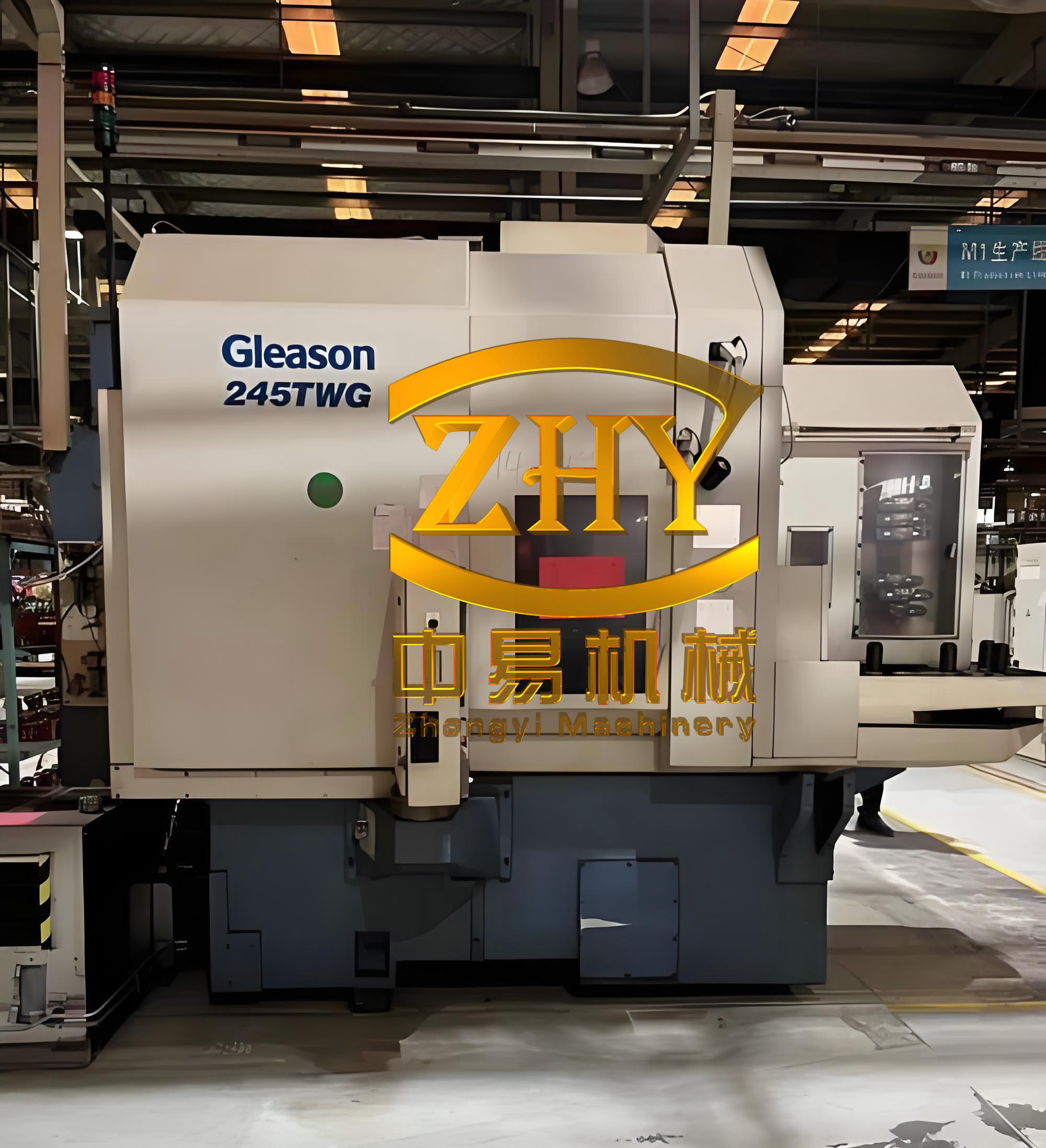
To address grinding cracks, which are a common issue in gear profile grinding, the software incorporates real-time monitoring and adjustment of grinding parameters. The risk of grinding cracks can be modeled using the formula: $$ C_r = \alpha \cdot T \cdot v_s $$ where $C_r$ is the crack risk factor, $\alpha$ is a thermal sensitivity coefficient, $T$ is the grinding temperature, and $v_s$ is the wheel speed. By optimizing these parameters, the system minimizes thermal damage. The image below illustrates typical grinding cracks that can occur if parameters are not controlled properly, emphasizing the importance of this upgrade in preventing such defects.
After completing the CNC system upgrade and mechanical accuracy restoration, I tested the machine by grinding sample workpieces. The results showed significant improvements in accuracy, efficiency, and reliability. For a gear with module 8, 28 teeth, pressure angle 20°, helix angle 25°, and width 100 mm, the accuracy achieved DIN4 level, with consistent dimensions and no out-of-tolerance issues, even with tight tolerances of 0.005 mm. In terms of efficiency, the grinding time for a specific product reduced from 8 hours to 6 hours post-upgrade. The failure rate dropped dramatically; the upgraded CNC system operated stably for nearly six months with zero downtime due to system faults. The custom grinding software package also performed flawlessly, enabling seamless gear grinding operations. The table below summarizes the performance comparison before and after the upgrade:
| Metric | Before Upgrade | After Upgrade |
|---|---|---|
| Grinding Accuracy | DIN6 | DIN4 |
| Grinding Time for Sample Product | 8 hours | 6 hours |
| CNC System Downtime | Frequent failures | Zero in 6 months |
| Wheel Life | Short due to imbalances | Extended with automatic dressing |
The success of this gear profile grinding machine upgrade demonstrates the viability of retrofitting aging equipment with modern systems. By focusing on electrical control, mechanical precision, and software optimization, I achieved enhanced gear grinding capabilities, reduced grinding cracks risks, and lower operational costs. Compared to purchasing a new NILES ZP20 grinding machine, this project saved approximately 5 million RMB and 8 months of time. It not only improved product quality and efficiency but also extended the residual value of the old machine. This approach provides a replicable model for similar upgrades in the industry, promoting sustainable manufacturing practices. Future work could explore further integrations of AI for predictive maintenance in gear grinding processes to continually minimize defects and maximize productivity.