
In mechanical engineering, spur gears are widely used in various transmission systems due to their simplicity and efficiency. However, the dynamic behavior of spur gears is often influenced by nonlinear factors such as backlash and excitation frequency, which can lead to complex phenomena like bifurcation and chaos. Understanding these nonlinear characteristics is crucial for designing reliable gear systems. In this study, we investigate the nonlinear dynamics of a single-stage spur gear transmission system by considering longitudinal and torsional displacements. We establish a coupled nonlinear dynamic model using the lumped mass method and derive the corresponding equations of motion. By employing numerical methods, such as the ode45 function, we solve the state equations and analyze the system’s behavior through bifurcation diagrams and Lyapunov exponents. Our focus is on how excitation frequency and backlash affect the dynamic response, particularly in terms of periodic and chaotic motions. The findings provide theoretical insights for selecting operational parameters and designing gear systems to minimize undesirable vibrations.
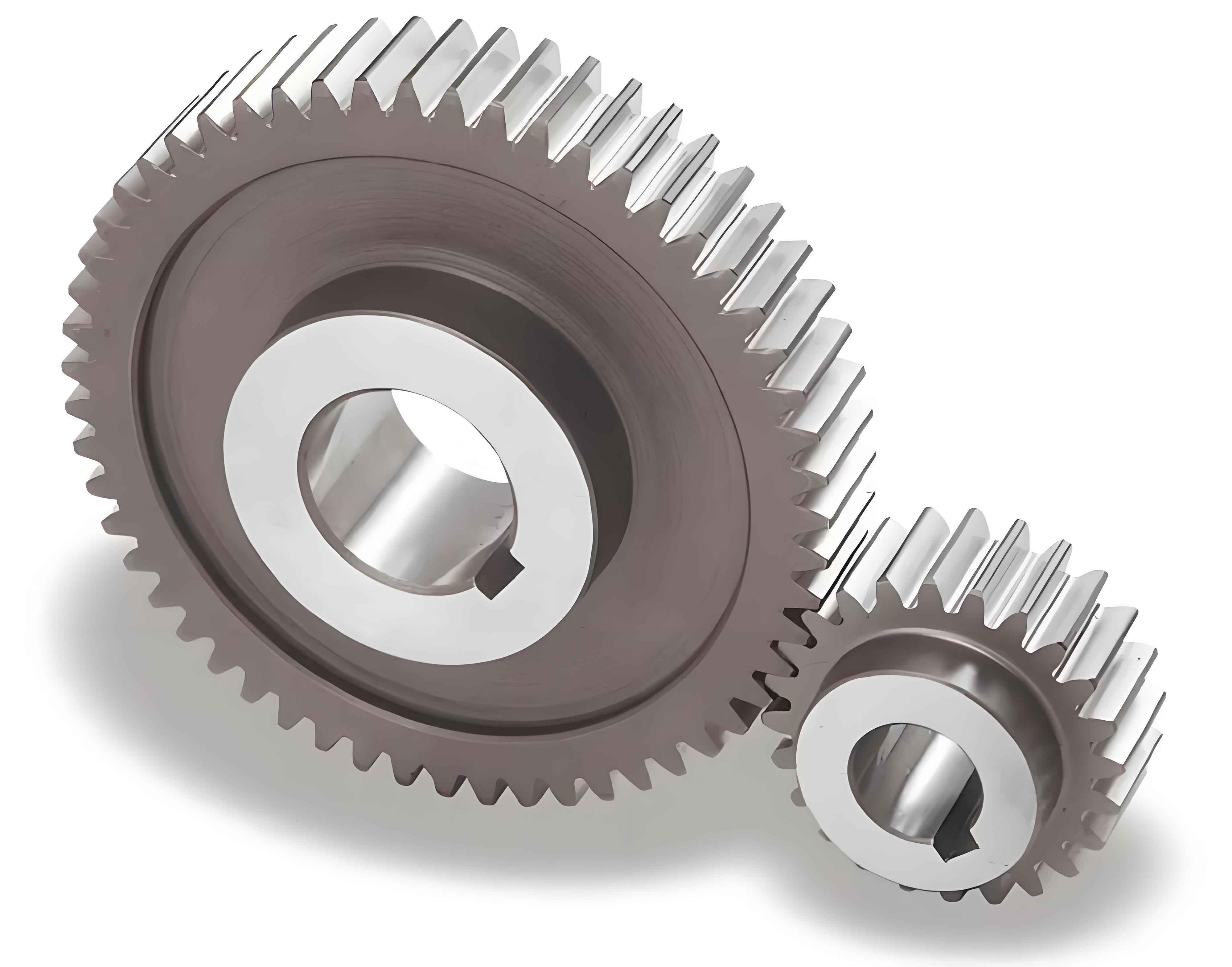
Spur gears are fundamental components in many mechanical systems, and their dynamic performance can be significantly impacted by nonlinearities. Previous research has highlighted the importance of factors like time-varying mesh stiffness and damping, but a comprehensive analysis using Lyapunov exponents for spur gears remains limited. In our work, we build upon existing models by incorporating multiple degrees of freedom to capture the essence of real-world spur gear behavior. The nonlinearities arising from backlash and excitation frequency are particularly critical, as they can induce instabilities that reduce the lifespan of spur gears. Through this study, we aim to bridge gaps in the literature by providing a detailed examination of how these parameters influence the transition between periodic and chaotic states in spur gear systems.
To model the spur gear system, we consider a three-degree-of-freedom approach that accounts for torsional vibrations and longitudinal displacements of the supporting structures. The equations of motion are derived based on Newton’s second law, leading to a set of nonlinear differential equations. The key parameters include masses, moments of inertia, damping coefficients, and stiffness values, which are summarized in the table below for clarity.
| Parameter | Symbol | Value |
|---|---|---|
| Mass of driving gear | $$m_{g1}$$ | Calculated based on geometry |
| Mass of driven gear | $$m_{g2}$$ | Calculated based on geometry |
| Moment of inertia (driving) | $$I_{g1}$$ | Derived from gear design |
| Moment of inertia (driven) | $$I_{g2}$$ | Derived from gear design |
| Base circle radius (driving) | $$r_{g1}$$ | From gear specifications |
| Base circle radius (driven) | $$r_{g2}$$ | From gear specifications |
| Mesh damping coefficient | $$c_h$$ | Assumed based on empirical data |
| Backlash | $$b$$ | Variable parameter |
| Excitation frequency | $$\omega_h$$ | Variable parameter |
The governing equations for the spur gear system are expressed as follows. First, the nonlinear functions account for backlash and displacement effects. For the bearings, the nonlinear displacement function is defined as:
$$ f_{b_i}(y_{g_i}) = \begin{cases}
y_{g_i} – b_i & \text{if } y_{g_i} > b_i \\
0 & \text{if } -b_i \leq y_{g_i} \leq b_i \\
y_{g_i} + b_i & \text{if } y_{g_i} < -b_i
\end{cases} $$
where $$i = 1, 2$$ for the driving and driven gears, respectively. Similarly, for the gear mesh, the nonlinear function is:
$$ f_h(p) = \begin{cases}
p – b & \text{if } p > b \\
0 & \text{if } -b \leq p \leq b \\
p + b & \text{if } p < -b
\end{cases} $$
Here, $$p$$ represents the relative torsional displacement between the gears, given by $$p = r_{g1} \theta_{g1} – r_{g2} \theta_{g2}$$. The equations of motion incorporate these nonlinearities and are written in dimensional form as:
$$ m_{g1} \ddot{y}_{g1} + c_{b1} \dot{y}_{g1} + c_h (\dot{x} – \dot{y}_{g1} + \dot{y}_{g2} – \dot{e}) + k_{b1} f_{b1}(y_{g1}) + k_h f_h(x – y_{g1} + y_{g2} – e) = F_{b1} $$
$$ m_{g2} \ddot{y}_{g2} + c_{b2} \dot{y}_{g2} – c_h (\dot{x} – \dot{y}_{g1} + \dot{y}_{g2} – \dot{e}) + k_{b2} f_{b2}(y_{g2}) – k_h f_h(x – y_{g1} + y_{g2} – e) = F_{b2} $$
$$ m_c \ddot{x} + c_h (\dot{x} – \dot{y}_{g1} + \dot{y}_{g2} – \dot{e}) + k_h f_h(x – y_{g1} + y_{g2} – e) = F_m + F_{aT} $$
In these equations, $$m_c$$ is the equivalent mass of the gear pair, calculated as $$m_c = \frac{I_{g1} I_{g2}}{I_{g1} r_{g2}^2 + I_{g2} r_{g1}^2}$$. The time-varying mesh stiffness $$k_h(\tau)$$ is modeled as a periodic function:
$$ k_h(\tau) = k_{hm} + \sum_{r=1}^{\infty} k_{har} \cos(r \omega_h \tau + \phi_{hr}) $$
where $$k_{hm}$$ is the average mesh stiffness, $$k_{har}$$ are harmonic coefficients, $$\omega_h$$ is the excitation frequency, and $$\phi_{hr}$$ are phase angles. The excitation functions, such as the gear error $$e(\tau)$$ and torque fluctuation $$F_{aT}(\tau)$$, are simplified to sinusoidal forms for analysis.
To normalize the equations, we introduce dimensionless variables and parameters. Let $$z_1 = y_{g1}$$, $$z_2 = \dot{y}_{g1}$$, $$z_3 = y_{g2}$$, $$z_4 = \dot{y}_{g2}$$, $$z_5 = p$$, and $$z_6 = \dot{p}$$. The dimensionless time $$t$$ is defined based on a reference frequency. This leads to the state-space representation:
$$ \dot{z}_1 = z_2 $$
$$ \dot{z}_2 = -2\zeta_{11} z_2 – 2\zeta_{13} z_6 – k_{11} z_1 – k_{13}(t) f_h(z_5) + F’_{b1} $$
$$ \dot{z}_3 = z_4 $$
$$ \dot{z}_4 = -2\zeta_{22} z_4 + 2\zeta_{23} z_6 – k_{22} z_3 + k_{23}(t) f_h(z_5) + F’_{b2} $$
$$ \dot{z}_5 = z_6 $$
$$ \dot{z}_6 = -2\zeta_{33} z_6 – k_{33}(t) f_h(z_5) + F’_m + F’_{aT}(t) $$
Here, $$\zeta_{ij}$$ are dimensionless damping ratios, and $$k_{ij}(t)$$ are dimensionless stiffness functions. The dimensionless loads $$F’_{b1}$$, $$F’_{b2}$$, $$F’_m$$, and $$F’_{aT}(t)$$ are derived from the original forces. This normalized system allows for numerical analysis using tools like the ode45 solver in MATLAB, which we employ to compute solutions and generate dynamic responses.
In our analysis of spur gears, we first examine the effect of excitation frequency on the system’s nonlinear dynamics. The excitation frequency $$\omega$$ is varied over the range [2.2, 3.1], while other parameters are held constant. The bifurcation diagram and Lyapunov exponent plot reveal distinct regions of behavior. For lower frequencies, such as $$\omega < 2.35$$, the system exhibits stable periodic motion, characterized by a negative largest Lyapunov exponent (LLE). As $$\omega$$ increases, the system undergoes a bifurcation into chaotic motion, indicated by a positive LLE. Further increases lead to periodic windows, such as a 4-period motion, before returning to stable periodic motion at higher frequencies. This transition is summarized in the table below.
| Frequency Range | Dynamic State | LLE Sign |
|---|---|---|
| 2.2 < $$\omega$$ < 2.35 | Stable periodic motion | Negative |
| 2.35 < $$\omega$$ < 2.54 | Chaotic motion | Positive |
| 2.54 < $$\omega$$ < 2.645 | 4-period motion | Negative |
| 2.645 < $$\omega$$ < 2.72 | 2-period motion | Negative |
| $$\omega$$ > 2.72 | Stable periodic motion | Negative |
To illustrate, at $$\omega = 2.3$$, the time history shows a constant-amplitude periodic curve, the phase portrait is a closed loop, the Poincaré map consists of a single point set, and the frequency spectrum has a dominant peak—all indicators of periodic motion. In contrast, at $$\omega = 2.52$$, the time history is aperiodic, the phase portrait is filled with irregular trajectories, the Poincaré map is a scattered point set, and the spectrum has multiple harmonics, confirming chaos. This behavior underscores the sensitivity of spur gears to excitation frequency variations.
Next, we investigate the influence of backlash on the spur gear system. Backlash $$b$$ is varied between 0.06 and 0.075, with the excitation fixed at $$\omega = 2.3$$. The bifurcation diagram and LLE plot show that small changes in backlash can trigger significant dynamic changes. For $$b < 0.06125$$, the system is in stable periodic motion with a negative LLE. As backlash increases, the system enters chaos through a crisis, followed by a period-doubling bifurcation into 4-period motion. At higher backlash values, intermittent chaotic windows appear, with the LLE alternating between positive and negative values. The table below summarizes these findings.
| Backlash Range | Dynamic State | LLE Sign |
|---|---|---|
| 0.06 < $$b$$ < 0.06125 | Stable periodic motion | Negative |
| 0.06125 < $$b$$ < 0.064 | Chaotic motion | Positive |
| 0.064 < $$b$$ < 0.07245 | 4-period motion | Negative |
| 0.07245 < $$b$$ < 0.075 | Intermittent chaos | Alternating |
For example, at $$b = 0.059$$, the time history is periodic, the phase portrait is elliptical, the Poincaré map is a point set, and the spectrum has a single peak. At $$b = 0.063$$, chaos is evident from the aperiodic time history, complex phase portrait, fractal Poincaré map, and broad spectrum. This highlights the critical role of backlash in inducing nonlinear effects in spur gears.
The Lyapunov exponent serves as a reliable tool for quantifying the stability of spur gear systems. The largest Lyapunov exponent (LLE) is computed numerically from the state equations. A negative LLE indicates periodic or quasi-periodic motion, while a positive LLE signifies chaos. In our study, the LLE calculations align with the bifurcation diagrams, providing a clear metric for dynamic transitions. For instance, in the excitation frequency analysis, the LLE changes from negative to positive and back to negative, correlating with the onset and termination of chaos. Similarly, for backlash, the LLE’s alternation reflects the system’s instability in chaotic regions.
In discussion, we emphasize that the nonlinear dynamics of spur gears are highly dependent on system parameters. The excitation frequency can drive the system through a series of bifurcations, ultimately affecting noise and vibration levels. Backlash, as a design parameter, requires careful selection to avoid chaotic zones that could lead to premature failure. Our results suggest that operating spur gears at frequencies outside the chaotic ranges or with minimized backlash can enhance performance and durability. Additionally, the use of Lyapunov exponents offers a practical approach for monitoring and controlling gear systems in real-time applications.
In conclusion, our investigation into the nonlinear characteristics of spur gears reveals that both excitation frequency and backlash play pivotal roles in determining dynamic behavior. Through numerical simulations and Lyapunov exponent analysis, we identify specific parameter ranges where the system transitions between periodic and chaotic states. These insights can guide the design and operation of spur gear systems, helping to optimize performance and reduce the risk of dynamic instabilities. Future work could explore additional nonlinearities, such as friction and wear, to further improve the predictive capabilities for spur gears in complex mechanical systems.