
In the cold precision forging process of spur gears, the mold undergoes significant elastic deformation due to high forming loads, which adversely affects the dimensional accuracy of the forged gears. To address this issue, we designed steel billets with varying pressure relief hole diameters based on the radial shunt method. We established a finite element model to analyze billet plastic forming and mold stress, investigating how different pressure relief hole diameters influence mold elastic deformation. Additionally, we applied an inverse compensation method to modify the tooth profile curve of the mold based on elastic deformation measurements and compared the deformation of forgings before and after modification. Our findings indicate that optimizing the pressure relief hole diameter can minimize elastic deformation, thereby enhancing the precision of spur gears in cold forging applications.
Spur gears are critical components in automotive transmissions, and their dimensional accuracy, surface quality, and mechanical properties significantly impact transmission performance. In plastic forming processes, factors such as billet material properties and mold elasticity affect gear precision. Previous studies have highlighted that mold elastic deformation leads to dimensional inaccuracies in forged parts. For instance, in closed-die forging, high loads cause mold expansion, resulting in deviations from the intended gear geometry. This study focuses on reducing forming loads and mold stress through the radial shunt method, which incorporates pressure relief holes in billets to facilitate metal flow and decrease resistance during forging.
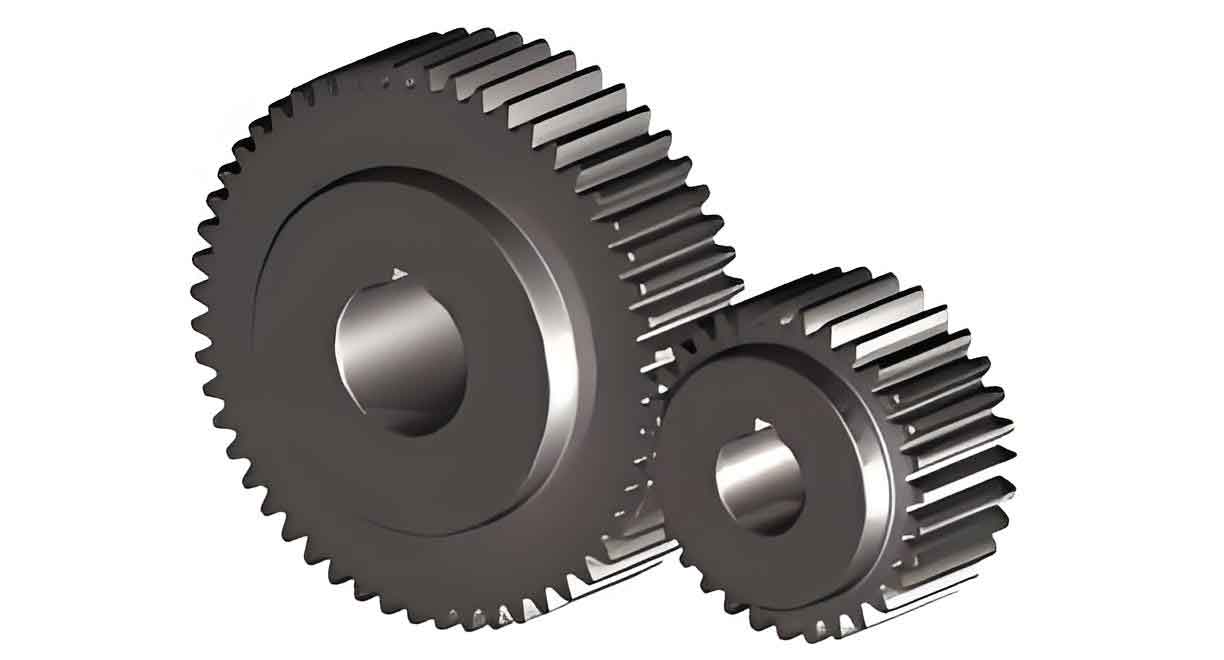
We designed billets with pressure relief hole diameters (d₀) of Φ0 mm, Φ5 mm, Φ10 mm, Φ15 mm, and Φ20 mm, corresponding to billet heights (h₀) of 12.2025 mm, 12.2736 mm, 12.5030 mm, 12.9002 mm, and 13.5005 mm, respectively. The spur gear model had a module of 3 mm, 24 teeth, a pressure angle of 20°, a face width of 10 mm, an addendum circle diameter of Φ78 mm, and a dedendum circle diameter of Φ64.5 mm. The billets were modeled in SolidWorks and imported into DEFORM-3D for finite element analysis. The billet material was 20CrMnTiH steel, with a yield strength of 835 MPa, while the mold material was H13 steel, with an elastic modulus of 2.10 × 10⁵ MPa and a Poisson’s ratio of 0.30. The simulation involved two steps: first, plastic forming of the billet with rigid molds, and second, stress analysis of the elastic molds using interpolated forces from the forging step. Friction was modeled as shear friction with a coefficient of 0.14, and the punch speed was set to 10 mm/s.
The finite element model for spur gear forging consisted of the billet and mold assembly, with mesh sizes of 80,000 for the billet and 60,000 for the mold. Volume compensation was enabled to account for material flow. The simulation step size was set to one-third of the minimum mesh edge length to ensure accuracy. In the stress analysis phase, boundary conditions included fixing the punch’s top surface and the die’s bottom surface in the Z-direction to prevent displacement. The forming loads from the forging simulation were mapped onto the mold using interpolation with a tolerance value to ensure precise force application.
The results of the forming load analysis for different pressure relief hole diameters are summarized in Table 1. The load-stroke curves exhibited three distinct phases: initial rapid increase due to direct contact between billet and mold, gradual rise during metal flow into the tooth cavity, and a sharp increase at the final stage due to high hydrostatic pressure. The maximum forming loads varied with d₀, showing a trend of initial increase followed by decrease.
| Pressure Relief Hole Diameter d₀ (mm) | Maximum Forming Load (kN) |
|---|---|
| Φ0 | 8589 |
| Φ5 | 8689 |
| Φ10 | 8551 |
| Φ15 | 8484 |
| Φ20 | 8217 |
The equivalent stress distribution on the mold was analyzed for each d₀. The stresses were uniformly distributed circumferentially but varied along the tooth width, with maximum stresses concentrated at the tooth tips. The maximum equivalent stress values followed a similar pattern to the forming loads, peaking at d₀ = Φ5 mm and reaching a minimum at d₀ = Φ20 mm. This relationship can be expressed using the von Mises stress formula: $$ \sigma_{v} = \sqrt{\frac{1}{2}\left[(\sigma_{1} – \sigma_{2})^2 + (\sigma_{2} – \sigma_{3})^2 + (\sigma_{3} – \sigma_{1})^2\right]} $$ where σ₁, σ₂, and σ₃ are the principal stresses. The stress distribution highlights the critical areas prone to elastic deformation in spur gear molds.
To quantify elastic deformation, we divided the mold cavity into upper, middle, and lower profile planes and tracked displacement at 18 points along a single tooth profile from the root to the adjacent root. The elastic deformation displacement curves for each plane are shown in Table 2. The deformation increased from the tooth root to the tip, with peaks at the addendum. The upper profile plane exhibited the highest deformation, with steep increases, while the middle and lower planes showed more gradual changes.
| Profile Plane | d₀ = Φ0 mm (mm) | d₀ = Φ5 mm (mm) | d₀ = Φ10 mm (mm) | d₀ = Φ15 mm (mm) | d₀ = Φ20 mm (mm) |
|---|---|---|---|---|---|
| Upper | 0.591 | 0.640 | 0.587 | 0.533 | 0.486 |
| Middle | 0.374 | 0.406 | 0.367 | 0.330 | 0.311 |
| Lower | 0.378 | 0.406 | 0.371 | 0.327 | 0.313 |
The elastic deformation behavior can be modeled using Hooke’s law for isotropic materials: $$ \delta = \frac{\sigma \cdot L}{E} $$ where δ is the deformation, σ is the applied stress, L is the characteristic length, and E is the elastic modulus. However, for complex geometries like spur gears, finite element analysis provides more accurate results. The deformation non-uniformity arises from the varying contact pressures during forging, with higher pressures at the tooth tips due to metal flow constraints.
Based on the deformation data, we applied the inverse compensation method to modify the tooth profile curve of the mold. This method involves extracting the original coordinates of the mold cavity, adding the negative of the deformation displacement to each point, and reconstructing the profile. The modified tooth cavity surface was generated by sweeping the compensated curve and arraying it to form the complete cavity. After modification, we simulated the forging process again and measured the elastic deformation of the forgings. For d₀ = Φ20 mm, the deformation on the middle profile plane decreased from 0.220 mm to 0.160 mm, a reduction of 28.6%. This demonstrates that mold compensation effectively improves the dimensional accuracy of spur gears.
To validate the simulation results, we conducted experiments using a four-column hydraulic press with billets of d₀ = Φ0 mm, Φ10 mm, and Φ20 mm. The forged spur gears were measured using a coordinate measuring machine, and the deformation values were compared to standard involute profiles. The experimental results showed that as d₀ increased, the elastic deformation of the forgings decreased, consistent with the simulations. Specifically, for d₀ = Φ0 mm, deformation was 0.376 mm; for d₀ = Φ10 mm, 0.312 mm; and for d₀ = Φ20 mm, 0.220 mm. This correlation confirms the reliability of our finite element model and the effectiveness of optimizing pressure relief hole diameter.
In conclusion, our study on cold precision forging of spur gears reveals that the diameter of pressure relief holes significantly influences mold elastic deformation. As d₀ increases, deformation initially rises and then decreases, with minimal deformation at d₀ = Φ20 mm. The deformation is non-uniform across the mold cavity, being highest at the upper plane and tooth tips. Applying inverse compensation to the mold profile reduces forging deformation by 28.6%, enhancing gear precision. Experimental results align with simulations, validating the approach. Future work could explore other geometric parameters or materials to further optimize the forging process for spur gears.
The implications of this research extend to industrial applications, where controlling mold elasticity can lead to higher-quality spur gears with tighter tolerances. By integrating finite element analysis with practical modifications, manufacturers can achieve better performance in automotive transmissions and other machinery reliant on precision spur gears.