
In modern manufacturing, the milling of spur gears using multi-axis machining centers has gained prominence due to its flexibility and applicability in rapid prototyping, large-scale gear production, and gear repair. Accurately predicting the cutter-workpiece engagement (CWE) is crucial for optimizing cutting parameters, minimizing tool wear, and ensuring high surface quality. This paper presents a comprehensive simulation method based on solid modeling to analyze the instantaneous CWE boundaries in ball-end milling of spur gears. We develop a kinematic model to describe the relative motion between the cutter and gear, derive the mathematical representation of the gear tooth profile, and implement a tool path planning strategy using the constant scallop height method. Through Boolean operations between the tool swept volume and the workpiece, we update the in-process workpiece model and extract the CWE based on spherical geometry. The engagement angles are calculated by slicing the CWE surfaces with planes parallel to the tool axis. Validation through milling experiments confirms the accuracy and effectiveness of our approach, providing a foundation for further research in cutting force prediction and tool wear analysis for spur gears.
The kinematics of spur gear milling involves defining coordinate systems to precisely capture the relative positions and orientations of the cutter and workpiece. We establish a workpiece coordinate system {S_W} fixed to the gear, with its origin at the rotational center of the gear’s top surface. The y-axis aligns with the centerline of the tooth profile, and the z-axis coincides with the gear axis. A feed coordinate system {S_F} is defined at the ball center of the cutter, with its z-axis normal to the ideal involute surface. The transformation between {S_F} and {S_W} accounts for the feed direction and gear geometry. The tool coordinate system {S_T} is derived by rotating {S_F} about its x-axis by a tool inclination angle, which is set to zero for simplicity in spur gear milling. The homogeneous transformation matrices are given by:
$$ \mathbf{M}_{T}^{F} = \begin{bmatrix} 1 & 0 & 0 & 0 \\ 0 & \cos \lambda_k & \sin \lambda_k & 0 \\ 0 & -\sin \lambda_k & \cos \lambda_k & 0 \\ 0 & 0 & 0 & 1 \end{bmatrix} $$
where $\lambda_k$ is the tool inclination angle for path k. The transformation from {S_F} to {S_W} is:
$$ \mathbf{M}_{F}^{W} = \begin{bmatrix} 1 & 0 & 0 & 0 \\ 0 & \cos \beta_k & -\sin \beta_k & 0 \\ 0 & \sin \beta_k & \cos \beta_k & 0 \\ 0 & 0 & 0 & 1 \end{bmatrix} \begin{bmatrix} 0 & 1 & 0 & 0 \\ 0 & 0 & 1 & 0 \\ 1 & 0 & 0 & 0 \\ 0 & 0 & 0 & 1 \end{bmatrix} \begin{bmatrix} 1 & 0 & 0 & x_{W}^{CL_{k,i}} \\ 0 & 1 & 0 & y_{W}^{CL_{k,i}} \\ 0 & 0 & 1 & z_{W}^{CL_{k,i}} \\ 0 & 0 & 0 & 1 \end{bmatrix} $$
Here, $\beta_k$ is the angle between the z-axes of {S_F} and {S_W}, and $(x_{W}^{CL_{k,i}}, y_{W}^{CL_{k,i}}, z_{W}^{CL_{k,i}})$ are the coordinates of the tool position CL_{k,i} in {S_W}. The overall transformation from {S_T} to {S_W} is $\mathbf{M}_{T}^{W} = \mathbf{M}_{T}^{F} \mathbf{M}_{F}^{W}$. The tool positions along a path are computed based on the initial position and feed length, enabling precise control in spur gear milling operations.
The tooth profile of spur gears is represented mathematically to define the workpiece geometry accurately. The involute curve on the gear tooth surface is derived from the base circle, and the finished tooth profile is an offset of this involute to account for machining allowances. For a point P’ on the involute curve A’B’, the coordinates are given by:
$$ x’ = \frac{r_b}{\cos \alpha} \sin(\Omega_S – \tan \alpha + \alpha) $$
$$ y’ = \frac{r_b}{\cos \alpha} \cos(\Omega_S – \tan \alpha + \alpha) $$
$$ z’ = 0 $$
where $r_b$ is the base circle radius, $\alpha$ is the pressure angle, and $\Omega_S$ is the angle corresponding to half the base circle tooth thickness, calculated as $\Omega_S = \pi / (2z) + \theta_n$, with $\theta_n$ being the roll angle $\theta_n = \tan(\alpha_n) – \alpha_n$ and $\alpha_n$ the pressure angle at the pitch circle. The normal vector at point P’ is:
$$ \mathbf{n}(\alpha) = \begin{bmatrix} \cos(\tan \alpha – \Omega_S) \\ \sin(\tan \alpha – \Omega_S) \\ 0 \end{bmatrix} $$
The coordinates of a point P on the finished tooth profile, including the semi-finishing allowance T, are:
$$ x = \frac{r_b}{\cos \alpha} \sin(\Omega_S – \tan \alpha + \alpha) + T \cos(\tan \alpha – \Omega_S) $$
$$ y = \frac{r_b}{\cos \alpha} \cos(\Omega_S – \tan \alpha + \alpha) + T \sin(\tan \alpha – \Omega_S) $$
$$ z = 0 $$
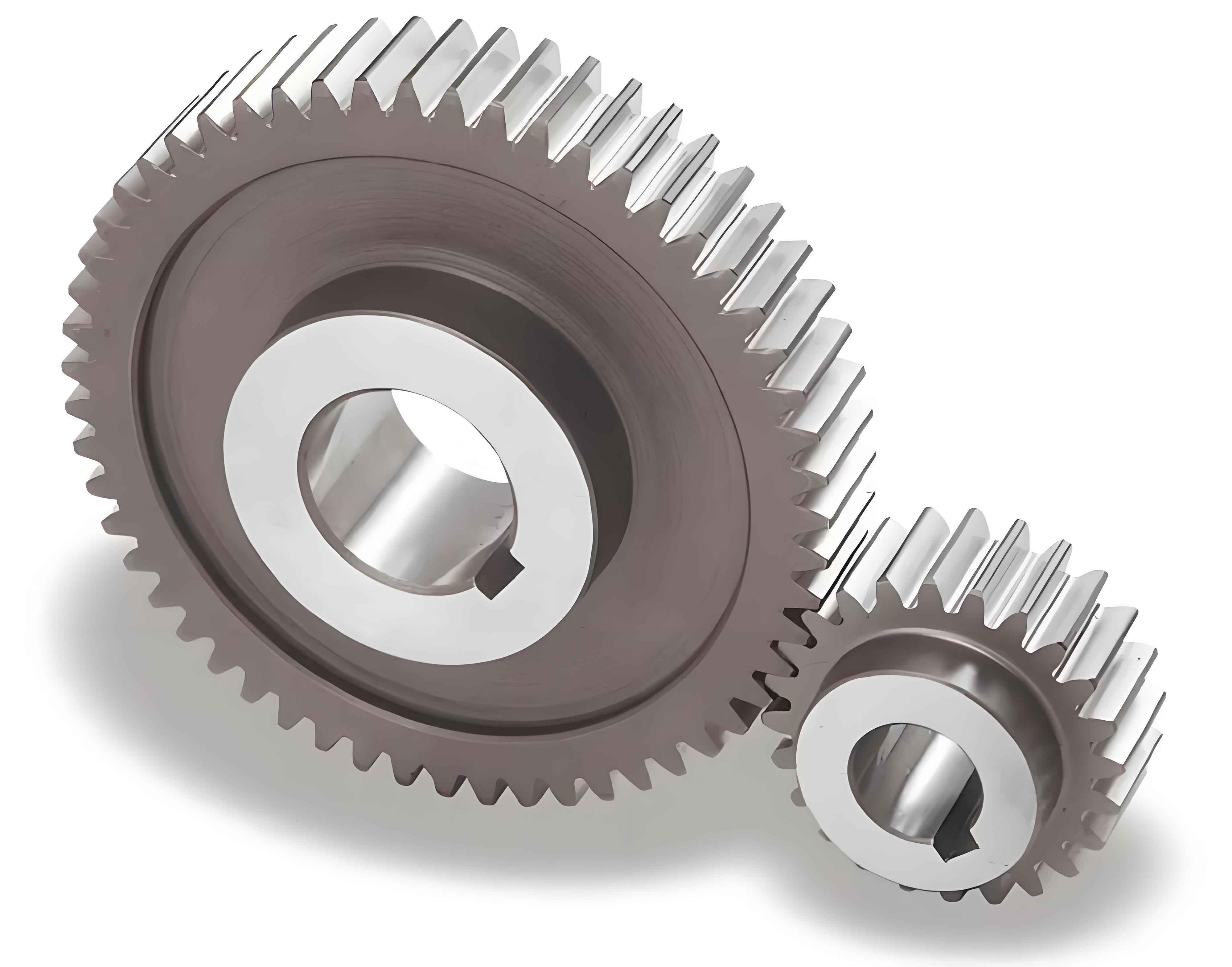
This model allows for the construction of the workpiece as a solid by extruding the tooth profile along the gear axis, facilitating accurate CWE simulation in spur gear milling.
Tool path planning is critical for achieving high surface quality in spur gear milling. We employ the constant scallop height method to generate tool paths that ensure uniform residual material, minimizing post-processing. The initial tool contact point CC_{k,0} and tool center point CL_{k,0} are projected onto the y_W-z_W plane of {S_W}. The scallop height h defines the curve ε_2 of residual points, while the tool center path lies on curve ε_3, an offset of the involute by the tool radius R. For a given tool path k, the residual point G_{k,0} is the intersection of the tool arc at CL_{k,0} and curve ε_2, satisfying:
$$ x_{G_{k,0}} = \frac{r_b}{\cos \alpha} \sin(\Omega_S – \tan \alpha + \alpha) + h \cos(\tan \alpha – \Omega_S) $$
$$ y_{G_{k,0}} = \frac{r_b}{\cos \alpha} \cos(\Omega_S – \tan \alpha + \alpha) + h \sin(\tan \alpha – \Omega_S) $$
$$ (x_{G_{k,0}} – x_{CL_{k,0}})^2 + (y_{G_{k,0}} – y_{CL_{k,0}})^2 = R^2 $$
The subsequent tool center CL_{k+1,0} is determined by solving:
$$ x_{CL_{k+1,0}} = \frac{r_b}{\cos \alpha} \sin(\Omega_S – \tan \alpha + \alpha) + R \cos(\tan \alpha – \Omega_S) $$
$$ y_{CL_{k+1,0}} = \frac{r_b}{\cos \alpha} \cos(\Omega_S – \tan \alpha + \alpha) + R \sin(\tan \alpha – \Omega_S) $$
$$ (x_{G_{k,0}} – x_{CL_{k+1,0}})^2 + (y_{G_{k,0}} – y_{CL_{k+1,0}})^2 = R^2 $$
This iterative process generates all tool centers along the tooth height, ensuring constant scallop height and efficient material removal in spur gear milling. The tool moves linearly along the gear axis (z-direction) between paths, with the feed length L_{k,i} computed from the initial position.
The CWE extraction using solid modeling involves several steps to simulate the material removal process accurately. First, tool positions are generated based on the planned paths. Second, the tool swept volume is constructed by creating swept surfaces between consecutive tool positions, including the ingress and egress surfaces at the start and end points. The swept volume is a solid model representing the region removed by the tool. Third, the in-process workpiece model is updated by performing a Boolean subtraction between the workpiece solid and the tool swept volume. Fourth, the CWE is identified from the updated workpiece as the spherical surface region that intersects the tool, leveraging the geometry of the ball-end mill. Finally, the engagement angles are computed by intersecting the CWE surface with planes parallel to the tool axis in {S_T}, yielding the entry and exit angles for each cutting element.
For example, the engagement angles φ for a given tool path can be summarized in a table based on simulation results. The following table illustrates the engagement angles for two tool paths in spur gear milling:
| Tool Path | Entry Angle (deg) | Exit Angle (deg) |
|---|---|---|
| Path 2 | 15.2 | 75.8 |
| Path 4 | 22.4 | 68.3 |
This method efficiently handles different tool orientations; for instance, changing the tool inclination angle λ_k alters the CWE geometry, but the engagement angles can be recalculated without repeating the entire simulation by applying coordinate transformations. The solid modeling approach ensures high accuracy in CWE prediction for spur gears, as validated by experimental comparisons.
To validate the simulation, we conducted milling experiments on a five-axis machining center. The workpiece material was 45 steel, and the spur gear parameters included a module m_n = 6 mm, tooth count z = 20, pressure angle α_n = 20°, addendum coefficient h_a* = 1, and dedendum coefficient c* = 0.25. A ball-end mill with radius R = 3 mm, two flutes, and a helix angle of 15° was used at a spindle speed of 3000 rpm and feed per tooth of 0.05 mm/rev. The tool inclination angle was set to λ_k = 60°, scallop height h = 0.03 mm, and semi-finishing allowance T = 0.3 mm. The CWE boundaries were measured using a digital universal measuring microscope, with the measurement coordinate system aligned parallel to the gear端面.
The experimental results showed close agreement with simulation predictions. For tool paths 2 and 4, the measured CWE boundaries matched the simulated curves within acceptable tolerances, with minor discrepancies attributed to measurement errors and surface deformation. The engagement angles derived from simulation, as listed in the table above, correlated well with the observed tool marks on the gear teeth. This confirmation underscores the reliability of our solid-modeling-based CWE extraction method for spur gear milling.
In conclusion, we have developed a robust simulation framework for analyzing CWE in spur gear milling using ball-end mills. The integration of kinematic modeling, precise tooth profile representation, constant scallop height tool path planning, and solid-based Boolean operations enables accurate prediction of engagement regions. The method’s validity is demonstrated through experimental verification, providing a solid foundation for optimizing cutting parameters and predicting physical phenomena like cutting forces and tool wear in spur gear manufacturing. Future work could extend this approach to helical gears or incorporate dynamic effects for real-time process monitoring.
The mathematical models and algorithms presented here are generalizable to other gear types, but the focus on spur gears highlights the simplicity and effectiveness of the approach. By repeatedly emphasizing spur gears throughout the analysis, we ensure that the methodology is tailored to their specific geometric characteristics, such as the involute profile and axial symmetry. The use of tables and equations facilitates the application of these concepts in practical CNC programming and simulation software for spur gear production.
Further refinement could involve adaptive tool path planning to account for varying engagement conditions or the integration of machine tool dynamics. However, the current method already offers a significant advancement in the virtual machining of spur gears, reducing the need for physical prototypes and enhancing manufacturing efficiency. The consistent reference to spur gears in this context reinforces the importance of specialized simulation techniques for standardized gear components in industrial applications.