
In modern mechanical transmission systems, spur gears play a critical role due to their reliability, stability, and compact structure. However, traditional machining methods for spur gears often involve high material waste and low efficiency. Through-feed rolling has emerged as a promising near-net shaping technique, offering advantages such as high production rates, reduced material consumption, and improved mechanical properties. Despite these benefits, the design of rolling dies, particularly for spur gears, faces challenges such as difficult tooth tip penetration, inadequate material flow, and severe stress conditions. To address these issues, we propose a geometric design method for beveloid rolling dies in the axial rolling process of spur gears. This study focuses on deriving the tooth profile equations for the cutting, finishing, and exiting sections of the dies, analyzing their impact on forming loads, material flow, and tooth profile errors through finite element simulations, and optimizing process parameters using orthogonal experiments. The goal is to enhance the forming quality and efficiency of spur gears while reducing defects.
The design of beveloid rolling dies is based on the principles of gear meshing and the rack tool machining process. By varying the center distance between the rack tool and the workpiece, we obtain tooth profiles with different modification coefficients. These profiles are then arranged equidistantly along the axial direction and reconstructed into a three-dimensional model of the rolling die. The coordinate systems are established to facilitate the transformation between the rack tool and the workpiece, as well as between the workpiece and the rolling die. For instance, the transformation matrix from the rack tool coordinate system to the workpiece coordinate system is given by:
$$ M_{31} = M_{32} \cdot M_{20} \cdot M_{01} = \begin{bmatrix} \cos\varphi & -\sin\varphi & r_1 \cos\varphi + T \sin\varphi \\ \sin\varphi & \cos\varphi & r_1 \sin\varphi – T \cos\varphi \\ 0 & 0 & 1 \end{bmatrix} $$
where $$ \varphi $$ is the rotation angle of the workpiece, $$ r_1 $$ is the pitch radius of the workpiece, and $$ T $$ is the horizontal displacement of the rack tool. Similarly, the transformation to the rolling die coordinate system is expressed as:
$$ M_{51} = M_{54} \cdot M_{42} \cdot M_{20} \cdot M_{01} = \begin{bmatrix} \cos\varepsilon & \sin\varepsilon & -r_2 (\cos\varepsilon + \varepsilon \sin\varepsilon) \\ -\sin\varepsilon & \cos\varepsilon & r_2 (\sin\varepsilon – \varepsilon \cos\varepsilon) \\ 0 & 0 & 1 \end{bmatrix} $$
where $$ \varepsilon $$ is the rotation angle of the rolling die, and $$ r_2 $$ is the corresponding pitch radius of the die. The tooth profile of the rack tool consists of three segments: the tooth tip straight line, the tooth tip arc, and the tooth flank straight line. The equations for these segments are derived as follows for the cutting section:
For the tooth tip straight line segment (ab):
$$ R^1_{ab} = \begin{bmatrix} R^1_{x_{ab}} \\ R^1_{y_{ab}} \\ 1 \end{bmatrix} = \begin{bmatrix} \pm (-\pi m – 4X_1 m \tan\alpha + l_{1ab}) \\ -h_a^* m – X_1 m + r_{bc} \sin\alpha – r_{bc} \\ 1 \end{bmatrix} $$
For the tooth tip arc segment (bc):
$$ R^1_{bc} = \begin{bmatrix} R^1_{x_{bc}} \\ R^1_{y_{bc}} \\ 1 \end{bmatrix} = \begin{bmatrix} \pm \left( -\frac{\pi}{2} m + 2X_1 m \tan\alpha – h_a^* m \tan\alpha – X_1 m \tan\alpha – r_{bc} \cos\alpha + r_{bc} \sin\theta_{2bc} \right) \\ -h_a^* m – X_1 m + r_{bc} \sin\alpha – r_{bc} \cos\theta_{2bc} \\ 1 \end{bmatrix} $$
For the tooth flank straight line segment (cd):
$$ R^1_{cd} = \begin{bmatrix} R^1_{x_{cd}} \\ R^1_{y_{cd}} \\ 1 \end{bmatrix} = \begin{bmatrix} \pm \left( -\frac{\pi}{2} m + 2X_1 m \tan\alpha – h_a^* m \tan\alpha – X_1 m \tan\alpha + l_{cd} \sin\alpha \right) \\ l_{cd} \cos\alpha – h_a^* m – X_1 m \\ 1 \end{bmatrix} $$
Here, $$ m $$ is the module, $$ \alpha $$ is the pressure angle, $$ h_a^* $$ is the addendum coefficient, $$ X_1 $$ is the modification coefficient, $$ r_{bc} $$ is the radius of the tooth tip arc, and $$ l_{1ab} $$, $$ \theta_{2bc} $$, and $$ l_{cd} $$ are parameters defining the positions on the segments. The workpiece tooth profiles are then obtained by applying the transformation matrices to these rack tool equations. For example, the workpiece profile for segment ab is:
$$ W^1_{ab} = \begin{bmatrix} W^1_{x_{ab}} \\ W^1_{y_{ab}} \\ 1 \end{bmatrix} = \begin{bmatrix} R^1_{x_{ab}} \cos\varphi – R^1_{y_{ab}} \sin\varphi + r_1 \cos\varphi + T \sin\varphi \\ R^1_{x_{ab}} \sin\varphi + R^1_{y_{ab}} \cos\varphi + r_1 \sin\varphi – T \cos\varphi \\ 1 \end{bmatrix} $$
Similarly, the rolling die tooth profiles for the cutting section are derived as:
$$ B^1_{ab} = \begin{bmatrix} B^1_{x_{ab}} \\ B^1_{y_{ab}} \\ 1 \end{bmatrix} = \begin{bmatrix} R^1_{x_{ab}} \cos\varepsilon + R^1_{y_{ab}} \sin\varepsilon – r_2 (\cos\varepsilon + \varepsilon \sin\varepsilon) \\ -R^1_{x_{ab}} \sin\varepsilon + R^1_{y_{ab}} \cos\varepsilon + r_2 (\sin\varepsilon – \varepsilon \cos\varepsilon) \\ 1 \end{bmatrix} $$
For the finishing section, the modification coefficient remains constant, resulting in unchanged tooth profiles. The equations are similar but with $$ X_1 = 0 $$. For the exiting section, the profiles are designed with gradually increasing clearance to prevent scratching of the formed tooth surfaces, using the same approach as the cutting section but with different modification coefficients.
To validate the design, we developed a finite element model using Deform software, focusing on spur gears with specific geometric parameters. The model includes a workpiece with an initial diameter of 80.75 mm and a dual-tooth configuration to improve computational efficiency. The material properties are set to AL-6061-T6-cold at 20°C, and the mesh is refined near the surface to capture deformation accurately. The process parameters include a friction factor of 0.1, a feed speed of 0.3 mm/s, and a rolling die rotational speed of 6.28 rad/s. We analyzed three types of beveloid rolling dies with different modification coefficient ranges: Die I (cutting: -2 to 0, finishing: 0, exiting: 0 to -0.5), Die II (cutting: -1 to 1, finishing: 1, exiting: 1 to 0.5), and Die III (cutting: 0 to 2, finishing: 2, exiting: 2 to 1.5). The results show that Die I exhibits the lowest forming load, with a peak value of 40,500 N, compared to 40,700 N for Die II and 41,300 N for Die III. This is attributed to the reduced radial force in Dies with negative modification coefficients. Material flow velocity analysis reveals that Die I promotes more uniform flow, with maximum velocities of 25 mm/s at the surface, 5.8 mm/s at 1 mm depth, and 5.4 mm/s at 2 mm depth, reducing the risk of defects such as ear formation. Tooth profile errors are also minimized for Die I, with maximum errors of 0.18 mm in the transition arc region, whereas Die III shows significant deviations in the addendum and flank regions.
We further optimized the process parameters using an orthogonal experimental design, considering factors such as rolling die rotational speed, feed speed, and friction factor. Each factor was tested at three levels, as summarized in the following table:
| Test Number | Friction Factor | Feed Speed (mm/s) | Rotation Speed (rad/s) |
|---|---|---|---|
| 1 | 0.15 | 0.5 | 1.34 |
| 2 | 0.15 | 0.75 | 4.94 |
| 3 | 0.15 | 1 | 3.14 |
| 4 | 0.3 | 0.5 | 4.94 |
| 5 | 0.3 | 0.75 | 3.14 |
| 6 | 0.3 | 1 | 1.34 |
| 7 | 0.45 | 0.5 | 3.14 |
| 8 | 0.45 | 0.75 | 1.34 |
| 9 | 0.45 | 1 | 4.94 |
The evaluation criteria included effective tooth height, forming load, and tooth profile error. The results indicate that the rotational speed of the rolling die has the most significant influence, followed by the friction factor and feed speed. For effective tooth height, the optimal levels are a friction factor of 0.15, feed speed of 0.5 mm/s, and rotational speed of 4.94 rad/s. The range analysis for effective tooth height is as follows:
| Item | Friction Factor | Feed Speed | Rotation Speed |
|---|---|---|---|
| K value | 126.11 | 126.05 | 125.81 |
| K average value | 42.0367 | 42.0167 | 41.9367 |
| Optimum level | 1 | 1 | 3 |
| R | 0.0634 | 0.05 | 0.0899 |
For forming load, the peak values ranged from 40,500 N to 45,000 N, with the minimum achieved at a rotational speed of 3.14 rad/s. The range analysis for maximum forming load is:
| Item | Friction Factor | Feed Speed | Rotation Speed |
|---|---|---|---|
| K value | 131100.09 | 131495.02 | 132236.85 |
| K average value | 43700.03 | 43831.67 | 44078.95 |
| Optimum level | 1 | 1 | 2 |
| R | 1313.14 | 977.30 | 1608.36 |
Tooth profile errors were minimized under the same optimal conditions, with the maximum error reduced to 0.128 mm for Die I. The range analysis for maximum profile error is:
| Item | Friction Factor | Feed Speed | Rotation Speed |
|---|---|---|---|
| K value | 0.3853 | 0.4503 | 0.8046 |
| K average value | 0.1284 | 0.1501 | 0.2682 |
| Optimum level | 1 | 1 | 3 |
| R | 0.1040 | 0.0483 | 0.1424 |
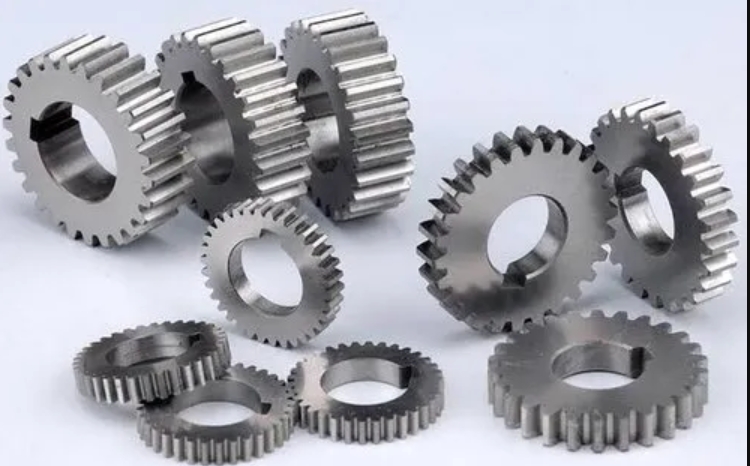
Based on these findings, we conducted experimental trials using Die I with the optimized parameters: rotational speed of 4.94 rad/s, feed speed of 0.5 mm/s, and friction factor of 0.15. The workpiece material was AL-1100, with an initial diameter of 80.75–80.85 mm and a thickness of 25 mm. The formed spur gears exhibited uniform tooth distribution, complete tooth profiles, and dimensions meeting the requirements, with an average addendum radius of 42.09 mm and dedendum radius of 38.11 mm. This confirms the effectiveness of the beveloid rolling die design and process optimization for spur gears.
In conclusion, our study presents a comprehensive approach to designing beveloid rolling dies for the axial rolling of spur gears. By deriving precise tooth profile equations and optimizing process parameters, we achieve reduced forming loads, improved material flow, and minimized tooth profile errors. The orthogonal experiments highlight the dominance of rotational speed in influencing forming quality, and the experimental results validate the practical applicability of our method. This work contributes to the advancement of near-net shaping techniques for spur gears, promoting efficiency and quality in industrial applications.