
In mechanical transmission systems, spur gears play a critical role in transmitting speed and torque, serving as essential components for efficient power delivery. Among various gear types, the variable hyperbolic circular arc tooth line cylindrical gear (VH-CATT) represents an innovative transmission mechanism that offers significant advantages over traditional spur gears. These advantages include higher load-carrying capacity, larger overlap coefficients, improved lubrication properties, enhanced bending strength, and the absence of axial forces. As a result, VH-CATT gears have broad application prospects in industries requiring high-performance gear systems. In this study, I focus on analyzing the impact of design parameters, such as displacement coefficients, cutter head radius, module, tooth width, and cutter tip fillet radius, on the root bending stress of these gears. The derivation of the tooth surface equation for displaced VH-CATT gears is presented, followed by a finite element analysis to investigate how these parameters influence bending stress. The findings provide a foundation for optimizing gear design parameters to enhance performance and durability in practical applications.
The mathematical model of the tooth surface for VH-CATT gears is derived based on the principle of displacement correction machining. This involves setting the rack cutter away from the standard position relative to the gear blank center by a distance $x_m$, where $x$ is the displacement coefficient and $m$ is the module, to prevent undercutting. The coordinate systems include the tool static coordinate system $O_1-x_1y_1z_1$ with basis vectors $\mathbf{i}, \mathbf{j}, \mathbf{k}$, the workpiece static coordinate system $O_2-x_2y_2z_2$ with basis vectors $\mathbf{i}_2, \mathbf{j}_2, \mathbf{k}_2$, and the workpiece dynamic coordinate system $O_d-x_dy_dz_d$ with basis vectors $\mathbf{i}_d, \mathbf{j}_d, \mathbf{k}_d$. The tool revolution surface equation in the fixed coordinate system $O_1-x_1y_1z_1$ is expressed as:
$$x_1 = -\left(R \mp \frac{\pi}{4}m \pm u \sin \alpha\right) \cos \theta$$
$$y_1 = -\left(R \mp \frac{\pi}{4}m \pm u \sin \alpha\right) \sin \theta$$
$$z_1 = u \cos \alpha$$
where $R$ is the cutter head radius, $m$ is the module, $\alpha$ is the pressure angle, $u$ is the tool surface parameter, and $\theta$ is the angular parameter. The upper signs correspond to the convex side of the gear, and the lower signs to the concave side. The unit normal vector of the tool revolution surface is given by:
$$\mathbf{e}_1 = \cos \theta \cos \alpha \, \mathbf{i} + \sin \theta \cos \alpha \, \mathbf{j} \pm \sin \alpha \, \mathbf{k}$$
According to spatial meshing theory, the engagement condition during machining is defined by $\phi = \mathbf{n}_1 \cdot \mathbf{v}_2 = \mathbf{e}_1 \cdot \mathbf{v}_2 = 0$, where $\mathbf{v}_2$ is the relative velocity vector. Solving this condition yields the contact line equation, which is then transformed into the gear workpiece’s dynamic coordinate system to obtain the tooth surface equation. The transformation matrices between coordinate systems are as follows:
$$M_{21} = \begin{bmatrix}
1 & 0 & 0 & R \\
0 & 0 & 1 & -R_1 – x_m \\
0 & -1 & 0 & 0 \\
0 & 0 & 0 & 1
\end{bmatrix}, \quad M_{d2} = \begin{bmatrix}
\cos \psi & \sin \psi & 0 & R_1 \psi \cos \psi \\
-\sin \psi & \cos \psi & 0 & -R_1 \psi \sin \psi \\
0 & 0 & 1 & 0 \\
0 & 0 & 0 & 1
\end{bmatrix}$$
where $R_1$ is the pitch circle radius and $\psi$ is the rotation angle. The tooth surface equation for the displaced VH-CATT gear is derived as:
$$x_d = \left[ -\left(R \mp \frac{\pi}{4}m \pm u \sin \alpha\right) \cos \theta + R + R_1 \psi \right] \cos \psi + (u \cos \alpha – R_1 – x_m) \sin \psi$$
$$y_d = \left[ \left(R \mp \frac{\pi}{4}m \pm u \sin \alpha\right) \cos \theta – R – R_1 \psi \right] \sin \psi + (u \cos \alpha – R_1 – x_m) \cos \psi$$
$$z_d = \left(R \mp \frac{\pi}{4}m \pm u \sin \alpha\right) \sin \theta$$
$$u = \frac{\mp \sin \alpha \cos \theta \left(R \mp \frac{\pi}{4}m\right) \pm \sin \alpha (R_1 \psi + R)}{\cos \theta} + x_m \cos \alpha$$
Additionally, the transition tooth surface equation, which accounts for the cutter tip fillet, is expressed as:
$$x_{dr} = \left\{ -\left[A \mp r (\cos \alpha – \cos \beta)\right] \cos \theta + R + R_1 \psi \right\} \cos \psi + \left[d + r (\sin \beta – \sin \alpha) – R_1 – x_m\right] \sin \psi$$
$$y_{dr} = \left\{ \left[A \mp r (\cos \alpha – \cos \beta)\right] \cos \theta – R – R_1 \psi \right\} \sin \psi + \left[d + r (\sin \beta – \sin \alpha) – R_1 – x_m\right] \cos \psi$$
$$z_{dr} = \left[A \mp r (\cos \alpha – \cos \beta)\right] \sin \theta$$
$$\beta = \arctan \left( \frac{d \cos \theta – r \sin \alpha \cos \theta – x_m \cos \theta}{\pm A \cos \theta \mp (R_1 \psi + R) – r \cos \alpha \cos \theta} \right)$$
where $A = R \mp \frac{\pi}{4}m \mp d \tan \alpha$, $d$ is the depth parameter, and $r$ is the cutter tip fillet radius. These equations form the basis for generating the gear tooth profile and conducting further analysis.
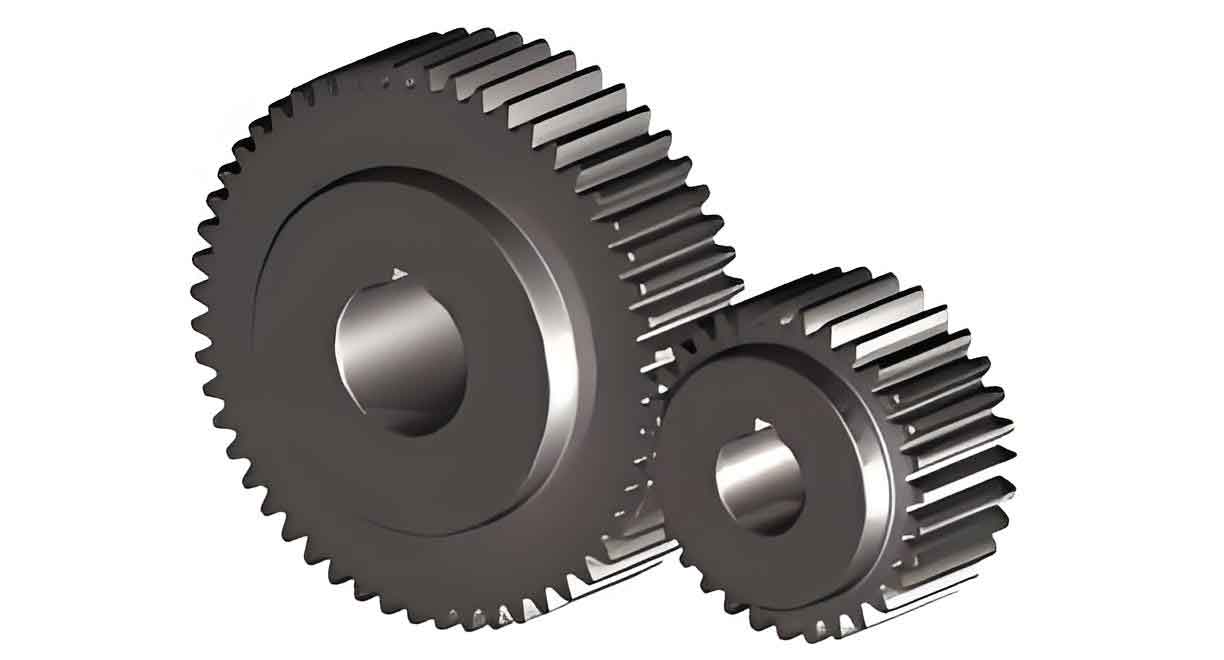
To analyze the bending stress of VH-CATT gears, I developed a finite element model using Abaqus software. The gear pair parameters are listed in Table 1, which includes key design parameters such as pressure angle, module, number of teeth, and cutter dimensions. The model employs a seven-tooth engagement approach to reduce computational cost while maintaining accuracy. The mesh consists of hexahedral reduced integration elements (C3D8R), and the material properties are set with an elastic modulus of 210 GPa and a Poisson’s ratio of 0.3. The analysis involves implicit static steps, with boundary conditions applied to reference points at the rotation centers of the driving and driven gears. A torque of 100 N·m is applied to the driven gear, and contact interactions are defined between the meshing surfaces. This setup allows for the simulation of the entire engagement process and the calculation of root bending stresses under various parameter configurations.
| Parameter | Value |
|---|---|
| Pressure angle $\alpha$ (°) | 20 |
| Module $m$ (mm) | 3 |
| Driving gear teeth $z_1$ | 21 |
| Driven gear teeth $z_2$ | 37 |
| Addendum coefficient $h_a^*$ | 1 |
| Dedendum coefficient $c^*$ | 0.25 |
| Tooth width $B$ (mm) | 45 |
| Cutter head radius $R$ (mm) | 80 |
| Cutter tip fillet radius $r$ (mm) | 0.2 |
The influence of the displacement coefficient on root bending stress is investigated first. For equal displacement gears, where the center distance remains unchanged, the displacement coefficient $x$ varies from -0.2 to 0.2. The results, as shown in Table 2, indicate that both driving and driven gears experience a significant reduction in root bending stress as the displacement coefficient increases. Specifically, the driving gear’s stress decreases from 110.03 MPa to 90.06 MPa, and the driven gear’s stress from 100.48 MPa to 85.64 MPa. This trend is attributed to the increase in tooth root thickness with higher displacement coefficients, which enhances bending strength. Such behavior is consistent with traditional spur gears, where positive displacement improves load capacity.
| Displacement Coefficient $x$ | Driving Gear Stress (MPa) | Driven Gear Stress (MPa) |
|---|---|---|
| -0.2 | 110.03 | 100.48 |
| -0.1 | 105.12 | 95.67 |
| 0.0 | 100.25 | 90.89 |
| 0.1 | 95.41 | 86.15 |
| 0.2 | 90.06 | 85.64 |
Next, I examine the effect of cutter head radius on bending stress. With other parameters fixed as in Table 1, cutter head radii of 60 mm, 80 mm, and 100 mm are analyzed. The results, summarized in Table 3, show that larger cutter head radii lead to lower root bending stresses across all displacement coefficients. For example, at $x = 0$, stress decreases from 105.0 MPa at $R = 60$ mm to 95.5 MPa at $R = 100$ mm. This is because a larger cutter head radius expands the load distribution area, reducing stress concentration. Thus, selecting a larger cutter head radius is beneficial for improving the bending strength of spur gears like VH-CATT gears.
| $x$ | $R = 60$ mm | $R = 80$ mm | $R = 100$ mm |
|---|---|---|---|
| -0.2 | 115.5 | 110.03 | 104.8 |
| -0.1 | 110.3 | 105.12 | 100.1 |
| 0.0 | 105.0 | 100.25 | 95.5 |
| 0.1 | 99.8 | 95.41 | 90.9 |
| 0.2 | 94.5 | 90.06 | 86.3 |
The module $m$ is another critical parameter affecting bending stress. Modules of 3 mm, 5 mm, and 7 mm are evaluated, with results presented in Table 4. As the module increases, root bending stress decreases substantially. For instance, at $x = 0$, stress drops by approximately 74% from 3 mm to 5 mm, and by 60% from 5 mm to 7 mm. Moreover, the rate of stress reduction with increasing displacement coefficient becomes more pronounced at larger modules. This highlights the module’s significant role in enhancing the bending strength of spur gears, making it a key factor in design optimization.
| $x$ | $m = 3$ mm | $m = 5$ mm | $m = 7$ mm |
|---|---|---|---|
| -0.2 | 110.03 | 28.5 | 11.4 |
| -0.1 | 105.12 | 27.2 | 10.9 |
| 0.0 | 100.25 | 26.0 | 10.4 |
| 0.1 | 95.41 | 24.7 | 9.9 |
| 0.2 | 90.06 | 23.4 | 9.4 |
Tooth width $B$ also influences bending stress. Analyses with tooth widths of 30 mm, 45 mm, and 60 mm reveal that stress decreases initially as tooth width increases but stabilizes beyond a certain point, as shown in Table 5. For example, at $x = 0$, stress reduces from 108.0 MPa at $B = 30$ mm to 100.25 MPa at $B = 45$ mm, but only marginally to 99.8 MPa at $B = 60$ mm. This is because the effective tooth width, determined by the cutter head radius, does not increase indefinitely with physical tooth width. Thus, excessive tooth width may not yield significant benefits and could lead to material waste.
| $x$ | $B = 30$ mm | $B = 45$ mm | $B = 60$ mm |
|---|---|---|---|
| -0.2 | 118.2 | 110.03 | 109.5 |
| -0.1 | 113.1 | 105.12 | 104.7 |
| 0.0 | 108.0 | 100.25 | 99.8 |
| 0.1 | 102.9 | 95.41 | 95.0 |
| 0.2 | 97.8 | 90.06 | 89.7 |
Finally, the effect of cutter tip fillet radius $r$ on bending stress is studied with values of 0 mm, 0.2 mm, and 0.4 mm. The results in Table 6 demonstrate that increasing the fillet radius reduces bending stress initially due to a smoother transition curve, but the effect diminishes at larger radii. For instance, at $x = 0$, stress decreases from 105.0 MPa at $r = 0$ mm to 100.25 MPa at $r = 0.2$ mm, and then to 99.0 MPa at $r = 0.4$ mm. However, beyond a certain point, the overlap coefficient may decrease, limiting further improvements. Therefore, an optimal fillet radius must balance stress reduction and meshing performance.
| $x$ | $r = 0$ mm | $r = 0.2$ mm | $r = 0.4$ mm |
|---|---|---|---|
| -0.2 | 115.0 | 110.03 | 108.5 |
| -0.1 | 110.0 | 105.12 | 103.7 |
| 0.0 | 105.0 | 100.25 | 99.0 |
| 0.1 | 100.0 | 95.41 | 94.2 |
| 0.2 | 95.0 | 90.06 | 89.4 |
In conclusion, this study comprehensively analyzes the influence of design parameters on the root bending stress of variable hyperbolic circular arc tooth line cylindrical gears. The derived tooth surface equations provide a mathematical foundation for gear design, and finite element analyses reveal that displacement coefficients, cutter head radius, module, tooth width, and cutter tip fillet radius all significantly affect bending stress. Key findings include the stress-reducing effect of positive displacement coefficients, the importance of larger modules and cutter head radii for enhanced strength, and the optimal ranges for tooth width and fillet radius. These insights are crucial for optimizing spur gears in high-performance applications, ensuring reliability and efficiency. Future work could focus on parameter optimization and experimental validation to further advance gear transmission systems.