
In the field of high-end equipment and precision instruments, open-loop high-ratio and high-precision gear transmissions play a critical role in indexing systems. However, traditional involute enveloping toroidal worm (TI worm) drives face challenges such as partial loading and incomplete tooth flank engagement due to the influence of helix angle parameters, which compromise indexing accuracy. To address these issues, I propose a novel elliptical toroidal worm (EI worm) drive that achieves full-tooth flank conjugation with involute spur gears. This study establishes the spatial relationship between the elliptical toroidal surface and the cylindrical surface of spur gears, derives the generatrix equation of the elliptical toroidal surface, and develops meshing theories based on spatial conjugate gear principles. By analyzing the impact of meshing parameters on instantaneous contact line distribution, I optimize the contact area on the gear tooth flank, enabling full-tooth engagement. Furthermore, I investigate the effects of meshing parameters on induced normal curvature, lubrication angle, and relative entrainment velocity. Comparative analysis under identical ideal parameters reveals that the EI worm drive offers a 5.49 times larger meshing area on the gear tooth flank compared to TI worm drives, with similar induced normal curvature and lubrication angle but higher relative entrainment velocity. These findings highlight the advantages of EI worm drives, including superior conjugate surface conformity, enhanced contact strength, and improved lubrication. This research provides a theoretical foundation for designing high-performance worm gear transmissions, with a focus on spur gears to ensure precision and reliability.
The elliptical toroidal surface of the EI worm is defined by the intersection of an oblique section through the worm’s axis and the pitch cylinder of the spur gear, forming an elliptical generatrix. The equation of this generatrix is given by:
$$ \frac{y^2}{r^2} + \frac{x^2}{(r \csc \varepsilon)^2} = 1 $$
where \( r \) is the pitch circle radius of the spur gear and \( \varepsilon \) is the shaft angle. This elliptical profile ensures extended contact lines and smoother transmission compared to circular toroidal surfaces. The tooth surface of the EI worm is generated by enveloping the tooth flank of an involute spur gear through coordinate transformations and conjugate meshing principles. The surface equation of the involute spur gear, considering left and right flanks, is expressed as:
$$ \mathbf{r}_{1L} = x_{1L} \mathbf{i} + y_{1L} \mathbf{j} + z_{1L} \mathbf{k} $$
with
$$ x_{1L} = r_b \cos \tau + r_b u \sin \tau $$
$$ y_{1L} = r_b \sin \tau – r_b u \cos \tau $$
$$ z_{1L} = h_L $$
$$ \tau = \sigma_0 – \alpha – \lambda $$
Here, \( r_b \) is the base circle radius, \( u \) is the roll angle, \( \sigma_0 \) is half the base circle angle corresponding to the gear’s tip thickness, \( h_L \) is the axial parameter, and \( \lambda \) is the rotation angle for helical motion. For spur gears, the helical parameters are set to zero, simplifying the equations. The coordinate systems for the worm and gear transmission are established, with non-orthogonal axes and a shaft angle \( \varepsilon \). The transformation matrix between gear and worm coordinates facilitates the derivation of the EI worm tooth surface equation through the enveloping method.
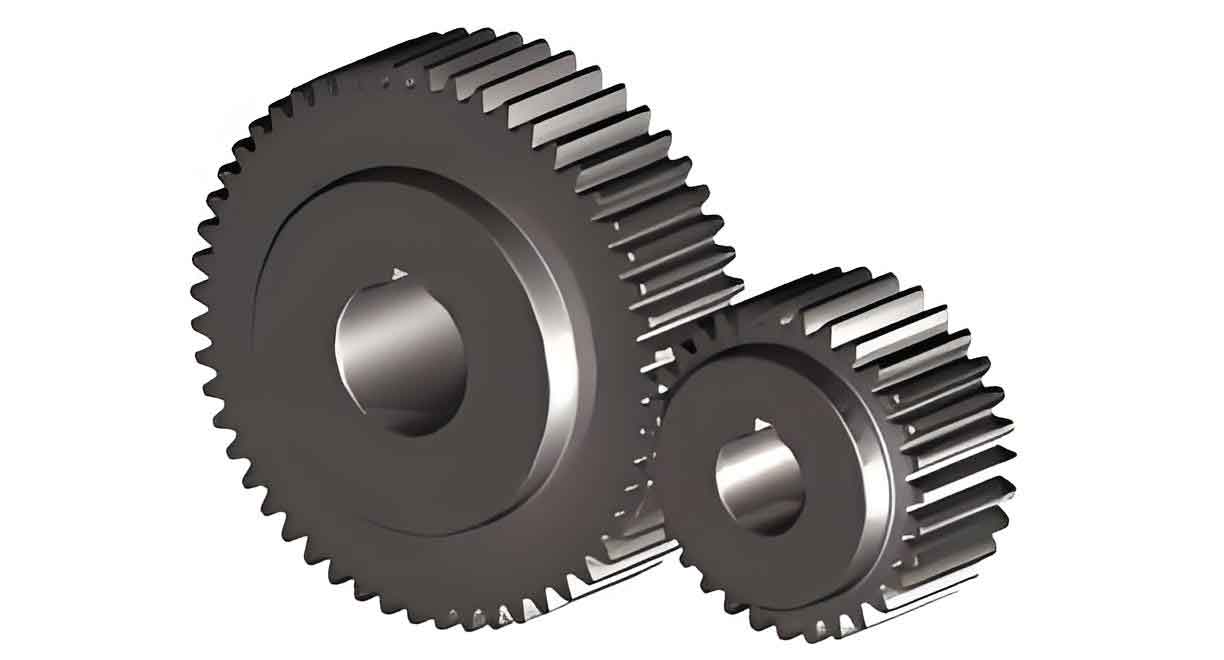
The meshing function, which ensures proper conjugation between the EI worm and spur gear tooth surfaces, is derived from the condition that the relative velocity vector \( \mathbf{v}_{12} \) is perpendicular to the unit normal vector \( \mathbf{n} \) at the contact point:
$$ \mathbf{v}_{12} \cdot \mathbf{n} = 0 $$
The relative velocity components and normal vector are computed based on the gear geometry and kinematic parameters. The resulting EI worm tooth surface equation, parameterized by \( \phi_1 \) and \( u \), is numerically analyzed using MATLAB to reconstruct the 3D model. The instantaneous contact lines on the spur gear tooth flank are determined by solving the meshing equation for various \( \phi_1 \) values, revealing the distribution of contact points during engagement. The existence of meshing boundary lines depends on the shaft angle \( \varepsilon \); for spur gears, no boundary lines exist when \( \varepsilon > \arccos \left( \frac{r_b}{i_{21} r_b – a} \right) \), ensuring full-tooth flank engagement. The root cut boundary on the EI worm surface is analyzed to avoid undercutting, with the boundary function derived from the relative motion and tooth geometry.
The meshing performance of EI worm drives is evaluated through key parameters: induced normal curvature, lubrication angle, and relative entrainment velocity. The induced normal curvature \( k_{\sigma} \) indicates the conformity between conjugate surfaces and is given by:
$$ k_{\sigma} = \frac{\psi^2}{N^2} $$
where \( \psi \) is the meshing function and \( N \) is related to the tooth surface derivatives. A smaller absolute value of \( k_{\sigma} \) denotes better surface conformity and higher contact strength. The lubrication angle \( \theta_v \), defined as the angle between the contact line direction and relative velocity vector, influences the formation of hydrodynamic lubricant films:
$$ \theta_v = \arcsin \left( \frac{|\mathbf{N} \cdot \mathbf{v}_{12}|}{|\mathbf{N}| |\mathbf{v}_{12}|} \right) $$
Values closer to 90° promote better lubrication. The relative entrainment velocity \( v_{e} \), which affects oil film thickness, is calculated as:
$$ v_{e} = \frac{|\mathbf{v}_{12} \times \mathbf{N}|}{2 |\mathbf{N}|} $$
Higher entrainment velocities enhance lubricant entrapment and reduce wear.
The influence of meshing parameters on contact line distribution is critical for optimizing gear design. Shaft angle \( \varepsilon \) significantly affects contact patterns; smaller angles lead to concentrated contact lines and uneven wear, while larger angles distribute contact across the full tooth width. The module \( m \) and transmission ratio \( i \) also impact contact distribution, with larger modules and ratios increasing the engagement area but potentially reducing the meshing area ratio beyond certain thresholds. For spur gears, selecting appropriate parameters ensures uniform contact and minimizes stress concentration.
| Parameter | Range | Effect on Contact Lines | Optimal Value |
|---|---|---|---|
| Shaft Angle \( \varepsilon \) | 85°–95° | Eliminates boundary lines, full-tooth engagement | 90°–93° |
| Module \( m \) (mm) | 1–3 | Increases tooth width, uniform distribution | 2 mm |
| Transmission Ratio \( i \) | 100–120 | Expands meshing area, maintains ratio | 110–115 |
Induced normal curvature decreases with larger shaft angles and smaller modules or transmission ratios, improving surface conformity. Lubrication angle increases with smaller shaft angles and larger modules, enhancing lubricant film formation. Relative entrainment velocity rises with larger transmission ratios and modules, but decreases with larger shaft angles, favoring lubrication at moderate shaft angles.
| Performance Metric | Equation | Impact of Parameters | Optimal Condition |
|---|---|---|---|
| Induced Normal Curvature \( k_{\sigma} \) | \( k_{\sigma} = \frac{\psi^2}{N^2} \) | Decreases with \( \varepsilon \), increases with \( m \), \( i \) | Minimize \( |k_{\sigma}| \) |
| Lubrication Angle \( \theta_v \) | \( \theta_v = \arcsin \left( \frac{|\mathbf{N} \cdot \mathbf{v}_{12}|}{|\mathbf{N}| |\mathbf{v}_{12}|} \right) \) | Increases with \( m \), decreases with \( \varepsilon \), \( i \) | Close to 90° |
| Relative Entrainment Velocity \( v_{e} \) | \( v_{e} = \frac{|\mathbf{v}_{12} \times \mathbf{N}|}{2 |\mathbf{N}|} \) | Increases with \( i \), \( m \), decreases with \( \varepsilon \) | Maximize \( v_{e} \) |
Comparative analysis with TI worm drives under identical parameters (e.g., module \( m = 2 \, \text{mm} \), transmission ratio \( i = 120 \)) demonstrates the superiority of EI worm drives. The meshing area on the spur gear tooth flank in EI worm drives is 5.49 times larger than in TI worm drives, reducing uneven wear and improving accuracy retention. Induced normal curvature and lubrication angle are comparable, but EI worm drives exhibit higher relative entrainment velocity, leading to better lubricant film formation and reduced friction. The optimization of meshing parameters for spur gears ensures full-tooth engagement, enhanced contact strength, and superior lubrication performance.
In conclusion, the EI worm drive represents a significant advancement in worm gear technology, particularly for applications involving spur gears. By leveraging elliptical toroidal surfaces and conjugate meshing principles, I achieve full-tooth flank engagement and optimized performance. The theoretical models and parametric analyses provide a foundation for designing high-precision, durable transmissions. Future work will focus on experimental validation and further refinement of meshing parameters for specific industrial applications.