
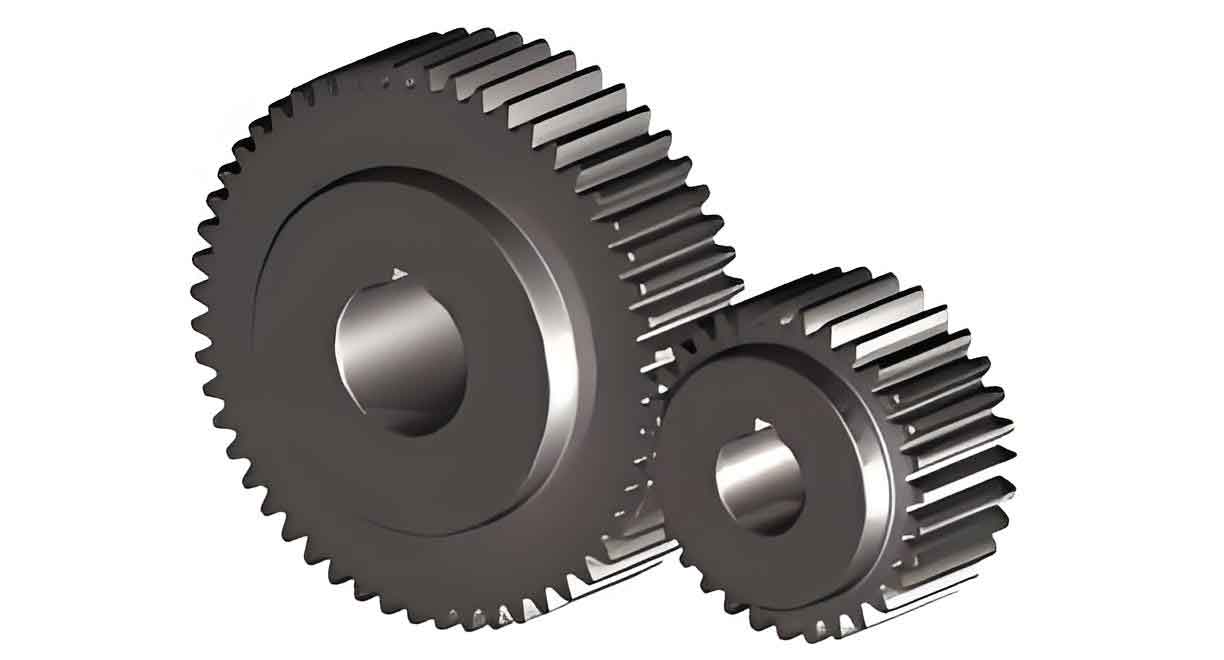
In modern engineering applications, spur gears are widely used due to their simplicity and efficiency in transmitting power between parallel shafts. The integration of polymer materials into spur gear systems has gained attention for their self-lubricating properties, low production costs, and reduced noise levels. However, polymer spur gears are prone to failure modes such as pitting under load and lubrication variations. Compared to polymer-polymer spur gear pairs, steel-polymer spur gear pairs exhibit longer service life and better thermal management. This study focuses on analyzing the elastohydrodynamic lubrication (EHL) performance of steel-polymer spur gear pairs under various operating conditions, emphasizing the role of lubrication in preventing micro-pitting failures. By evaluating film thickness ratios and oil film safety factors, I assess the lubrication state and potential micro-pitting risks in these spur gear systems.
The mathematical model for EHL in spur gears involves several key equations that describe the fluid film behavior between contacting surfaces. For line contact under steady-state isothermal conditions, the Reynolds equation governs the pressure distribution:
$$ \frac{d}{dx} \left( \frac{\rho h^3}{\eta} \cdot \frac{dp}{dx} \right) = 12u \frac{d(\rho h)}{dx} $$
where $\rho$ is the fluid density, $h$ is the film thickness, $\eta$ is the dynamic viscosity, $p$ is the pressure, and $x$ is the coordinate along the contact path. The boundary conditions are defined as $p(x_{\text{in}}) = p(x_{\text{out}}) = 0$ and $p \geq 0$ for $x_{\text{in}} < x < x_{\text{out}}$. The film thickness equation accounts for elastic deformation:
$$ h = h_0 + \frac{x^2}{2r} – \frac{2}{\pi E} \int_{-\infty}^{x} p(s) \ln(x – s)^2 ds $$
Here, $h_0$ is a constant, $r$ is the composite radius of curvature, and $E$ is the equivalent elastic modulus, given by $1/E = [(1 – \mu_1^2)/E_1 + (1 – \mu_2^2)/E_2]/2$, where $E_1$ and $E_2$ are the elastic moduli of steel and polymer, respectively, and $\mu_1$ and $\mu_2$ are their Poisson’s ratios. The viscosity-pressure relationship follows the Roelands equation:
$$ \eta = \eta_0 \exp \left\{ (\ln \eta_0 + 9.67) \left[ (1 + 5.1 \times 10^{-9} p)^{z_0} – 1 \right] \right\} $$
with $z_0 = \alpha / [5.1 \times 10^{-9} (\ln \eta_0 + 9.67)]$, where $\alpha$ is the pressure-viscosity coefficient. The density-pressure equation is:
$$ \rho = \rho_0 \left( \frac{1 + 0.6 \times 10^{-9} p}{1 + 1.7 \times 10^{-9} p} \right) $$
The load equation integrates pressure over the contact length: $\int_{-\infty}^{x} p(x) dx = C_w w$, where $w$ is the load per unit length and $C_w$ is the load sharing factor (1.0 for single-tooth contact, 0.5 for double-tooth contact). To evaluate lubrication states, the film thickness ratio $\lambda$ is defined as $\lambda = h_{\text{min}} / \sigma$, where $\sigma = \sqrt{\sigma_1^2 + \sigma_2^2}$ is the composite surface roughness, and $\sigma_1$ and $\sigma_2$ are the root mean square roughness values of the steel and polymer spur gears, respectively. A $\lambda > 3$ indicates full-film EHL, $1 < \lambda \leq 3$ mixed lubrication, and $\lambda \leq 1$ boundary lubrication. The oil film safety factor $S_\lambda = 2h_{\text{min}} / (\sigma_1 + \sigma_2)$ is used to assess micro-pitting risk, with $S_\lambda \geq 2$ indicating no micro-pitting.
In the numerical analysis, I employ a multi-grid method to solve the dimensionless forms of these equations. The dimensionless parameters are: $X = x/b$, $b = \sqrt{8w r / (\pi E)}$, $W = w / (E r)$, $G = \alpha E$, $U = u \eta_0 / (E r)$, $P = p / p_H$, $p_H = E b / (4r)$, $H = h r / b^2$, $\bar{\eta} = \eta / \eta_0$, and $\bar{\rho} = \rho / \rho_0$. A six-level grid with 961 nodes at the finest level is used, and the computational domain spans $X_{\text{in}} = -4.6$ to $X_{\text{out}} = 1.4$. The Hertzian pressure serves as the initial guess, and a W-cycle is applied for pressure relaxation. To validate the numerical approach, I compare results with Dowson’s empirical formula for minimum film thickness in spur gears:
$$ h_{\text{min}} = 2.65 \alpha^{0.54} (\eta_0 u)^{0.7} E^{-0.03} r^{0.43} w^{-0.13} $$
The gear parameters include a module of 0.003 m, pressure angles of 20°, 25°, and 30°, and materials such as steel (elastic modulus 206 GPa) and polymers like POM (2.6 GPa), PEEK (3.66 GPa), and PPS (3.5 GPa). The lubricant has a Barus pressure-viscosity coefficient of $2.2 \times 10^{-8}$ Pa$^{-1}$. Under a speed of 2,000 rpm and load of $2.0 \times 10^4$ N/m, the numerical results show close agreement with Dowson’s formula, with relative errors below 3%, confirming the method’s reliability for analyzing spur gear EHL.
The influence of different polymer materials on the EHL performance of steel-polymer spur gear pairs is significant. For spur gears with POM, PEEK, and PPS as the driven gear materials, the pressure and film thickness distributions at the meshing points reveal variations. The steel-POM spur gear pair exhibits lower maximum oil film pressure and higher minimum film thickness compared to steel-PEEK and steel-PPS pairs, due to POM’s lower elastic modulus. This results in a more stable lubricant film in steel-POM spur gears. The film thickness ratio $\lambda$ and oil film safety factor $S_\lambda$ are higher for steel-POM spur gears across the meshing cycle, indicating better lubrication states and reduced micro-pitting risk. For instance, at the approach point, steel-POM spur gears have $S_\lambda = 1.72$, whereas steel-PEEK and steel-PPS spur gears have values of 1.58 and 1.59, respectively, all below the safe threshold, highlighting the susceptibility to micro-pitting in mixed lubrication conditions.
| Polymer Material | Film Thickness Ratio ($\lambda$) | Oil Film Safety Factor ($S_\lambda$) |
|---|---|---|
| POM | 1.18 | 1.72 |
| PEEK | 0.95 | 1.58 |
| PPS | 0.92 | 1.59 |
Pressure angle alterations in spur gears directly impact the EHL characteristics. Increasing the pressure angle from 20° to 30° reduces the maximum oil film pressure and increases the minimum film thickness due to a larger composite radius of curvature. This enhances the film thickness ratio and oil film safety factor, improving the lubrication state. For example, at the approach point of steel-POM spur gears, $\lambda$ increases from 1.18 at 20° to 2.64 at 30°, and $S_\lambda$ rises from 1.72 to 3.84, transitioning from mixed to safer lubrication and eliminating micro-pitting risk. The relationship between pressure angle and film thickness can be expressed as:
$$ h_{\text{min}} \propto r^{0.43} $$
where $r$ is influenced by the pressure angle in spur gears. Thus, higher pressure angles in spur gears promote better EHL performance.
| Pressure Angle (°) | Film Thickness Ratio ($\lambda$) | Oil Film Safety Factor ($S_\lambda$) |
|---|---|---|
| 20 | 1.18 | 1.72 |
| 25 | 1.94 | 2.82 |
| 30 | 2.64 | 3.84 |
Rotational speed is a critical factor in the EHL of spur gears. As speed increases from 2,000 to 5,000 rpm, the entrainment velocity rises, strengthening the hydrodynamic effect and increasing film thickness. For steel-POM spur gears, the minimum film thickness at the approach point grows with speed, leading to higher $\lambda$ and $S_\lambda$ values. At 3,000 rpm, $\lambda$ exceeds 3 at the recess point, indicating full-film EHL, and $S_\lambda$ surpasses 2 at the approach point, ensuring no micro-pitting. The speed parameter $U$ in the dimensionless analysis highlights this dependency:
$$ H \propto U^{0.7} $$
This underscores the importance of operational speed in maintaining effective lubrication in spur gears.
| Speed (rpm) | Approach Point $\lambda$ | Single-Tooth Approach $\lambda$ | Recess Point $\lambda$ |
|---|---|---|---|
| 2,000 | 1.18 | 1.24 | 1.97 |
| 3,000 | 1.65 | 1.73 | 3.05 |
| 5,000 | 2.41 | 2.52 | 4.12 |
Load variations significantly affect the EHL behavior of spur gears. Under constant speed, increasing the load from $2.0 \times 10^4$ to $4.0 \times 10^4$ N/m reduces the minimum film thickness due to greater elastic deformation. For steel-POM spur gears at 2,000 rpm, $\lambda$ decreases from 1.18 to 0.98 at the approach point, shifting from mixed to boundary lubrication. The oil film safety factor drops below 2 at most meshing points, increasing micro-pitting risk. The load parameter $W$ influences the film thickness as:
$$ H \propto W^{-0.13} $$
This inverse relationship emphasizes that higher loads compromise lubrication in spur gears, necessitating careful design considerations.
| Load (N/m) | Approach Point $\lambda$ | Approach Point $S_\lambda$ | Recess Point $\lambda$ | Recess Point $S_\lambda$ |
|---|---|---|---|---|
| $2.0 \times 10^4$ | 1.18 | 1.72 | 1.97 | 2.86 |
| $3.0 \times 10^4$ | 1.02 | 1.48 | 1.71 | 2.49 |
| $4.0 \times 10^4$ | 0.98 | 1.43 | 1.41 | 2.04 |
Lubricant viscosity plays a vital role in the EHL performance of spur gears. Higher viscosity enhances film formation, as shown by increases in $\lambda$ and $S_\lambda$ with viscosity from 0.03 to 0.12 Pa·s. For steel-POM spur gears at 2,000 rpm and $2.0 \times 10^4$ N/m, $\lambda$ at the approach point rises from 0.63 to 2.64, and $S_\lambda$ from 0.92 to 3.84, transitioning from boundary to full-film EHL and eliminating micro-pitting risk. The viscosity effect is captured in the dimensionless parameter $U$:
$$ H \propto \eta_0^{0.7} $$
This demonstrates that selecting appropriate lubricant viscosity is crucial for optimal spur gear operation.
| Viscosity (Pa·s) | Approach Point $\lambda$ | Approach Point $S_\lambda$ | Recess Point $\lambda$ | Recess Point $S_\lambda$ |
|---|---|---|---|---|
| 0.03 | 0.63 | 0.92 | 1.05 | 1.53 |
| 0.075 | 1.18 | 1.72 | 1.97 | 2.86 |
| 0.12 | 2.64 | 3.84 | 3.12 | 4.54 |
In conclusion, the EHL analysis of steel-polymer spur gear pairs reveals that material selection, pressure angle, rotational speed, applied load, and lubricant viscosity critically influence lubrication states and micro-pitting resistance. Steel-POM spur gears exhibit superior performance with stable lubricant films under oil lubrication. To avoid pitting failures in spur gears, designers must optimize these parameters, ensuring adequate film thickness and safety factors. This study provides insights for enhancing the durability and efficiency of spur gears in practical applications.