
Spur gears are widely used in mining machinery due to their efficient power transmission and straightforward design. However, the complex contact relationships on gear tooth surfaces can lead to failures such as pitting, scuffing, and fracture, which are closely related to the dynamic variations in contact stress and bending stress. Traditional methods for calculating gear contact stress rely on static theories like Hertzian contact for spheres or cylinders, while bending strength is assessed using plate theory or the 30° tangent method. These approaches only provide static strength checks and fail to capture the dynamic stress changes during gear meshing. Finite element analysis (FEA) offers a superior alternative by simulating the entire meshing process under dynamic conditions, enabling accurate and efficient computation of contact and bending stresses. In this study, we employ Creo2.0 software to develop a parametric model of spur gears used in mining reducers and utilize ABAQUS with sub-modeling techniques to analyze dynamic contact and bending stresses. This method enhances calculation precision and supports the parametric and serialized design of spur gears.
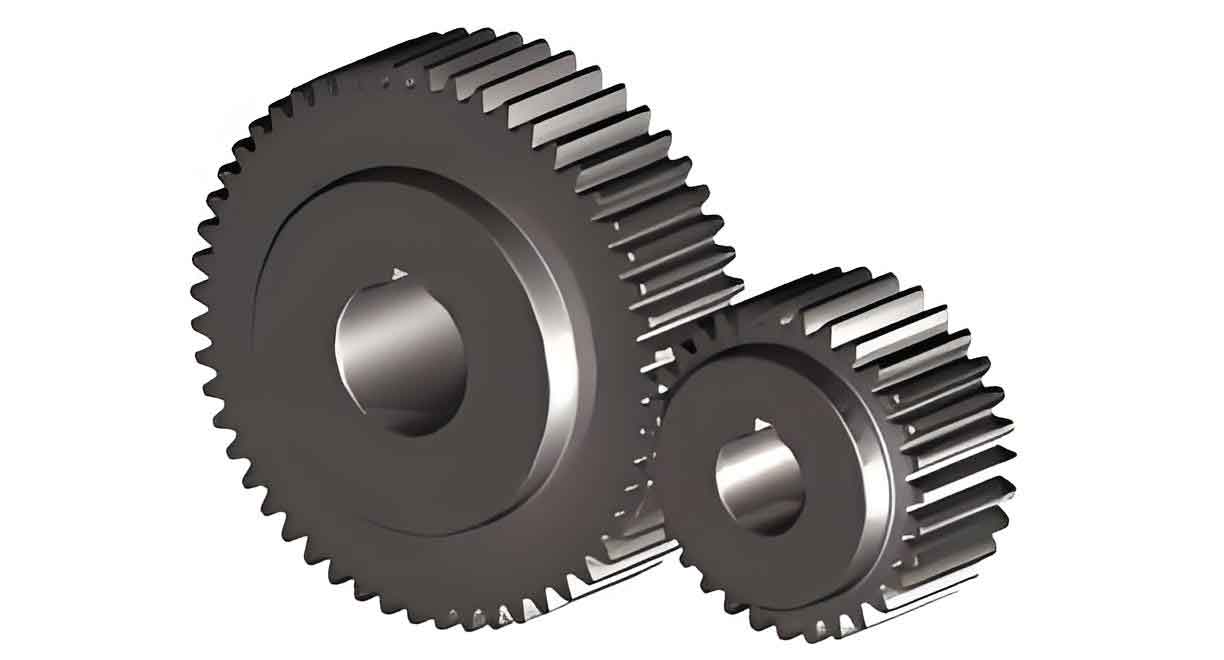
Parametric design of spur gears is essential for creating adaptable and scalable models. Using Creo2.0, we implement geometric modeling, mathematical equations, and relational controls to define key parameters. For spur gears, critical factors include module (m), number of teeth (z), pressure angle (α), face width (b), addendum coefficient (ha*), dedendum coefficient (c*), and modification coefficient (x). These parameters determine other geometric dimensions, such as pitch diameter (d), addendum diameter (da), base diameter (db), and dedendum diameter (df). The relationships are expressed as follows:
$$h_a = m(h_a^* + x)$$
$$h_f = m(h_a^* + c^* – x)$$
$$d = m z$$
$$d_a = d + 2 h_a$$
$$d_b = d \cos \alpha$$
$$d_f = d – 2 h_f$$
Here, d0 = d, d1 = db, d2 = df, and d3 = da represent intermediate variables in the modeling process. To generate the involute tooth profile, we use Cartesian coordinates with variables for the unwinding angle (θ) and a parameter t ranging from 0 to 1. The base circle radius r is defined as r = db / 2, and the involute equations are:
$$\theta = 45 t$$
$$s = \theta \frac{\pi}{180}$$
$$x = r (\cos \theta + s \sin \theta)$$
$$y = r (\sin \theta – s \cos \theta)$$
$$z = 0$$
By inputting these parameters into Creo2.0, we create detailed 3D models of both the driving and driven spur gears. The assembly is constrained using pin connections and exported in .stp format for further analysis in ABAQUS. This parametric approach allows for rapid iteration and optimization of spur gear designs, facilitating series production.
For the finite element analysis, we focus on a pair of spur gears made from 40Cr steel, with material properties including an elastic modulus of 206 GPa, Poisson’s ratio of 0.3, and density of 7.9 × 10⁻⁹ t/mm³. The gear parameters and operating conditions are summarized in the table below:
| Parameter | Driving Gear | Driven Gear |
|---|---|---|
| Number of Teeth (z) | 25 | 80 |
| Module (m) [mm] | 5 | |
| Pressure Angle (α) [°] | 20 | |
| Face Width (b) [mm] | 50 | |
| Addendum Coefficient (ha*) | 1 | |
| Dedendum Coefficient (c*) | 0.25 | |
| Input Power [kW] | 27.7 | |
| Rotational Speed [r/min] | 311 | — |
| Torque [N·m] | — | 820 |
| Transmission Ratio | 3.2 | |
In ABAQUS/Explicit, we perform a dynamic contact analysis using a sub-model technique to reduce computational cost while maintaining accuracy. The full gear model is truncated to a 5-tooth segment, and meshing is refined with C3D8R hexahedral elements. Boundary conditions include constraining five degrees of freedom (U1=U2=U3=UR1=UR2=0) at reference points coupled to the gear hubs. A rotational velocity of VR3 = 32.55 rad/s is applied to the driving spur gear, and a torque of 820 N·m is applied to the driven spur gear. Surface-to-surface contact is defined, with the driving gear as the master surface and the driven gear as the slave surface.
The dynamic analysis reveals significant insights into the stress behavior of spur gears during meshing. Contact stress distribution varies between single-tooth and double-tooth engagement zones. In double-tooth contact, the load is shared, resulting in lower stress values, whereas single-tooth contact leads to higher stress concentrations. The transition between these zones causes fluctuations in stress levels. The maximum contact stress of 579.4 MPa occurs near the pitch circle in the single-tooth engagement region, as shown in the stress distribution plots. The contact stress curve over time demonstrates periodic peaks during single-tooth engagement and relative stability in double-tooth regions, indicating reduced impact forces in the latter.
Bending stress at the tooth root follows a distinct pattern: it increases as the contact point moves from the tooth tip toward the root, peaking near the highest point of single-tooth contact (HPSTC), and then decreases as the tooth exits meshing. The bending stress curve exhibits周期性 fluctuations corresponding to the alternation between single and double-tooth engagement. The maximum bending stress of 242.1 MPa is observed at the root of the driven spur gear during critical meshing phases. This dynamic behavior underscores the importance of considering transient effects in spur gear design.
To validate the FEA results, we compare them with theoretical calculations based on established formulas. For contact stress, the Hertzian theory is adapted with load factors accounting for dynamic conditions. The load coefficient K is computed as:
$$K = K_\beta K_\varepsilon K_V K_A = 1.54$$
where Kβ = 1.262 (face load factor), Kε = 1.163 (transverse load factor), KV = 1.05 (dynamic factor), and KA = 1.00 (application factor). The contact stress σH is given by:
$$\sigma_H = Z_\varepsilon Z_H Z_E \sqrt{\frac{(\mu + 1) K F_t}{\mu b d}} = 647.51 \text{ MPa}$$
Here, Zε = 0.93 (contact ratio factor), ZH = 2.5 (zone factor), ZE = 189.812 MPa⁰·⁵ (elastic coefficient), Ft = 15,081 N (tangential load), μ = 80/25 (gear ratio), b = 50 mm (face width), and d = 125 mm (pitch diameter of driving gear). The theoretical value is higher than the FEA result (579.4 MPa), suggesting that the Hertzian approach is conservative for spur gears under dynamic loads.
For bending stress, the standard formula based on plate theory assumes full load at the tooth tip. The bending stress σF is calculated as:
$$\sigma_F = \frac{F_t K_O K_V K_S K_H K_B}{b m_t Y_J} = 227.67 \text{ MPa}$$
where KO = 1.45 (overload factor), KS = 1 (size factor), KH = 1.05 (dynamic factor), KB = 1.00 (application factor), YJ = 0.404 (geometry factor for bending), and mt = 5 mm (transverse module). The FEA result of 242.1 MPa is slightly higher, indicating that dynamic effects amplify bending stresses in spur gears.
Further analysis of spur gears involves examining the influence of key parameters on stress distributions. For instance, varying the module or pressure angle can alter the contact ratio and load sharing. The table below summarizes the effect of different parameters on maximum stresses:
| Parameter Variation | Effect on Contact Stress | Effect on Bending Stress |
|---|---|---|
| Increase Module (m) | Decreases due to larger contact area | Decreases due to thicker tooth base |
| Increase Pressure Angle (α) | Increases due to higher contact forces | Decreases due to stronger tooth geometry |
| Increase Face Width (b) | Decreases due to load distribution | Decreases due to reduced unit load |
| Addendum Modification (x) | Can optimize stress distribution | Affects root thickness and stress concentration |
Additionally, the dynamic response of spur gears can be modeled using differential equations of motion. For a pair of spur gears, the equation accounting for torsional vibration is:
$$I_1 \ddot{\theta}_1 + c (\dot{\theta}_1 – \dot{\theta}_2) + k(t) (\theta_1 – \theta_2) = T_1$$
$$I_2 \ddot{\theta}_2 – c (\dot{\theta}_1 – \dot{\theta}_2) – k(t) (\theta_1 – \theta_2) = -T_2$$
where I₁ and I₂ are mass moments of inertia, θ₁ and θ₂ are angular displacements, c is damping coefficient, k(t) is time-varying mesh stiffness, and T₁ and T₂ are torques. This formulation highlights the complexity of dynamic loading in spur gears, which FEA captures more comprehensively than static methods.
In conclusion, the dynamic finite element analysis of spur gears provides valuable insights into stress variations during meshing. The maximum contact stress occurs in the single-tooth engagement zone near the pitch circle, while the maximum bending stress is found at the tooth root during critical engagement points. The alternation between single and double-tooth contact causes stress fluctuations, with double-tooth regions offering more stable and lower stress levels. Theoretical calculations, though conservative, align reasonably with FEA results, validating the model. This approach facilitates the optimization of spur gears for mining applications, enabling designs that enhance durability and performance. Future work could explore the effects of lubrication, wear, and advanced materials on the dynamic behavior of spur gears.