
In modern mechanical transmission systems, the demand for high-speed, heavy-duty applications with low vibration and noise has driven the need for improved gear performance. High Contact Ratio (HCR) spur gears, defined as spur gears with a contact ratio greater than 2, offer significant advantages over standard spur gears by enabling more teeth to share the load during meshing. This enhances load capacity and transmission smoothness without substantially increasing the system’s weight. In this study, we investigate the coupling dynamic characteristics of HCR spur gear systems, focusing on time-varying meshing stiffness and system dynamics under various operational conditions. We develop computational models based on potential energy methods and finite element approaches to compare HCR spur gears with standard spur gears, analyzing key parameters such as dynamic meshing forces and vibration responses. Our findings demonstrate that HCR spur gears substantially reduce stiffness fluctuations and improve overall system stability, making them ideal for advanced transmission applications.
The fundamental principle behind HCR spur gears lies in their increased contact ratio, which allows for multiple tooth pairs to be engaged simultaneously during operation. For standard spur gears, the contact ratio typically ranges between 1 and 2, meaning that one or two tooth pairs are in contact at any given time. In contrast, HCR spur gears maintain a contact ratio of 2 to 3, resulting in at least two and up to three tooth pairs sharing the load. This distribution reduces stress concentrations and minimizes dynamic excitations, leading to smoother operation. The evaluation of spur gears, particularly HCR spur gears, involves calculating time-varying meshing stiffness, which is a critical factor in dynamic behavior. We employ the potential energy method to model this stiffness, considering components such as Hertzian contact, bending, shear, and axial compression, as well as gear body flexibility. The equations derived from this approach provide a comprehensive understanding of how spur gears behave under load.
To compute the single-tooth stiffness of spur gears, we model each tooth as a cantilever beam subjected to normal load. The total deformation along the line of action is represented as a series of spring deformations, leading to the following stiffness components:
$$ \frac{1}{K_h} = \frac{4(1 – \nu^2)}{\pi E b} $$
where \( K_h \) is the Hertzian contact stiffness, \( \nu \) is Poisson’s ratio, \( E \) is the elastic modulus, and \( b \) is the tooth width. The bending stiffness \( K_b \) is given by:
$$ \frac{1}{K_b} = \int_0^S \frac{(x \cos \alpha_1 – h \sin \alpha_1)^2}{E I_x} dx $$
Here, \( \alpha_1 \) is the angle between the normal load and tooth thickness direction, \( I_x \) is the area moment of inertia, \( h \) is half the tooth thickness at the load point, \( S \) is the distance from the load point to the root circle along the tooth height, and \( dx \) is an infinitesimal length along the tooth height. The shear stiffness \( K_s \) and axial compression stiffness \( K_a \) are expressed as:
$$ \frac{1}{K_s} = \int_0^S \frac{1.2 \cos^2 \alpha_1}{G A_x} dx $$
$$ \frac{1}{K_a} = \int_0^S \frac{\sin^2 \alpha_1}{E A_x} dx $$
where \( G \) is the shear modulus, and \( A_x \) is the cross-sectional area. Additionally, the gear body flexibility stiffness \( K_f \) is calculated as:
$$ \frac{1}{K_f} = \frac{\delta_f}{F} $$
with \( \delta_f \) being the deformation of the gear body under load \( F \). The overall single-tooth meshing stiffness \( K_e \) for a spur gear pair is then:
$$ K_e = \frac{1}{\frac{1}{K_h} + \frac{1}{K_{b1}} + \frac{1}{K_{a1}} + \frac{1}{K_{s1}} + \frac{1}{K_{f1}} + \frac{1}{K_{b2}} + \frac{1}{K_{s2}} + \frac{1}{K_{a2}} + \frac{1}{K_{f2}}} $$
where subscripts 1 and 2 denote the driving and driven spur gears, respectively. For HCR spur gears, the total meshing stiffness is derived by superimposing the stiffness of multiple engaged tooth pairs, modeled as parallel springs. This results in a higher and more stable composite stiffness compared to standard spur gears, as illustrated in the following comparison.
| Parameter | HCR Spur Gears (ε = 2.3719) | Standard Spur Gears (ε = 1.5549) |
|---|---|---|
| Module m (mm) | 2.75 | 2.75 |
| Driving Gear Teeth z1 | 36 | 36 |
| Driven Gear Teeth z2 | 61 | 61 |
| Pressure Angle α (°) | 18.0 | 24.0 |
| Addendum Coefficient h*_a | 1.3283 | 1.0 |
| Driving Gear Shift Coefficient x1 | 0.250 | 0.250 |
| Driven Gear Shift Coefficient x2 | -0.383 | -0.383 |
| Tooth Width b (mm) | 33 | 33 |
| Driving Gear Bore Radius R_int1 (mm) | 25 | 25 |
| Driven Gear Bore Radius R_int2 (mm) | 40 | 40 |
The calculated stiffness values for HCR spur gears and standard spur gears are summarized below:
| Stiffness Type | HCR Spur Gears (N/mm) | Standard Spur Gears (N/mm) |
|---|---|---|
| Single-Tooth Stiffness Max | 537,620 | 615,838 |
| Single-Tooth Stiffness Min | 255,063 | 328,921 |
| Single-Tooth Stiffness Avg | 453,340 | 533,933 |
| Composite Stiffness Max | 1,286,885 | 1,037,805 |
| Composite Stiffness Min | 920,083 | 578,372 |
| Composite Stiffness Avg | 1,106,679 | 895,805 |
As shown, HCR spur gears exhibit lower single-tooth stiffness but higher composite stiffness, with reduced fluctuations. Specifically, the maximum, minimum, and average composite stiffness values for HCR spur gears are approximately 24.0%, 59.08%, and 23.56% higher than those for standard spur gears, respectively. Moreover, the peak-to-peak stiffness variation and overall stiffness fluctuation decrease by about 21.44% and 13.6%, highlighting the superiority of HCR spur gears in minimizing dynamic excitations.
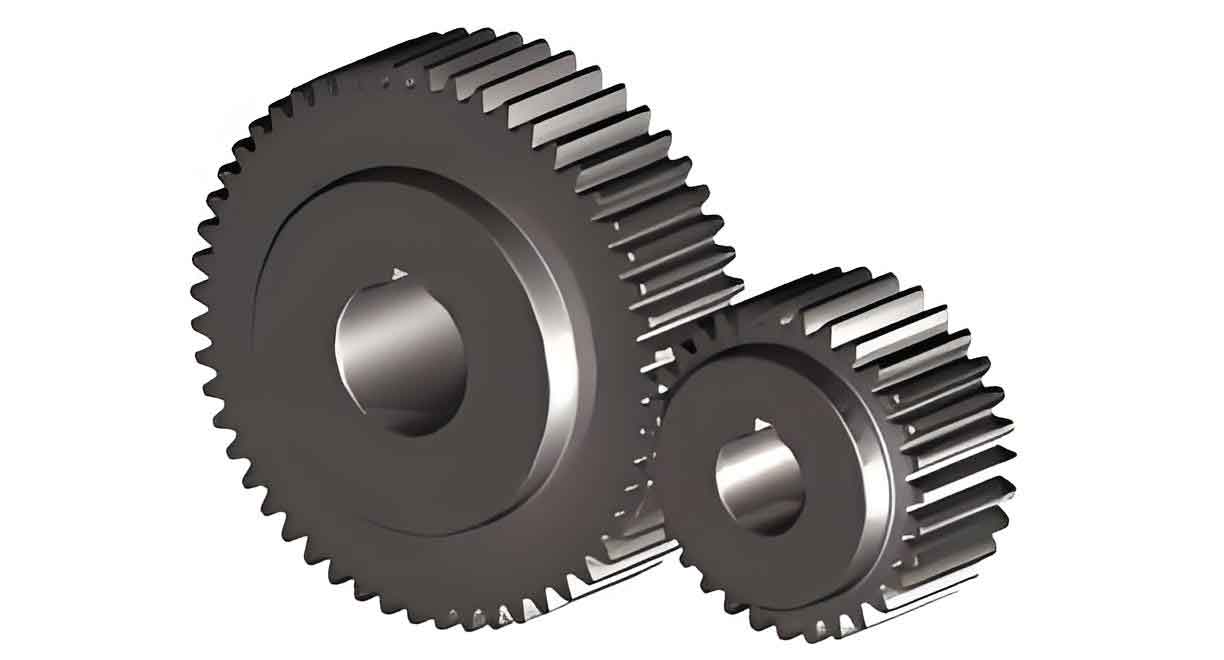
To analyze the dynamic behavior of spur gear systems, we develop a coupled dynamics model that includes shaft segments, spur gear pairs, and bearings. The system is discretized using finite elements, with Timoshenko beam elements representing shaft segments to account for shear deformation. Each shaft element has two nodes, with six degrees of freedom per node: translations along x, y, z axes and rotations about these axes. The displacement vector for a shaft element is:
$$ \mathbf{X}_S = \left( \mathbf{X}_{S_j}, \mathbf{X}_{S_{j+1}} \right)^T $$
where \( \mathbf{X}_{S_j} = (x_j, y_j, z_j, \theta_{x_j}, \theta_{y_j}, \theta_{z_j})^T \) and similarly for node j+1. The mass matrix \( \mathbf{M}_S \), stiffness matrix \( \mathbf{K}_S \), and damping matrix \( \mathbf{C}_S \) for the shaft element are derived as:
$$ \mathbf{M}_S = \rho A a \begin{bmatrix} \mathbf{m}_{s1} & \mathbf{m}_{s2} \\ \mathbf{m}_{s3} & \mathbf{m}_{s4} \end{bmatrix} $$
$$ \mathbf{K}_S = \begin{bmatrix} \mathbf{k}_{s1} & \mathbf{k}_{s2} \\ \mathbf{k}_{s3} & \mathbf{k}_{s4} \end{bmatrix} $$
$$ \mathbf{C}_S = p \mathbf{M}_S + q \mathbf{K}_S $$
Here, \( \rho \) is material density, \( A \) is cross-sectional area, \( a \) is element length, and \( p \), \( q \) are Rayleigh damping coefficients calculated from system natural frequencies and damping ratios. The equation of motion for a shaft element is:
$$ \mathbf{M}_S \ddot{\mathbf{X}}_S + \mathbf{C}_S \dot{\mathbf{X}}_S + \mathbf{K}_S \mathbf{X}_S = 0 $$
For the spur gear meshing element, we model the interaction between driving and driven spur gears. The relative displacement along the line of action is given by:
$$ \delta = \mathbf{V}_G \mathbf{X}_G $$
where \( \mathbf{X}_G \) is the displacement vector of the gear pair, and \( \mathbf{V}_G \) is the meshing matrix. For spur gears, the meshing matrix incorporates parameters such as pressure angle and base circle radii. The equations of motion for the meshing element are derived using Newton’s second law:
$$ \mathbf{M}_G \ddot{\mathbf{X}}_G + \mathbf{C}_G \dot{\mathbf{X}}_G + \mathbf{K}_G \mathbf{X}_G = \mathbf{F}_G $$
Here, \( \mathbf{M}_G \), \( \mathbf{C}_G \), and \( \mathbf{K}_G \) are the mass, damping, and stiffness matrices of the spur gear pair, respectively, and \( \mathbf{F}_G \) is the external force vector including input and output torques. The stiffness matrix \( \mathbf{K}_G \) incorporates the time-varying meshing stiffness computed earlier for HCR spur gears and standard spur gears.
Bearings are modeled as spring-damper elements with stiffness and damping matrices. The bearing stiffness matrix \( \mathbf{K}_B \) is:
$$ \mathbf{K}_B = \begin{bmatrix}
k_{xx} & k_{xy} & k_{xz} & k_{x\theta_x} & k_{x\theta_y} & 0 \\
k_{yx} & k_{yy} & k_{yz} & k_{y\theta_x} & k_{y\theta_y} & 0 \\
k_{zx} & k_{zy} & k_{zz} & k_{z\theta_x} & k_{z\theta_y} & 0 \\
k_{\theta_x x} & k_{\theta_x y} & k_{\theta_x z} & k_{\theta_x \theta_x} & k_{\theta_x \theta_y} & 0 \\
k_{\theta_y x} & k_{\theta_y y} & k_{\theta_y z} & k_{\theta_y \theta_x} & k_{\theta_y \theta_y} & 0 \\
0 & 0 & 0 & 0 & 0 & 0
\end{bmatrix} $$
where terms like \( k_{xx} \) and \( k_{yy} \) represent radial stiffness, \( k_{zz} \) axial stiffness, and \( k_{\theta_x \theta_x} \) torsional stiffness. The bearing dynamics equation is:
$$ \mathbf{M}_B \ddot{\mathbf{X}}_B + \mathbf{C}_B \dot{\mathbf{X}}_B + \mathbf{K}_B \mathbf{X}_B = 0 $$
The overall system dynamics model is assembled by combining shaft, spur gear meshing, and bearing elements. The global equation of motion is:
$$ \mathbf{M} \ddot{\mathbf{X}}(t) + \mathbf{C} \dot{\mathbf{X}}(t) + \mathbf{K} \mathbf{X}(t) = \mathbf{F}(t) $$
where \( \mathbf{M} \), \( \mathbf{C} \), and \( \mathbf{K} \) are the system-level mass, damping, and stiffness matrices, \( \mathbf{X}(t) \) is the displacement vector, and \( \mathbf{F}(t) \) is the external excitation vector.
We analyze the dynamic characteristics of HCR spur gear systems and standard spur gear systems under varying rotational speeds from 1,000 to 15,000 rpm. Key performance metrics include dynamic meshing force and vibration acceleration. The dynamic meshing force is evaluated in terms of Root Mean Square (RMS) and peak-to-peak values. For HCR spur gears, the RMS and peak-to-peak values of dynamic meshing force are significantly lower than those for standard spur gears across all speeds. At 3,000 rpm, the maximum reductions are observed: 20.39% for RMS and 75.61% for peak-to-peak values. Even at lower speeds, such as 1,000 rpm, the RMS reduction is 9.10%, and at 5,000 rpm, the peak-to-peak reduction is 3.97%, demonstrating the consistent benefits of HCR spur gears.
Vibration acceleration is measured at four points on the gearbox housing, located above the bearing positions. The RMS and peak-to-peak values of acceleration in X and Y directions are compared. For all measurement points, HCR spur gear systems exhibit substantial reductions in vibration acceleration. For instance, at point 1 and 3,000 rpm, the RMS reductions in X and Y directions are 75.56% and 76.97%, respectively, with peak-to-peak reductions of 67.14% and 75.12%. Similar trends are observed at other points, with maximum reductions at point 4 (82.09% RMS in X-direction) and point 2 (77.43% peak-to-peak in Y-direction). At higher speeds, such as 15,000 rpm, the reductions are smaller but still notable, e.g., 5.77% peak-to-peak at point 2 in X-direction.
The following table summarizes the vibration acceleration reductions for HCR spur gears compared to standard spur gears at selected speeds:
| Measurement Point | Direction | Speed (rpm) | RMS Reduction (%) | Peak-to-Peak Reduction (%) |
|---|---|---|---|---|
| Point 1 | X | 3,000 | 75.56 | 67.14 |
| Point 1 | Y | 3,000 | 76.97 | 75.12 |
| Point 2 | X | 3,000 | 76.66 | 69.08 |
| Point 2 | Y | 3,000 | 78.75 | 77.43 |
| Point 3 | X | 3,000 | 80.98 | 69.81 |
| Point 3 | Y | 3,000 | 76.97 | 75.12 |
| Point 4 | X | 3,000 | 82.09 | 76.45 |
| Point 4 | Y | 3,000 | 78.75 | 77.43 |
These results underscore the effectiveness of HCR spur gears in enhancing dynamic performance. The reduced stiffness fluctuations and higher composite stiffness in HCR spur gears lead to lower dynamic meshing forces and vibrations, which are critical for high-speed applications. The mathematical models and simulations confirm that HCR spur gears provide a robust solution for improving the reliability and efficiency of gear transmission systems.
In conclusion, our analysis demonstrates that HCR spur gears outperform standard spur gears in terms of dynamic characteristics. The increased contact ratio in HCR spur gears allows for more teeth to engage simultaneously, reducing single-tooth stiffness but increasing composite stiffness and minimizing stiffness variations. This results in significant reductions in dynamic meshing forces and vibration accelerations across a wide range of speeds. The coupling dynamics model, incorporating shaft flexibility and bearing effects, provides a comprehensive framework for evaluating spur gear systems. Future work could explore optimized tooth profiles for HCR spur gears or extend the analysis to helical and other gear types. Overall, HCR spur gears represent a promising advancement in transmission technology, offering improved load capacity and smoother operation for demanding mechanical applications.