
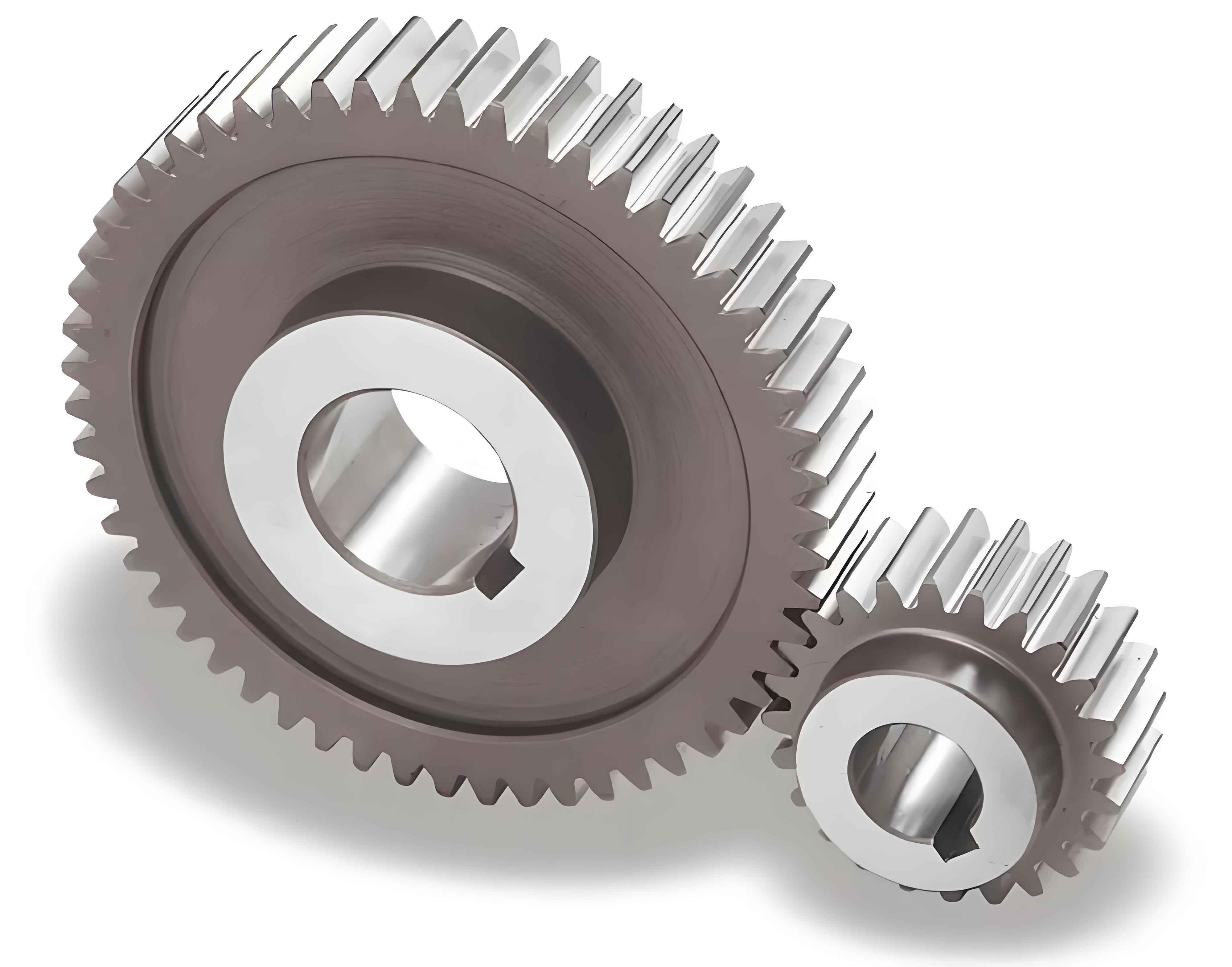
In modern manufacturing, spur gears play a critical role in power transmission systems due to their simplicity and efficiency. Traditional machining methods like hobbing or shaping often compromise gear fatigue strength by severing metal flow lines. To address this, rolling forming technology has emerged as a near-net-shape process that enhances material utilization and improves mechanical properties by preserving continuous metal flow. This study focuses on the numerical simulation of spur gear rolling forming, specifically analyzing the formation mechanisms of defects like lugs and exploring control strategies through process parameter optimization. We employ finite element analysis to model the rolling process, derive key equations for gear tooth geometry, and investigate the influence of factors such as friction on defect formation. By integrating theoretical derivations with simulation results, we aim to provide a comprehensive framework for improving spur gear manufacturing quality and efficiency.
The rolling forming process for spur gears involves three distinct stages: initial tooth splitting, forming, and finishing. During the splitting stage, the mold wheel indents the blank to create preliminary tooth profiles. In the forming stage, radial feed increases to plastically deform the outer material into the desired tooth shape. Finally, the finishing stage involves alternating rotations without further feed to refine the tooth geometry and minimize subsequent machining. This process ensures that metal flow lines remain intact, significantly enhancing the fatigue life of spur gears compared to conventional methods. To accurately model this, we first derive the tooth surface equations for spur gears based on involute geometry, which serves as the foundation for numerical simulations.
The coordinate system for an involute spur gear is defined in the end face, where the profile consists of symmetric involute curves. For a base circle radius \( r_b \), and an initial angle \( \theta_0 \), the parametric equations for the left and right involute curves can be expressed as follows. Let \( \theta_s \) be the roll angle parameter, and \( u_a \) represent the axial position coordinate. The tooth surface vector \( \mathbf{r}_a(\theta_s, u_a) \) is given by:
$$ \mathbf{r}_a(\theta_s, u_a) = \begin{bmatrix} X_a \\ Y_a \\ Z_a \\ 1 \end{bmatrix} = \begin{bmatrix} \pm \left[ r_b \sin(\theta_0 + \theta_s) – \theta_s \cos(\theta_0 + \theta_s) \right] \\ -r_b \cos(\theta_0 + \theta_s) + \theta_s \sin(\theta_0 + \theta_s) \\ u_a \\ 1 \end{bmatrix} $$
Here, the \( \pm \) sign corresponds to the left and right involutes, respectively. This equation allows for the computation of points on the tooth surface, which are essential for constructing the 3D model of the mold wheel and blank. Using MATLAB, we generate coordinate points for the mold wheel profile based on standard spur gear parameters, such as module, pressure angle, and number of teeth. For instance, the target spur gear and mold wheel parameters are summarized in the table below:
| Parameter | Target Gear | Mold Wheel |
|---|---|---|
| Module (mm) | 2 | 2 |
| Pressure Angle (°) | 20 | 20 |
| Number of Teeth | 19 | 53 |
| Addendum Coefficient | 1 | 1 |
| Dedendum Coefficient | 0.25 | 0.25 |
These points are imported into UG software to fit surfaces and assemble the rolling process model. The volume constancy principle is applied to determine the initial blank dimensions, ensuring that the cross-sectional area remains constant before and after deformation. For example, if the deformed tooth area is \( A_2 \), the initial blank area \( A_1 \) is set equal to \( A_2 \), leading to the calculation of the blank diameter assuming axial dimensions remain unchanged.
For numerical simulation, we use DEFORM-3D software to model the hot rolling process of spur gears. The mold wheels are treated as rigid bodies, while the blank is considered a rigid-plastic material with homogeneous properties. The simulation assumes a constant friction coefficient and stable environmental temperature. To reduce computational cost, we analyze half of the blank and introduce a central hole for motion settings. The mesh is refined in the deformation zone (outer 4 mm thickness) with a ratio of 0.01, totaling 101,536 elements. Boundary conditions include symmetry constraints on the mid-plane and fixed velocities in X, Y, and Z directions on the inner surface to prevent slippage. The mold wheels are set with a radial feed speed of 0.1 mm/s, a rotation speed of 2.2525 rad/s around their axis, and a revolution speed of 6.2832 rad/s around the blank’s Y-axis. Key simulation parameters are listed below:
| Parameter | Value |
|---|---|
| Blank Temperature (°C) | 950 |
| Mold Wheel Temperature (°C) | 20 |
| Initial Feed (mm) | 0.3 |
| Friction Coefficient | 0.3 |
The simulation results reveal the evolution of equivalent strain and stress fields during the rolling stages. At 30% feed depth, the equivalent strain is concentrated in the tooth root region, with maximum values occurring near the mid-point of the tooth profile偏向 the root. As the feed increases to 60% and 100%, the strain distribution expands, but the peak remains in the same area. The equivalent stress follows a similar pattern, starting at approximately 309 MPa in the splitting stage and rising to 347 MPa at full feed due to increased plastic deformation. During finishing, the stress stabilizes around 250 MPa as the material undergoes elastic recovery. The strain and stress analysis highlights that the maximum deformation occurs where the mold wheel teeth compress the blank, leading to work hardening in critical zones of the spur gears.
Rolling force analysis shows dynamic variations in X, Y, and Z directions over time. The forces in X and Z directions exhibit significant fluctuations, increasing with feed depth due to greater material resistance. In contrast, the Y-direction force is negligible, as it represents the axial component, which is minimal in this setup. The overall rolling force trend is upward, consistent with prior studies on gear rolling, validating our approach for spur gears. The force curves can be approximated by the following relation, where \( F(t) \) is the rolling force at time \( t \), and \( k \) is a material-dependent constant:
$$ F(t) = k \cdot \delta(t) $$
Here, \( \delta(t) \) represents the instantaneous feed depth. This equation underscores the proportionality between force and deformation, emphasizing the need for precise control in spur gear rolling processes.
A critical defect in spur gear rolling is the formation of lugs, which are protrusions at the tooth tips caused by excessive metal flow. The mechanism involves frictional forces directing material toward the tooth crest during engagement and disengagement of the mold wheels. When a mold wheel tooth separates from the blank, the frictional force \( f \) acts upward, pulling material and forming lugs. This is influenced by process parameters like friction coefficient, feed speed, and rotational speeds. To quantify lugs, we define an evaluation index based on the volume ratio of the lug to the entire tooth at 55% feed depth, where lug formation is most prominent. The formula is:
$$ F_0 = \frac{\sum_{i=1}^{n} \left( \frac{V_i^0}{V_i} \times 100 \right)}{n} \% $$
where \( V_i^0 \) is the lug volume of the \( i \)-th tooth, \( V_i \) is the total tooth volume, and \( n \) is the number of teeth. This metric allows for consistent comparison across different rolling conditions.
We investigate the effect of friction coefficient on lug volume by simulating rolling with values of 0.1, 0.2, and 0.3. The results, summarized in the table below, show that higher friction increases lug volume due to enhanced frictional forces driving material upward. For instance, at a friction coefficient of 0.1, the lug volume percentage is 16.63%, rising to 18.51% at 0.3. This trend aligns with findings in other gear types, confirming the role of friction in defect formation for spur gears. Optimizing lubrication to reduce friction can thus mitigate lugs, improving the quality of rolled spur gears.
| Friction Coefficient | Lug Volume (%) |
|---|---|
| 0.1 | 16.63 |
| 0.2 | 17.01 |
| 0.3 | 18.51 |
In conclusion, this study provides a detailed analysis of spur gear rolling forming through numerical simulation and defect control. We derive the tooth surface equations, simulate the process using DEFORM-3D, and analyze strain, stress, and rolling forces. Our results indicate that maximum strain occurs at the tooth root mid-point, while stress peaks at the mold wheel-blank contact. Lug defects are primarily driven by frictional forces, and optimizing the friction coefficient can significantly reduce their volume. This work establishes a theoretical foundation for enhancing spur gear manufacturing, emphasizing the importance of parameter control in achieving high-quality, durable gears. Future research could explore thermal effects and dynamic recrystallization to further refine the process for spur gears.