
Spur gears are widely used in mechanical transmission systems due to their high efficiency, compact structure, and reliable operation. However, tooth surface pitting, as one of the most common failures, directly affects the time-varying meshing stiffness (TVMS) of spur gear pairs, leading to changes in dynamic characteristics. In this study, we model each pitting defect as part of an elliptical cylinder and define three damage levels—slight pitting, moderate pitting, and severe pitting—based on the distribution and number of pits. Using the potential energy method, we calculate the TVMS for both healthy and pitted spur gears, analyzing the effects of pit position and size. Furthermore, we investigate the dynamic response of a single-stage spur gear transmission system and qualitatively validate the results with experimental data. Our findings indicate that the proposed pitting model closely matches real-world scenarios, providing a theoretical basis for fault detection and diagnosis in spur gear systems.
The dynamic behavior of spur gears is significantly influenced by the TVMS, which varies due to the alternating single and double tooth meshing and changes in contact position. When pitting occurs, it alters the effective tooth width, cross-sectional area, and moment of inertia, thereby reducing the TVMS. We consider the spur gear tooth as a cantilever beam starting from the base circle and approximate pitting shapes as elliptical cylinders. The total pitted area is treated as the union of multiple elliptical cylinders, addressing potential overlaps that are often overlooked in existing research. For spur gears, the driving gear, with fewer teeth, is more prone to fatigue damage; thus, we assume pitting exists on one tooth of the driving gear while other teeth and the driven gear remain healthy.
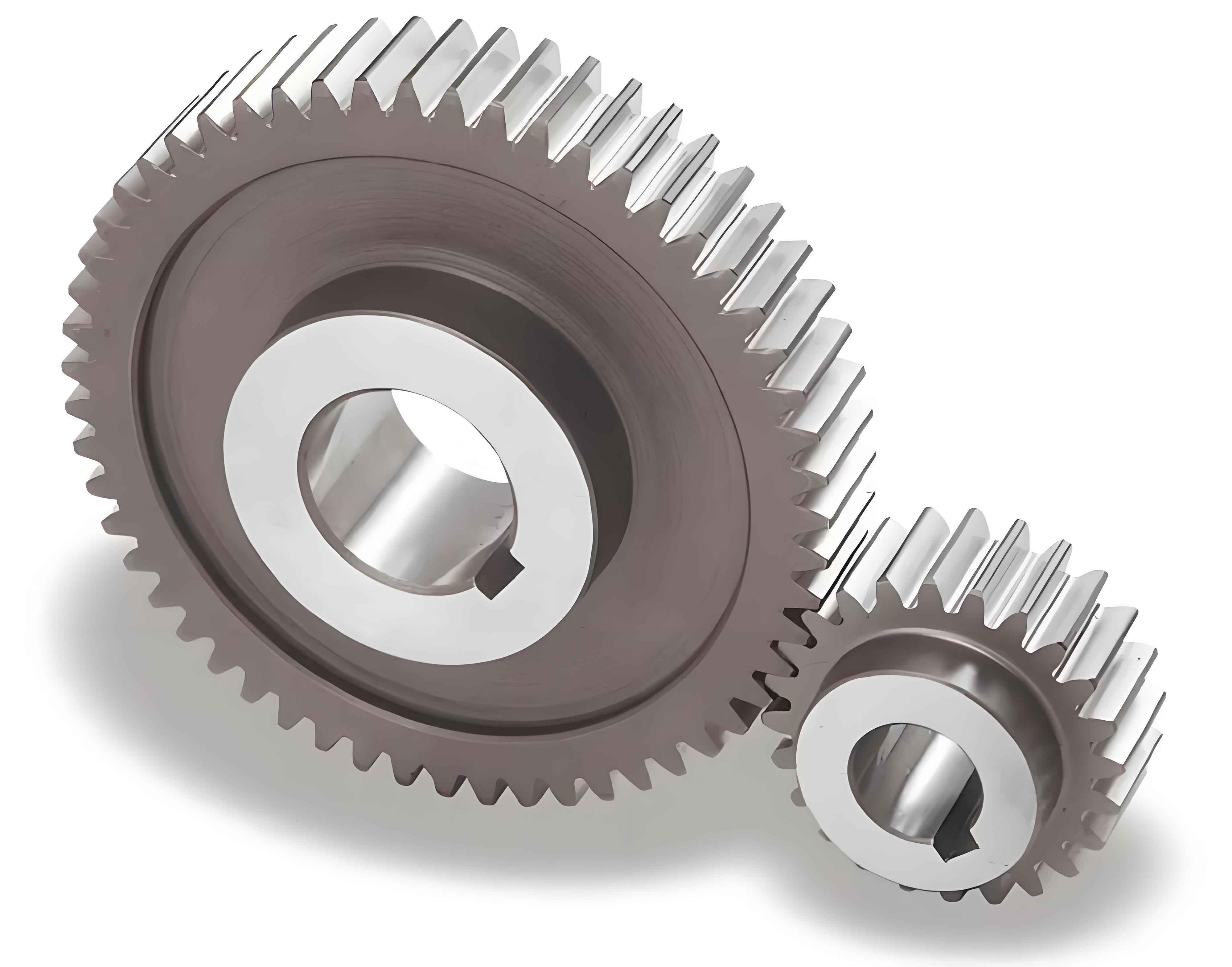
To compute the TVMS, we employ the potential energy method, which accounts for Hertzian contact energy, bending deformation energy, shear deformation energy, axial compression energy, and gear body flexibility energy. The stiffness components—Hertzian contact stiffness \(k_h\), bending stiffness \(k_b\), shear stiffness \(k_s\), axial compression stiffness \(k_a\), and fillet foundation stiffness \(k_f\)—are derived as follows:
$$ \frac{1}{k_h} = \frac{4(1 – \nu^2)}{\pi E L} $$
$$ \frac{1}{k_b} = \int_0^d \frac{[F_b (d – x) – F_a h]^2}{2E I_x} dx $$
$$ \frac{1}{k_s} = \int_0^d \frac{1.2 F_b^2}{2G A_x} dx $$
$$ \frac{1}{k_a} = \int_0^d \frac{F_a^2}{2E A_x} dx $$
$$ \frac{1}{k_f} = \frac{\cos^2 \alpha}{E L} \left[ L^* \left( \frac{u_f}{s_f} \right)^2 + M^* \left( \frac{u_f}{s_f} \right) + P^* (1 + Q^* \tan^2 \alpha) \right] $$
where \(E\) is the elastic modulus, \(\nu\) is Poisson’s ratio, \(L\) is the tooth width, \(d\) is the distance from the base circle to the contact point, \(F_a\) and \(F_b\) are the axial and bending forces, \(h\) is the tooth height, \(I_x\) is the area moment of inertia, \(A_x\) is the cross-sectional area, \(G\) is the shear modulus, \(\alpha\) is the pressure angle, and \(u_f\), \(s_f\), \(L^*\), \(M^*\), \(P^*\), \(Q^*\) are geometric parameters for the fillet foundation.
For pitted spur gears, the effective tooth width reduction \(\Delta L\) is calculated based on the pitting geometry. For slight pitting:
$$ \Delta L = 2\Delta L^- + 7\Delta L^\sim $$
For moderate pitting:
$$ \Delta L = 2\Delta L^- + 16\Delta L^\sim $$
For severe pitting:
$$ \Delta L = \Delta L_1 + \Delta L_2 $$
where \(\Delta L^-\), \(\Delta L^\sim\), \(\Delta L_1\), and \(\Delta L_2\) are defined piecewise based on the position along the tooth profile. The effective cross-sectional area \(A_{x\_pit}\) and moment of inertia \(I_{x\_pit}\) are then:
$$ A_{x\_pit} = A_x – \Delta A_x, \quad \Delta A_x = \Delta L \delta $$
$$ I_{x\_pit} = I_x – \Delta I_x, \quad \Delta I_x = \frac{1}{12} \Delta L \delta^3 + \frac{A_x \Delta A_x (h_x – \delta/2)^2}{A_x – \Delta A_x} $$
Here, \(\delta\) is the pitting depth. The stiffness components for pitted teeth are adjusted accordingly, e.g.,
$$ \frac{1}{k_{h\_pit}} = \frac{4(1 – \nu^2)}{\pi E (L – \Delta L)} \quad \text{for} \quad x \in \text{pitted region} $$
The total TVMS for a spur gear pair with pitting is derived by combining the stiffnesses of the driving and driven gears, considering single and double tooth contact periods.
We analyze the influence of pitting on TVMS by varying the position parameter \(u\) (distance from base circle to pitting center) and the elliptical axes lengths \(a\) (major axis) and \(b\) (minor axis). The following table summarizes the key parameters used in our analysis for spur gears:
| Parameter | Driving Gear | Driven Gear |
|---|---|---|
| Number of teeth \(z\) | 19 | 48 |
| Elastic modulus \(E\) (GPa) | 206.8 | 206.8 |
| Poisson’s ratio \(\nu\) | 0.3 | 0.3 |
| Module \(m\) (mm) | 3.2 | 3.2 |
| Tooth width \(L\) (mm) | 16 | 16 |
| Pressure angle \(\alpha_0\) (°) | 20 | 20 |
Our results show that as the pitting position parameter \(u\) increases, the pitted area shifts from the base circle toward the tooth tip. For instance, with \(u = 1.9\) mm, \(a = 0.3\) mm, \(b = 0.2\) mm, and \(\delta = 0.4\) mm, the TVMS decreases significantly when the contact point traverses the pitted region. The reduction in TVMS is more pronounced for longer major axis lengths \(a\), as it increases the effective tooth width reduction. In contrast, variations in the minor axis length \(b\) affect the span of the pitted area along the tooth profile but do not alter the magnitude of TVMS reduction within the same angular displacement range.
The dynamic response of the spur gear system is evaluated using a four-degree-of-freedom model that includes torsional vibrations of the gears and vertical translations of the supporting bearings. The equations of motion are:
$$ I_1 \ddot{\theta}_1 + c (\dot{\theta}_1 – \dot{\theta}_2) + k_t(t) R_1 (R_1 \theta_1 – R_2 \theta_2 – y_1 + y_2) = T_1 $$
$$ I_2 \ddot{\theta}_2 – c (\dot{\theta}_1 – \dot{\theta}_2) – k_t(t) R_2 (R_1 \theta_1 – R_2 \theta_2 – y_1 + y_2) = -T_2 $$
$$ m_1 \ddot{y}_1 + c_{y1} \dot{y}_1 + k_{y1} y_1 – k_t(t) (R_1 \theta_1 – R_2 \theta_2 – y_1 + y_2) = 0 $$
$$ m_2 \ddot{y}_2 + c_{y2} \dot{y}_2 + k_{y2} y_2 + k_t(t) (R_1 \theta_1 – R_2 \theta_2 – y_1 + y_2) = 0 $$
where \(I_1\), \(I_2\) are moments of inertia, \(R_1\), \(R_2\) are base circle radii, \(m_1\), \(m_2\) are masses, \(c\) is damping, \(k_{y1}\), \(k_{y2}\) are bearing stiffnesses, and \(T_1\), \(T_2\) are torques. The TVMS \(k_t(t)\) is incorporated as a time-varying function derived from the pitting model.
We simulate the system under an input shaft speed of 30 Hz and analyze the frequency domain response. The following table compares the TVMS reduction for different pitting levels in spur gears:
| Pitting Level | TVMS Reduction Range | Angular Displacement Interval |
|---|---|---|
| Slight | 5-10% | 15.64° – 17.99° |
| Moderate | 10-15% | 15.64° – 17.99° |
| Severe | 15-20% | 15.64° – 20.05° |
The frequency spectrum of the vertical acceleration response shows dominant meshing frequency \(f_m\) and its higher harmonics. For healthy spur gears, the response is smooth, but pitting introduces sidebands around \(f_m\) and its harmonics, spaced at the input shaft frequency. As pitting severity increases, the sideband amplitudes grow, indicating fault progression. Experimental validation using a drivetrain dynamics simulator confirms these trends, with measured data showing increased sideband activity for pitted spur gears.
In conclusion, our study demonstrates that tooth pitting in spur gears significantly impacts TVMS and dynamic response. The elliptical cylinder-based pitting model effectively captures the stiffness reduction, and the dynamic analysis reveals characteristic frequency sidebands that can be used for fault diagnosis. This work provides a foundation for monitoring and maintaining spur gear systems in practical applications.