
In the field of mechanical design, engineering drawings serve as critical blueprints for translating conceptual designs into tangible products. These drawings provide comprehensive information about the shape, dimensions, geometric features, and tolerance requirements of components, such as spur gears. However, a significant challenge arises when converting these 2D representations into 3D models, particularly in accurately expressing tolerances like shape tolerances and surface roughness. Traditional methods often struggle with unclear tolerance representation in 3D models, leading to potential inefficiencies in manufacturing and communication. To address this, I propose a novel approach for reconstructing 3D models of spur gears directly from DXF files, leveraging advanced algorithms to extract and interpret key information, including dimensions and tolerances.
My method focuses on automating the reconstruction process by analyzing DXF files, which are widely used for storing CAD data. The core idea involves extracting entity information (e.g., lines, circles, arcs) and annotation data (e.g., dimensions, tolerances) from the DXF file, clustering these elements into respective views using K-means algorithm, and then employing a BP neural network to identify critical parameters of the spur gear. Additionally, I utilize normalized cross-correlation template matching to recognize geometric tolerances, and finally, implement parametric modeling in SolidWorks via VBA to generate a 3D model that incorporates key tolerance information. This approach not only enhances the clarity of tolerance expression in 3D models but also streamlines the design-to-manufacturing workflow for spur gears.
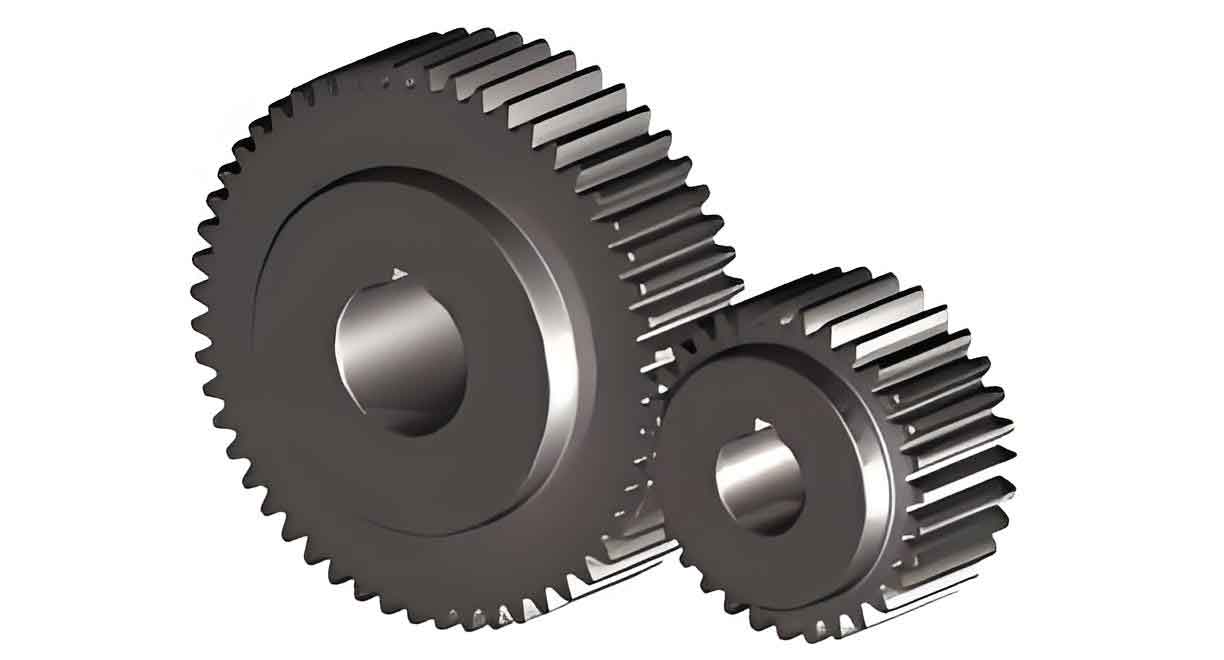
The reconstruction of spur gears from DXF files begins with a detailed extraction of entity and annotation information. DXF files contain various sections, such as entities for geometric elements and blocks for annotations. I parse these sections to retrieve data on lines, circles, arcs, and dimensions. For instance, dimension annotations include types (e.g., linear, radial, angular), leader coordinates, and text values, which are essential for determining the spur gear’s key features like addendum circle diameter, tooth thickness, and root circle diameter. Similarly, surface roughness symbols and datum indicators are extracted based on standardized patterns, such as those defined in GB/T 131-2006, by calculating intersection points and distances between connected entities. This initial step ensures that all relevant data is gathered for subsequent processing.
To organize the extracted entities into distinct views (e.g., front, side, top), I apply the K-means clustering algorithm. This unsupervised machine learning technique groups entities based on their spatial proximity to view center points, which are derived from the intersections of center lines. The algorithm works by initializing cluster centroids at these center points and iteratively assigning entities to the nearest centroid based on Euclidean distance. The objective function minimizes the within-cluster variance, defined as:
$$J = \sum_{i=1}^{k} \sum_{x \in C_i} \|x – \mu_i\|^2$$
where $k$ is the number of clusters (views), $C_i$ represents the set of entities in cluster $i$, $x$ is the coordinate vector of an entity, and $\mu_i$ is the centroid of cluster $i$. This clustering step effectively segregates elements like lines, circles, and annotations into their respective views, facilitating accurate 3D reconstruction. For spur gears, this ensures that features such as the gear profile and keyway are correctly associated with their intended projections.
Next, I employ a BP neural network to predict the critical parameters of the spur gear from the extracted annotation and entity data. The neural network consists of an input layer, multiple hidden layers, and an output layer. The hidden layers use the Xavier initialization method for weights, which helps in maintaining stable gradients during training. The initialization formula is:
$$w \sim U\left[-\frac{\sqrt{6}}{\sqrt{n_{\text{in}} + n_{\text{out}}}}, \frac{\sqrt{6}}{\sqrt{n_{\text{in}} + n_{\text{out}}}}\right]$$
where $w$ represents the weights, $U$ denotes a uniform distribution, $n_{\text{in}}$ is the number of input neurons, and $n_{\text{out}}$ is the number of output neurons. The input to a hidden layer neuron $i$ is computed as:
$$\text{net}_i = \sum_{j=1}^{M} w_{ij} x_j + \theta_i$$
where $x_j$ are the input features (e.g., dimension values, coordinate points), $w_{ij}$ are the weights, $\theta_i$ is the bias term, and $M$ is the number of inputs. The output of the hidden layer uses the hyperbolic tangent (tanh) activation function to introduce non-linearity:
$$o_i = \phi(\text{net}_i) = \tanh(\text{net}_i) = \frac{e^{\text{net}_i} – e^{-\text{net}_i}}{e^{\text{net}_i} + e^{-\text{net}_i}}$$
This function outputs values in the range $[-1, 1]$, aiding in faster convergence compared to sigmoid. The output layer then computes the final predictions, such as the addendum circle diameter or tooth thickness, using a linear combination of the hidden layer outputs. The loss function is the mean squared error (MSE):
$$L = \frac{1}{2} \sum_{k=1}^{K} (y_k – o_k)^2$$
where $y_k$ is the actual value and $o_k$ is the predicted value for output $k$. Through backpropagation and iterative training, the network learns to map input features to the gear parameters accurately. For example, in predicting the addendum circle diameter of spur gears, the network achieves high accuracy with minimal root mean square error, as demonstrated in experimental results.
For recognizing geometric tolerances, such as circular runout or symmetry, I use normalized cross-correlation template matching. This method compares template images of tolerance symbols with the extracted annotation images from the DXF file. The correlation coefficient $R(x, y)$ at position $(x, y)$ in the input image is calculated as:
$$R(x, y) = \frac{\sum_{x’, y’} (T'(x’, y’) \cdot I'(x + x’, y + y’))}{\sqrt{\sum_{x’, y’} T'(x’, y’)^2 \cdot \sum_{x’, y’} I'(x + x’, y + y’)^2}}$$
where $T'(x’, y’)$ and $I'(x + x’, y + y’)$ are the normalized template and input image regions, respectively, computed by subtracting their mean values:
$$T'(x’, y’) = T(x’, y’) – \frac{\sum_{x”, y”} T(x”, y”)}{w \cdot h}$$
$$I'(x + x’, y + y’) = I(x + x’, y + y’) – \frac{\sum_{x”, y”} I(x + x”, y + y”)}{w \cdot h}$$
Here, $w$ and $h$ are the width and height of the template. This approach reliably identifies tolerance symbols even under minor variations in orientation or scale, ensuring that critical tolerances for spur gears are captured and integrated into the 3D model.
The parametric modeling phase involves using SolidWorks and VBA macros to generate the 3D spur gear model based on the predicted parameters and extracted tolerance information. Key dimensions, such as the addendum circle diameter, root circle diameter, and keyway width, are fed into the modeling script. Additionally, surface roughness values and geometric tolerances are assigned to specific faces of the gear. For instance, the gear teeth might have a roughness of Ra 3.2, while the shaft diameter serves as a datum for symmetry tolerances. This step ensures that the 3D model not only reflects the geometric shape but also adheres to the design specifications for manufacturability and performance.
In experimental validation, I tested the method on a dataset of spur gear drawings. The BP neural network was trained on 30 samples and tested on 20 samples, achieving high prediction accuracy for parameters like addendum circle diameter. The results show close alignment between predicted and actual values, with the root mean square error converging to a low value. The following table summarizes the prediction outcomes for the addendum circle diameter, demonstrating the effectiveness of the neural network:
| Sample | Actual Value (mm) | Predicted Value (mm) | Root Mean Square Error |
|---|---|---|---|
| 1 | 170 | 170.0052684 | 0.000028 |
| 2 | 228 | 227.998589 | 0.000015 |
| 3 | 285 | 284.9998947 | 0.000010 |
| 4 | 210 | 209.9915772 | 0.000025 |
| 5 | 228 | 227.998589 | 0.000021 |
| 6 | 285 | 284.9839623 | 0.000060 |
| 7 | 190 | 189.9995894 | 0.000051 |
| 8 | 315 | 315.0000105 | 0.000045 |
| 9 | 285 | 284.9991394 | 0.000040 |
| 10 | 190 | 189.9996304 | 0.000036 |
Furthermore, the table below compares key data for the spur gear, including dimensions, tolerances, and associated roughness values, which are used in the parametric modeling:
| Dimension | Upper Deviation | Lower Deviation | Diameter Flag | View | Datum | Roughness (Ra) | Geometric Tolerance |
|---|---|---|---|---|---|---|---|
| Addendum Circle Diameter | 0 | 0 | 1 | 1 | 1 | 3.2 | Circular Runout |
| Root Circle Diameter | 0 | 0 | 1 | 1 | 1 | 3.2 | – |
| Shaft Diameter | 0.33 | -0.02 | 1 | 1 | A | – | – |
| Keyway Width | 0.24 | -0.02 | 0 | 0 | 0 | – | Symmetry |
The integration of these elements into the 3D model highlights the method’s ability to handle complex spur gear designs. For example, in a web-type spur gear, the shaft is designated as the datum, with symmetry tolerance applied to the keyway and circular runout to the gear teeth. The parametric modeling script in SolidWorks assigns these tolerances and roughness values to the appropriate faces, resulting in a comprehensive 3D representation that can be directly used for manufacturing and inspection.
In conclusion, my approach for reconstructing spur gears from DXF files effectively addresses the challenge of unclear tolerance expression in 3D models. By combining K-means clustering, BP neural networks, and template matching, I achieve accurate extraction and interpretation of key design parameters. The use of parametric modeling ensures that tolerances are visually represented, enhancing communication between design and manufacturing stages. This method not only improves efficiency but also provides a foundation for further research into automated 3D reconstruction for other mechanical components. Future work could focus on extending the neural network to handle more complex gear types or integrating real-time data for dynamic updates.