
In the field of mechanical engineering, spur gears play a critical role in power transmission systems due to their simplicity and efficiency. However, spur gears are often subjected to various modifications and misalignments, such as tooth length modification (commonly referred to as crowning) and axial misalignment, which significantly impact their meshing characteristics and dynamic behavior. Traditional methods for calculating the time-varying meshing stiffness of spur gears, including finite element methods, analytical approaches, and hybrid methods, have limitations in accurately addressing these complex scenarios. In this study, I propose a comprehensive analytical framework to compute the time-varying meshing stiffness of spur gears with tooth length modification and misalignment. This method integrates elastic theory, tooth contact analysis (TCA), loaded tooth contact analysis (LTCA), and an improved potential energy approach with slice theory to account for localized contact effects. By deriving enhanced models for geometric stiffness, coupling stiffness, Hertzian contact stiffness, and gear foundation stiffness, I aim to provide a more accurate and efficient solution for stiffness excitation analysis in spur gears. The proposed method is validated against finite element results, and the influences of different crowning amounts and misalignment levels on spur gear stiffness are thoroughly investigated. This research offers a theoretical foundation for the optimal design of spur gear transmission systems under realistic operating conditions.
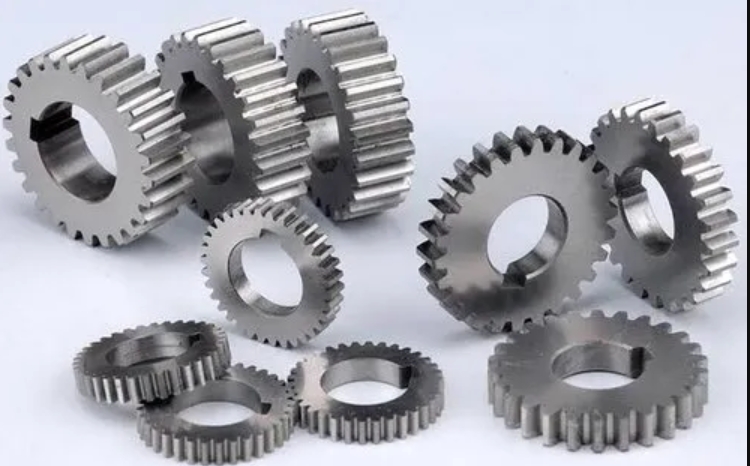
Spur gears are widely used in various industrial applications, but their performance can be compromised by manufacturing errors, assembly inaccuracies, and intentional modifications like crowning. Tooth length modification, or crowning, involves altering the tooth profile along the face width to mitigate edge loading and improve load distribution. Axial misalignment, on the other hand, occurs when the gear axes are not perfectly parallel, leading to uneven contact and increased stress concentrations. These factors transform the ideal line contact of spur gears into localized elliptical contact regions under load, complicating the calculation of meshing stiffness. The time-varying meshing stiffness is a key excitation source in gear dynamics, influencing vibration, noise, and fatigue life. Existing methods, such as the finite element method, offer high accuracy but are computationally intensive and unsuitable for rapid design optimization. Analytical methods, like the potential energy method, are efficient but often overlook the coupling effects between sliced tooth segments in modified spur gears. Therefore, I develop an improved analytical model that incorporates slice theory and coupling stiffness to address these shortcomings. This approach enables precise stiffness calculations for spur gears with tooth length modification and misalignment, facilitating better design and analysis of gear systems.
To model the errors in spur gears, I first establish mathematical representations for tooth length modification and axial misalignment. For tooth length modification, the crowning amount at any point along the tooth width can be expressed using a polynomial function. Let \( C_c \) be the maximum crowning amount, \( B \) the face width, \( b_0 \) the reference position, and \( b_i \) the position along the face width. The crowning amount \( C_{ci} \) at any point is given by:
$$ C_{ci} = C_c \cdot \left( \frac{b_i – b_0}{B / 2} \right)^s $$
where \( s \) is the curve bending coefficient. For axial misalignment, the misalignment amount \( C_{mi} \) at any截面 can be defined based on the rotation angles of the pinion and gear. Assuming \( \theta_{x1} \), \( \theta_{y1} \) for the pinion and \( \theta_{x2} \), \( \theta_{y2} \) for the gear, and \( \psi_{12} \) as the angle between axes, the misalignment is calculated as:
$$ C_{mi} = \frac{b_i}{\cos \beta_b} \cdot \left( (\theta_{x1} – \theta_{x2}) \cdot \cos \psi_{12} + (\theta_{y1} – \theta_{y2}) \cdot \sin \psi_{12} \right) $$
Here, \( \beta_b \) is the base helix angle. The total error \( E_i \) for a tooth pair is the sum of crowning and misalignment errors:
$$ E_i = C_{ci}^{(p)} + C_{ci}^{(g)} + C_{mi} $$
where the superscripts (p) and (g) denote the pinion and gear, respectively. This error model forms the basis for subsequent contact and stiffness analyses in spur gears.
Next, I perform tooth contact analysis (TCA) and loaded tooth contact analysis (LTCA) to determine the meshing characteristics of spur gears with tooth length modification and misalignment. Under load, the contact between spur gears shifts from line contact to localized elliptical regions, which affects the instantaneous contact points, contact paths, and load distribution. In TCA, I represent the tooth surfaces of the pinion and gear using B-spline surfaces to account for deviations from the ideal involute profile. The position vectors and unit normal vectors for the pinion surface \( \Sigma^{(1)} \) and gear surface \( \Sigma^{(2)} \) are defined in their local coordinate systems \( S_1 \) and \( S_2 \), respectively. These are then transformed to a global fixed coordinate system \( S_f \) using transformation matrices. The contact conditions require that the position vectors and unit normal vectors of both surfaces coincide at the contact point, leading to a system of nonlinear equations. By solving these equations iteratively for different parameters, I obtain the contact points and paths. For LTCA, I analyze the deformation under load to determine the elliptical contact area. At each contact point, I establish a local coordinate system \( S_p \) with the \( z_p \)-axis aligned with the surface normal. The principal curvatures and directions are computed using Euler’s formula, and the relative curvatures between the surfaces are used to find the semi-major and semi-minor axes of the contact ellipse. The Hertzian theory provides the relationship between the contact force \( F \), equivalent radius \( R_e \), equivalent elastic modulus \( E^* \), and the ellipse dimensions. The semi-major axis \( a \) and semi-minor axis \( b \) satisfy:
$$ \frac{R_I}{R_{II}} = \left( \frac{a}{b} \right)^2 \frac{E(e) – K(e)}{K(e) – E(e)} $$
and
$$ a \cdot b = \left( \frac{3 F R_e}{4 E^*} \right)^{2/3} f(e)^2 $$
where \( K(e) \) and \( E(e) \) are complete elliptic integrals of the first and second kind, respectively, and \( f(e) \) is a function of the ellipse ratio. The equivalent elastic modulus is given by:
$$ \frac{1}{E^*} = \frac{1 – \nu_1^2}{E_1} + \frac{1 – \nu_2^2}{E_2} $$
Here, \( E_1 \), \( E_2 \), \( \nu_1 \), and \( \nu_2 \) are the elastic moduli and Poisson’s ratios of the pinion and gear materials. These analyses yield the contact traces and loaded contact areas, which are essential for accurate stiffness calculation in spur gears.
For the stiffness model, I employ an improved potential energy method combined with slice theory. The spur gear tooth is divided into multiple slices along the face width, and each slice is treated as a variable-section cantilever beam. The deformation energy stored in each slice includes bending, shear, axial compression, and Hertzian contact components. The bending stiffness \( dK_b \), shear stiffness \( dK_s \), and axial compression stiffness \( dK_a \) for a slice of width \( db \) are derived as:
$$ \frac{1}{dK_b} = \int_0^{x_{ps}} \frac{3 \left[ (x_{ps} – x) \cos \alpha – h_{ps} \sin \alpha \right]^2}{2 E h_x^3 db} dx $$
$$ \frac{1}{dK_s} = \int_0^{x_{ps}} \frac{1.2 \cos^2 \alpha}{2 G h_x db} dx $$
$$ \frac{1}{dK_a} = \int_0^{x_{ps}} \frac{\sin^2 \alpha}{2 E h_x db} dx $$
where \( x_{ps} \) and \( h_{ps} \) are the coordinates of the meshing point, \( h_x \) is the tooth thickness at position \( x \), \( \alpha \) is the pressure angle, \( E \) is the elastic modulus, and \( G \) is the shear modulus. The Hertzian contact stiffness for a slice is nonlinear and expressed as:
$$ dK_h = \frac{E_e^{0.9} db^{0.8} F_i^{0.1}}{1.275} $$
where \( E_e = 2 E_1 E_2 / (E_1 + E_2) \) is the equivalent elastic modulus, and \( F_i \) is the load on the slice. The gear foundation stiffness \( K_f \) is modeled using an empirical formula:
$$ \frac{1}{K_f} = \frac{\cos^2 \alpha}{B E} \left[ L^* \left( \frac{u_f}{S_f} \right)^2 + M^* \left( \frac{u_f}{S_f} \right) + P^* (1 + Q^* \tan^2 \alpha) \right] $$
where \( B \) is the face width, and \( L^* \), \( M^* \), \( P^* \), \( Q^* \), \( u_f \), and \( S_f \) are coefficients based on gear geometry. To account for the coupling between adjacent slices due to non-uniform deformation, I introduce a coupling stiffness \( K_{c_i(i+1)} \) between slices \( i \) and \( i+1 \):
$$ \frac{1}{dK_t} = \frac{1}{dK_b} + \frac{1}{dK_s} + \frac{1}{dK_a} $$
$$ K_{c_i(i+1)} = \frac{2.75 (dK_{t_i} + dK_{t_{i+1}})}{2} \left( \frac{m}{db} \right)^2 $$
where \( dK_t \) is the total slice stiffness, and \( m \) is a coupling factor. The overall stiffness matrix \( K \) for the tooth pair is assembled considering the slice stiffnesses and coupling springs. The force-deformation relationship is given by \( F = K \cdot \delta \), where \( F \) is the load vector and \( \delta \) is the deformation vector. For multi-tooth meshing, the foundation stiffness is adjusted using a correction factor \( \lambda \) to account for shared foundation effects. The total meshing stiffness \( K \) for spur gears with multiple tooth pairs in contact is:
$$ \frac{1}{K} = \frac{1}{\sum_{i=1}^n K_{(pg)_i}} + \frac{1}{K_{tf}} $$
where \( n \) is the number of meshing tooth pairs, \( K_{(pg)_i} \) is the stiffness of the \( i \)-th tooth pair, and \( K_{tf} = \frac{1}{\lambda_p K_f^{(p)} + \lambda_g K_f^{(g)}} \) is the modified foundation stiffness. This comprehensive model allows for accurate computation of time-varying meshing stiffness in spur gears with tooth length modification and misalignment.
To validate the proposed method, I compare its results with finite element analysis (FEA) for a spur gear pair with parameters listed in Table 1. The gears have a module of 2 mm, 25 and 30 teeth, a face width of 20 mm, a pressure angle of 20°, and material properties of steel. I apply a torque of 100 N·m and consider cases with and without crowning and misalignment. For the ideal spur gear case (no modification or misalignment), the time-varying meshing stiffness calculated using my method aligns closely with FEA results, with a mean stiffness error of 2.1%. When introducing a crowning amount of 0.01 mm and a misalignment of 0.01°, the contact path and elliptical contact area from TCA and LTCA match the FEA predictions, as shown in Figure 1. The stiffness results demonstrate that my method yields a mean stiffness of 339 kN/mm, while FEA gives 329 kN/mm, resulting in an error of 3%. In contrast, traditional methods that neglect slice coupling exhibit higher errors. This validation confirms the accuracy of my approach for spur gears with modifications.
| Parameter | Pinion | Gear |
|---|---|---|
| Module (mm) | 2 | 2 |
| Number of Teeth | 25 | 30 |
| Face Width (mm) | 20 | 20 |
| Pressure Angle (°) | 20 | 20 |
| Bore Diameter (mm) | 20 | 20 |
| Elastic Modulus (GPa) | 210 | 210 |
| Poisson’s Ratio | 0.3 | 0.3 |
| Misalignment (°) | 0.01 | 0.01 |
| Crowning Amount (mm) | 0.01 | 0.01 |
I further investigate the influence of different misalignment and crowning amounts on the meshing stiffness of spur gears. As misalignment increases from 0.01° to 0.04°, the contact area shifts towards the gear ends, reducing the effective contact length and thus decreasing the meshing stiffness. The relationship is non-linear, as depicted in Figure 2, where higher misalignment leads to a significant drop in stiffness. Similarly, increasing the crowning amount from 10 μm to 25 μm results in a smaller elliptical contact area due to higher curvature, which reduces the geometric and Hertzian contact stiffness. The stiffness reduction is also non-linear with respect to crowning, emphasizing the need to consider these parameters in spur gear design. These findings highlight that both misalignment and crowning have substantial impacts on the stiffness excitation of spur gears, and their effects must be incorporated in dynamic analyses to ensure reliable performance.
In conclusion, I have developed an improved analytical method for calculating the time-varying meshing stiffness of spur gears with tooth length modification and axial misalignment. By integrating error modeling, TCA, LTCA, and an enhanced potential energy approach with slice coupling, this method accurately captures the localized contact behavior and stiffness variations in spur gears. Validation against FEA shows a high level of accuracy, with errors around 3%, making it suitable for practical applications. The analysis of different misalignment and crowning levels reveals non-linear stiffness reductions, underscoring the importance of these factors in spur gear dynamics. This research provides a robust theoretical basis for optimizing spur gear designs, particularly in applications where modifications and misalignments are prevalent. Future work could extend this method to helical gears or other gear types, and incorporate dynamic effects for comprehensive system analysis.