
Spur gears are fundamental components in mechanical systems for efficient power and motion transmission. However, localized tooth breakage, a common fault, significantly impacts the stability and safety of gear operations. The phenomenon of tooth impact, particularly back-side collision, cannot be overlooked, especially under high-speed or light-load conditions. Understanding the meshing-impact dynamics under localized breakage is crucial for enhancing the reliability and longevity of gear systems. In this study, we develop a comprehensive dynamic model that incorporates friction and multi-state meshing behaviors, including back-side impact, to analyze the nonlinear characteristics of spur gears with localized tooth breakage. We explore how breakage affects time-varying parameters, such as mesh stiffness and load distribution, and investigate the system’s bifurcation and chaos behavior under varying operational conditions. Our findings provide insights into the complex dynamics of faulty gear systems and offer practical guidance for parameter design and fault prediction.
The modeling of gear systems with faults like cracks, wear, and breakage has been extensively studied, but most existing models neglect the multi-state meshing behaviors and transient back-side contact. For instance, prior research focused on crack propagation paths or wear effects using finite element methods, but these often oversimplify the dynamic interactions. In contrast, our approach integrates a dissipative contact force model to represent back-side impact more accurately, considering energy loss during collisions. We classify meshing behaviors into five states based on contact conditions and force environments, enabling a detailed analysis of the system’s response to localized breakage. This model accounts for time-varying stiffness, load sharing, and friction, providing a more realistic representation of spur gear dynamics under fault conditions.
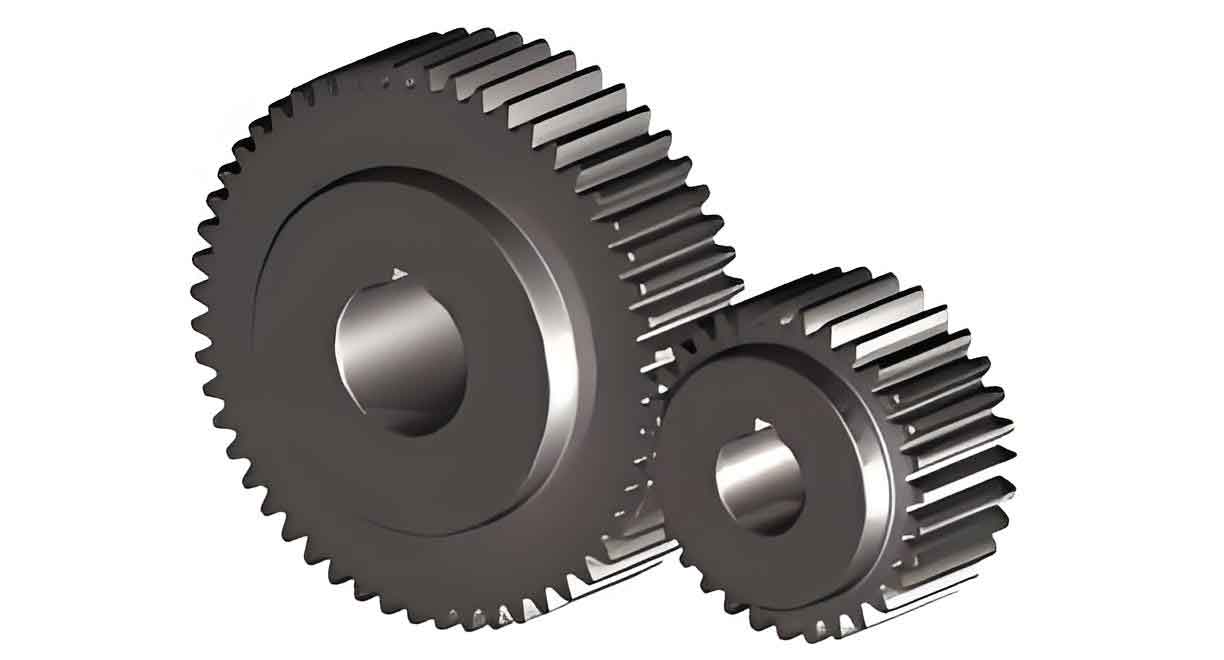
To formulate the dynamic model, we consider a spur gear pair with rigid supports, focusing on the meshing and impact between teeth. The relative displacement between the pinion and gear is defined as $$x = R_{bp} \theta_p – R_{bg} \theta_g – e(t)$$, where $$R_{bp}$$ and $$R_{bg}$$ are the base circle radii, $$\theta_p$$ and $$\theta_g$$ are angular displacements, and $$e(t) = E_a \omega_h \cos(\omega_h t)$$ represents the dynamic transmission error. The meshing stiffness $$k_m(t)$$ varies with time due to the changing number of tooth pairs in contact, and the damping coefficient $$c_g$$ accounts for energy dissipation. The backlash, denoted as $$2D$$, introduces nonlinearities that lead to multi-state behaviors, including tooth separation and back-side impact. We define the collision recovery coefficient $$R$$ to model energy loss during impact, and the friction coefficient $$\mu$$ influences the tangential forces during meshing.
The localized tooth breakage alters the gear’s contact characteristics, reducing the contact ratio and shifting the single and double-tooth meshing regions. For a healthy spur gear pair, the contact ratio $$\varepsilon_m$$ is given by the length of the path of contact divided by the base pitch. Under breakage, the effective contact ratio $$\varepsilon_b$$ decreases, as the damaged tooth exits meshing prematurely. This change affects the load distribution and stiffness, leading to localized overloading and increased dynamic responses. The time-varying mesh stiffness $$k_m(t)$$ is computed as a combination of Hertzian contact stiffness, bending stiffness, axial compression stiffness, shear stiffness, and fillet foundation stiffness, expressed as:
$$ \frac{1}{k_m(t)} = \frac{1}{k_h} + \frac{1}{k_{bji}} + \frac{1}{k_{aji}} + \frac{1}{k_{sji}} + \frac{1}{k_f} $$
where the subscripts denote different stiffness components for the pinion and gear (j = p, g) and tooth pairs (i = 1, 2). The load distribution coefficient $$L(\xi)$$ varies along the path of contact and is adjusted for breakage, influencing how the dynamic load is shared between tooth pairs. For a damaged tooth, the load distribution shifts, increasing the load on adjacent teeth and potentially accelerating fatigue.
We categorize the meshing-impact behaviors into five states based on the relative displacement $$x$$ and the backlash $$D$$:
- Double-tooth drive-side meshing: Occurs when $$x \geq D$$ and the contact point lies in regions corresponding to dual-tooth engagement. The stiffness is higher, and the load is shared between two tooth pairs.
- Single-tooth drive-side meshing I: This state occurs in the single-tooth contact region of healthy meshing cycles, where $$x \geq D$$ and only one tooth pair carries the load.
- Single-tooth drive-side meshing II: Caused by localized breakage, where a portion of the double-tooth region becomes single-tooth, leading to reduced stiffness and altered load distribution.
- Tooth separation: When $$-D < x < D$$, no contact occurs, and the gears are disengaged, resulting in zero mesh force.
- Back-side impact: When $$x = -D$$, the teeth collide on the non-drive side, generating an impact force modeled using a dissipative contact model.
The equations of motion for these states are derived using Newton’s second law. For double-tooth meshing, the system is described by:
$$ I_p \ddot{\theta}_p + R_{bp} F_{Np1} + S_{dp1} F_{fp1} + R_{bp} F_{Np2} + S_{dp2} F_{fp2} = T_p $$
$$ I_g \ddot{\theta}_g – R_{bg} F_{Ng1} – S_{dg1} F_{fg1} – R_{bg} F_{Ng2} – S_{dg2} F_{fg2} = -T_g $$
where $$F_{Npi}$$ and $$F_{Ngi}$$ are the normal forces, $$F_{fpi}$$ and $$F_{fgi}$$ are friction forces, and $$S_{dpi}$$ and $$S_{dgi}$$ are friction arms. The friction forces depend on the friction coefficient $$\mu$$ and the direction of sliding. The equivalent mass $$m_e$$ and the dynamic mesh force $$F_m(t)$$ are used to simplify the equations. For single-tooth meshing, the equations are similar but with reduced stiffness and load terms. During tooth separation, the mesh force is zero, and the system is governed by the external forces and error excitation. For back-side impact, the impact force $$F_c$$ is calculated using:
$$ F_c = -k_c(t) \left( \frac{5 R m_e}{4 k_c(t)} \right)^{2/5} \dot{x}^{6/5} $$
where $$k_c(t)$$ is the time-varying back-side contact stiffness, and $$m_e$$ is the equivalent mass. The relative velocity before and after impact is related by $$\dot{x}^{(+)} = -R \dot{x}^{(-)}$$, accounting for energy dissipation.
To normalize the equations, we introduce dimensionless parameters: time $$\tau = \omega_n t$$, where $$\omega_n$$ is the natural frequency; displacement $$x = \frac{\bar{x}}{D_c}$$, with $$D_c$$ as a characteristic length; and force terms scaled accordingly. The dimensionless equation of motion becomes:
$$ \ddot{x} – h(\tau, x) f(x, \dot{x}) = F + \varepsilon \omega^2 \cos(\omega \tau) $$
where $$h(\tau, x)$$ is the state function that switches between meshing states, and $$f(x, \dot{x})$$ represents the mesh force. The back-side impact condition is included as a boundary condition. This formulation allows us to analyze the system’s nonlinear dynamics, including bifurcations and chaos, using numerical methods like the Runge-Kutta algorithm.
The time-varying parameters are critical for accurate dynamics. The mesh stiffness $$k_m(\tau)$$ varies periodically, with reductions in the damaged region due to breakage. The load distribution coefficient $$L(\xi)$$ is computed based on the contact point’s position along the path of contact. For a damaged tooth, $$L(\xi)$$ changes abruptly in the breakage-affected zone, leading to uneven load sharing. The following table summarizes the key parameters used in our analysis:
| Parameter | Symbol | Value/Range |
|---|---|---|
| Number of teeth (pinion/gear) | $$z_p, z_g$$ | 40, 40 |
| Module | $$m$$ | 3 mm |
| Pressure angle | $$\alpha_0$$ | 20° |
| Damping coefficient | $$c$$ | 0.01 |
| Friction coefficient | $$\mu$$ | 0.15 |
| Backlash | $$2D$$ | 2.0 |
| Error coefficient | $$\varepsilon$$ | 0.05 |
| Collision recovery coefficient | $$R$$ | 0.85 |
We investigate the effects of the load coefficient $$F$$ and meshing frequency $$\omega$$ on the system’s dynamics. For $$F$$ varying from 0 to 0.15, the system exhibits different behaviors, including periodic, chaotic, and coexisting motions. At higher loads (e.g., $$F > 0.1$$), the system tends to remain in periodic motion without back-side impact. As $$F$$ decreases, chaotic motions and period-doubling bifurcations occur, often accompanied by back-side impact. For example, at $$F = 0.05$$, the system shows period-4 and period-2 coexisting attractors, with back-side impact present in the chaotic regions. This indicates that lower loads promote instability and impact phenomena. The following equation represents the dimensionless dynamic contact force:
$$ F_m = \begin{cases}
k_m(\tau) (x – D) + c \dot{x} & x \geq D \\
0 & -D < x < D \\
– k_c(\tau) \left( \frac{5 R m_e}{4 k_c(\tau)} \right)^{2/5} \dot{x}^{6/5} & x = -D
\end{cases} $$
In terms of meshing frequency $$\omega$$, we observe that both low and high values can induce chaos and back-side impact. At $$\omega = 0.1$$, the system is chaotic, with frequent back-side collisions. As $$\omega$$ increases to 1.2, the motion becomes periodic (e.g., period-1 or period-2), and back-side impact diminishes. However, at higher frequencies (e.g., $$\omega > 2.0$$), chaos reappears, along with back-side impact. This suggests that operating at moderate meshing frequencies can mitigate undesirable dynamics. The coexistence of multiple periodic attractors, such as period-2 and period-3 motions, further complicates the system’s behavior, as different initial conditions lead to different steady-states. This highlights the importance of controlling initial conditions in practical applications of spur gears.
Comparing healthy and locally broken spur gears reveals significant differences in dynamic responses. Under healthy conditions, the system shows smoother transitions between meshing states, with less pronounced chaos and back-side impact. In contrast, localized breakage introduces disruptions in stiffness and load distribution, amplifying nonlinearities and promoting impact behaviors. For instance, in healthy gears, a decrease in load may cause a transition from period-1 to period-2 motion, whereas in broken gears, the same change can lead to chaotic motion and back-side impact. This underscores the vulnerability of faulty spur gears to parameter variations and the need for robust design.
In conclusion, our study on spur gears with localized tooth breakage demonstrates the critical role of multi-state meshing and impact dynamics. The integration of a dissipative contact model allows for a realistic simulation of back-side collisions, revealing how breakage exacerbates nonlinear behaviors. We find that lower loads and extreme meshing frequencies tend to induce chaos and back-side impact, while higher loads suppress these phenomena. The coexistence of periodic attractors adds complexity, necessitating careful parameter selection in spur gear systems. Future work could extend this model to include more detailed friction models or experimental validation. Ultimately, this research provides a foundation for improving the reliability and performance of spur gears in mechanical transmissions, contributing to safer and more efficient machinery.