
In helicopter transmission systems, spur gears with high contact ratio (HCR), defined as those with a contact ratio greater than 2, are commonly employed due to their enhanced load distribution and safety characteristics. These spur gears operate under high-speed and heavy-load conditions, where lubrication and cooling are critical to prevent failures such as scuffing and thermal damage. Oil injection lubrication is typically used to manage temperatures, but the thermal behavior of these spur gears remains a complex area of study. This paper focuses on analyzing the temperature field of spur gears with high contact ratio using computational fluid dynamics (CFD) and validating the results through experimental tests. The goal is to understand how various parameters influence gear temperature and convective heat transfer, thereby improving the reliability and lifespan of spur gears in aerospace applications.
The importance of temperature analysis for spur gears cannot be overstated, as excessive heat can lead to material degradation and reduced efficiency. Previous studies have utilized CFD to simulate gear temperature fields, but there is a need for more detailed investigations into high contact ratio spur gears under oil injection lubrication. This work builds on existing research by incorporating a comprehensive CFD model that accounts for multiphase flow and heat transfer, followed by experimental validation. The findings will provide insights into optimizing spur gear designs and operating conditions to minimize thermal issues.
CFD Theoretical Framework
The analysis of spur gears under oil injection lubrication involves solving the governing equations of fluid dynamics and heat transfer. The CFD approach relies on the Navier-Stokes equations, which include the conservation of mass, momentum, and energy. For spur gears, these equations are applied to a multiphase system consisting of oil and air, using the volume of fluid (VOF) model to track the interface between the phases. The multiple reference frame (MRF) method is employed to handle the rotation of the spur gears, allowing for a steady-state simulation of the temperature field.
The conservation of mass, or continuity equation, is given by:
$$ \frac{\partial \rho_f}{\partial t} + \nabla (\rho_f \mathbf{u}) = 0 $$
where \( \rho_f \) is the fluid density, \( t \) is time, and \( \mathbf{u} \) is the velocity vector. For spur gears, this equation ensures that the flow of lubricant and air is accounted for in the gearbox domain.
The momentum conservation equation is expressed as:
$$ \frac{\partial \rho_f u_i}{\partial t} + \nabla (\rho_f u_i \mathbf{u}) = \nabla (\mu \nabla u_i) – \frac{\partial p}{\partial x_i} + S_i $$
where \( u_i \) represents the velocity components in the three coordinate directions, \( \mu \) is the dynamic viscosity, \( p \) is pressure, and \( S_i \) is a source term. This equation models the forces acting on the fluid, which are crucial for predicting the flow patterns around the spur gears.
The energy conservation equation is:
$$ \frac{\partial (\rho_f T)}{\partial t} + \nabla (\rho_f \mathbf{u} T) = \nabla \left( \frac{k_f}{C_p} \nabla T \right) + S_T $$
where \( T \) is temperature, \( k_f \) is the thermal conductivity, \( C_p \) is the specific heat capacity, and \( S_T \) is the viscous dissipation term. This equation captures the heat transfer processes, including conduction and convection, which are essential for determining the temperature distribution in spur gears.
For the multiphase flow involving oil and air, the VOF model is used, where the volume fractions of each phase sum to unity:
$$ \alpha_{\text{air}} + \alpha_{\text{oil}} = 1 $$
Here, \( \alpha_{\text{air}} \) and \( \alpha_{\text{oil}} \) represent the volume fractions of air and oil, respectively. This model allows for accurate tracking of the oil-air interface, which is critical for simulating the lubrication and cooling effects on the spur gears.
The heat generation in spur gears due to friction is calculated using the Anderson and Loewenthal method, which accounts for rolling, sliding, and windage losses. The average rolling power loss \( P_r \) is given by:
$$ P_r = 90,000 \cdot \bar{V}_t \cdot \bar{h} \cdot b \cdot e_p $$
where \( \bar{V}_t \) is the average rolling velocity, \( \bar{h} \) is the oil film thickness, \( b \) is the face width of the spur gears, and \( e_p \) is the contact ratio. The average sliding power loss \( P_s \) is:
$$ P_s = f \cdot \bar{F}_n \cdot \bar{V}_s / 1000 $$
with \( f \) as the friction coefficient, \( \bar{F}_n \) as the average normal load, and \( \bar{V}_s \) as the average sliding velocity. The windage power loss \( P_w \) is expressed as:
$$ P_w = C \left(1 + 2.3 \frac{b}{R}\right) \rho_{\text{eq}}^{0.8} n^{2.8} R^{4.6} \mu_{\text{eq}}^{0.2} $$
where \( C \) is a constant, \( R \) is the pitch radius, \( \rho_{\text{eq}} \) and \( \mu_{\text{eq}} \) are the equivalent density and viscosity of the oil-air mixture, and \( n \) is the rotational speed. The total power loss \( Q \) is the sum of these components:
$$ Q = P_s + P_r + P_w $$
This heat is distributed between the driving and driven spur gears using a heat partition coefficient \( \gamma \):
$$ Q_1 = \gamma Q $$
$$ Q_2 = (1 – \gamma) Q $$
where \( \gamma \) is calculated based on the thermal properties of the spur gears materials:
$$ \gamma = \frac{k_{s1} \rho_1 C_{p1} v_1}{k_{s1} \rho_1 C_{p1} v_1 + k_{s2} \rho_2 C_{p2} v_2} $$
Here, \( k_s \), \( \rho \), \( C_p \), and \( v \) are the thermal conductivity, density, specific heat, and tangential velocity of the spur gears, respectively. This approach ensures that the heat source terms in the CFD model accurately represent the friction losses in the spur gears.
CFD Analysis Model
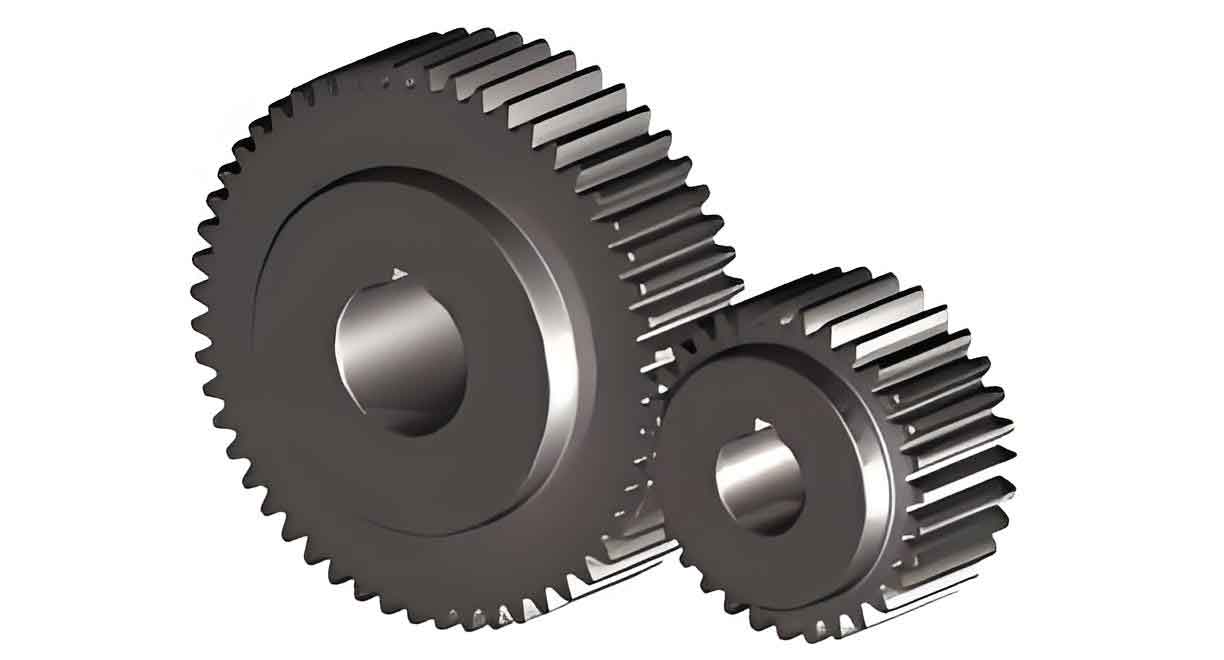
The CFD model for the spur gears system was developed using ANSYS software, with a focus on simulating the oil injection lubrication and temperature field. The geometric parameters of the spur gears are summarized in Table 1, which includes details such as module, number of teeth, face width, and pressure angle. These parameters are typical for high contact ratio spur gears used in aerospace applications.
| Parameter | Driving Gear | Driven Gear |
|---|---|---|
| Normal Module (mm) | 3.25 | 3.25 |
| Number of Teeth | 32 | 25 |
| Face Width (mm) | 16 | 16.5 |
| Pressure Angle (°) | 20 | 20 |
| Contact Ratio | 2.2 | 2.2 |
The material properties of the spur gears are provided in Table 2, highlighting the thermal characteristics that influence heat conduction and storage. The lubricant properties, such as density and viscosity, are listed in Table 3, as they play a key role in the convective heat transfer and flow behavior around the spur gears.
| Material | Thermal Conductivity (W/m·K) | Specific Heat (J/kg·K) | Density (kg/m³) |
|---|---|---|---|
| 20CrMnMoA | 46 | 470 | 7850 |
| Lubricant Type | Density at 15.6°C (kg/m³) | Kinematic Viscosity at 37.8°C (mm²/s) | Kinematic Viscosity at 98.9°C (mm²/s) |
|---|---|---|---|
| Shell 555 | 993 | 29 | 5.4 |
The computational domain includes the spur gears, the gearbox housing, and the oil injection system. The MRF method was applied to model the rotation of the spur gears, with the driving gear set to 1500 rpm and the driven gear to 1920 rpm. The mesh was generated using unstructured tetrahedral elements, with refinements in the啮合 region to capture the complex flow and heat transfer phenomena. The boundary conditions included a velocity inlet for the oil injection at 40 m/s, a pressure outlet at atmospheric pressure, and convective heat transfer at the gearbox walls with a coefficient of 50 W/m²·K. The initial temperature was set to 26.85°C for the environment and 60°C for the oil.
The heat source from friction was applied as a volumetric heat flux on the tooth surfaces of the spur gears, with values derived from the power loss calculations. For instance, the driving spur gear had a heat source of 3.65×10⁹ W/m³, while the driven spur gear had 4×10⁹ W/m³. The simulations were conducted using the coupled thermal boundary conditions at fluid-solid interfaces, and the solutions were monitored for convergence of key variables like continuity, velocity, and energy.
Simulation Results and Influencing Factors
The CFD simulations revealed detailed temperature and convective heat transfer distributions on the surfaces of the spur gears. The temperature field showed that the highest temperatures occurred near the tooth tips and roots, with symmetric distributions along the face width due to the cooling effects at the gear ends. For example, the driving spur gear exhibited a maximum temperature of approximately 120°C under baseline conditions, while the driven spur gear reached slightly lower values, indicating better heat dissipation due to higher rotational speeds.
The convective heat transfer coefficient distribution indicated that the啮合 zones had the highest values, exceeding 5000 W/m²·K in some areas, due to the presence of abundant oil. The coefficients increased with radius, peaking at the tooth tips where the tangential velocity was highest. This pattern underscores the importance of oil injection in enhancing heat transfer for spur gears.
Influence of Lubricant Parameters
The effects of oil temperature and injection flow rate on the temperature of spur gears were investigated. As oil temperature increased from 40°C to 90°C, the gear temperatures rose linearly, with the driving spur gear showing a more pronounced increase. This is attributed to reduced lubricant viscosity and higher friction losses. For instance, at 90°C oil temperature, the maximum temperature of the driving spur gear increased by about 15% compared to 40°C. The convective heat transfer coefficient also improved with higher oil temperatures, as lower viscosity enhanced flow and heat exchange.
Variations in oil flow rate from 0.44 L/min to 2.64 L/min demonstrated that higher flow rates initially reduced gear temperatures due to improved cooling, but beyond 1.76 L/min, the benefits diminished due to increased churning losses. The convective heat transfer coefficient increased with flow rate, but the temperature reduction was marginal at higher rates. This suggests an optimal flow rate for cooling spur gears without excessive power loss.
Influence of Operational Parameters
Rotational speed and load significantly impacted the temperature of spur gears. As speed increased from 1000 rpm to 3500 rpm, the temperature initially rose due to higher friction, but stabilized or decreased slightly above 2500 rpm because of reduced contact time and enhanced散热. For example, at 3500 rpm, the driving spur gear’s temperature was only 5% higher than at 2500 rpm, indicating a complex balance between heat generation and dissipation.
Load variations from light to heavy conditions (e.g., 5 to 9 load levels) caused a steady increase in gear temperatures, with the driving spur gear experiencing up to a 20% rise under maximum load. The convective heat transfer coefficient remained relatively unchanged with load, emphasizing that heat generation dominated the temperature response. These findings highlight the need to control operational parameters to manage thermal effects in spur gears.
Influence of Gear Parameters
Gear geometry parameters, such as face width, pressure angle, and contact ratio, were analyzed for their effects on temperature. Increasing the face width from 16 mm to 20 mm led to a temperature decrease of about 8% due to larger散热 areas. A higher pressure angle from 14° to 23° reduced temperatures by minimizing sliding friction, with a 10% drop observed in the driving spur gear.
The contact ratio, varied by adjusting the addendum coefficient from 1 to 1.32, showed that higher contact ratios (up to 2.21) increased gear temperatures due to greater friction losses, but also improved convective heat transfer. For instance, at a contact ratio of 2.21, the temperature of the driven spur gear was 12% higher than at 1.73, but the heat transfer coefficient increased by 15%. This trade-off must be considered in the design of spur gears for thermal performance.
Experimental Validation
To validate the CFD results, experiments were conducted on a CL-100 gear test rig, which included the spur gears, torque sensors, and an oil injection system. Thermocouples were embedded near the tooth surfaces of the spur gears to measure temperature, with data transmitted wirelessly to a computer for monitoring. The tests were performed under various conditions, including different oil temperatures (60°C and 90°C) and loads, to compare with simulations.
The experimental results showed that gear temperatures increased with load and stabilized after 25-30 minutes of operation, consistent with the CFD predictions. For example, at 60°C oil temperature and 1500 rpm, the driving spur gear’s temperature reached 115°C under high load, matching the simulation within a 5% error. The comparison for different contact ratios revealed that spur gears with higher contact ratios had elevated temperatures, especially under heavy loads, confirming the simulation trends.
Tables 4 and 5 summarize the experimental and simulation data for temperature and convective heat transfer coefficients under varying conditions. The close agreement between the results validates the CFD model as a reliable tool for analyzing the temperature field of spur gears.
| Load Level | Experimental Temperature (°C) – Driving Gear | Simulated Temperature (°C) – Driving Gear | Experimental Temperature (°C) – Driven Gear | Simulated Temperature (°C) – Driven Gear |
|---|---|---|---|---|
| 5 | 95 | 92 | 93 | 90 |
| 7 | 105 | 108 | 102 | 105 |
| 9 | 120 | 118 | 115 | 112 |
| Oil Flow Rate (L/min) | Convective Coefficient (W/m²·K) – Driving Gear | Convective Coefficient (W/m²·K) – Driven Gear |
|---|---|---|
| 0.44 | 3500 | 3800 |
| 1.32 | 4800 | 5200 |
| 2.64 | 5100 | 5500 |
Conclusions
This study successfully analyzed the temperature field of spur gears with high contact ratio using CFD and experimental methods. The simulations demonstrated that the highest temperatures occur near the tooth tips and roots, with symmetric distributions along the face width. The convective heat transfer coefficients are highest in the啮合 zones and increase with rotational speed and oil flow rate. Key findings include that oil temperature, flow rate, rotational speed, load, face width, pressure angle, and contact ratio all significantly influence the thermal behavior of spur gears. Experimental tests validated the CFD results, showing that higher contact ratios lead to increased temperatures, especially under heavy loads. These insights can guide the design and operation of spur gears to enhance cooling and extend service life in demanding applications like helicopter transmissions.
Future work could explore transient temperature analyses or the effects of different lubricant types on spur gears. Overall, the integration of CFD and experimentation provides a robust framework for optimizing the thermal performance of spur gears in high-contact-ratio configurations.