
In modern industrial applications, spur gears play a critical role in power transmission systems across various sectors, including automotive, machinery, and robotics. The demand for high-precision and high-quality spur gears has driven the adoption of advanced manufacturing processes like cold extrusion. This method offers superior mechanical properties, excellent surface finish, and enhanced load-bearing capacity compared to traditional machining techniques. However, challenges such as large corner collapse, incomplete tooth formation, high forming loads, and reduced die life persist in cold extrusion processes for spur gears. To address these issues, this article presents a comprehensive design and analysis of a cold extrusion die for spur gears, focusing on process optimization through finite element simulation. The study outlines the cold extrusion process flow, die structure design, and parametric analysis to achieve optimal performance. By leveraging simulations, we validate the die feasibility and identify key parameters that minimize defects and extend die longevity. The integration of theoretical calculations, material selection, and iterative simulations ensures a robust approach to manufacturing high-performance spur gears.
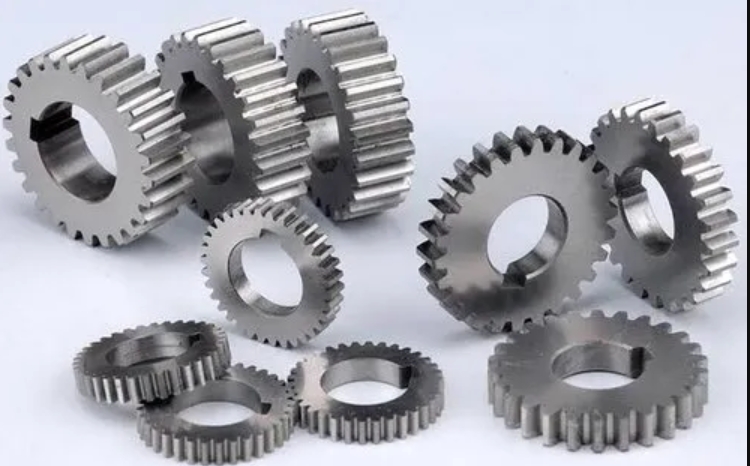
The cold extrusion process for spur gears begins with a detailed understanding of gear parameters and material properties. For this study, the spur gears are defined with a module of 2.5 mm, 20 teeth, a pressure angle of 20°, a pitch diameter of 50 mm, and a face width of 25 mm, resulting in a face width coefficient of 0.5. The material selected for the spur gears is 40Cr alloy steel, known for its high strength and durability, making it suitable for hard-faced gear applications. The cold extrusion process flow is systematically designed to ensure efficiency and quality, comprising the following stages: raw material preparation, material cutting, extrusion forming, surface treatment, and quality inspection. Each stage is critical for minimizing defects and achieving the desired dimensional accuracy in spur gears. Raw material preparation involves selecting and conditioning the 40Cr alloy steel billets, while material cutting ensures precise billet dimensions. Extrusion forming is the core stage where the billet is deformed into the spur gear shape under high pressure, followed by surface treatments to enhance corrosion resistance and fatigue life. Finally, quality inspection verifies that the spur gears meet stringent standards for applications in demanding environments.
To determine the required equipment and die specifications, the extrusion force must be calculated accurately. The extrusion force is influenced by factors such as billet geometry, material properties, die design, extrusion speed, and lubrication conditions. For spur gears, the unit extrusion pressure in forward extrusion can be derived using the following formula:
$$ p = 2k_f \left( \ln \frac{d_0}{d_1} + 2\mu \frac{h_1}{d_1} \right) \cdot e^{2\mu \frac{h_0}{d_0}} $$
Where \( p \) is the unit extrusion pressure, \( k_f \) is the flow stress of the material, \( d_0 \) and \( d_1 \) are the initial and final diameters, \( h_0 \) and \( h_1 \) are the initial and final heights, and \( \mu \) is the friction coefficient. For 40Cr alloy steel spur gears, substituting the relevant values yields an extrusion pressure of approximately 391.365 MPa. Based on this, the total extrusion tonnage is calculated using:
$$ T = \frac{\pi}{4} \times D^2 \times L \times K $$
Here, \( T \) is the extrusion tonnage, \( D \) is the billet diameter, \( L \) is the billet length, and \( K \) is a correction factor accounting for material and process conditions. The computed tonnage for the spur gears is about 89,093.604 tons, leading to the selection of a Y32-150t four-column hydraulic press as the extrusion equipment. This machine provides the necessary force and stability for the cold extrusion of spur gears, ensuring consistent performance and high productivity.
| Parameter | Value |
|---|---|
| Module | 2.5 mm |
| Number of Teeth | 20 |
| Pressure Angle | 20° |
| Pitch Diameter | 50 mm |
| Face Width | 25 mm |
| Material | 40Cr Alloy Steel |
| Process Stage | Description |
| Raw Material Preparation | Selection and conditioning of 40Cr billets |
| Material Cutting | Precision cutting to required billet dimensions |
| Extrusion Forming | Deformation under high pressure into spur gear shape |
| Surface Treatment | Enhancement of surface properties for durability |
| Quality Inspection | Verification of dimensional and mechanical standards |
The design of the cold extrusion die for spur gears is pivotal to achieving high-quality outputs. Die material selection is based on criteria such as high hardness, strength, wear resistance, and toughness to withstand the severe conditions of cold extrusion. T8A steel, a carbon tool steel with a carbon content of 0.75% to 0.84%, is chosen for its excellent hardness and fatigue resistance. This material ensures dimensional stability and longevity during the extrusion of spur gears, reducing the risk of premature failure. The die structure employs a forward extrusion configuration, which includes key components like the punch, die, guiding mechanism, and ejection system. The punch is responsible for imparting the desired shape to the spur gears, while the die cavity defines the gear profile. Guiding mechanisms, such as guide pillars and bushes, ensure precise alignment during operation, minimizing misalignment and wear. The ejection system facilitates the removal of the formed spur gears, enhancing process continuity and preventing damage.
In the punch design, stability is achieved through fixed elements like the punch holder and positioning ring, which prevent movement under high pressure. The punch assembly features a stepped internal structure with heights of 5 mm and 15 mm, optimized for stress distribution. The die design considers factors like shape, dimensions, wall thickness, and fixation methods. A wall thickness of 15 mm and an entry angle of 30° are selected to promote material flow and improve surface quality of the spur gears. Fixed components such as the die holder and pressure plate secure the die, maintaining accuracy during extrusion. The overall die assembly, with an upper and lower module, has a closed height of 180 mm, with guide pillars of 120 mm length and 20 mm diameter, and guide bushes of 100 mm length and 25 mm diameter. This design ensures robust performance for the cold extrusion of spur gears, as validated through finite element simulations.
| Component | Specification |
|---|---|
| Punch Material | T8A Steel |
| Die Material | T8A Steel |
| Punch Holder Height | 20 mm (total, with stepped design) |
| Die Wall Thickness | 15 mm |
| Entry Angle | 30° |
| Guide Pillar Dimensions | 120 mm length, 20 mm diameter |
| Guide Bush Dimensions | 100 mm length, 25 mm diameter, 5 mm wall thickness |
| Overall Die Height | 180 mm |
Finite element analysis (FEA) is employed to simulate the cold extrusion process for spur gears, assessing stress and strain distributions under various工艺 parameters. The simulations help identify optimal conditions that reduce defects like corner collapse and incomplete filling. For spur gears, the FEA model incorporates material properties of 40Cr alloy steel and die interactions, with parameters such as extrusion speed and friction coefficient varied to study their effects. The extrusion speed is tested at 1 mm/s, 2 mm/s, and 3 mm/s, while the friction coefficient is set to 0.10, 0.12, and 0.14. The simulation results indicate that stress and strain distributions are more uniform at specific combinations, leading to better forming quality for spur gears. For instance, at a friction coefficient of 0.14 and an extrusion speed of 2 mm/s, the stress distribution is relatively low and even, minimizing localized stress concentrations that could cause failure in spur gears. Similarly, strain analysis shows that lower strain values and uniform distribution contribute to the durability of spur gears by preventing surface damage.
The relationship between extrusion parameters and forming quality can be expressed through empirical models. For example, the effective strain \( \epsilon \) in cold extrusion of spur gears is influenced by the friction coefficient \( \mu \) and extrusion speed \( v \), as approximated by:
$$ \epsilon = k_1 \mu^a + k_2 v^b $$
Where \( k_1 \), \( k_2 \), \( a \), and \( b \) are material-dependent constants. Through iterative simulations, we derive that for spur gears, the optimal parameters are an extrusion speed of 2 mm/s and a friction coefficient of 0.14, which yield balanced stress and strain profiles. This combination ensures that the spur gears exhibit minimal defects and high dimensional accuracy, as confirmed by the FEA results. The table below summarizes the simulation outcomes for different parameter sets, highlighting the best conditions for spur gear cold extrusion.
| Friction Coefficient | Extrusion Speed (mm/s) | Stress Distribution | Strain Distribution | Overall Quality |
|---|---|---|---|---|
| 0.10 | 1 | Uniform, low stress | Moderate uniformity | Good |
| 0.10 | 2 | Slightly uneven | High strain concentrations | Fair |
| 0.10 | 3 | Uniform, low stress | Uniform, low strain | Excellent |
| 0.12 | 1 | Uniform, low stress | Uniform, low strain | Excellent |
| 0.12 | 2 | Moderate stress | Uneven strain | Fair |
| 0.12 | 3 | High stress, uniform | Uniform, low strain | Good |
| 0.14 | 1 | Uneven stress | Uniform, but high local strain | Fair |
| 0.14 | 2 | Uniform, low stress | Moderate uniformity, low strain | Optimal |
| 0.14 | 3 | High stress concentrations | Uneven strain | Poor |
Based on the FEA, the optimal工艺 parameters for cold extrusion of spur gears are an extrusion speed of 2 mm/s and a friction coefficient of 0.14. These settings result in a stress distribution that is relatively low and uniform, reducing the risk of localized failures in spur gears. The strain distribution, although not perfectly uniform, shows lower values that contribute to the longevity of spur gears by minimizing plastic deformation issues. This parametric optimization demonstrates the importance of simulation-driven design in achieving high-quality spur gears through cold extrusion. Furthermore, the die structure’s feasibility is confirmed, as the simulations show complete filling of the gear teeth without significant defects. The use of T8A steel for the die components proves effective, providing the necessary hardness and wear resistance for prolonged production of spur gears.
In conclusion, the cold extrusion process for spur gears involves a meticulously designed workflow from raw material preparation to quality inspection. The die design, utilizing T8A steel and incorporating punches, dies, guiding mechanisms, and ejection systems, ensures precise and efficient forming of spur gears. Finite element analysis validates the die’s performance and identifies optimal工艺 parameters, specifically an extrusion speed of 2 mm/s and a friction coefficient of 0.14, which enhance the quality and durability of spur gears. This approach not only addresses common issues like large corner collapse and high forming loads but also provides a foundation for industrial applications, promoting the production of high-performance spur gears for various mechanical systems. Future work could explore advanced materials and real-time monitoring to further optimize the cold extrusion of spur gears.