
In the realm of high-precision gear shaft production, particularly for components like harmonic reducers, achieving consistent accuracy in mass manufacturing is paramount. As an engineer specializing in fixture design, I have developed a specialized eccentric gear shaft fixture that addresses the challenges of maintaining stability in machining conditions, even with minor environmental fluctuations. This gear shaft fixture ensures product qualification with a process capability index (Cp) of at least 1.67, while reducing costs, enhancing efficiency, and minimizing reliance on skilled operators. The design replaces imported machine tools and fixtures, leveraging domestic high-precision lathes and customized tooling to meet competitive market demands.
The core of this gear shaft fixture revolves around eccentric gear shafts used in high-precision reducers. These gear shaft components require meticulous attention to eccentricity, cylindricity, and angular positioning during machining. By integrating a dual-center定位原理 and a spring-based clamping mechanism, the fixture achieves reliable角定位 and clamping for批量加工. Below, I will elaborate on the part requirements, design principles, structural components, precision considerations, and interchangeability features, supported by tables and formulas to summarize key aspects.
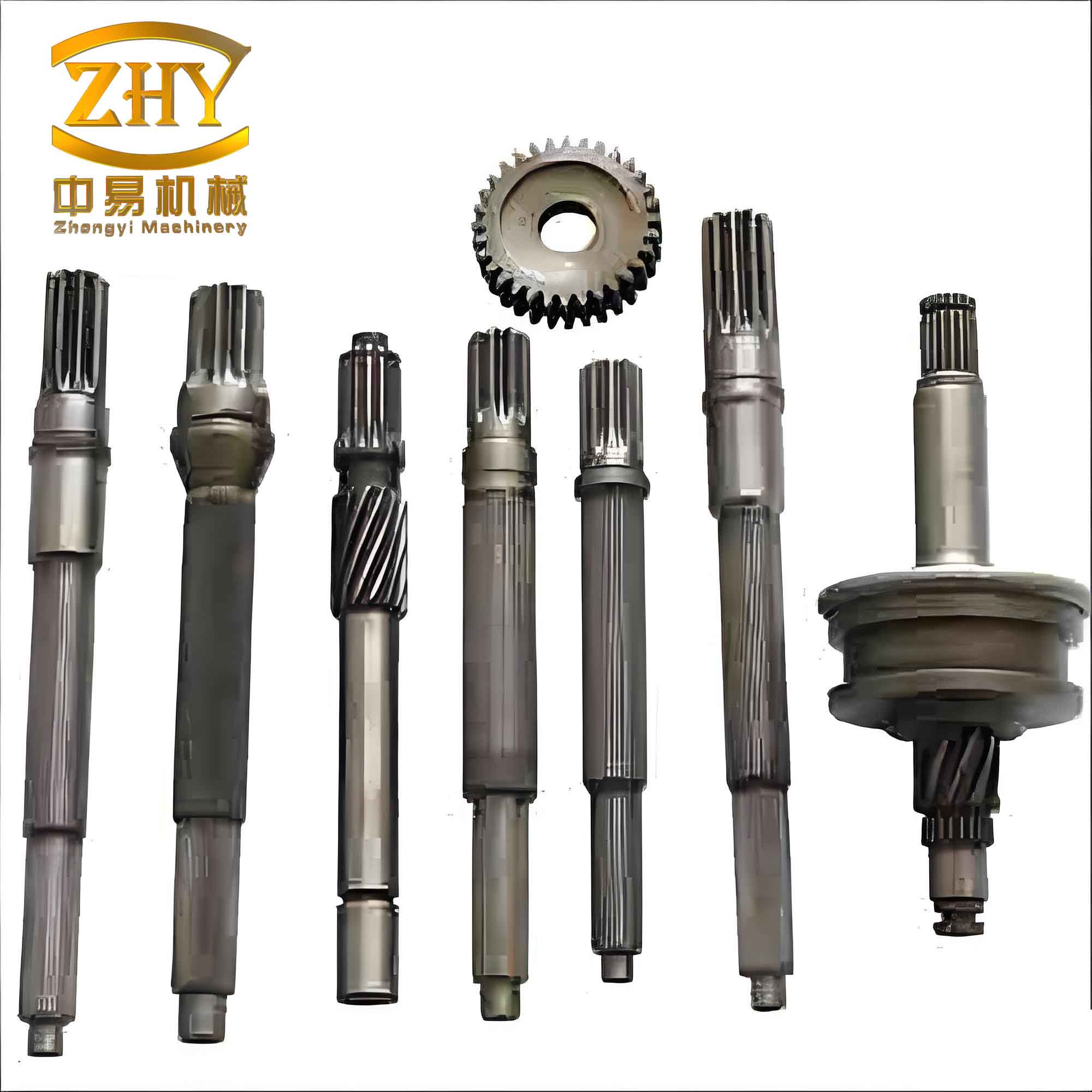
The machining requirements for the eccentric gear shaft are stringent, focusing on eccentricity tolerances and cylindricity. The gear shaft material is 20Cr, normalized to a hardness of 150–180 HBW, and each operation must be completed within one minute to maintain efficiency. The primary processes include cutting, rough and finish turning of the outer profile, gear hobbing, eccentric finish turning, heat treatment, and rough and finish gear grinding. For the eccentric turning operation, which is the focus of this gear shaft fixture, the part is positioned using dual center holes and four gear tooth slots for angular orientation. The key specifications for this gear shaft operation are as follows: the angle between the eccentric axis and the rotational axis must be 180° ± 0.2°, the cylindricity of the eccentric cylindrical surfaces should not exceed 0.005 mm, and the process must demonstrate a Cp ≥ 1.67 over 50 consecutive parts. Additionally, the fixture supports interchangeability across four different gear shaft variants, as detailed in the table below.
| Sequence Number | Gear Shaft Name | Positioning Dimensions (mm) | Machined End Face Diameter (mm) |
|---|---|---|---|
| 1 | 7F Eccentric Turning | Center hole, φ35 tooth angle positioning | 2-φ52.15 × 28.5 eccentric step cylindrical surface |
| 2 | 3E Eccentric Turning | Center hole, φ29.85 tooth angle positioning | 2-φ45.15 × 21.5 eccentric step cylindrical surface |
| 3 | 1E Eccentric Turning | Center hole, φ19.85 tooth angle positioning | 2-φ30.15 × 14 eccentric step cylindrical surface |
| 4 | 2N Eccentric Turning | Center hole, φ9 tooth angle positioning | 2-φ18.1 × 10 eccentric step cylindrical surface |
The design of this gear shaft fixture is rooted in the dual-center positioning principle, which ensures high concentricity between the主轴顶尖 and tailstock center. The fixture comprises four main components: the tail center and main center, the spring positioning sleeve, the fixture body, and the connecting rod. The spring positioning sleeve, made from 65Mn steel with a hardness of 55–60 HRC after heat treatment, features four lobes that engage with the gear tooth slots of the gear shaft. This engagement provides angular定位, with the lobes manufactured via slow wire cutting to maintain a profile tolerance within 0.02 mm. In its relaxed state, the clearance between the lobes and the gear shaft is 0.05–0.1 mm, facilitating easy insertion while preventing rotation around the X-axis during loading.
The clamping mechanism involves a hydraulic rotary cylinder on the lathe spindle, which actuates a pull tube to apply axial force through the connecting rod. This force tightens the taper sleeve against the spring positioning sleeve, causing the lobes to contract uniformly and clamp the gear shaft. The taper angles are designed at 15° for the taper sleeve and 14° for the spring positioning sleeve, creating a line contact that prevents friction locking and ensures roundness of the contact circle. The concentricity of the fixture is critical; during installation, the outer cylindrical surface of the body is adjusted to achieve a runout of ≤ 0.002 mm, and the spring positioning sleeve’s taper surface is ground to a radial runout of < 0.002 mm. This guarantees that the gear shaft’s rotational accuracy meets the part’s tolerance requirements.
To quantify the precision, consider the cylindricity requirement of 0.005 mm for the eccentric cylindrical surfaces. The cylindricity error (ΔC) can be expressed as the maximum deviation from a perfect cylinder, and for a gear shaft under clamping, it relates to the fixture’s runout (δ) and the part’s inherent form errors. Using the formula for cylindricity in a rotating system: $$ \Delta C = \sqrt{(\delta_r)^2 + (\delta_a)^2} $$ where δ_r is the radial runout and δ_a is the axial runout. Given that the fixture maintains δ_r ≤ 0.003 mm and δ_a is negligible due to the dual-center design, ΔC remains within 0.005 mm, satisfying the gear shaft specification.
For the angular positioning accuracy of 180° ± 0.2°, the error primarily depends on the symmetry of the lobe engagement. The angular error (Δθ) can be modeled as: $$ \Delta \theta = \tan^{-1}\left(\frac{d}{L}\right) $$ where d is the clearance between the lobe and gear shaft tooth (0.05–0.1 mm), and L is the effective engagement length (10–15 mm). Substituting values, Δθ ≈ 0.19° to 0.38°, which is controlled to within ±0.2° through precise lobe manufacturing and clamping force.
Interchangeability is a key advantage of this gear shaft fixture, allowing quick changeovers between different gear shaft sizes. The process involves five steps: loosening side fixation screws, rotating and removing the taper sleeve, replacing the spring positioning sleeve, installing new components, and adjusting for concentricity. During adjustment, a dial indicator is used to ensure the taper surfaces have a radial runout within 0.003 mm, maintaining alignment with the spindle axis. This modular approach reduces downtime and enhances flexibility in high-volume gear shaft production.
Compared to imported alternatives like HAINBUCH eccentric rubber collet chucks, this gear shaft fixture offers significant cost savings and superior versatility. The use of standardized components, such as MS2 centers, and domestically sourced materials, lowers initial investment and maintenance costs. Moreover, the fixture’s design eliminates over-positioning issues common in dual-center systems, ensuring stable machining conditions. In terms of process capability, the Cp ≥ 1.67 indicates that the fixture can handle normal process variations while producing conforming gear shaft parts. The Cp index is calculated as: $$ C_p = \frac{USL – LSL}{6\sigma} $$ where USL and LSL are the upper and specification limits, and σ is the process standard deviation. For the eccentric angle tolerance of ±0.2°, if the process mean is centered, a Cp of 1.67 corresponds to a σ of approximately 0.02°, achievable with the fixture’s precision.
In conclusion, this eccentric gear shaft fixture represents an innovative integration of dual-center positioning and spring-based clamping, tailored for the demands of high-precision, high-volume manufacturing. By focusing on the gear shaft as the central element, the design ensures accuracy, reliability, and efficiency, making it a competitive solution in the global market. The fixture not only meets technical specifications but also aligns with economic goals, demonstrating how targeted engineering can drive advancements in gear shaft production.
Further considerations for optimizing the gear shaft fixture include thermal stability and wear resistance. Given that the gear shaft material undergoes heat treatment, the fixture components must withstand thermal expansion without compromising accuracy. The coefficient of thermal expansion (α) for 65Mn steel is approximately 11.5 × 10^{-6} /°C. The change in dimension (ΔL) due to temperature variation (ΔT) can be estimated as: $$ \Delta L = L_0 \cdot \alpha \cdot \Delta T $$ where L_0 is the initial length. For a typical gear shaft engagement length of 15 mm and a ΔT of 10°C, ΔL is about 0.001725 mm, which is negligible compared to the tolerances. This ensures that the gear shaft fixture maintains performance under varying shop floor conditions.
Additionally, the spring positioning sleeve’s durability is critical for long-term use in gear shaft machining. The wear rate (W) can be approximated using Archard’s wear equation: $$ W = K \cdot \frac{F_N \cdot v}{H} $$ where K is the wear coefficient, F_N is the normal force, v is the sliding velocity, and H is the hardness. With H = 55–60 HRC for the sleeve and the gear shaft hardness at 150–180 HBW, the wear is minimal, extending the fixture’s lifespan and reducing replacement frequency for gear shaft production runs.
Overall, this gear shaft fixture design exemplifies how mechanical principles can be applied to solve real-world manufacturing challenges. By emphasizing the gear shaft throughout the process, from定位 to clamping, the fixture delivers consistent results that support the trend toward automation and quality assurance in precision engineering.