
In the rapidly expanding wind energy sector, the reliability of wind turbine components is paramount for efficient power generation. Among these components, the pitch and yaw drivers play a critical role in adjusting blade angles and aligning the rotor with wind direction. These drivers incorporate a gear shaft supported by two tapered roller bearings, which are subjected to high loads due to the large transmission ratios involved. The gear shaft, as a central element, transmits torque from the motor to the gear, and its bearing system must withstand static and dynamic loads over the turbine’s lifespan. This study focuses on the verification of gear shaft bearings in wind power deflection drivers, comparing simplified calculation methods with advanced finite element simulations to ensure compliance with industry standards. The gear shaft’s design directly impacts bearing performance, making it essential to evaluate factors like preload effects on safety and longevity.
Wind turbine specifications, such as those outlined in the GL2010 certification system, impose stringent requirements on driver bearings. For instance, the static load safety factor \( S_0 \) must be at least 1.1, and the ISO281 basic rating life \( L_{10h} \) should not fall below 130,000 hours (approximately 15 years). These criteria ensure that bearings in pitch and yaw systems can handle extreme operational conditions without failure. The gear shaft bearings, typically standard single-row tapered roller bearings from series like 30, 32, or 33, are exposed to slow rotational speeds (often below 2 rpm) but high transmitted loads due to gear ratios reaching up to 1:1000. Consequently, accurate bearing verification is crucial during the design phase to prevent premature failures and optimize the gear shaft assembly for long-term reliability.
The verification process for gear shaft bearings traditionally involves two main approaches: the simplified simply supported beam algorithm and finite element simulation methods. The simply supported beam method, while computationally straightforward, assumes a rigid shaft and simplified load distributions, which may not capture the complex interactions in actual gear shaft systems. In contrast, finite element simulations, such as those performed using Romax software, account for shaft flexibility, precise bearing geometries, and real-world operating conditions. This study delves into both methods, highlighting their applications through engineering cases and emphasizing the importance of the gear shaft in transmitting forces to the bearings. By analyzing static safety factors and fatigue life, we aim to provide insights into optimal bearing selection and preload settings for gear shaft assemblies in wind turbines.
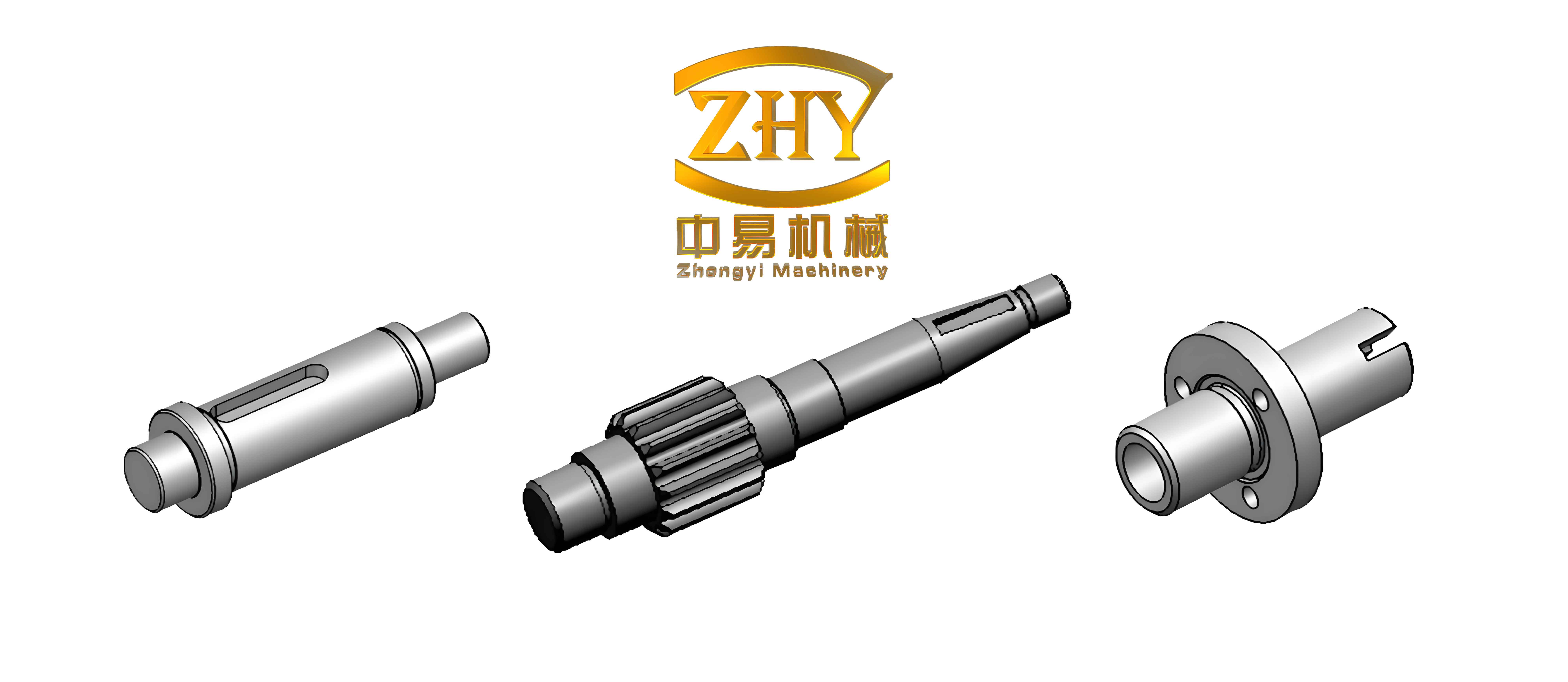
To begin, the simply supported beam algorithm calculates bearing loads based on gear forces acting on the gear shaft. For a spur gear, the normal load \( K_n \) on the tooth surface is derived from the tangential force \( K_t \) and radial force \( K_r \), with no axial force generated. The equations are as follows:
$$K_t = \frac{2M}{mz}$$
$$K_n = \frac{K_t}{\cos \alpha_c}$$
where \( M \) is the gear torque in kN·m, \( m \) is the module, \( z \) is the number of teeth, and \( \alpha_c \) is the pressure angle in degrees. The gear shaft is modeled as a beam with bearings at supports A and B, and the radial forces \( F_{rA} \) and \( F_{rB} \) are computed using equilibrium equations. For instance, the radial force at bearing A is given by:
$$F_{rA} = \frac{K_n (0.5L_1 + L_2 + L_3)}{L_3}$$
where \( L_1 \), \( L_2 \), and \( L_3 \) are distances along the gear shaft from the gear to the bearings. The axial forces \( F_{aA} \) and \( F_{aB} \) for tapered roller bearings arise from the derived radial forces and are calculated based on the bearing’s dynamic load coefficients \( X \) and \( Y \), where \( Y = 0.4 \cot \alpha \) and \( \alpha \) is the contact angle. The static load safety factor \( S_0 \) is then evaluated as:
$$S_0 = \frac{C_0}{P_0}$$
with \( P_0 \) being the equivalent static load, which is the larger of \( X_0 F_r + Y_0 F_a \) or \( F_r \), where \( C_0 \) is the basic static load rating, and \( X_0 \) and \( Y_0 \) are static load coefficients. For fatigue life, the ISO281 standard life \( L_{10} \) in millions of revolutions is:
$$L_{10} = \left( \frac{C_r}{P_r} \right)^{10/3}$$
where \( C_r \) is the basic dynamic load rating and \( P_r \) is the equivalent dynamic load, given by \( P_r = X F_r + Y F_a \). The life in hours \( L_{10h} \) is converted using:
$$L_{10h} = \frac{L_{10}}{60n}$$
where \( n \) is the rotational speed in rpm. However, this simplified approach may overlook shaft deformations and localized stress concentrations in the gear shaft, leading to potential inaccuracies in bearing load estimates.
In comparison, finite element simulations using Romax software provide a more detailed analysis of the gear shaft bearing system. The model incorporates the entire drive assembly, including the gear shaft, bearings, and housing, with realistic boundary conditions and material properties. Loads are applied uniformly along the gear tooth width, and bearing fits are specified according to standard tolerances (e.g., shaft deviations of n6 or m6 and housing deviations of H7). This method accounts for shaft flexibility, which redistributes loads and reduces the calculated bearing forces compared to the rigid shaft assumption in the simply supported beam method. As a result, finite element analysis often yields higher safety factors and longer life estimates for the gear shaft bearings, aligning better with the stringent requirements of wind turbine applications.
To illustrate the differences between these methods, three engineering cases were analyzed, each involving a gear shaft with specific dimensions and bearing configurations. The cases vary in torque values, gear parameters, and bearing types, reflecting common scenarios in wind power deflection drivers. The following table summarizes the key parameters for each case, including gear shaft spacings and bearing details:
| Case | Torque M (kN·m) | Gear Parameters | Spacings (mm) | Bearing Parameters |
|---|---|---|---|---|
| Limit / Rated | m / z / α_c | L1 / L2 / L3 | Position / Model / α / e / X0 / Y0 / Cr (kN) / C0 (kN) | |
| 1 | 65 / 19.5 | 16 / 15 / 20° | 140 / 52 / 140 | A: 32228 / 16°10’20” / 0.44 / 0.5 / 0.76 / 657 / 1020 B: 30224 / 16°10’20” / 0.44 / 0.5 / 0.76 / 353 / 483 |
| 2 | 147 / 35.3 | 24 / 14 / 20° | 205 / 82 / 161 | A: 32240 / 15°10′ / 0.41 / 0.5 / 0.82 / 1380 / 2180 B: 32036 / 15°45′ / 0.42 / 0.5 / 0.78 / 622 / 1090 |
| 3 | 57.8 / 19.9 | 16 / 15 / 20° | 170 / 65.5 / 184 | A: 32230 / 16°10’20” / 0.44 / 0.5 / 0.76 / 756 / 1180 B: 30226 / 16°10’20” / 0.44 / 0.5 / 0.76 / 378 / 512 |
For each case, the static load safety factor \( S_0 \) and ISO281 life \( L_{10h} \) were computed using both the simply supported beam algorithm and finite element simulations. The results, presented in the tables below, demonstrate significant discrepancies. Under the simply supported beam method, some cases failed to meet the mandatory \( S_0 \geq 1.1 \) requirement, whereas the finite element approach consistently achieved compliance. Similarly, the calculated life values were higher with finite element analysis, ensuring all bearings exceeded the 130,000-hour threshold. This underscores the limitations of the simplified method for gear shaft bearing verification in wind turbines, where accurate load distribution is critical.
| Case | Bearing Position | Simply Supported Beam \( S_0 \) | Finite Element \( S_0 \) |
|---|---|---|---|
| 1 | A | 0.95 | 1.16 |
| 1 | B | 0.88 | 1.30 |
| 2 | A | 1.09 | 1.40 |
| 2 | B | 1.03 | 1.55 |
| 3 | A | 1.27 | 1.50 |
| 3 | B | 1.10 | 1.53 |
| Case | Bearing Position | Simply Supported Beam \( L_{10h} \) (hours) | Finite Element \( L_{10h} \) (hours) |
|---|---|---|---|
| 1 | A | 1.8 × 10^5 | 3.6 × 10^5 |
| 1 | B | 8.2 × 10^4 | 2.6 × 10^5 |
| 2 | A | 1.0 × 10^6 | 2.3 × 10^6 |
| 2 | B | 2.4 × 10^5 | 8.3 × 10^5 |
| 3 | A | 8.0 × 10^5 | 1.4 × 10^6 |
| 3 | B | 2.9 × 10^5 | 8.0 × 10^5 |
The differences in results stem from how each method handles the gear shaft’s behavior. In the simply supported beam approach, the assumption of a rigid shaft leads to higher calculated radial and axial forces on the bearings, as the gear shaft does not flex under load. This overestimation reduces the safety factor and life values. For example, in Case 1, the simply supported beam method yielded a radial force \( F_{rA} \) of 1079 kN for bearing A, while the finite element simulation gave 881 kN, a reduction of approximately 18%. Similarly, axial forces were lower in the finite element model due to better load sharing along the gear shaft. Since bearing life is highly sensitive to load (as \( L_{10} \propto (1/P_r)^{10/3} \)), even small reductions in force significantly extend calculated life, making finite element analysis more aligned with real-world gear shaft performance.
Beyond method comparison, the preload applied to the gear shaft bearings plays a vital role in their performance. Preload, typically set as an axial displacement on the bearing inner ring, influences the stiffness, life, and safety of the gear shaft assembly. Using the finite element model, the effect of preload magnitude (ranging from 0 to 0.5 mm) on static safety factor \( S_0 \), life \( L_{10h} \), and maximum gear shaft deformation was analyzed for all three cases. The trends observed were consistent across cases: as preload increases, \( S_0 \) decreases gradually, while \( L_{10h} \) shows a more pronounced decline beyond a certain threshold. Specifically, for the gear shaft, the life of the larger bearing (position A) remains relatively stable up to 0.35 mm preload but drops sharply thereafter, whereas the smaller bearing (position B) experiences a steady decrease. The gear shaft’s maximum deformation, however, reduces with increasing preload, enhancing stiffness but potentially compromising life if excessive.
The relationship between preload and gear shaft deformation can be described by the shaft’s deflection equation under load. For a gear shaft supported by two bearings, the maximum deformation \( \delta_{\text{max}} \) at the gear location is influenced by the preload-induced stiffness change. In general, the deformation decreases with preload according to a nonlinear function, which can be approximated as:
$$\delta_{\text{max}} \approx \frac{K_n L_1^3}{3EI} – k_p P_p$$
where \( E \) is the modulus of elasticity, \( I \) is the moment of inertia of the gear shaft, \( k_p \) is a preload-dependent stiffness coefficient, and \( P_p \) is the preload force. This reduction in deformation improves the gear mesh alignment and reduces dynamic loads on the gear shaft, but it must be balanced against the negative impact on bearing life. The following table summarizes the effects of preload on key parameters for a typical gear shaft bearing system, based on finite element results:
| Preload (mm) | Average \( S_0 \) | Average \( L_{10h} \) (hours) | Average Shaft Deformation (mm) |
|---|---|---|---|
| 0 | 1.50 | 1.2 × 10^6 | 0.12 |
| 0.15 | 1.45 | 1.1 × 10^6 | 0.09 |
| 0.30 | 1.35 | 9.5 × 10^5 | 0.07 |
| 0.45 | 1.20 | 6.0 × 10^5 | 0.05 |
| 0.50 | 1.15 | 4.5 × 10^5 | 0.04 |
From the data, it is evident that preload levels between 0 and 0.35 mm offer a reasonable compromise, maintaining \( S_0 \) above 1.1 and \( L_{10h} \) above 130,000 hours while reducing gear shaft deformation by up to 40%. This range ensures that the gear shaft remains sufficiently stiff without drastically shortening bearing life. For instance, in Case 2, preloads beyond 0.35 mm caused the life of bearing A to fall below the requirement, highlighting the need for careful optimization in gear shaft designs. Engineers should therefore use finite element simulations to determine the optimal preload for each specific gear shaft configuration, considering factors like load spectrum and environmental conditions.
In conclusion, the verification of gear shaft bearings in wind power deflection drivers requires a meticulous approach to meet industry standards. The simply supported beam algorithm, while simple, often underestimates bearing performance due to its rigid shaft assumption and may not satisfy mandatory criteria for safety and life. Finite element simulations, such as those with Romax, provide a more accurate representation of gear shaft behavior, leading to reliable bearing verification results. Additionally, preload management is crucial; a preload range of 0 to 0.35 mm is recommended to balance safety, life, and gear shaft deformation. Future work could explore the universal applicability of these findings across different gear shaft geometries and operational conditions, further enhancing the reliability of wind turbine systems. By prioritizing advanced simulation techniques and optimized preload settings, designers can ensure the longevity and efficiency of gear shaft bearings in renewable energy applications.