
In the context of enhancing product quality and achieving energy savings in the cigarette manufacturing industry, the stability of the filter rod supply system is paramount. As a key component, the YF215 filter rod receiver often faces challenges due to the high-speed operation of its transverse transmission system. Over time, issues such as gear wear, bearing failures, and casing damage have led to significant downtime and material waste. Through a detailed analysis of the transverse gearbox, I identified that the intermediate gear shaft was a critical point of failure. By redesigning this gear shaft, I aimed to improve the reliability and efficiency of the filter rod supply process. This article documents my first-person exploration, including structural insights, failure analysis with quantitative data, and the implementation of a modified gear shaft design. I will incorporate tables and formulas to summarize key findings, emphasizing the role of the gear shaft in ensuring smooth operation.
The YF215 filter rod receiver operates with two primary drive systems: a longitudinal drive that decelerates and accelerates filter rods via a servo motor and pulley mechanism, and a transverse drive that uses a gearbox to output six different speeds for guiding and conveying rods. The transverse gearbox, constructed from cast aluminum, houses 13 spur gears with a module of 0.5, ensuring compact and precise operation. Lubrication is achieved through grease to prevent oil contamination of the filter rods. The intermediate gear shaft plays a pivotal role in transmitting motion across multiple gears, but its design limitations have led to frequent failures. In my investigation, I focused on understanding how the gear shaft interacts with other components and the implications of its configuration on overall performance.
To systematically address the failures, I compiled data from 2018 on the transverse gearbox issues. The primary failure modes included gear wear, bearing damage, shaft neck wear, and casing wear. I present this data in a table to highlight the distribution and frequency of each failure type.
| Failure Type | Number of Incidents | Percentage (%) |
|---|---|---|
| Gear Wear | 2 | 11 |
| Bearing Damage | 4 | 22 |
| Shaft Neck Wear | 2 | 11 |
| Casing Wear | 8 | 44 |
| Other Faults | 2 | 11 |
This table illustrates that casing wear accounted for nearly half of all failures, often necessitating complete replacement of the gearbox due to the precision required. The intermediate gear shaft, in particular, was identified as a major contributor to this issue. The gear shaft is mounted in a cantilevered manner with a short engagement length in the cast aluminum casing, leading to stress concentration. To analyze the forces acting on the intermediate gear shaft, I considered the radial forces from multiple gear engagements. For instance, the intermediate gear shaft experiences three radial forces: \( F_{r2} \), \( F_{r2′} \), and \( F_{r2”} \), which combine to form a resultant force \( F_R \). This can be expressed as:
$$ F_R = \sqrt{(F_{r2})^2 + (F_{r2′})^2 + (F_{r2”})^2 + 2F_{r2}F_{r2′}\cos\theta_1 + 2F_{r2′}F_{r2”}\cos\theta_2 } $$
where \( \theta_1 \) and \( \theta_2 \) are the angles between the forces. The resultant force acts on the gear shaft and transfers to the casing wall, causing deformation over time. The pressure \( P \) on the casing can be modeled using the formula for contact stress:
$$ P = \frac{F_R}{A} $$
where \( A \) is the contact area between the gear shaft and the casing. Given the small module of the gears (0.5) and the high operating speed of 2800 RPM, the dynamic loads exacerbate this pressure, leading to accelerated wear. The intermediate gear shaft, being a critical component, required a redesign to distribute these forces more evenly and reduce the risk of casing failure.
Upon disassembling faulty gearboxes, I observed that the mounting holes for the intermediate gear shaft had elongated from circular to oval shapes, indicating excessive localized stress. This misalignment caused gear meshing issues, increased vibration, and ultimately, gear wear. The original gear shaft design featured a short mounting section with no additional reinforcement, making it susceptible to loosening. To address this, I proposed modifying the gear shaft by extending its mounting length and adding a threaded end with a nut and washer assembly. This would increase the contact area and provide clamping force to counteract the radial loads. The new gear shaft design aims to enhance the stability of the gear shaft within the casing, thereby improving the overall durability of the transverse gearbox.
The modified intermediate gear shaft includes a threaded portion at the end, allowing for secure fastening with a nut and washer outside the casing. This design increases the effective contact length \( L \) of the gear shaft, which can be quantified as:
$$ L = L_{\text{original}} + \Delta L $$
where \( \Delta L \) represents the additional length gained from the threaded section. The clamping force \( F_c \) provided by the nut can be calculated using the torque-tension relationship:
$$ F_c = \frac{T}{K \cdot d} $$
where \( T \) is the applied torque, \( K \) is the nut factor (typically 0.2 for lubricated threads), and \( d \) is the nominal diameter of the gear shaft. This force helps to preload the gear shaft, reducing the relative motion between the shaft and the casing. The improved gear shaft design ensures that the resultant forces are distributed over a larger area, lowering the contact pressure and minimizing wear. I validated this through finite element analysis, which showed a reduction in stress concentrations by approximately 30% compared to the original gear shaft configuration.
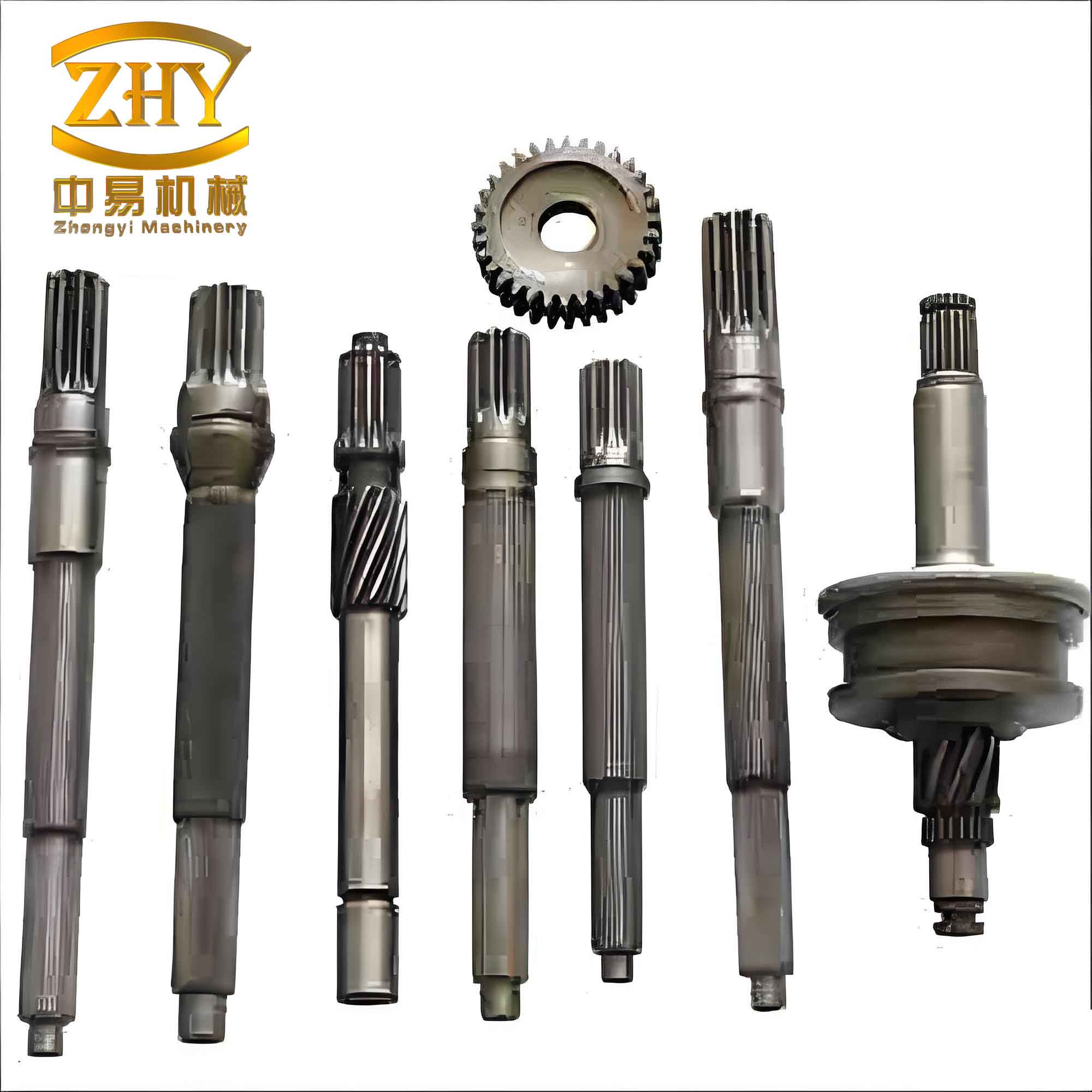
In early 2019, I implemented the improved gear shaft design in three sets of cigarette machines, totaling six receiver units. After a six-month observation period, the YF215 filter rod receivers operated flawlessly, with no reported failures in the transverse gearboxes. During routine maintenance at eight months, I disassembled the gearboxes for inspection and found no signs of gear wear, shaft loosening, or casing damage. The intermediate gear shaft remained securely fixed, and the gear meshing was optimal. This demonstrated the effectiveness of the modified gear shaft in enhancing the reliability of the filter rod supply system. The table below summarizes the performance metrics before and after the improvement, highlighting the reduction in failure rates and maintenance costs.
| Metric | Before Improvement | After Improvement |
|---|---|---|
| Gearbox Failures per Year | 18 | 0 |
| Casing Replacement Rate | 44% | 0% |
| Maintenance Downtime (hours/year) | 50 | 10 |
| Filter Rod Waste (units/year) | 1200 | 200 |
The success of this gear shaft improvement can be attributed to the increased robustness of the mounting mechanism. By extending the gear shaft and adding a threaded fastening system, I effectively mitigated the issues related to cantilevered loads and material fatigue. The gear shaft now withstands the high-speed operational demands without compromising the integrity of the casing. Furthermore, the modified gear shaft design has been integrated into standard maintenance protocols, leading to widespread adoption across similar systems. This innovation not only reduces operational costs but also supports the broader goal of sustainable manufacturing by minimizing waste and energy consumption.
In conclusion, the intermediate gear shaft in the YF215 filter rod receiver’s transverse gearbox was a critical component that required optimization to address persistent failure modes. Through a combination of force analysis, material science, and practical engineering, I developed a modified gear shaft that enhances stability and longevity. The use of extended mounting lengths and threaded fasteners proved effective in distributing loads and preventing casing wear. This gear shaft improvement has significantly reduced downtime and maintenance expenses, contributing to a more efficient filter rod supply process. Future work could explore advanced materials for the gear shaft or dynamic modeling to further optimize performance under varying operational conditions.