
In modern manufacturing, the cross wedge rolling process for gear shafts represents an efficient and high-quality method for forming integrated components that combine gear teeth and stepped shafts. This study focuses on the critical aspect of billet temperature and its impact on the precision of gear splitting during the forming of involute spur gear shafts. As a researcher in this field, I have investigated how variations in billet temperature affect the metal flow and splitting accuracy, utilizing finite element simulations to derive actionable insights. The gear shaft is a fundamental component in transmission systems, and its成形 quality directly influences performance and durability. Through this work, I aim to provide a comprehensive analysis that bridges theoretical models with practical applications, emphasizing the importance of temperature control in achieving optimal splitting results for gear shafts.
The cross wedge rolling process involves plastic deformation of a heated billet using wedge-shaped dies that impart a rotational motion to the billet, enabling simultaneous formation of gear teeth and shaft sections. A key challenge lies in ensuring accurate initial splitting, where the dies create precise grooves on the billet surface to define the gear teeth. If the splitting phase is compromised, it can lead to defects such as misaligned teeth, extra teeth, or irregular profiles, ultimately affecting the functionality of the gear shaft. My research delves into the theoretical conditions for uniform splitting and how billet temperature alters these conditions, necessitating adjustments in die design parameters.
To establish a foundation, I first derived the theoretical uniform splitting condition based on gear meshing principles. For a gear shaft with a billet diameter \( d_{\text{billet}} \) and a target number of teeth \( z \), the die pitch \( p \) must satisfy the relationship where the billet rotates by an angle \( 2\theta \) as the die moves horizontally by one pitch. This can be expressed as:
$$ p = d_{\text{billet}} \sin\theta $$
where \( \theta = \frac{\pi}{z} \). For small angles, the sine function can be approximated using its Taylor series expansion:
$$ \sin\theta \approx \theta – \frac{\theta^3}{6} + \frac{\theta^5}{120} – \cdots $$
However, in practical applications for gear shafts with finite tooth counts, a simplified form is often used:
$$ p \approx d_{\text{billet}} \theta = d_{\text{billet}} \frac{\pi}{z} $$
This approximation introduces errors, especially for smaller \( z \), but it serves as a baseline for die design. The billet diameter is calculated based on volume conservation before and after deformation, ensuring that the material flow aligns with the intended gear shaft geometry. For instance, the volume \( V \) of the initial cylindrical billet should equal the volume of the final gear shaft, which can be modeled as a combination of cylindrical and gear-shaped sections. The volume equation for a standard involute gear shaft can be complex, but a simplified approach involves:
$$ V = \frac{\pi}{4} d_{\text{billet}}^2 L = V_{\text{shaft}} + V_{\text{gear}} $$
where \( L \) is the billet length, and \( V_{\text{gear}} \) is derived from gear geometry parameters like module \( m \) and tooth number \( z \). For an involute gear, the gear volume can be estimated using empirical formulas or numerical integration, but in this study, I assumed a standard module of 2 and tooth number of 18 for simulation purposes.
The influence of billet temperature on this process cannot be overstated. As temperature increases, the metal’s plasticity improves, but it also affects flow stress and friction conditions. To quantify this, I developed a finite element model using Deform-3D software, which handles the nonlinear plastic deformation involved in cross wedge rolling of gear shafts. The model considered the billet as a plastic body with AISI-1045 steel properties, while the dies and baffle were treated as rigid bodies. Key parameters included a constant die speed of 30 mm/s, a shear friction coefficient of 0.99 between the dies and billet, and a lower friction coefficient of 0.12 between the baffle and billet. The mesh consisted of 100,000 tetrahedral elements, with localized refinement in the deformation zone to capture detailed splitting behavior.
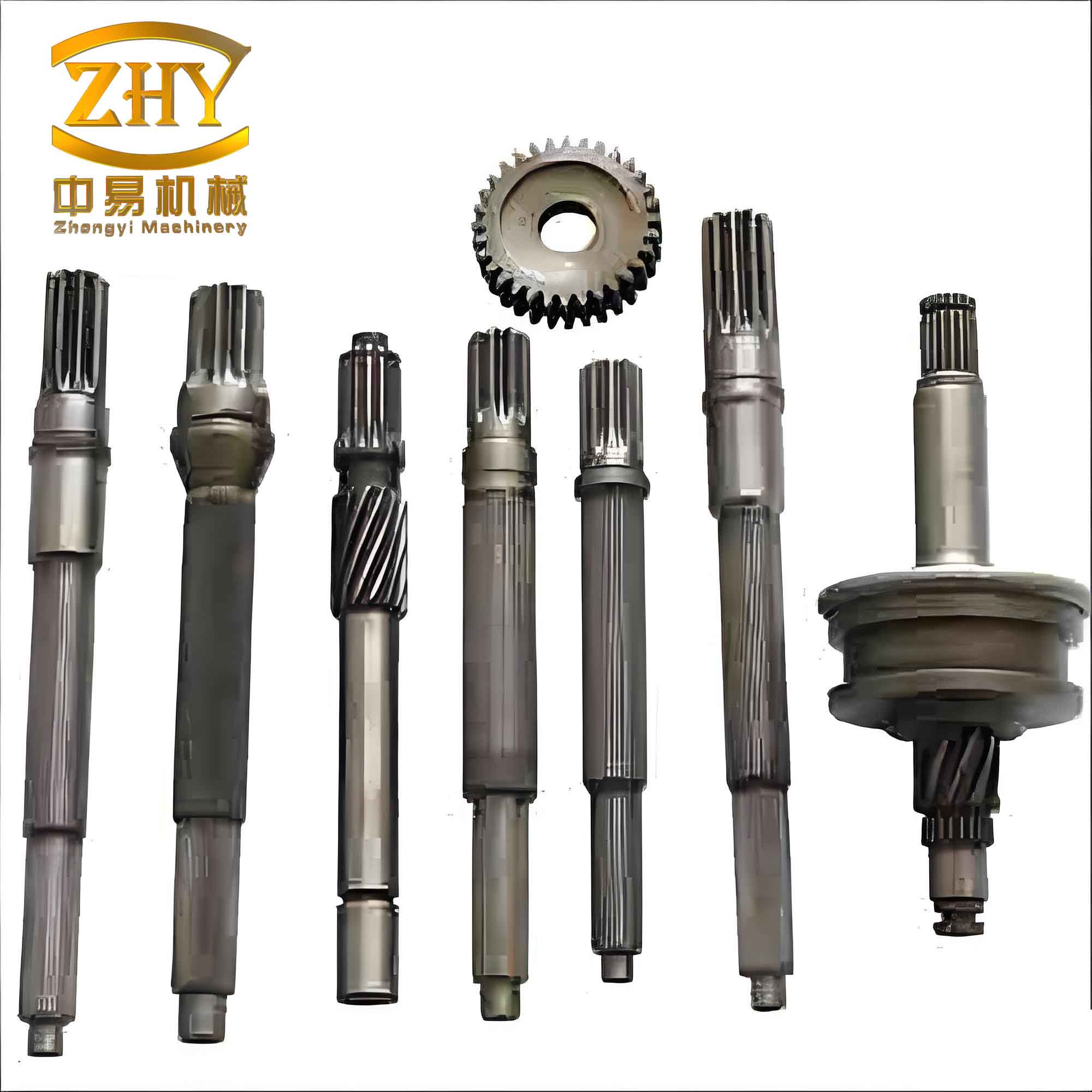
In the simulations, I varied the billet temperature from 1000°C to 1150°C, as these ranges are typical for hot forming processes involving gear shafts. The initial die temperature was set to 300°C, and environmental conditions were maintained at 20°C, with heat transfer effects neglected for simplicity. For each temperature, I applied the standard die pitch calculated as \( p = d_{\text{billet}} \frac{\pi}{z} \), which for a billet diameter of approximately 40 mm (derived from volume conservation) and \( z = 18 \), gives \( p \approx 6.283 \) mm. However, the results revealed that this standard pitch led to incorrect splitting at elevated temperatures, manifesting as overlapping teeth, extra grooves, and overall poor quality in the gear shaft formation.
To address this, I introduced a compensation factor \( \Delta \) to the die pitch, modifying the equation to:
$$ p = d_{\text{billet}} \frac{\pi}{z} + \Delta $$
where \( \Delta \) is determined empirically based on temperature. The table below summarizes the simulation results for different billet temperatures, showing the required compensation values and the corresponding percentage increases to achieve accurate splitting for the gear shaft:
| Temperature (°C) | Compensation \( \Delta \) (mm) | Increase Percentage (%) |
|---|---|---|
| 1000 | 0.43 | 6.9 |
| 1100 | 0.43 | 6.9 |
| 1150 | 0.44 | 7.0 |
As evident from the table, higher temperatures necessitate a larger compensation, indicating that metal flow becomes more volatile, requiring adjustments in die design to maintain splitting precision for the gear shaft. The relationship between temperature and compensation can be modeled linearly for this range, but for broader applications, a more complex thermal model might be needed.
Further analysis involved examining the metal flow patterns during splitting. The velocity field \( \vec{v} \) of the billet material can be described by the Navier-Stokes equations for incompressible flow, simplified for plastic deformation:
$$ \nabla \cdot \vec{v} = 0 $$
and the momentum equation:
$$ \rho \left( \frac{\partial \vec{v}}{\partial t} + \vec{v} \cdot \nabla \vec{v} \right) = -\nabla p + \mu \nabla^2 \vec{v} + \vec{f} $$
where \( \rho \) is density, \( p \) is pressure, \( \mu \) is dynamic viscosity, and \( \vec{f} \) represents body forces. In the context of gear shaft forming, the effective viscosity decreases with temperature, leading to higher strain rates and potential slippage. The strain rate tensor \( \dot{\epsilon}_{ij} \) can be linked to the stress tensor \( \sigma_{ij} \) via constitutive equations for AISI-1045 steel, such as the Arrhenius-type model:
$$ \dot{\epsilon} = A \sigma^n \exp\left(-\frac{Q}{RT}\right) $$
where \( A \) is a material constant, \( n \) is the stress exponent, \( Q \) is activation energy, \( R \) is the gas constant, and \( T \) is absolute temperature. This equation highlights how temperature elevates strain rates, affecting the splitting accuracy in gear shaft production.
To illustrate the impact on splitting quality, I conducted multiple simulation runs and recorded key metrics like tooth alignment error and groove depth uniformity. The following table compares the splitting outcomes for uncompensated and compensated die pitches across different temperatures, emphasizing the critical role of temperature management in gear shaft manufacturing:
| Temperature (°C) | Standard Pitch Result | Compensated Pitch Result | Key Observations for Gear Shaft |
|---|---|---|---|
| 1000 | Incorrect splitting: misaligned teeth | Accurate 18-tooth splitting | Metal flow stable with compensation |
| 1100 | Multiple teeth and irregularities | Precise groove formation | Increased流动性 requires pitch adjustment |
| 1150 | Severe overlapping and defects | Uniform tooth distribution | Highest compensation needed for gear shaft integrity |
The data clearly shows that without compensation, the gear shaft exhibits significant defects, whereas with the adjusted pitch, splitting quality is restored. This underscores the importance of dynamic die design that accounts for thermal effects. In practical terms, for a gear shaft with module 2 and 18 teeth, the compensated pitch equation becomes:
$$ p = 40 \times \frac{\pi}{18} + \Delta \approx 6.283 + \Delta $$
with \( \Delta \) values as listed earlier. This adjustment ensures that the die teeth engage the billet properly, minimizing slippage and promoting uniform deformation.
Beyond splitting, the overall forming process for gear shafts involves multiple stages: initial splitting, groove formation, and finishing. The energy required for plastic work \( W \) can be estimated as:
$$ W = \int \sigma \, d\epsilon $$
where \( \sigma \) is flow stress and \( \epsilon \) is strain. At higher temperatures, \( \sigma \) decreases, reducing the force needed but increasing the risk of uncontrolled flow. For gear shafts, this translates to a trade-off between formability and precision. My simulations also considered the effect of die angle and width, but temperature emerged as the dominant factor for splitting accuracy.
In conclusion, my research demonstrates that billet temperature plays a pivotal role in the splitting quality of gear shafts during cross wedge rolling. The theoretical uniform splitting condition provides a baseline, but real-world applications require compensatory measures to counteract temperature-induced flow variations. For gear shafts with common specifications, a pitch increase of 6.9% to 7.0% is recommended for temperatures between 1000°C and 1150°C. This insight not only enhances the quality of gear shaft production but also contributes to sustainable manufacturing by reducing material waste and rework. Future work could explore adaptive control systems that dynamically adjust die parameters based on real-time temperature monitoring, further optimizing the process for diverse gear shaft designs.
Throughout this study, the gear shaft has been the central focus, and the findings reinforce the need for integrated thermal-mechanical models in advanced manufacturing. By leveraging finite element analysis and empirical validations, I have established a framework that can be extended to other complex geometries, ensuring that gear shafts meet the stringent demands of modern engineering applications.