
In my investigation of a gear shaft failure within a crane reducer system, I encountered a critical incident where multiple teeth on the third-stage gear shaft fractured after a short service period. The gear shaft, fabricated from 20CrMnTi steel, is integral to transmitting torque and motion in demanding industrial applications. My analysis aimed to uncover the root causes of this failure using a multidisciplinary approach, focusing on material properties, manufacturing defects, and operational stresses. Throughout this report, I will emphasize the importance of the gear shaft’s design and processing in preventing such failures, as the gear shaft is a pivotal component in mechanical power transmission systems.
I initiated the examination with a macroscopic assessment of the failed gear shaft. The fracture involved four adjacent teeth, labeled 1 to 4 for reference. Tooth 1 exhibited the primary fracture origin at the sharp corner where the gear end face meets the tooth root surface. This area lacked a chamfer, resulting in a stress concentration point. Subsequent fractures propagated to teeth 2 through 4, with all fracture surfaces displaying a bright gray, brittle appearance devoid of plastic deformation. Radiating patterns converged at the tooth roots, indicating instantaneous failure without fatigue characteristics. The surface roughness near the tooth roots was evident, with visible machining marks from the gear hobbing process, which likely exacerbated stress concentrations. This initial observation led me to suspect that the gear shaft experienced an overload event, compounded by geometric and surface imperfections.
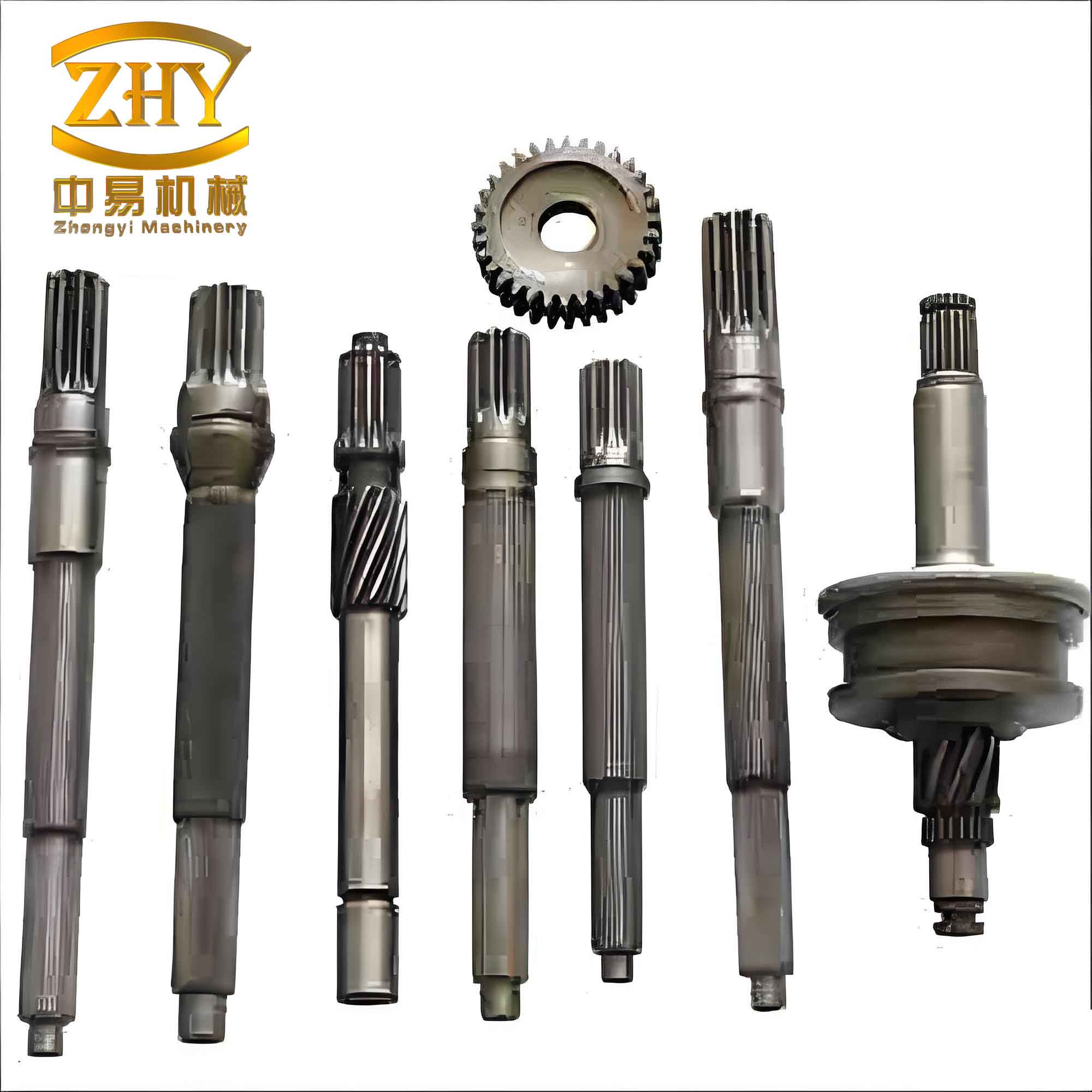
To evaluate the material integrity, I performed chemical composition analysis using optical emission spectroscopy. The results confirmed that the gear shaft material complied with standard specifications for 20CrMnTi steel, as outlined in Table 1. This alloy is commonly selected for gear shafts due to its high hardenability and toughness, which are essential for withstanding cyclic loads. The carbon content, along with chromium and titanium additions, supports carburizing treatments to achieve a hard, wear-resistant surface while maintaining a ductile core. Since the composition was within acceptable limits, I ruled out material non-conformity as a contributing factor to the gear shaft failure.
| Element | Measured Value | Standard Range |
|---|---|---|
| C | 0.19 | 0.17-0.23 |
| Si | 0.22 | 0.17-0.37 |
| Mn | 0.87 | 0.80-1.10 |
| P | 0.017 | ≤0.030 |
| S | 0.024 | ≤0.030 |
| Cr | 1.07 | 1.00-1.30 |
| Ti | 0.05 | 0.04-0.10 |
Moving to microscopic fracture analysis, I examined the fracture surfaces using scanning electron microscopy (SEM). The origin region in tooth 1 showed minor mechanical wear, but no evidence of pre-existing cracks or inclusions. The carburized layer displayed intergranular fracture features, while the substrate exhibited cleavage patterns, consistent with brittle overload. The surface roughness at the tooth root, combined with the sharp, unchamfered edge, created micro-notches that acted as stress raisers. I quantified the stress concentration effect using the formula for a sharp notch: $$ K_t = 1 + 2\sqrt{\frac{a}{\rho}} $$ where \( K_t \) is the stress concentration factor, \( a \) is the depth of surface irregularities (approximately 0.04 mm based on measurements), and \( \rho \) is the radius of curvature. Given the near-zero \( \rho \) at the sharp corner, \( K_t \) values exceeded 5, significantly reducing the gear shaft’s load-bearing capacity. This analysis underscored how minor machining flaws in a gear shaft can lead to catastrophic failure under transient overloads.
I conducted metallographic examinations to assess the microstructural quality of the gear shaft. Samples were sectioned from unfractured teeth and the tooth root region, then prepared using standard grinding and etching techniques. The carburized layer exhibited a uniform depth of 1.3–1.5 mm, with a microstructure consisting of fine martensite and minimal retained austenite. However, the tooth root surface revealed roughness-induced defects up to 0.04 mm deep, as shown in Table 2, which summarizes the metallographic ratings. The core microstructure comprised lath martensite and bainite, indicative of proper heat treatment. Non-metallic inclusions were primarily Type A (sulfide) strings, rated at 2.5 on the fine scale, but these are generally considered benign in wrought steels. The absence of decarburization or abnormal grain growth confirmed that the heat treatment process for the gear shaft was adequate, directing attention to mechanical aspects.
| Location | Martensite Rating | Carbide Rating | Retained Austenite Rating | Surface Oxidation Rating |
|---|---|---|---|---|
| Pitch Circle | 4 | 1 | 1 | 1 |
| Tooth Root | 4 | 1 | 1 | 3 |
Hardness testing provided further insights into the gear shaft’s mechanical properties. I measured microhardness profiles across the carburized layer at both the pitch circle and tooth root, with results detailed in Table 3. The surface hardness, converted to Rockwell C scale, averaged 59 HRC, meeting technical requirements. The core hardness ranged from 30.5 to 33.4 HRC, aligning with standards for carburized gears. The hardness gradient can be modeled using an exponential decay function: $$ H(d) = H_s – (H_s – H_c) \cdot e^{-k d} $$ where \( H(d) \) is the hardness at depth \( d \), \( H_s \) is the surface hardness, \( H_c \) is the core hardness, and \( k \) is a material constant. For this gear shaft, \( k \) was approximately 0.8 mm⁻¹, indicating a steep gradient that enhances surface durability but may sensitize the material to stress concentrations at the case-core interface.
| Depth (mm) | Pitch Circle Hardness | Tooth Root Hardness |
|---|---|---|
| 0.1 | 680 | 685 |
| 0.2 | 694 | 675 |
| 0.3 | 678 | 661 |
| 0.4 | 667 | 658 |
| 0.5 | 664 | 653 |
| 0.6 | 644 | 642 |
| 0.7 | 638 | 643 |
| 0.8 | 601 | 634 |
| 0.9 | 599 | 607 |
| 1.0 | 587 | 591 |
| 1.1 | 573 | 587 |
| 1.2 | 554 | 580 |
| 1.3 | 552 | 573 |
| 1.4 | 543 | 554 |
| 1.5 | 520 | 550 |
| 1.6 | 512 | 537 |
In discussing the failure mechanism, I analyzed the operational context of the gear shaft. Cranes frequently experience start-stop cycles and sudden load changes, which can induce shock loads exceeding the design limits. The fracture initiated at the sharp, unchamfered corner of tooth 1, where stress concentrations peaked. Using fracture mechanics, I estimated the critical stress intensity factor for brittle fracture: $$ K_{IC} = \sigma_f \sqrt{\pi a} $$ where \( K_{IC} \) is the material’s fracture toughness (approximately 60 MPa√m for 20CrMnTi steel), \( \sigma_f \) is the fracture stress, and \( a \) is the effective crack size. Given the surface defect depth of 0.04 mm, the calculated \( \sigma_f \) was around 1200 MPa, which could be surpassed during an overload event. The sequential failure of teeth 2 to 4 resulted from load redistribution after the initial fracture, highlighting the gear shaft’s vulnerability to cascading failures under dynamic conditions.
To mitigate such issues, I recommend optimizing the gear shaft manufacturing process. Implementing a chamfer at the tooth root-end face intersection can reduce the stress concentration factor significantly. For instance, a chamfer radius \( r \) of 0.5 mm would lower \( K_t \) to approximately 2.5, as per the formula: $$ K_t = 1 + 2\sqrt{\frac{a}{r}} $$ Additionally, improving surface finish through controlled grinding parameters—such as reduced feed rates and adequate cooling—can minimize roughness-induced defects. Regular inspections using non-destructive testing should focus on these critical areas to detect early signs of stress concentration in the gear shaft.
Further, I considered the role of material selection and heat treatment in enhancing gear shaft performance. While 20CrMnTi steel is suitable, alternative alloys with higher fracture toughness could be evaluated for extreme service conditions. The carburizing process should maintain a balanced case depth to avoid brittleness; for example, the ideal depth \( D \) can be derived from the gear module \( m \) using: $$ D = 0.2 \cdot m $$ where \( m \) is typically 4–6 mm for such applications, yielding \( D \) around 1.0–1.2 mm. This ensures sufficient hardness without compromising toughness, critical for the gear shaft’s longevity.
In conclusion, my analysis confirms that the gear shaft failure was due to brittle overload fracture, primarily driven by stress concentrations from the unchamfered sharp corner and rough surface finish. Short-term operational overloads acted as the triggering mechanism. The gear shaft’s material and heat treatment met standards, but manufacturing imperfections rendered it susceptible to failure. By addressing these issues through design modifications and process controls, similar failures can be prevented, ensuring the reliability of gear shafts in heavy-duty machinery. This case underscores the importance of holistic design and quality assurance in gear shaft production, where even minor details can have major implications for performance and safety.