
In the manufacturing industry, gear shafts are typical components with diverse characteristics and processing methods. This article focuses on the manufacturing of gear shafts with large length-diameter ratios, which present significant challenges due to their slender geometry. The high length-diameter ratio complicates alignment during machining and exacerbates vibrations that adversely affect surface quality. To mitigate technical risks in component development, we conducted process research and experiments, mastering key production technologies and overcoming technical bottlenecks. The study primarily addresses high-precision external cylindrical machining and long deep-hole processing, providing detailed analyses and experimental validations to identify optimal process schemes.
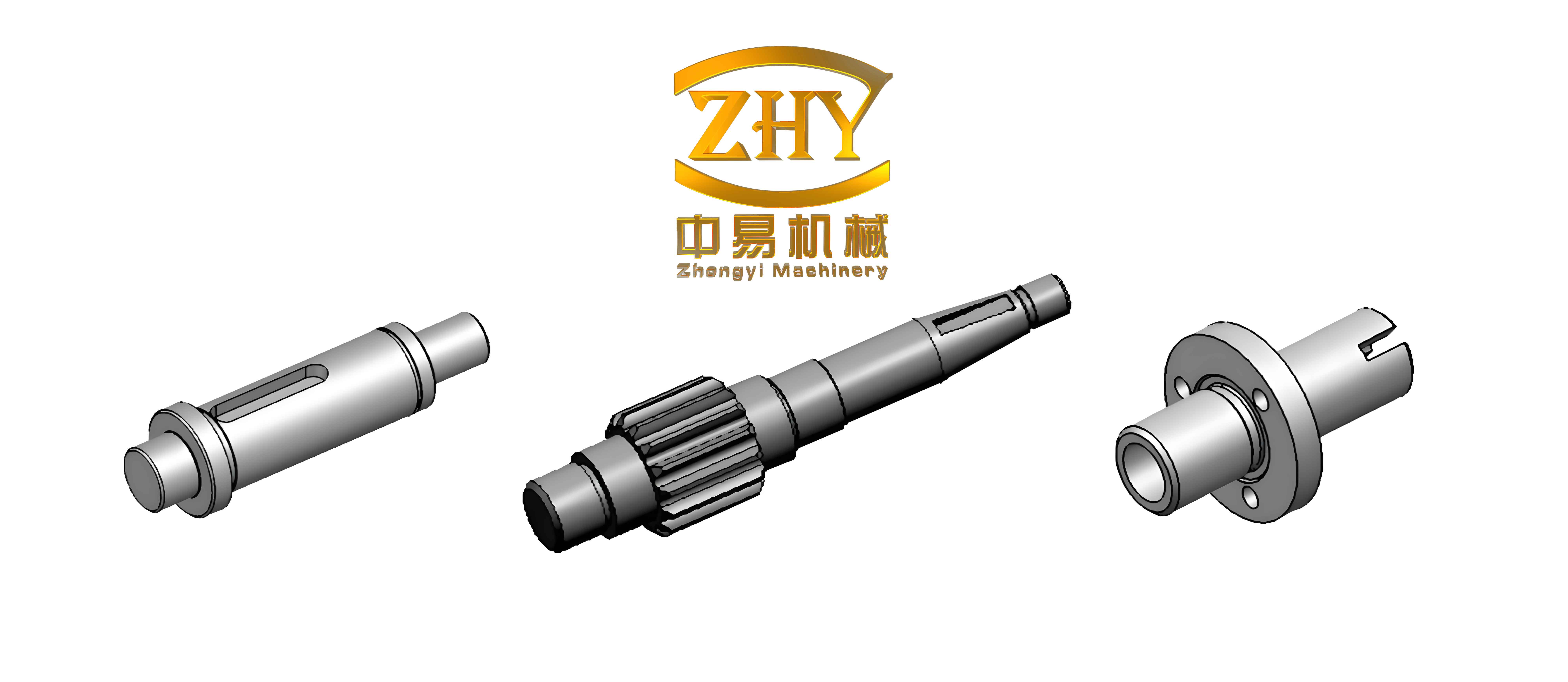
The gear shaft under investigation, such as a low-pressure pinion in certain machinery, exemplifies these challenges. With a length of 3030 mm, an internal diameter of φ150 mm, and stringent requirements for internal surface roughness (Ra 3.2) and runout (0.5 mm), along with external journal specifications including a diameter of φ240 mm, tolerance of 0.029 mm, runout of 0.012 mm, cylindricity of 0.007 mm, and roughness of Ra 0.4, achieving these precision levels demands advanced equipment and meticulous process control. The slender nature of the gear shaft necessitates careful management of clamping alignment, cutting parameters, and vibration suppression to minimize deformation and stress during machining.
Process Analysis
Structural Analysis
The gear shaft’s large length-diameter ratio, typically exceeding 20:1, introduces inherent flexibility that complicates machining. The deflection under cutting forces can be modeled using the Euler-Bernoulli beam equation for a cantilever beam under point load: $$y = \frac{F L^3}{3 E I}$$ where \(y\) is the deflection, \(F\) is the applied force, \(L\) is the length, \(E\) is the elastic modulus, and \(I\) is the area moment of inertia. For a gear shaft with circular cross-section, \(I = \frac{\pi d^4}{64}\), where \(d\) is the diameter. This deflection must be compensated during machining to achieve desired tolerances.
Process Design Analysis
High-precision machining of the gear shaft journals requires grinding processes due to the h6 tolerance and Ra 0.4 roughness. The allocation of machining allowances and selection of cutting parameters critically influence final accuracy. We emphasize reducing cutting stresses and vibrational effects through optimized tool paths and dynamic stabilization techniques. The fundamental relationship for cutting force in turning operations is given by: $$F_c = k_c \cdot a_p \cdot f$$ where \(F_c\) is the cutting force, \(k_c\) is the specific cutting force coefficient, \(a_p\) is the depth of cut, and \(f\) is the feed rate. Controlling these parameters minimizes deformation in the gear shaft.
Technical Challenges and Key Points
Key difficulties in gear shaft machining include journal grinding and deep-hole processing. The journal’s precision requires grinding, where parameter selection affects surface integrity. Deep holes spanning the entire gear shaft length (3030 mm) cannot be machined in a single setup, necessitating secondary clamping which introduces alignment errors. The critical aspect is controlling datum transformation accuracy to maintain concentricity between internal and external diameters.
| Challenge | Description | Impact on Gear Shaft |
|---|---|---|
| Journal Grinding | Achieving h6 tolerance and Ra 0.4 roughness | Requires precise grinding parameters and vibration control |
| Deep-Hole Machining | Maintaining concentricity over 3030 mm length | Dependent on alignment accuracy and tool rigidity |
| Vibration Suppression | Minimizing dynamic deflections during cutting | Affects surface finish and dimensional accuracy |
| Multi-Point Alignment | Reducing errors from secondary clamping | Crucial for maintaining geometric tolerances |
Research Content
High-Precision Machining of Journals
To address dimensional errors in tooling, we performed multiple trial cuts before finish machining to calibrate the difference between theoretical and actual depth of cut. Intermediate measurements allowed real-time adjustments. For turning the slender gear shaft, we conducted parameter experiments focusing on tool wear and machining effectiveness. The optimal parameters were identified through iterative testing, as summarized in Table 1.
| Cutting Speed (m/min) | Feed Rate (mm/min) | Depth of Cut (mm) | Insert Material | Observations |
|---|---|---|---|---|
| 80 | 0.2 | 0.05 | KCU10 | Moderate tool wear, acceptable finish |
| 80 | 0.2 | 0.2 | KCU10 | High cutting force, increased vibration |
| 150 | 0.2 | 0.05 | KCU10 | High speed caused thermal issues |
| 150 | 0.2 | 0.2 | KCU10 | Poor surface finish due to chatter |
| 115 | 0.2 | 0.1 | KCU10 | Balanced parameters, good results |
| 100 | 0.2 | 0.07 | KCU10 | Optimal for gear shaft machining |
| 105 | 0.2 | 0.07 | KCU10 | Slight improvement over 100 m/min |
| 95 | 0.2 | 0.07 | KCU10 | Reduced speed lowered efficiency |
| 100 | 0.2 | 0.06 | KCU10 | Best combination for gear shaft |
| 100 | 0.2 | 0.05 | KCU10 | Adequate but slower material removal |
| 100 | 0.2 | 0.06 | LC4152 | Comparable performance to KCU10 |
| 100 | 0.2 | 0.06 | PC8115 | Good wear resistance for gear shaft |
| 100 | 0.2 | 0.06 | SWD025MS | Excellent for high-precision applications |
The results indicate that a cutting speed of 100 m/min, feed rate of 0.2 mm/min, and depth of cut of 0.06 mm yield the best machining outcomes for the gear shaft. The vibrational stability during turning can be analyzed using the following equation for natural frequency: $$f_n = \frac{1}{2\pi} \sqrt{\frac{k}{m}}$$ where \(f_n\) is the natural frequency, \(k\) is the stiffness, and \(m\) is the mass. By optimizing parameters, we reduced forced vibrations that compromise gear shaft quality.
To control geometric tolerances, we minimized alignment errors using a “one-clamp-one-support” method. Before repositioning the gear shaft, we added multiple runout check points. After repositioning, we verified and adjusted these points to match initial values. Finish machining consistently used the same datum points to offset errors from secondary clamping. For journal finishing, we employed a “one-clamp-one-center” approach with end plugs and intermediate auxiliary supports. We developed three schemes for precision grinding:
Scheme 1: Utilize a high-precision CNC deep-hole lathe (e.g., PT1-1250II 6000) equipped with a precision power grinding head. This allows finish turning and grinding of the gear shaft’s tip circle and journals in one setup, eliminating realignment errors.
Scheme 2: Employ a CNC rotor lathe with a dedicated abrasive belt polisher. After finish turning with a 0.02 mm allowance, the journals and tip circle are polished to specification.
Scheme 3: Perform finish turning on a CNC rotor lathe, leaving a grinding allowance, then transfer to a long horizontal grinder or KVH4-2600 horizontal grinding center for final grinding of the gear shaft’s external surfaces.
We conducted grinding experiments to determine optimal parameters, as shown in Table 2. The governing equation for material removal rate in grinding is: $$MRR = v_w \cdot a_e \cdot v_f$$ where \(MRR\) is the material removal rate, \(v_w\) is the work speed, \(a_e\) is the depth of engagement, and \(v_f\) is the feed rate. Under conditions of spindle speed 20 rpm, wheel speed 450 m/min, feed rate 80 mm/min, and grinding depth 0.002 mm/pass, we achieved the best results for the gear shaft.
| Spindle Speed (rpm) | Wheel Speed (m/min) | Feed Rate (mm/min) | Grinding Depth (mm/pass) | Observations |
|---|---|---|---|---|
| 10 | 100 | 20 | 0.005 | Low efficiency, minimal wear |
| 10 | 100 | 20 | 0.02 | High depth caused surface burns |
| 10 | 450 | 20 | 0.005 | Improved wheel speed helped finish |
| 10 | 450 | 120 | 0.005 | High feed rate induced vibrations |
| 10 | 450 | 90 | 0.005 | Moderate feed, acceptable for gear shaft |
| 10 | 450 | 60 | 0.005 | Better stability, good surface quality |
| 10 | 450 | 80 | 0.005 | Optimal feed rate for this setup |
| 40 | 450 | 80 | 0.005 | High spindle speed increased runout |
| 20 | 450 | 80 | 0.005 | Balanced parameters, best for gear shaft |
| 20 | 300 | 80 | 0.005 | Reduced wheel speed lowered MRR |
| 20 | 400 | 80 | 0.005 | Close to optimal, minor improvements |
| 15 | 450 | 80 | 0.005 | Slower spindle, adequate precision |
| 30 | 450 | 80 | 0.005 | Higher speed, slight chatter observed |
| 20 | 450 | 80 | 0.002 | Reduced depth, superior finish for gear shaft |
All three schemes met precision requirements, but Scheme 2’s belt grinding imposed spatial constraints due to tool turret limitations and offered lower efficiency compared to the KVH4-2600 center. Thus, Schemes 1 and 3 are preferred for gear shaft manufacturing.
Long Deep-Hole Machining
For deep-hole machining in the gear shaft, concentricity with the external diameter is critical. Given the length, single-setup machining is infeasible; thus, we adopted a “one-clamp-one-support” method with repositioning and secondary clamping. We established three uniformly distributed external datum points for alignment, recording values before repositioning and replicating them after to ensure accuracy. The deviation due to repositioning can be modeled as: $$\Delta = \sqrt{\sum_{i=1}^{n} (\delta x_i^2 + \delta y_i^2)}$$ where \(\Delta\) is the total alignment error, and \(\delta x_i\) and \(\delta y_i\) are deviations at each datum point. Minimizing this error is essential for the gear shaft’s integrity.
We used a φ140 mm vibration-damping tool holder for finish boring, controlling the final pass parameters. Through experimentation, we monitored chip formation—disordered chips or poor breakage indicated need for parameter adjustment. The machining length per side exceeded \(L/2\) to ensure overlap and consistency. Table 3 summarizes the internal machining parameters for the gear shaft.
| Cutting Speed (m/min) | Feed Rate (mm/min) | Depth of Cut (mm) | Insert Material | Chip Behavior |
|---|---|---|---|---|
| 130 | 0.2 | 0.15 | KCU10 | Well-formed chips, minimal vibration |
| 120 | 0.15 | 0.1 | KCU10 | Good finish, slower process |
| 140 | 0.25 | 0.2 | LC4152 | High speed caused tool wear |
| 130 | 0.2 | 0.12 | PC8115 | Optimal for gear shaft deep holes |
| 135 | 0.18 | 0.15 | SWD025MS | Excellent stability and finish |
An auxiliary measure involved using an internal grinding device for honing, with an effective length of 1738 mm, sufficient for the gear shaft’s deep holes. The honing process improves surface roughness and can be described by the equation for abrasive action: $$R_a = C \cdot \frac{v_a}{v_w} \cdot P$$ where \(R_a\) is the roughness, \(C\) is a constant, \(v_a\) is the abrasive speed, \(v_w\) is the work speed, and \(P\) is the pressure. This step ensures the gear shaft meets Ra 3.2 requirements.
Summary
Through theoretical analysis and experimental validation, we conclude that strict control of cutting parameters, combined with multi-point alignment to minimize errors, and high-precision external grinding equipment, effectively ensures the machining accuracy of gear shaft journals. Selecting appropriate vibration-damping tool holders enhances internal hole precision and efficiency. Due to the necessity of repositioning during gear shaft machining, multi-point alignment reduces errors and improves precision. If further roughness improvement is required, conventional internal grinding may be insufficient for long deep holes, necessitating specialized internal honing devices. The optimal process for gear shafts with large length-diameter ratios integrates these elements, balancing technical feasibility with economic efficiency. Future work could explore advanced materials and dynamic modeling to further optimize gear shaft manufacturing.