
As an engineer involved in failure analysis, I recently examined a critical gear shaft from an air conditioning system that experienced premature fracture. This gear shaft, designed to transmit rotational power in a compressor, failed at the threaded end after only about 400 hours of operation during commissioning, accompanied by abnormal noises. The gear shaft was manufactured from 18CrNiMo7-6 steel through a process involving forging, normalizing, rough machining, thermal refining (quenching and tempering), and final machining. My investigation focused on identifying the root causes of this early failure by evaluating chemical composition, hardness, mechanical properties, microstructure, and fracture surface characteristics. The term ‘gear shaft’ is central to this analysis, as its performance directly impacts system reliability. In this report, I will detail my findings, incorporating tables and equations to summarize data and explain the failure mechanisms. The integration of material science principles will help elucidate how multiple factors converged to cause the fracture.
The gear shaft’s fracture occurred at the threaded portion, which had a pitch diameter of 42 mm. Macroscopic examination revealed that the fracture originated at the root of the thread, exhibiting torsional deformation features. When the fracture surfaces were aligned, the maximum misalignment was observed at the thread root, indicating stress concentration points. No obvious defects like slag inclusions were visible on the fracture surface. To provide a visual reference, the following image shows the general appearance of such a gear shaft, though the specific fractured sample is not depicted here due to the prohibition on referencing original images.
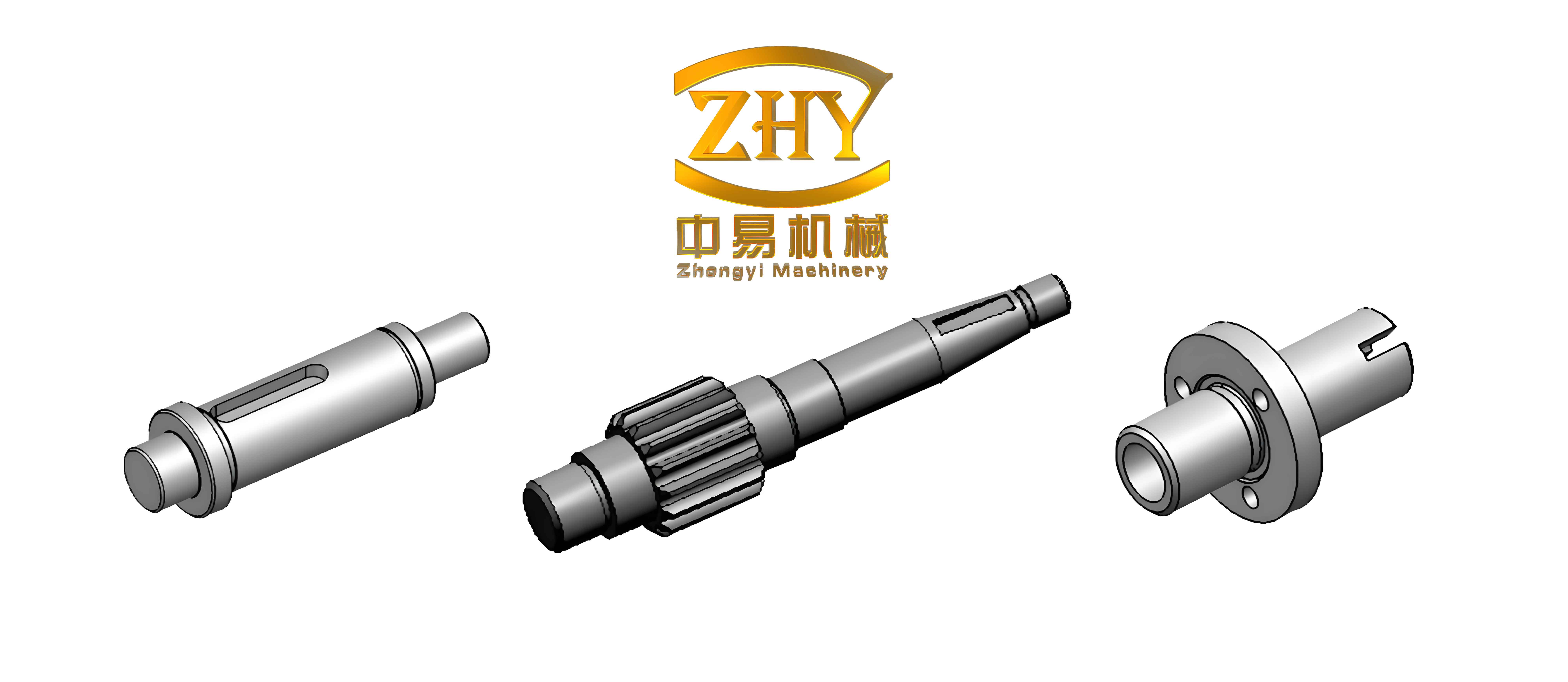
This gear shaft component is typical in compressors, where it supports and drives gears under high loads. The early failure suggests inherent material or processing issues, which I explored through systematic testing.
Chemical composition analysis was conducted on samples extracted from the fractured gear shaft according to standard methods such as GB/T 223 and GB/T 20123-2006. The results were compared to the EN10084-2008 standard for carburizing steels, as this gear shaft material should meet specific requirements for performance. Table 1 summarizes the chemical composition in weight percentage, highlighting deviations. Carbon content exceeded the upper limit specified by the standard, which can significantly alter mechanical properties. The elevated carbon level increases hardness and strength but reduces ductility, making the gear shaft more susceptible to brittle fracture. Other elements like chromium, nickel, and molybdenum were within acceptable ranges, but carbon’s role is critical in martensite formation during heat treatment. The imbalance in composition likely contributed to the gear shaft’s inadequate toughness.
| Element | C | Si | Mn | P | S | Cr | Mo | Ni |
|---|---|---|---|---|---|---|---|---|
| EN10084-2008 Requirement | 0.15–0.21 | ≤0.40 | 0.50–0.90 | ≤0.025 | ≤0.035 | 1.50–1.80 | 0.25–0.35 | 1.40–1.70 |
| Measured Value | 0.30 | 0.20 | 0.64 | 0.015 | 0.013 | 1.73 | 0.29 | 1.62 |
Mechanical properties were evaluated through tensile and impact tests on specimens taken from the gear shaft. The results, compared to the technical requirements, are presented in Table 2. The gear shaft exhibited higher tensile and yield strengths but lower elongation and reduction of area than specified. This combination indicates reduced ductility, which is critical for withstanding dynamic loads in service. The impact energy values were acceptable, but the low ductility parameters suggest that the gear shaft could not absorb sufficient energy before fracture. The relationship between strength and ductility can be described using the following equation for true stress-strain behavior: $$ \sigma = K \epsilon^n $$ where $\sigma$ is the true stress, $\epsilon$ is the true strain, $K$ is the strength coefficient, and $n$ is the strain hardening exponent. For this gear shaft, a high $K$ and low $n$ would correlate with high strength and low ductility, aligning with the observed mechanical properties.
| Property | Tensile Strength (MPa) | Yield Strength (MPa) | Elongation (%) | Reduction of Area (%) | Impact Energy (J) |
|---|---|---|---|---|---|
| Technical Requirement | ≥1095 | ≥925 | ≥16 | ≥56 | ≥62 |
| Measured Value | 1373 | 1039 | 13.0 | 53 | 73, 77, 77 |
Hardness testing was performed on the threaded section of the gear shaft using standard methods. The measured hardness values were 47.78, 49.04, and 47.52 HRC, which exceed the technical requirement of 32–40 HRC. This elevated hardness is consistent with the high carbon content and likely resulted from improper heat treatment. Hardness can be related to yield strength through empirical equations, such as: $$ \text{Hardness} \approx C \times \text{Yield Strength} $$ where $C$ is a material-dependent constant. For steel, a common approximation is that HRC hardness correlates with strength, and excessive hardness reduces toughness. In this gear shaft, the high hardness increased susceptibility to crack initiation and propagation, especially at stress concentrators like thread roots.
Microstructural examination involved preparing samples from near the fracture origin and away from it, followed by etching and observation under a microscope. Non-metallic inclusions were assessed according to DIN50602 standard, and both areas rated K4 = 12 (S:1; O:11), which meets EN10084-2008 requirements. However, the microstructure revealed significant “black” and “white” regions after etching, indicating alloy element segregation. These regions consisted of tempered martensite with small amounts of ferrite. The “white” areas showed clearer martensite morphology and higher hardness, while “black” areas had more ferrite and lower hardness. Microhardness tests using a 100 g load confirmed this: “black” regions averaged 461 HV, and “white” regions averaged 542 HV. The hardness difference can be expressed as: $$ \Delta H = H_{\text{white}} – H_{\text{black}} $$ where $\Delta H$ is approximately 81 HV, highlighting the inhomogeneity. Energy dispersive spectroscopy (EDS) analysis further showed higher chromium and nickel content in “white” regions, explaining their superior resistance to tempering. This segregation disrupts the continuity of the gear shaft material, reducing overall strength and promoting crack initiation.
Fracture surface analysis using scanning electron microscopy (SEM) revealed distinct zones. The origin area exhibited features of intergranular and transgranular brittle fracture, with “cloud-like” patterns and minor plastic deformation, suggesting stress concentration at the thread root. The propagation zone showed mixed intergranular and transgranular brittle characteristics, while the final fracture area displayed dimples indicative of ductile failure. The presence of decarburization near the fracture origin indicates that cracks formed prior to final failure, likely during the quenching step of thermal refining. Quenching induces internal stresses due to martensitic transformation; the core transforms last, causing tensile stresses at the surface. When these stresses exceed the material’s strength, cracking occurs at stress concentrators. The stress intensity factor $K_I$ for a crack can be modeled as: $$ K_I = Y \sigma \sqrt{\pi a} $$ where $Y$ is a geometry factor, $\sigma$ is applied stress, and $a$ is crack length. For this gear shaft, high residual stresses from quenching, combined with thread root stress concentration, led to $K_I$ exceeding the fracture toughness, initiating cracks that propagated under service loads.
The discussion integrates these findings to explain the gear shaft failure. The elevated carbon content directly increased hardness and reduced ductility, as evidenced by the low elongation and reduction of area. Alloy element segregation created “hard” and “soft” zones, weakening the gear shaft’s structural integrity. The quenching process during thermal refining generated cracks at the thread root due to tensile stresses, exacerbated by the stress concentration factor $K_t$ for threads: $$ K_t = 1 + 2\sqrt{\frac{a}{\rho}} $$ where $a$ is a characteristic dimension and $\rho$ is the root radius. A small $\rho$ increases $K_t$, making threads prone to cracking. The combined effect of compositional issues, segregation, and processing defects made the gear shaft vulnerable to early fracture under operational torsional loads. This gear shaft failure underscores the importance of controlling material quality and heat treatment parameters to prevent such incidents.
In conclusion, the fracture of this gear shaft resulted from a combination of factors: excessive carbon content beyond standard limits, elevated hardness reducing toughness, low ductility parameters, alloy element segregation, and quench-induced cracks at the thread root. The gear shaft’s performance was compromised by these issues, leading to premature failure during commissioning. To prevent recurrence, I recommend stringent quality controls on chemical composition, improved heat treatment processes to minimize segregation and residual stresses, and design modifications such as increasing the thread root radius to reduce stress concentration. This analysis highlights the critical role of material science in ensuring the reliability of gear shafts in demanding applications like air conditioning systems. Future work could involve finite element analysis to simulate stress distributions and optimize the gear shaft geometry for enhanced durability.