
In my analysis of the gear shaft failure, I focused on a 20CrMoH alloy steel reducer bevel gear shaft that fractured during installation and tightening. The gear shaft exhibited multiple crack origins at poorly machined thread run-out grooves, leading to severe wear in the source area. Under bending shear stress, the cracks propagated along the carburized transition layer, resulting in a fracture surface with intergranular characteristics. This study employed optical microscopy, scanning electron microscopy (SEM), and microhardness testing to evaluate the microstructure, chemical composition, and mechanical properties of the failed gear shaft. The primary goal was to identify the root causes of the fracture and propose improvements to prevent future failures in similar gear shaft applications.
The gear shaft material, 20CrMoH steel, is commonly used in heavy-duty applications due to its high hardenability, tempering stability, and corrosion resistance. However, the fracture occurred in the threaded region, which had undergone carburizing and induction annealing processes. My investigation revealed that the gear shaft failure was primarily due to stress concentration from machining defects and material inhomogeneity, exacerbated by high operational stresses. In this report, I will detail the methodologies, results, and conclusions drawn from my analysis, emphasizing the role of microstructural features and mechanical properties in the gear shaft’s performance.
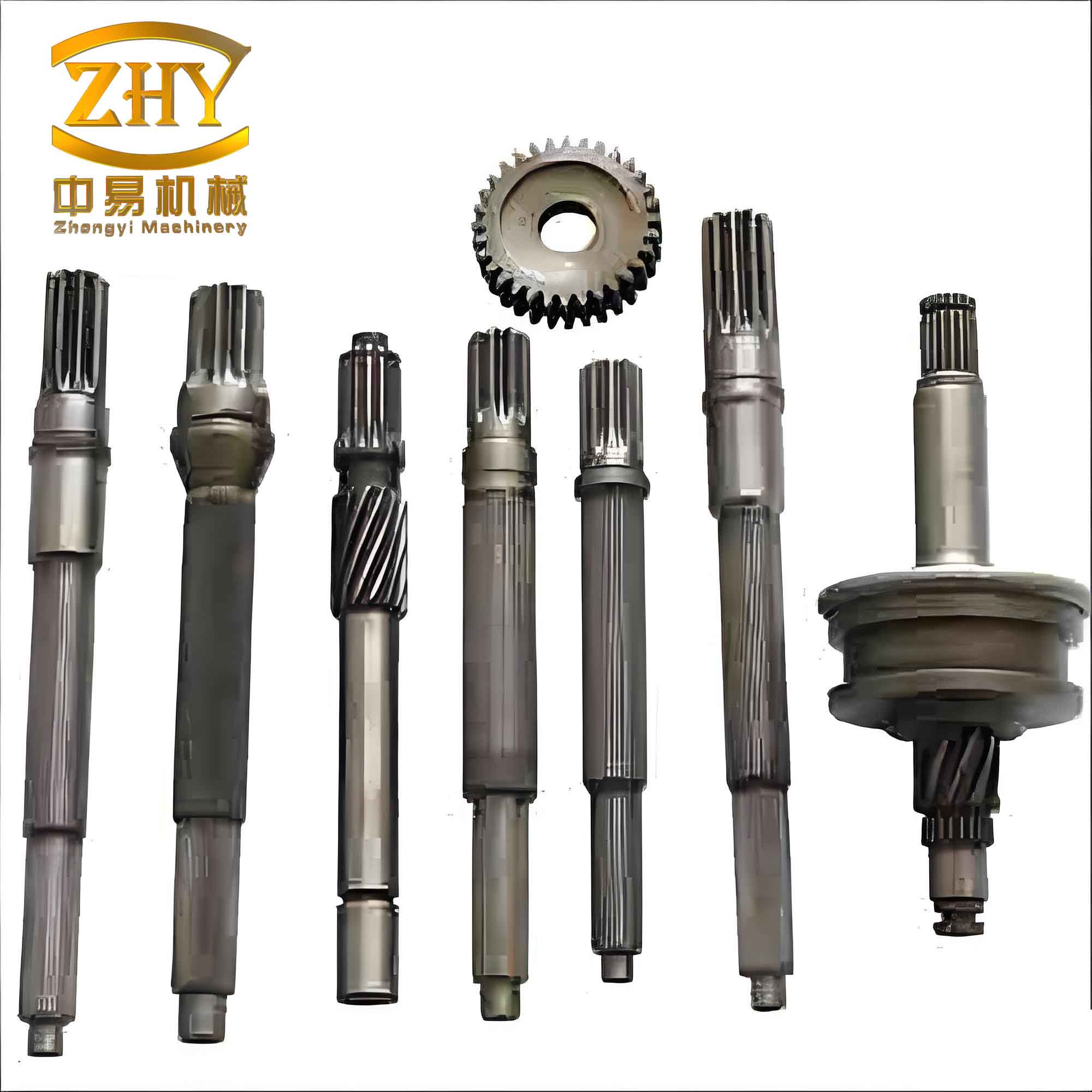
To begin, I conducted a macroscopic examination of the fractured gear shaft. The crack initiated at the thread run-out area, where machining imperfections created stress raisers. Multiple origins were observed, indicating a high-stress overload condition. The fracture surface showed signs of wear in the source region, followed by rapid propagation through the carburized layer. Using SEM, I analyzed the micro-morphology of the fracture, which displayed intergranular features and secondary cracks. This suggests that the gear shaft experienced significant bending stresses during tightening, leading to instantaneous failure. The absence of material defects like inclusions confirmed that the failure was not due to inherent material issues but rather external factors related to processing and loading.
Next, I performed chemical composition analysis using energy-dispersive spectroscopy (EDS) to verify the material conformity. The results, summarized in Table 1, show that the gear shaft’s composition meets the requirements of GB/T 5216-2014 for 20CrMoH steel. This indicates that the material was not a contributing factor to the fracture, allowing me to focus on mechanical and microstructural aspects.
| Element | C | Mn | Si | Cr | Mo | S | P | Fe |
|---|---|---|---|---|---|---|---|---|
| Gear Shaft Sample | 0.19 | 0.81 | 0.29 | 1.08 | 0.22 | 0.015 | 0.011 | Bal. |
| Standard Range | 0.17–0.23 | 0.55–0.90 | 0.17–0.37 | 0.85–1.25 | 0.15–0.35 | ≤0.03 | ≤0.03 | Bal. |
Microstructural analysis was crucial in understanding the gear shaft’s behavior. I prepared longitudinal and radial sections of the gear shaft for examination under optical and scanning electron microscopes. The threaded region exhibited a non-martensitic surface layer due to grain boundary oxidation, with a depth of approximately 11 μm. This layer can reduce surface hardness and fatigue resistance, as described by the following relationship for fatigue life reduction: $$ L_f \propto \frac{1}{\sigma_a^m} $$ where \( L_f \) is the fatigue life, \( \sigma_a \) is the stress amplitude, and \( m \) is a material constant. In this gear shaft, the non-martensitic layer likely accelerated crack initiation under cyclic loading.
Further, the microstructure in the carburized zone consisted of fine acicular martensite and retained austenite, which is desirable for high strength. However, the transition zone showed a mix of martensite, bainite, and ferrite due to induction annealing, leading to inhomogeneous properties. The core of the gear shaft displayed tempered lath martensite with some upper bainite, which can affect toughness. The presence of bainite is often associated with reduced impact resistance, as per the equation for fracture toughness: $$ K_{IC} = Y \sigma \sqrt{\pi a} $$ where \( K_{IC} \) is the fracture toughness, \( Y \) is a geometric factor, \( \sigma \) is the applied stress, and \( a \) is the crack length. For this gear shaft, the microstructural gradients contributed to stress concentration at the thread roots.
Hardness testing revealed variations across the gear shaft, as shown in Table 2. The surface hardness in the spline region was approximately 58.5 HRC, with an effective case depth of 0.9 mm (using 550 HV as a threshold). The core hardness, however, showed significant scatter, ranging from 32 to 39 HRC, likely due to material segregation. The induction-annealed layer had a hardness of about 31 HRC, meeting the technical requirement of not exceeding 48 HRC. The hardness gradient can be modeled using an exponential decay function: $$ H(d) = H_s + (H_c – H_s) e^{-k d} $$ where \( H(d) \) is the hardness at depth \( d \), \( H_s \) is the surface hardness, \( H_c \) is the core hardness, and \( k \) is a constant. In this gear shaft, the abrupt changes in hardness near the threaded area increased susceptibility to cracking.
| Location | Measurement 1 | Measurement 2 | Measurement 3 | Measurement 4 | Measurement 5 |
|---|---|---|---|---|---|
| Spline Core Hardness | 33.1 | 34.2 | 36.2 | 38.1 | 32.3 |
| Annealed Layer Hardness | 33.2 | 30.6 | 32.6 | 30.1 | 31.9 |
The fracture mechanics of the gear shaft can be further analyzed using stress intensity factors. For a crack originating at a machining defect, the stress intensity factor \( K_I \) for mode I loading is given by: $$ K_I = \sigma \sqrt{\pi a} F\left(\frac{a}{W}\right) $$ where \( \sigma \) is the remote stress, \( a \) is the crack length, \( W \) is the width of the component, and \( F \) is a correction factor. In this case, the gear shaft’s thread run-out acted as a stress concentrator, with \( K_I \) exceeding the material’s toughness, leading to unstable crack growth. The multiple origins suggest that the gear shaft was subjected to high multiaxial stresses during installation.
In my evaluation, I also considered the effect of residual stresses from heat treatment. Carburizing and induction annealing can introduce compressive surface stresses, which are beneficial for fatigue resistance. However, if not properly controlled, they can lead to tensile stresses in the subsurface, promoting crack propagation. The residual stress profile \( \sigma_r(z) \) as a function of depth \( z \) can be approximated by: $$ \sigma_r(z) = \sigma_0 \left(1 – \frac{z}{d}\right)^n $$ where \( \sigma_0 \) is the surface residual stress, \( d \) is the case depth, and \( n \) is an exponent. For this gear shaft, the induction annealing may have altered the residual stress distribution, reducing the fatigue strength.
To quantify the impact of microstructure on hardness, I used the Hall-Petch relationship for grain size strengthening: $$ \sigma_y = \sigma_0 + \frac{k_y}{\sqrt{d_g}} $$ where \( \sigma_y \) is the yield strength, \( \sigma_0 \) is the friction stress, \( k_y \) is the strengthening coefficient, and \( d_g \) is the grain size. In the gear shaft’s carburized layer, the fine martensitic structure contributed to high hardness, but the coarse grains in the transition zone lowered the overall strength, making the gear shaft prone to fracture under high loads.
Based on my findings, I conclude that the gear shaft failure was due to a combination of factors: poor machining quality at the thread run-out, microstructural inhomogeneity, and high applied stresses during tightening. The gear shaft’s material composition was adequate, but the heat treatment processes need optimization to reduce the depth of the induction-annealed layer and minimize the heat-affected zone. Future designs should incorporate better machining practices and stress analysis during assembly to prevent similar failures in gear shaft applications. Additionally, non-destructive testing methods could be employed to detect early-stage cracks in critical regions of the gear shaft.
In summary, this investigation highlights the importance of integrated material and mechanical analysis in understanding gear shaft failures. By addressing the root causes, manufacturers can enhance the durability and reliability of gear shafts in demanding environments. Further research could focus on developing advanced heat treatment techniques to achieve more uniform microstructures in gear shaft components.