
In the rapidly evolving automotive manufacturing industry, the demand for high precision in stamping processes has intensified, driving the need for enhanced accuracy in press machinery. A critical component in this context is the gear shaft, which plays a pivotal role in transmitting torque and ensuring the smooth operation of the slider in four-point presses. The synchronization of phase angles between matching teeth at the front and rear ends of a long gear shaft is essential for maintaining precision, with tolerances typically required to be within 0.02 mm, equivalent to a phase angle difference of less than 0.02°. However, achieving such precision in large-scale gear shafts has been challenging due to limitations in conventional machining and measurement techniques. Traditional methods, such as 3D laser scanning, often fall short when dealing with oversized gear shafts, leading to inefficiencies and increased costs. In response, we have developed a novel measurement approach that addresses these limitations, enabling accurate detection and correction of phase angle errors in long gear shafts. This method not only simplifies the measurement process but also significantly reduces costs, making it a valuable innovation for high-precision applications.
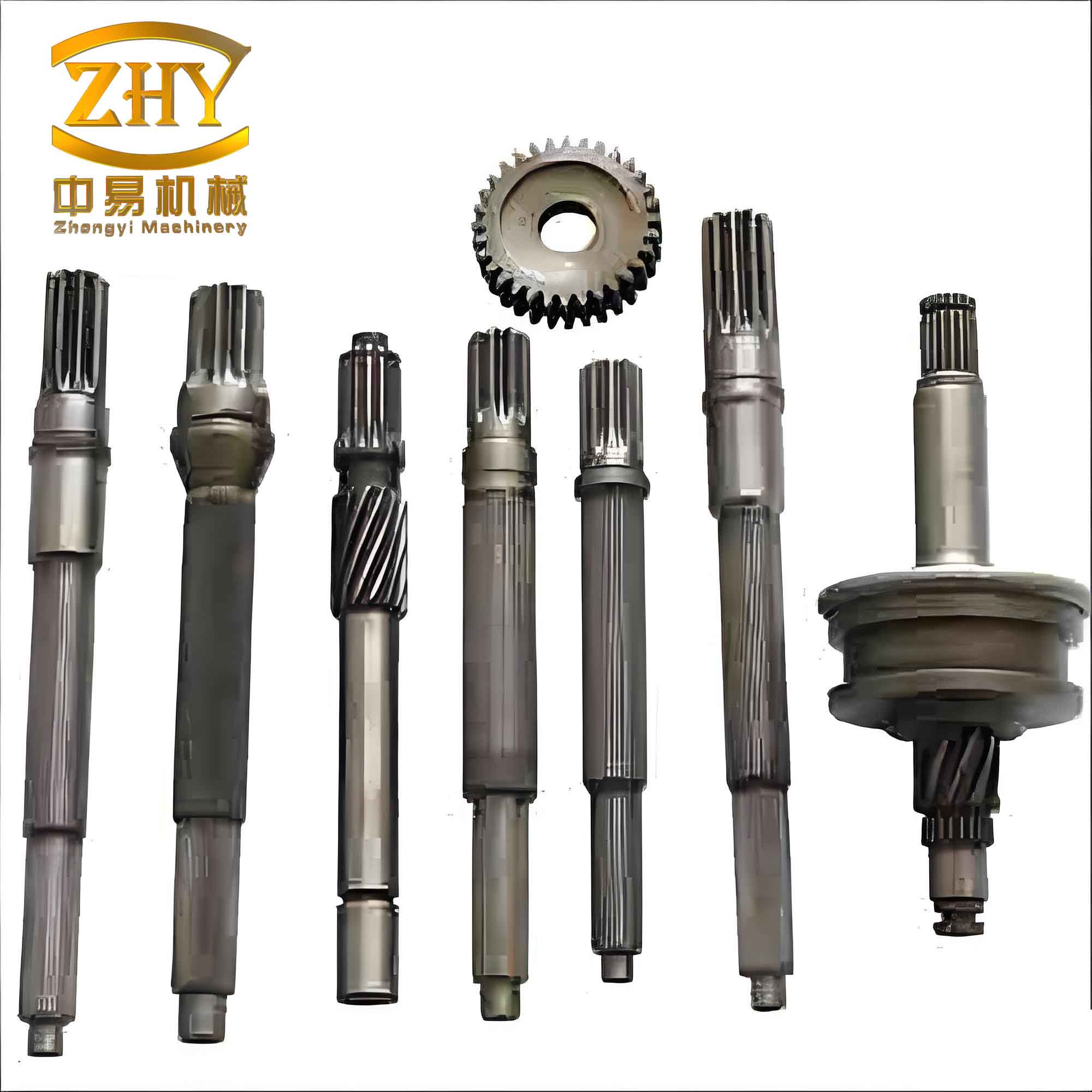
The importance of the gear shaft in press systems cannot be overstated. In four-point presses, the gear shaft acts as a transmission element that distributes torque across large spans, with two sets of gears positioned at the front and rear ends. These matching teeth must be perfectly synchronized to prevent slider tilt and ensure uniform motion. Any deviation in phase angle synchronization can lead to operational failures, such as uneven stamping and reduced product quality. Historically, compensating for such errors involved complex mechanisms, but with the rise of servo presses and higher accuracy demands, these workarounds have become insufficient. Our measurement method provides a reliable solution by leveraging a custom-designed tool that can be easily fabricated and operated, offering a practical alternative to expensive and limited-range instruments like 3D scanners.
To understand the phase angle synchronization error in a gear shaft, it is essential to define the relationship between linear displacement and angular deviation. For a gear with a pitch circle radius \( r \), the phase angle error \( \Delta \theta \) (in radians) can be related to the linear error \( \Delta s \) (in mm) using the formula: $$ \Delta s = r \cdot \Delta \theta $$ Given that the tolerance for \( \Delta s \) is 0.02 mm, the corresponding angular error \( \Delta \theta \) in degrees can be calculated as: $$ \Delta \theta = \frac{\Delta s}{r} \cdot \frac{180}{\pi} $$ For instance, if the pitch circle radius is 500 mm, the allowable angular error is approximately 0.0023°. This highlights the stringent requirements for gear shaft manufacturing and the necessity of precise measurement techniques.
The core of our measurement method involves a custom tool composed of several components, as summarized in the table below. This tool is designed to be versatile, applicable to both helical and spur gear shafts, and emphasizes simplicity and accuracy.
| Component | Description | Specifications |
|---|---|---|
| Ball-ended Rod (2 units) | Consists of a spherical ball fixed to a threaded rod; the ball contacts the gear teeth. | Ball diameter varies with gear module; rod length exceeds plate thickness. |
| Measurement Plate | A rectangular plate with a handle; serves as the reference surface. | Front face (B) parallel to rod axes; distances from B to each rod axis are equal. |
| Locking Nuts (2 units) | Secure the ball-ended rods to the plate. | Threaded to match rods; ensure stability during measurement. |
| Handle | Attached to the plate for manual positioning. | Ergonomic design for easy handling. |
The measurement procedure begins by securing the gear shaft in a stable setup, such as on a boring machine or coordinate measuring machine. The shaft must be leveled to ensure accuracy. The custom tool is then placed onto the teeth at one end of the gear shaft, with the ball-ended rods engaging the tooth spaces. A dial indicator is zeroed against the reference surface B of the measurement plate. Subsequently, the tool is moved to the matching teeth at the opposite end of the gear shaft, and the dial indicator is again brought into contact with surface B. The deviation recorded by the dial indicator represents the phase angle synchronization error between the front and rear teeth. This value is used to guide subsequent grinding processes, ensuring that the gear shaft meets the required tolerances.
Key considerations during measurement include ensuring that the ball-ended rods have consistent spherical surfaces, with all points on the ball maintaining equal distance to the reference surface B. This minimizes measurement uncertainties. Additionally, the size of the balls should be selected based on the gear module to ensure proper engagement with the tooth profiles. The simplicity of this method allows for rapid implementation without the need for sophisticated equipment, making it highly accessible for various industrial applications.
To further illustrate the impact of phase angle errors, consider the following formula that relates the synchronization error to operational performance. The torsional stiffness \( k_t \) of a gear shaft can be affected by phase discrepancies, leading to dynamic imbalances. The equivalent error in torque transmission \( \Delta T \) can be expressed as: $$ \Delta T = k_t \cdot \Delta \theta $$ where \( \Delta \theta \) is the cumulative phase error. For a gear shaft with multiple teeth, the total error \( \Delta \theta_{\text{total}} \) is the sum of individual tooth errors: $$ \Delta \theta_{\text{total}} = \sum_{i=1}^{n} \Delta \theta_i $$ Here, \( n \) represents the number of teeth involved in the measurement. By controlling \( \Delta \theta_{\text{total}} \) within the specified limits, the overall performance of the press system is enhanced.
In practical applications, this measurement method has been successfully implemented in various high-tonnage presses, such as 1600t, 2000t, and 2400t four-point models. The table below summarizes the results from these cases, demonstrating the effectiveness of the approach in achieving precision.
| Press Model | Gear Shaft Type | Initial Error (mm) | Corrected Error (mm) | Cost Savings (USD) |
|---|---|---|---|---|
| 1600t Four-Point | Helical Gear Shaft | 0.05 | 0.015 | 20,000 |
| 2000t Four-Point | Spur Gear Shaft | 0.08 | 0.018 | 20,000 |
| 2400t Four-Point | Helical Gear Shaft | 0.06 | 0.012 | 20,000 |
The economic benefits of this method are substantial. By eliminating the need for expensive external measurement services and reducing assembly time, it saves approximately $20,000 per press unit. This cost efficiency, combined with the method’s adaptability to various gear shaft configurations, underscores its potential for widespread adoption in the manufacturing sector. Moreover, the method has been granted patent protection, ensuring its intellectual property rights and fostering further innovation.
Looking ahead, the proliferation of servo press technology and increasing precision demands in industries such as automotive and aerospace will amplify the need for reliable measurement techniques. Our method addresses these trends by providing a scalable and cost-effective solution. Future enhancements could involve integrating digital sensors for real-time error analysis or automating the measurement process using robotics. Nonetheless, the core principle remains focused on the accurate assessment of phase angle synchronization in long gear shafts, a critical factor in achieving high-performance press systems.
In conclusion, the development of this measurement method represents a significant advancement in the field of gear shaft precision. By leveraging simple yet effective tools, it overcomes the limitations of traditional approaches and enables manufacturers to meet stringent tolerance requirements. The repeated emphasis on the gear shaft throughout this discussion highlights its central role in press machinery, and our method ensures that these components can be produced and maintained with the highest accuracy. As industries continue to evolve, such innovations will be crucial in driving efficiency and quality in manufacturing processes.