
In our investigation of a high-voltage circuit breaker that exhibited abnormal operation after 300 opening and closing tests, we discovered a critical failure in the primary gear shaft, where all teeth at the meshing point fractured. This gear shaft, manufactured from 20CrMnMo steel, undergoes a rigorous processing route: forging, normalizing, rough machining, carburizing, quenching, low-temperature tempering, and finish machining. To determine the root cause of this gear shaft failure, we employed a comprehensive analytical approach, including macroscopic observation, chemical composition analysis, hardness and carburized layer depth testing, metallographic examination, scanning electron microscopy (SEM), and energy-dispersive spectroscopy (EDS). Our findings indicate that elevated temperature and carbon potential during carburizing led to microstructural anomalies, such as coarse acicular martensite and networked carbides, which increased material brittleness. Cracks initiated at brittle phases in the tooth root and propagated along grain boundaries under stress, ultimately resulting in intergranular fracture. This analysis underscores the importance of precise control over heat treatment parameters to prevent such failures in critical components like the gear shaft.
High-voltage circuit breakers are essential for maintaining grid stability by interrupting and closing electrical circuits under normal and fault conditions. The gear shaft, as a key transmission element, must withstand cyclic loads; its failure can lead to operational anomalies and system downtime. In this case, the gear shaft fracture occurred after a relatively low number of cycles, suggesting inherent material or processing defects. We focused on characterizing the gear shaft’s properties to identify the failure mechanism, with an emphasis on the carburizing process, which is critical for enhancing surface hardness and wear resistance. The following sections detail our methodology, results, and interpretations, supported by quantitative data and microstructural evidence.
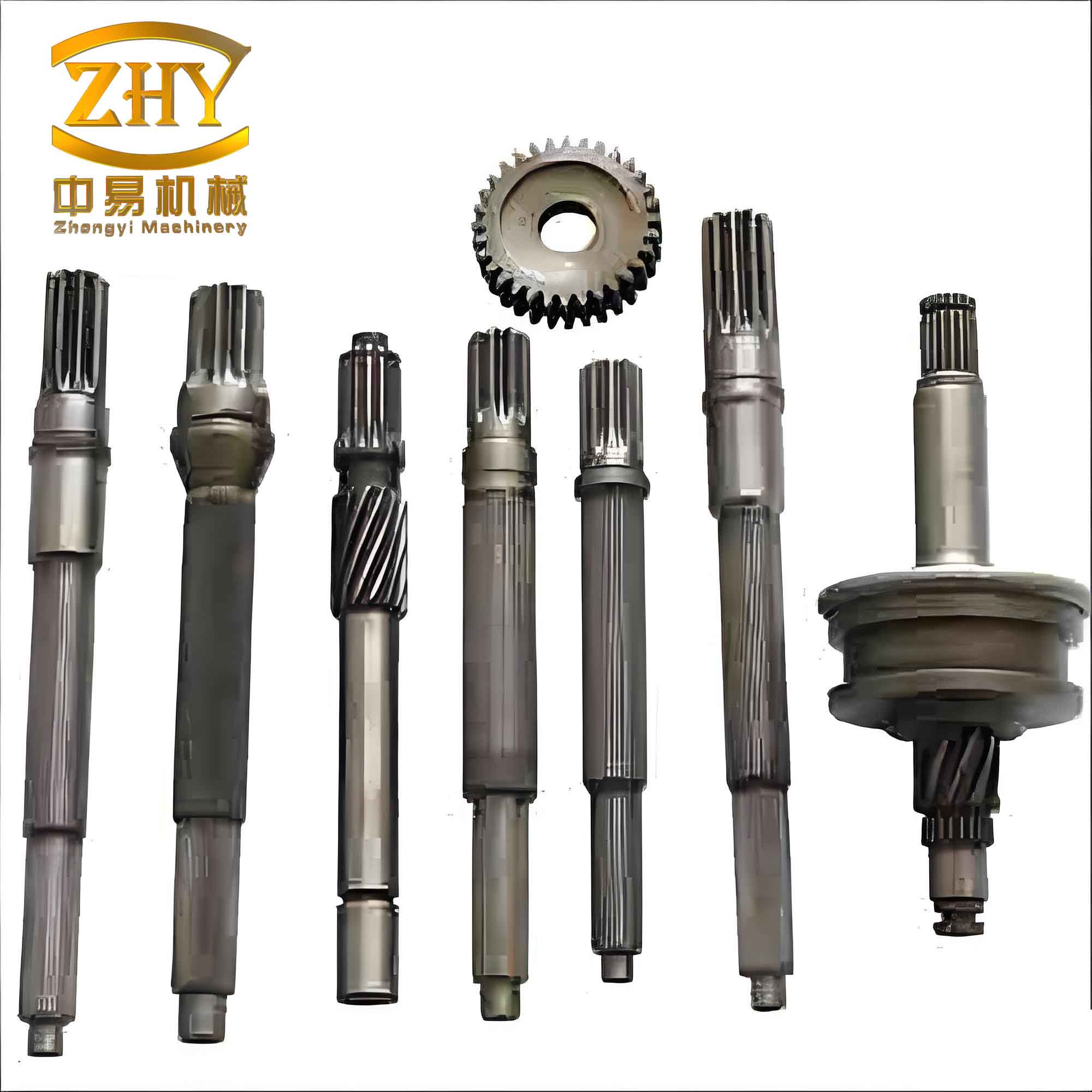
Macroscopic observation of the failed gear shaft revealed that all teeth fractured at the root, with no significant plastic deformation or shear lips, indicating a brittle failure mode. The fracture surfaces exhibited a crystalline appearance with multiple crack initiation sites, as evidenced by convergence lines pointing toward the loaded surface. This multi-origin cracking pattern is typical of stress concentration in brittle materials. Minor wear marks on the loaded surfaces were attributed to normal operational contact, but these did not contribute to the fracture, as the tooth roots remained unaffected. The absence of ductile features underscores the脆性 nature of the failure, which we further explored through compositional and microstructural analysis.
Chemical composition analysis was performed on the gear shaft substrate using optical emission spectrometry. The results, summarized in Table 1, confirm that the material conforms to the specifications for 20CrMnMo steel, as per standard alloy structural steel requirements. This ruled out material misidentification as a contributing factor, directing our attention to the heat treatment processes.
| Element | Measured Value | Standard Range |
|---|---|---|
| C | 0.17 | 0.17-0.23 |
| Si | 0.26 | 0.17-0.37 |
| Mn | 1.07 | 0.90-1.20 |
| P | 0.014 | ≤0.035 |
| S | 0.005 | ≤0.035 |
| Cr | 1.22 | 1.10-1.40 |
| Mo | 0.22 | 0.20-0.30 |
Hardness and carburized layer depth measurements were conducted according to standardized methods. The effective case depth, measured from the tooth root circle, was approximately 1.16 mm, which is near the upper limit of the specified range (0.8-1.2 mm). The hardness profile, plotted in Figure 1, shows an initial increase from the surface to the subsurface, followed by a gradual decrease toward the core. Surface hardness ranged from 56 to 58 HRC, meeting design requirements, but subsurface hardness peaked at 62-63 HRC, exceeding the specified 50-60 HRC. Core hardness was 34-36 HRC, within the acceptable range of 30-40 HRC. This anomalous hardness gradient suggests non-uniform carbon distribution and microstructural issues, which we quantified using the relationship for case depth diffusion: $$D = k \sqrt{t}$$ where \(D\) is the diffusion depth, \(k\) is a temperature-dependent constant, and \(t\) is time. Deviations in \(k\) due to high temperature could explain the observed depth and hardness variations.
Metallographic examination of samples extracted near the fracture site revealed critical microstructural defects. The tooth tip region contained massive and coarse networked carbides within a matrix of coarse acicular martensite and significant retained austenite. Similarly, the tooth flank and root areas showed networked carbides, coarse acicular martensite, and retained austenite, with additional blocky carbides at the root. The core microstructure consisted of coarse low-carbon martensite and minor bainite. According to standard classifications, the carbides were rated at level 6, and martensite and retained austenite at level 6, indicating an overheated structure with excessive carbon content in the carburized layer. The presence of these brittle phases, particularly at stress-concentration points like the tooth root, predisposes the gear shaft to crack initiation. The carbon potential (\(C_p\)) during carburizing, defined as the equilibrium carbon content at the surface, can be expressed as: $$C_p = f(T, P_{CO}, P_{CO2})$$ where \(T\) is temperature, and \(P_{CO}\) and \(P_{CO2}\) are partial pressures of gases. High \(C_p\) and \(T\) likely led to carbon saturation and carbide precipitation.
Scanning electron microscopy of the fracture surfaces revealed a冰糖-like intergranular morphology with coarse grains. Cracks originated at the loaded surface and propagated along grain boundaries toward the non-loaded side, with secondary intergranular cracks in both the initiation and propagation zones. Energy-dispersive spectroscopy analysis of blocky particles at crack initiation sites showed high carbon content (approximately 10 wt%), confirming them as carbides, while grain surfaces had negligible carbon. This aligns with the metallographic findings and highlights the role of carbides as stress concentrators. The fracture toughness (\(K_{IC}\)) of the material can be approximated by: $$K_{IC} = \sigma \sqrt{\pi a}$$ where \(\sigma\) is applied stress and \(a\) is crack length. The low toughness due to brittle phases facilitated crack growth under operational stresses.
Our integrated analysis indicates that the gear shaft failure resulted from improper carburizing parameters. Elevated temperature and carbon potential caused austenite grain coarsening and increased alloy element solubility, stabilizing austenite and promoting coarse martensite and retained austenite upon quenching. High surface carbon content raised the critical temperature, leading to blocky and networked carbide precipitation, exacerbated at stress concentration points like the tooth root due to the “corner effect.” The hardness gradient, with subsurface values exceeding specifications, reflects this carbon imbalance, as retained austenite at the surface reduced hardness marginally. The coarse grains and brittle phases embrittled the material, reducing its strength and fatigue resistance. During operation, stress concentrated at the tooth root, where carbides acted as initiation sites for microcracks. These cracks propagated along austenite grain boundaries, resulting in multi-origin intergranular fracture. This failure mechanism emphasizes the sensitivity of the gear shaft to heat treatment deviations.
To prevent recurrence, we recommend strict adherence to specified carburizing parameters, including temperature, carbon potential, and time, for complex-shaped components like the gear shaft. Standard tests for case depth and surface hardness may not detect microstructural defects; thus, metallographic inspection should include careful examination of the carburized layer, especially at sharp corners, for anomalies such as coarse carbides and martensite. Implementing statistical process control for heat treatment and regular microstructural audits can enhance reliability. Further, optimizing the quenching medium and tempering conditions could mitigate retained austenite and residual stresses. In summary, the gear shaft failure underscores the criticality of controlled carburizing to balance hardness and toughness, ensuring longevity in high-stress applications.
In conclusion, our investigation into the gear shaft tooth breakage revealed that excessive carbon potential and temperature during carburizing induced microstructural degradation, leading to brittle fracture. The gear shaft’s performance is highly dependent on precise heat treatment, and deviations can have catastrophic consequences. By addressing these factors, manufacturers can improve the durability and reliability of gear shafts in high-voltage circuit breakers, ultimately enhancing grid safety. Future work could explore advanced non-destructive testing methods for real-time monitoring of carburizing processes to prevent similar failures.