
In this study, I investigate the quenching process of a large gear shaft made from 17Cr2Ni2Mo steel, focusing on the control of deformation and stress fields through finite element simulation. The gear shaft is a critical component in heavy machinery, such as reducers for metallurgical rolling equipment and hydraulic systems, where its performance under thermal loads is paramount. Quenching, as a key heat treatment step, induces residual stresses that significantly affect fatigue strength, precision, and corrosion resistance. Uncontrolled stress states can lead to excessive distortion or even cracking, making it essential to analyze temperature, stress, and deformation evolution during quenching. Using the DEFORM heat treatment module, I simulate the quenching process to understand these fields and examine the influence of quenching holding time on stress and deformation. This research aims to provide theoretical guidance for optimizing quenching parameters, ensuring minimal distortion and stress in large gear shaft applications.
The gear shaft under consideration has a maximum diameter of 915 mm and a length of 4350 mm, with helical teeth designed for high-load operations. The quenching process involves heating to 810°C, holding for a specified time, and then oil cooling. To efficiently model this, I employ a symmetric approach by extracting a 45° segment of the cylindrical geometry, leveraging axisymmetric properties to reduce computational complexity while maintaining accuracy. The finite element model discretizes the gear shaft into elements that capture thermal and mechanical interactions. Material properties for 17Cr2Ni2Mo steel, such as thermal conductivity, specific heat, and phase transformation behaviors, are incorporated into the simulation to reflect real-world conditions. The coordinate system is defined with the X-axis along the axial direction and Y and Z along radial directions, facilitating analysis of stress components.
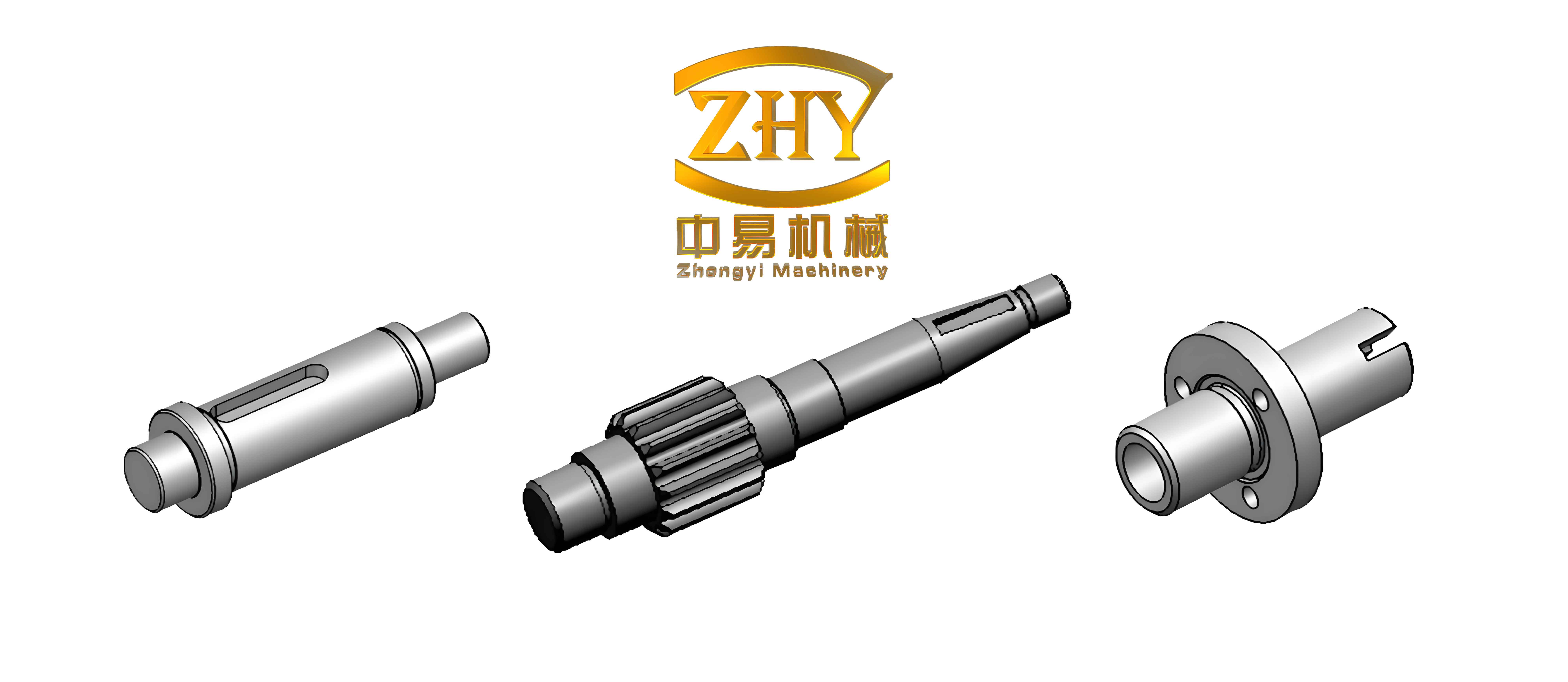
The temperature field during quenching is governed by the heat conduction equation, which accounts for transient thermal effects. The general form of the heat transfer equation is given by:
$$ \rho c_p \frac{\partial T}{\partial t} = \nabla \cdot (k \nabla T) + Q $$
where \( \rho \) is density, \( c_p \) is specific heat capacity, \( T \) is temperature, \( t \) is time, \( k \) is thermal conductivity, and \( Q \) represents internal heat sources, such as phase transformation latent heat. During quenching, the boundary conditions involve convective heat transfer with the oil, described by Newton’s law of cooling:
$$ q = h (T_s – T_{\infty}) $$
where \( q \) is heat flux, \( h \) is the heat transfer coefficient, \( T_s \) is surface temperature, and \( T_{\infty} \) is the oil temperature. The simulation tracks temperature distribution from initial heating at 20°C to the final cooling stage, revealing gradients between the surface and core of the gear shaft. For instance, during heating to 650°C, the surface temperatures rise faster, but prolonged holding allows uniformity, reducing thermal stresses. At the end of quenching, the core temperature remains higher than the surface, leading to significant thermal gradients that influence stress development.
Stress analysis incorporates thermo-elasto-plastic theory, where the total strain \( \epsilon_{total} \) is decomposed into thermal, elastic, plastic, and transformation strain components:
$$ \epsilon_{total} = \epsilon_{thermal} + \epsilon_{elastic} + \epsilon_{plastic} + \epsilon_{transformation} $$
The thermal strain is calculated as \( \epsilon_{thermal} = \alpha (T – T_{ref}) \), with \( \alpha \) being the coefficient of thermal expansion and \( T_{ref} \) the reference temperature. The stress-strain relationship follows Hooke’s law for elastic behavior:
$$ \sigma = E \epsilon_{elastic} $$
where \( \sigma \) is stress and \( E \) is Young’s modulus, which varies with temperature. Phase transformations, such as austenite to martensite, introduce volumetric changes, contributing to transformation plasticity and affecting residual stresses. The von Mises stress, used to assess yield criteria, is given by:
$$ \sigma_{v} = \sqrt{\frac{1}{2} \left[ (\sigma_x – \sigma_y)^2 + (\sigma_y – \sigma_z)^2 + (\sigma_z – \sigma_x)^2 + 6(\tau_{xy}^2 + \tau_{yz}^2 + \tau_{zx}^2) \right]} $$
where \( \sigma_x, \sigma_y, \sigma_z \) are normal stresses and \( \tau_{xy}, \tau_{yz}, \tau_{zx} \) are shear stresses. In the gear shaft, stresses are analyzed along X (axial), Y, and Z (radial) directions, with average stress providing a comprehensive view of the stress state.
Deformation during quenching arises from thermal expansion and phase transformations. The total deformation vector \( \mathbf{u} \) is derived from displacement fields, and the distortion is quantified using the magnitude of displacement. For large gear shafts, axial deformation predominates due to the geometry and cooling asymmetry. The simulation outputs displacement contours, showing how deformation evolves from expansion during heating to contraction during cooling, with martensitic transformation causing localized volume increases.
To quantify the results, I present key data in tables. Table 1 summarizes the temperature distribution at critical time points during the quenching process, highlighting the core-surface temperature differences that drive stress generation.
| Time (s) | Process Stage | Surface Temp (°C) | Core Temp (°C) | Max Temp Gradient (°C/mm) |
|---|---|---|---|---|
| 14,400 | Heating to 400°C | 400 | 380 | 5.2 |
| 28,800 | Holding at 650°C | 650 | 650 | 0.1 |
| 57,000 | Heating to 810°C | 810 | 759 | 8.7 |
| 84,600 | End of Quenching Hold | 810 | 759 | 6.5 |
| 94,400 | End of Oil Cooling | 130 | 242 | 15.3 |
The stress field results indicate that maximum stresses occur in the tooth interior and core regions. For example, after quenching with a 7.5-hour hold, the X-direction stress peaks at 345 MPa, while the average stress in the core is 166 MPa. This is attributed to the phase transformations and thermal contraction. The distribution of stresses shows compressive stresses on the surface and tensile stresses in the core, which is typical for quenching processes. To elaborate, the effective stress \( \sigma_{eff} \), which combines all stress components, is critical for assessing failure risk and is calculated as:
$$ \sigma_{eff} = \sqrt{\frac{1}{2} \left[ (\sigma_x – \sigma_y)^2 + (\sigma_y – \sigma_z)^2 + (\sigma_z – \sigma_x)^2 \right] + 3(\tau_{xy}^2 + \tau_{yz}^2 + \tau_{zx}^2)} $$
In the gear shaft, the maximum effective stress reaches up to 252 MPa in shear, located in the tooth regions, highlighting areas prone to distortion.
Deformation analysis reveals that the gear shaft undergoes axial expansion during heating, with maximum displacement near the ends. The total deformation \( \Delta L \) along the X-axis can be approximated by integrating the strain over the length:
$$ \Delta L = \int_0^L \epsilon_x dx $$
where \( \epsilon_x \) is the axial strain. During cooling, contraction occurs, but the net deformation remains positive due to martensitic expansion. The simulation shows that deformation decreases from 46.3 mm to 17.3 mm along the axis, indicating non-uniform cooling effects. This deformation behavior is crucial for ensuring dimensional accuracy in gear shaft manufacturing.
Next, I examine the effect of quenching holding time on stress and deformation. Holding time influences the degree of austenitization and temperature uniformity, thereby affecting residual stresses and distortion. I compare four holding times: 7 h, 7.5 h, 10 h, and 16 h, while keeping other parameters constant. The results are summarized in Table 2, which shows stress components and deformation magnitudes for each case.
| Holding Time (h) | X-Dir Stress (MPa) | Y-Dir Stress (MPa) | Z-Dir Stress (MPa) | Average Stress (MPa) | Max Shear Stress (MPa) | Axial Deformation (mm) |
|---|---|---|---|---|---|---|
| 7 | 359 | 191 | 180 | 185 | 254 | 19.5 |
| 7.5 | 345 | 185 | 172 | 166 | 252 | 17.3 |
| 10 | 346 | 186 | 178 | 172 | 252 | 18.1 |
| 16 | 349 | 188 | 184 | 177 | 249 | 18.7 |
From Table 2, it is evident that a holding time of 7.5 h results in the lowest stresses and deformation. Shorter times, such as 7 h, lead to higher stresses due to insufficient austenitization and larger thermal gradients. Longer times, like 16 h, increase stresses slightly, possibly due to grain growth and increased oxidation, which can exacerbate distortion. The relationship between holding time \( t_h \) and average stress \( \sigma_{avg} \) can be modeled empirically as:
$$ \sigma_{avg} = a \cdot t_h^2 + b \cdot t_h + c $$
where \( a, b, c \) are constants derived from simulation data. For this gear shaft, the optimal holding time minimizes both stress and deformation, balancing process efficiency and mechanical integrity.
Further analysis of the stress field shows that the core region experiences tensile stresses, which are critical for fatigue life. The maximum principal stress \( \sigma_1 \) in the core is given by:
$$ \sigma_1 = \frac{\sigma_x + \sigma_y}{2} + \sqrt{\left( \frac{\sigma_x – \sigma_y}{2} \right)^2 + \tau_{xy}^2} $$
In cases with longer holding times, \( \sigma_1 \) increases, raising the risk of cracking. Conversely, shorter times may leave the core under-hardened, compromising strength. Thus, the 7.5-hour holding time offers a compromise, achieving adequate hardness with controlled stresses.
Deformation trends are also influenced by phase transformations. The volume change during martensitic transformation is described by the dilation coefficient \( \beta \), related to the carbon content. For 17Cr2Ni2Mo steel, the martensite start temperature \( M_s \) is around 300°C, and the transformation strain \( \epsilon_{trans} \) contributes to deformation:
$$ \epsilon_{trans} = \beta \cdot f_m $$
where \( f_m \) is the martensite fraction. During cooling, the rapid surface quenching causes early martensite formation, while the core transforms later, leading to differential expansion and residual stresses. The simulation captures this effect, showing higher deformation in areas with greater martensitic transformation.
In conclusion, this study demonstrates that finite element simulation is a powerful tool for optimizing the quenching process of large gear shafts. The temperature, stress, and deformation fields provide insights into the mechanisms driving distortion and residual stresses. For a gear shaft with a maximum cross-sectional area of 915 mm, a quenching holding time of 7.5 hours yields the best balance of low stress and minimal deformation. This approach can be extended to other geometries and materials, enhancing the reliability of heat treatment in industrial applications. Future work could incorporate carburization effects and experimental validation to further refine the models.
The implications of this research are significant for manufacturers of heavy machinery, where gear shaft performance is critical. By controlling deformation and stress fields through optimized quenching, service life and efficiency can be improved. Repeated use of the term gear shaft throughout this analysis underscores its importance in mechanical systems, and the methodologies developed here can be applied to various gear shaft designs to achieve superior thermal and mechanical properties.