
In the field of gear manufacturing, the precision and quality of straight bevel gears are critical for various industrial applications. As a developer, I have focused on addressing the challenges in manufacturing and inspection of straight bevel gears by designing a double-flank meshing tester. This instrument aims to provide an efficient, cost-effective solution for on-line measurement, ensuring consistency in parameters such as tooth thickness and mounting distance. In this article, I will elaborate on the working principles, functionalities, structural design, and application methods of this tester, incorporating tables and formulas to summarize key aspects. The design emphasizes reliability and simplicity, making it suitable for factory environments where technical capabilities may be limited.
The increasing demand for high-quality straight bevel gears, particularly with advancements in precision forging technology, necessitates robust inspection tools. Traditional double-flank meshing testers have been enhanced with microcontrollers and digital interfaces, but they often come with high costs, complex operations, and sensitivity to environmental conditions. My development of this double-flank meshing tester for straight bevel gears focuses on economic viability, structural simplicity, and enhanced functionality. It enables comprehensive assessment of gear quality by measuring parameters like single-tooth jump and total tooth jump, which reflect the overall meshing point errors. This approach aligns with practical usage scenarios, providing a holistic view of gear processing quality.
The core principle of double-flank meshing measurement involves the meshing of tested gear with an ideal precision master gear under zero-backlash conditions, where variations in the center distance are monitored. This method is highly effective for straight bevel gears as it captures composite errors, including those related to tooth profile and alignment. In my design, the tester consists of a base that houses components for positioning the semi-axial gear and planetary gear, with their axes perpendicularly intersecting. A spring mechanism ensures continuous meshing without backlash, and a dial indicator records center distance changes. This setup allows for rapid detection of deviations, facilitating on-line monitoring in production lines.
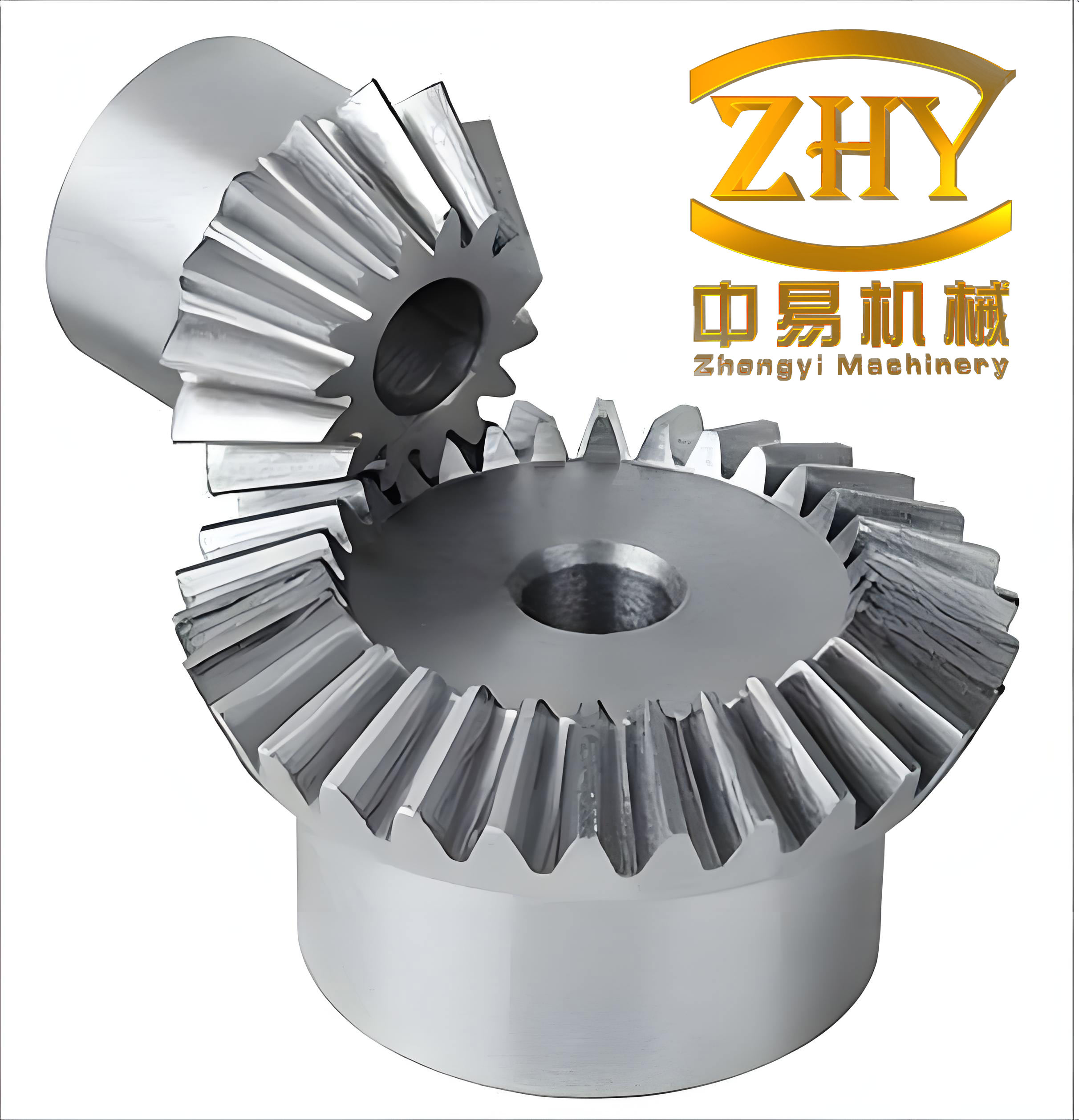
To achieve accurate positioning and smooth operation, I incorporated a rolling guide mechanism in the tester. The guide features V-shaped grooves on the moving parts that interact with corresponding grooves on the main body, supported by three ball bearings. The spring is positioned at the centroid of the triangle formed by these bearings, ensuring minimal friction and stable movement. This design is crucial for maintaining precision in straight bevel gear measurements, as it reduces resistance and prevents misalignment. The use of hardened steel pads on sliding surfaces enhances durability and simplifies maintenance. The guide’s ability to self-adjust for clearance further improves reliability in detecting center distance variations for straight bevel gears.
In terms of structural design, the semi-axial gear (including the master gear) is positioned using its outer diameter and end face. A small handle connected to a threaded rod facilitates clamping, with a slot controlled by a screw to manage travel distance. This allows for quick loading and unloading via a split washer. The large handle, integrated with the main shaft, serves as the driving element for meshing rotation. To ensure smooth operation, I carefully calibrated radial and axial clearances—excessive clearance leads to instability, while insufficient clearance causes jamming. This design ensures that the positioning end face of the semi-axial gear remains constant relative to the planetary gear, regardless of rotation angle.
For the planetary gear, positioning is achieved through a spherical surface and inner bore. I utilized CNC machining to produce high-quality spherical surfaces, complemented by nitriding treatment for enhanced wear resistance. Verification was done using a coordinate measuring machine. During loading and unloading, a flange acts as a dust seal, with ground end surfaces and minimized radial clearance to maintain internal cleanliness. This attention to detail ensures that the planetary gear, a key component in straight bevel gear assemblies, is accurately aligned for precise meshing tests.
An eccentric cam mechanism was integrated to address the need for sufficient space during workpiece handling. This mechanism allows the slide plate to move horizontally relative to the semi-axial gear, with the total displacement determined by the combined travel of the guide and eccentric cam. The eccentric travel depends on the offset distance, and its relationship with the guide travel is mediated by the position of an angle plate. Proper calculation of these parameters ensures adequate overlap, providing ample room for gear manipulation. A long handle connected to the eccentric cam, along with two pins on the main body, limits the handle’s extreme positions, defining whether the planetary gear is in working or loading state. This user-friendly feature streamlines the inspection process for straight bevel gears.
Adjusting the mounting distance is vital for accurate straight bevel gear measurements. The planetary gear mounting distance, denoted as \( L_p \), is influenced by the distance from the slide plate’s upper surface to the semi-axial gear mounting center (\( L_s \)), the spherical washer dimensions, and the shaft shoulder dimensions (\( D \)). By modifying \( L_s \) and \( D \), I can fine-tune \( L_p \). For the semi-axial gear mounting distance \( L_a \), adjustment is achieved via a screw that regulates the position of a pin in contact with a cam mechanism. Once the position is set, tightening the screw secures the pin through split bushings, locking the mounting distance. This precise control is essential for maintaining consistency in straight bevel gear production.
The economic benefits of this double-flank meshing tester are significant. Commercially available testers can cost tens of thousands of dollars, whereas my design reduces the total manufacturing cost to approximately $10,000. This cost efficiency does not compromise performance; the tester reliably measures center distance variations, single-tooth jump, and total tooth jump, providing a continuous error profile for straight bevel gears. The simplicity of the structure, with basic positioning and clamping devices, minimizes the impact of factory environments, ensuring long-term reliability.
In practice, the tester operates by installing a master gear and the被测 straight bevel gear, then rotating them via the handle to engage meshing. The dial indicator displays center distance changes, which are recorded for analysis. This process is rapid, enabling 100% inspection in batch production. The data can be used to generate meshing error curves, identify error sources, and monitor mold conditions in forging processes. Future enhancements could include error analysis, measurement system analysis (MSA), and the integration of IoT technologies for real-time monitoring of straight bevel gear manufacturing.
To summarize the key parameters and relationships, I have developed several formulas and tables. For instance, the center distance variation \( \Delta C \) can be expressed as a function of gear errors: $$ \Delta C = f(\delta_t, \delta_p) $$ where \( \delta_t \) represents tooth thickness error and \( \delta_p \) denotes pitch error. This formula highlights how the double-flank meshing tester captures composite deviations in straight bevel gears.
Another critical formula involves the mounting distance adjustment for the planetary gear: $$ L_p = L_s + D + S $$ where \( S \) is the spherical washer dimension. This linear relationship allows for straightforward calibration during setup.
For the eccentric cam mechanism, the total horizontal displacement \( X_{\text{total}} \) is given by: $$ X_{\text{total}} = X_{\text{guide}} + X_{\text{cam}} $$ where \( X_{\text{guide}} \) is the guide travel and \( X_{\text{cam}} = e \cdot \sin(\theta) \), with \( e \) being the eccentricity and \( \theta \) the rotation angle. This ensures sufficient space for gear handling.
Below is a table summarizing the main components and their functions in the double-flank meshing tester for straight bevel gears:
| Component | Function | Key Feature |
|---|---|---|
| Base and Main Body | Supports semi-axial and planetary gear assemblies | Perpendicular axis intersection |
| Rolling Guide | Ensures smooth linear motion | Low friction, self-adjusting clearance |
| Eccentric Cam Mechanism | Provides displacement for gear handling | User-controlled via long handle |
| Spring Mechanism | Maintains zero-backlash meshing | Positioned at triangle centroid |
| Dial Indicator | Measures center distance variations | High precision reading |
Additionally, a table of typical error parameters measurable with the tester for straight bevel gears is provided:
| Parameter | Description | Impact on Gear Quality |
|---|---|---|
| Single-Tooth Jump | Variation per tooth engagement | Indicates local tooth defects |
| Total Tooth Jump | Cumulative variation over all teeth | Reflects overall gear accuracy |
| Center Distance Change | Fluctuation during meshing | Measures composite errors |
The development of this double-flank meshing tester has been successfully implemented in a gear manufacturing setting, where it meets all requirements for inspecting straight bevel gears. It has demonstrated the correctness of the theoretical and structural design, as well as cost-effectiveness. However, further work is needed, such as conducting detailed error analysis and measurement system analysis to quantify uncertainty. In production, data from the tester can be used to plot meshing error curves, diagnose error causes, and assess mold conditions. The integration of IoT could enable predictive maintenance and real-time quality control for straight bevel gear production.
In conclusion, the double-flank meshing tester I designed offers a practical solution for the inspection of straight bevel gears, combining affordability, reliability, and comprehensive functionality. By leveraging simple mechanical principles and precise adjustments, it supports high-volume production with consistent quality assurance. The repeated emphasis on straight bevel gears throughout this discussion underscores their importance in various mechanical systems, and this tester plays a crucial role in ensuring their performance and longevity.