
In modern industrial applications, the demand for large-scale straight bevel gears has significantly increased, particularly in sectors such as heavy machinery, mining, and power generation. These gears are characterized by their large dimensions and complex manufacturing requirements, often necessitating specialized equipment and processes. Traditional methods for machining straight bevel gears typically involve dedicated gear-cutting machines and custom tools, which can be costly and inflexible. However, the advent of multi-axis CNC machining has opened up new possibilities for using standard tools, such as end mills, to achieve high-precision gear surfaces. This paper explores the use of an end milling cutter for side milling of split straight bevel gears, focusing on the development of a robust cutter position solution that enables efficient and accurate machining on general-purpose CNC machines. The split configuration of these gears introduces additional complexities, as the gear blank is divided into segments, altering the machining dynamics and requiring tailored toolpath strategies. By leveraging mathematical modeling and simulation, we aim to provide a comprehensive methodology for determining cutter positions and orientations, ensuring that the machined surfaces meet stringent quality standards while reducing manufacturing costs and lead times.
The machining of straight bevel gears using end mills involves a side milling approach, where the cutter’s peripheral teeth engage with the gear tooth surface. This method is particularly advantageous for split straight bevel gears, as it allows for localized machining of individual segments without the need for large, dedicated machines. The key challenge lies in accurately calculating the cutter’s position (tool center point) and orientation (tool axis vector) at each point along the toolpath. These parameters must be derived from the geometric properties of the straight bevel gear tooth surface, which can be represented as a ruled surface generated by the motion of a straight line along two base curves—the gear’s large and small end profiles. The mathematical formulation of this surface serves as the foundation for all subsequent calculations, enabling the derivation of normal vectors and offset points that define the cutter’s path. In this work, we establish a coordinate system attached to the split gear blank, facilitating the transformation of global machining coordinates into a local frame that accounts for the gear’s segmented nature. This approach ensures that the toolpath is optimized for the specific geometry of the split straight bevel gear, minimizing errors and enhancing surface finish.
The tooth surface of a straight bevel gear can be mathematically described using parametric equations that capture its ruled surface characteristics. Let \( S(r, \phi) \) represent the position vector of any point on the tooth surface, where \( r \) is a parameter ranging from 0 to 1, and \( \phi \) is the angular parameter. The surface is defined by the interpolation between the large end profile \( Q(\phi) \) and the small end profile \( W(\phi) \), as given by:
$$ S(r, \phi) = (1 – r) W(\phi) + r Q(\phi) $$
Here, \( W(\phi) \) and \( Q(\phi) \) are vector functions describing the tooth profiles at the small and large ends, respectively. For a straight bevel gear with base cone angle \( \delta_b \), pitch radius \( R \), and face width \( B \), these profiles can be expressed as:
$$ W(\phi) = \begin{cases}
W_x(\phi) = (R – B) \cos(\phi \sin \delta_b) \sin \delta_b \cos \phi \\
W_y(\phi) = (R – B) \cos(\phi \sin \delta_b) \sin \delta_b \sin \phi \\
W_z(\phi) = (R – B) \cos(\phi \sin \delta_b) \cos \delta_b
\end{cases} $$
$$ Q(\phi) = \begin{cases}
Q_x(\phi) = R \cos(\phi \sin \delta_b) \sin \delta_b \cos \phi \\
Q_y(\phi) = R \cos(\phi \sin \delta_b) \sin \delta_b \sin \phi \\
Q_z(\phi) = R \cos(\phi \sin \delta_b) \cos \delta_b
\end{cases} $$
The derivatives of these profiles with respect to \( \phi \) are crucial for computing the surface tangents and normal vectors. For instance, \( Q'(\phi) \) and \( W'(\phi) \) are obtained by differentiating each component, which will be used in subsequent steps to determine the tool orientation. The ruled surface representation not only simplifies the geometric analysis but also facilitates the integration of machining parameters, such as cutter radius and step-over distance, into the toolpath planning process. This mathematical framework is essential for achieving high accuracy in the machining of straight bevel gears, as it directly influences the calculation of cutter engagement and surface deviation.
To determine the cutter position for side milling, the unit normal vector at each point on the tooth surface must be computed. This involves calculating the partial derivatives of \( S(r, \phi) \) with respect to \( r \) and \( \phi \), denoted as \( S_r \) and \( S_\phi \), respectively. These vectors represent the tangential directions along the surface, and their cross product yields the normal vector \( F_s \):
$$ S_r = \frac{\partial S(r, \phi)}{\partial r} = Q(\phi) – W(\phi) $$
$$ S_\phi = \frac{\partial S(r, \phi)}{\partial \phi} = (1 – r) W'(\phi) + r Q'(\phi) $$
$$ F_s = S_r \times S_\phi = [f_x, f_y, f_z] $$
where the components \( f_x, f_y, f_z \) are computed as follows:
$$ f_x = S_{r_y} S_{\phi_z} – S_{r_z} S_{\phi_y} $$
$$ f_y = S_{r_z} S_{\phi_x} – S_{r_x} S_{\phi_z} $$
$$ f_z = S_{r_x} S_{\phi_y} – S_{r_y} S_{\phi_x} $$
The unit normal vector \( \mathbf{e} \) is then obtained by normalizing \( F_s \):
$$ \mathbf{e} = \frac{F_s}{\| F_s \|} = [a_x, a_y, a_z] $$
This unit normal vector is used to offset the surface point by the radius of the end mill, \( R_d \), to find the tool center point \( M = (x_o, y_o, z_o) \). The coordinates of \( M \) are given by:
$$ x_o = R \left[ \cos(\phi \sin \delta_b) \sin \delta_b \cos \phi + \sin(\phi \sin \delta_b) \sin \phi \right] a_x R_d $$
$$ y_o = R \left[ \cos(\phi \sin \delta_b) \sin \delta_b \sin \phi – \sin(\phi \sin \delta_b) \cos \phi \right] a_y R_d $$
$$ z_o = R \cos(\phi \sin \delta_b) \cos \delta_b a_z R_d $$
The tool axis vector \( \mathbf{P} = (p_x, p_y, p_z) \), which defines the orientation of the cutter, is derived by rotating the initial tool axis vector (aligned with \( S_r \)) by an angle \( b \) around the Y-axis. The rotation matrix \( M_{oc} \) is applied as follows:
$$ M_{oc} = \begin{bmatrix}
\cos b & 0 & \sin b \\
0 & 1 & 0 \\
-\sin b & 0 & \cos b
\end{bmatrix} $$
Thus, the tool axis vector components are:
$$ p_x = R \left[ \cos(\phi \sin \delta_b) \sin \delta_b \cos \phi + \sin(\phi \sin \delta_b) \sin \phi \right] (\cos b – \sin b) $$
$$ p_y = R \left[ \cos(\phi \sin \delta_b) \sin \delta_b \sin \phi – \sin(\phi \sin \delta_b) \cos \phi \right] $$
$$ p_z = R \cos(\phi \sin \delta_b) \cos \delta_b (\sin b + \cos b) $$
These equations provide a complete set of parameters for controlling the end mill during the side milling process. The explicit expressions for tool center and orientation enable efficient CNC programming and facilitate real-time adjustments during machining. The integration of these calculations into a post-processing routine allows for the generation of toolpaths that are optimized for the split straight bevel gear geometry, ensuring that the machined surface closely matches the theoretical design. The use of standard end mills, as opposed to custom tools, reduces tooling costs and increases flexibility, making this approach particularly suitable for small-batch production and prototyping of large straight bevel gears.
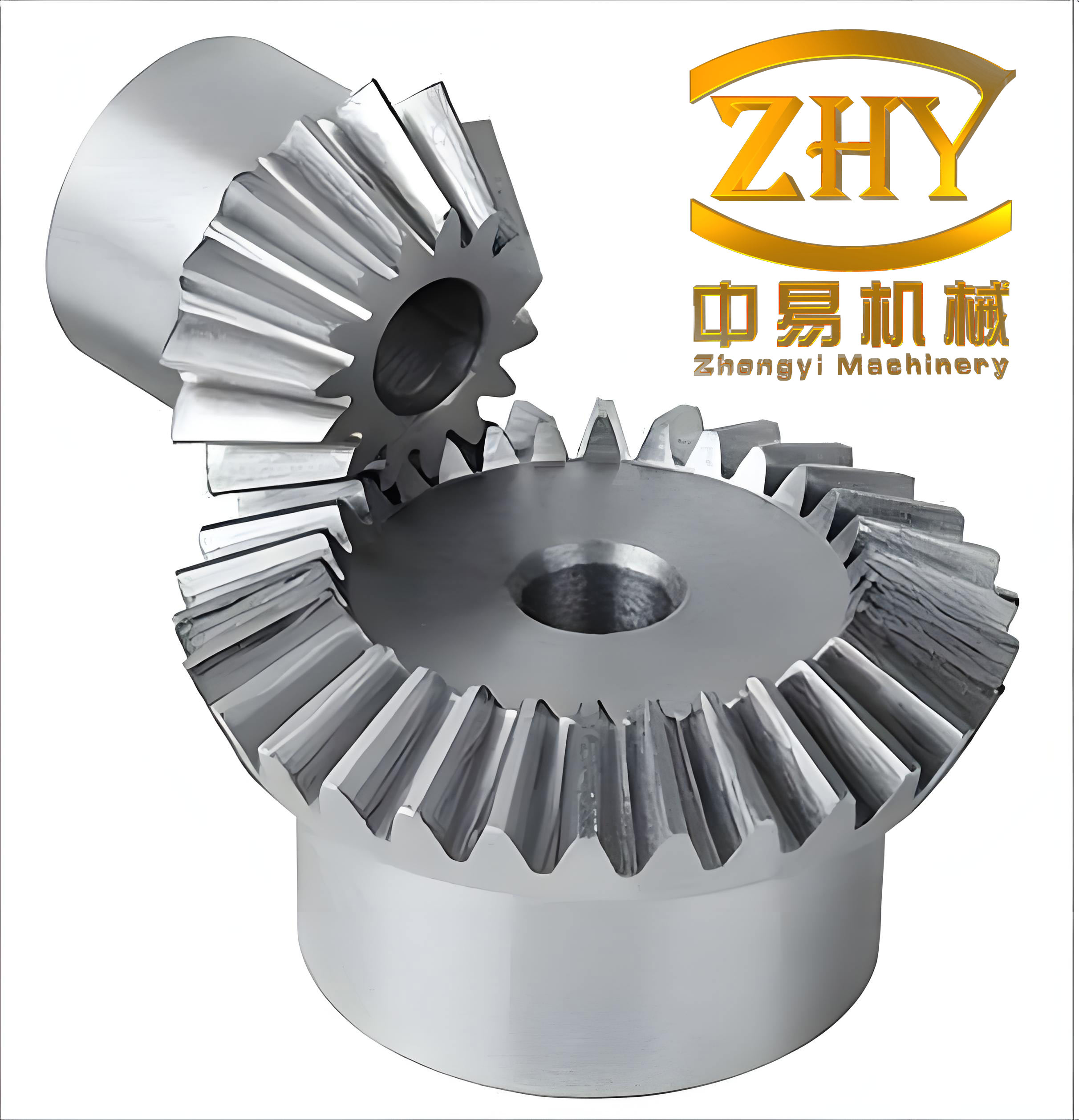
The toolpath for side milling a split straight bevel gear is planned as a series of zig-zag motions along the tooth surface, following the direction of the conical generators. This strategy minimizes non-cutting time and ensures consistent engagement conditions throughout the process. Starting from the large end of the gear tooth, the cutter moves towards the small end along a straight path, then reverses direction to cover the adjacent region. This pattern is repeated until the entire tooth surface is machined. The step-over distance between consecutive passes is determined based on the required surface finish and machining efficiency, typically set to a fraction of the cutter diameter. For a straight bevel gear with a face width of 100 mm and a module of 20 mm, a step-over of 2–5 mm is often suitable, balancing productivity and accuracy. The toolpath points are computed by discretizing the parameters \( r \) and \( \phi \) over their respective ranges, with the number of points adjusted to achieve the desired chordal deviation. The following table summarizes the key parameters used in the toolpath calculation for a typical straight bevel gear:
| Parameter | Symbol | Value |
|---|---|---|
| Module | \( m_n \) | 20 mm |
| Number of Teeth | \( Z \) | 72 |
| Pressure Angle | \( \alpha_n \) | 20° |
| Face Width | \( B \) | 100 mm |
| Pitch Radius | \( R \) | 720 mm |
| Cutter Radius | \( R_d \) | 5 mm |
| Base Cone Angle | \( \delta_b \) | Calculated from gear geometry |
The machining simulation is conducted using VERICUT software to validate the toolpath and cutter position data. A virtual model of a 5-axis CNC machine is constructed, incorporating the kinematic chain and controller characteristics. The straight bevel gear blank is positioned such that its coordinate system aligns with the machine’s workpiece coordinate system, accounting for the split configuration. The toolpath, generated from the calculated cutter positions, is imported into VERICUT, and the material removal process is simulated step by step. The simulation results are compared against the design model to identify any gouging or undercutting regions. For a straight bevel gear with the parameters listed above, the simulation shows that the maximum deviation between the machined surface and the theoretical model is within 0.05 mm, indicating the accuracy of the proposed method. The following table outlines the simulation parameters and results:
| Simulation Parameter | Value |
|---|---|
| Machine Type | 5-Axis CNC |
| Workpiece Material | Steel |
| Cutter Type | End Mill |
| Toolpath Points | 5000 |
| Maximum Deviation | 0.05 mm |
| Simulation Time | 2 hours |
Experimental validation is performed on a DMU100 5-axis CNC machining center. A split straight bevel gear blank made of 42CrMo steel is used, with pre-machined tooth slots created by form milling to leave a 0.1 mm allowance for finish machining. A 10 mm diameter end mill is employed for the side milling operations, with cutting parameters set to a spindle speed of 3000 rpm and a feed rate of 500 mm/min. The machining process follows the computed toolpath, and the resulting gear teeth are inspected using a coordinate measuring machine (CMM). The measurement data is compared to the theoretical tooth profile to evaluate form errors, pitch accuracy, and radial runout. The results demonstrate that the machined straight bevel gear meets the accuracy requirements of GB/T 10095.1, with all deviations within acceptable limits. The table below summarizes the measurement results for key gear parameters:
| Gear Parameter | Measured Value | Tolerance Standard |
|---|---|---|
| Profile Total Deviation | 5.6 μm | GB/T 10095.1 |
| Profile Form Deviation | 2.6 μm | GB/T 10095.1 |
| Single Pitch Deviation | 25.3 μm | GB/T 10095.1 |
| Total Cumulative Pitch Deviation | 21.8 μm | GB/T 10095.1 |
| Radial Runout | 38.3 μm | GB/T 10095.1 |
The mathematical model for cutter position calculation can be extended to account for dynamic effects such as cutter deflection and thermal deformation. The force acting on the end mill during side milling can be modeled using the mechanistic approach, where the cutting force is proportional to the uncut chip thickness. For a straight bevel gear tooth surface, the uncut chip thickness \( h \) varies along the toolpath and can be expressed as:
$$ h = f_t \sin(\theta) $$
where \( f_t \) is the feed per tooth and \( \theta \) is the engagement angle. The cutting force components in the radial, tangential, and axial directions are given by:
$$ F_t = K_t a_p h $$
$$ F_r = K_r a_p h $$
$$ F_a = K_a a_p h $$
Here, \( K_t, K_r, K_a \) are the specific cutting force coefficients, and \( a_p \) is the axial depth of cut. These forces can cause tool deflection, which in turn leads to form errors on the machined surface. To compensate for this, the toolpath can be adjusted by offsetting the cutter position based on the predicted deflection. The deflection \( \delta \) at the cutter tip can be estimated using a cantilever beam model:
$$ \delta = \frac{F L^3}{3 E I} $$
where \( F \) is the resultant force, \( L \) is the overhang length, \( E \) is the modulus of elasticity, and \( I \) is the moment of inertia of the tool. By integrating this compensation into the toolpath calculation, the accuracy of the machined straight bevel gear can be further improved.
Another important consideration is the optimization of cutting parameters to minimize machining time while maintaining surface quality. The material removal rate (MRR) for side milling a straight bevel gear tooth can be calculated as:
$$ \text{MRR} = a_p a_e f_t Z n $$
where \( a_e \) is the radial depth of cut, \( Z \) is the number of teeth on the cutter, and \( n \) is the spindle speed. However, increasing MRR may lead to higher cutting forces and temperatures, which can adversely affect tool life and surface integrity. Therefore, a balance must be struck between productivity and quality. The use of coolant and advanced tool coatings can help mitigate these issues, allowing for higher cutting parameters. For the straight bevel gear machining process, recommended cutting parameters are listed in the table below:
| Cutting Parameter | Value |
|---|---|
| Spindle Speed | 3000–5000 rpm |
| Feed Rate | 500–1000 mm/min |
| Axial Depth of Cut | 0.5–2 mm |
| Radial Depth of Cut | 1–5 mm |
| Coolant | Flood |
In conclusion, the side milling of split straight bevel gears using an end milling cutter is a viable and efficient method that leverages standard CNC machinery and tools. The mathematical framework developed for cutter position and orientation calculation provides a precise and reliable basis for toolpath generation. The simulation and experimental results confirm that the proposed approach meets the required accuracy standards for large straight bevel gears, with all measured deviations within the specified tolerances. This method offers significant cost savings and flexibility compared to traditional gear-cutting techniques, making it particularly suitable for the manufacturing of large and split straight bevel gears in various industrial applications. Future work could focus on extending this approach to other types of bevel gears, such as spiral or hypoid gears, and incorporating real-time monitoring and adaptive control to further enhance machining performance.