
In the aerospace industry, the demand for high-precision transmission components has driven significant advancements in manufacturing and inspection techniques. As a key component in angular gearboxes, the straight bevel gear plays a critical role in systems such as high-lift mechanisms and door actuation systems in civil aircraft like the C919. The straight bevel gear is responsible for changing the direction of motion and transmitting torque, and its performance directly impacts the efficiency, lifespan, and reliability of the entire system. However, traditional manufacturing methods for straight bevel gears often fall short of meeting the stringent requirements for precision, contact patterns, and interchangeability in modern applications. In this article, I will explore how improvements in milling cutter design and advanced testing technologies have enhanced the quality of straight bevel gear processing, focusing on the transition from conventional methods to CNC-based approaches that achieve higher accuracy and consistency.
The manufacturing of straight bevel gears has evolved significantly over the years, with traditional methods like gear planing and forging being gradually replaced by more precise techniques. Planing, for instance, involves using tools with pressure angles equal to the standard values to produce approximate spherical involute tooth surfaces. This results in full-length contact patterns, which are highly sensitive to installation errors and load variations, leading to issues like edge contact and inconsistent performance. In contrast, modern CNC milling methods, such as the Coniflex system developed by Gleason, utilize rotary cutting tools and non-generated milling processes to create crowned tooth profiles. This approach allows for localized contact patterns, such as elliptical or rounded rectangular shapes, which improve load distribution and reduce sensitivity to misalignments. The straight bevel gear produced through these methods exhibits superior performance, making it suitable for high-stakes applications in aircraft like the C919. The global market for gears, including straight bevel gears, has seen substantial growth, driven by advancements in defense and aerospace sectors. This shift underscores the importance of adopting high-precision manufacturing and inspection technologies to meet the escalating demands for quality and reliability.
Several factors influence the machining accuracy of straight bevel gears, including the machine tool, fixture, cutter, gear blank, manufacturing process, and inspection methods. While CNC milling machines like the 275HC can achieve geometric accuracies compliant with GB/T 11365—2019 grade 5-6, and hydraulic fixtures provide positioning precision within 0.005 mm, the cutter parameters and material are among the most critical elements affecting gear quality. The gear blank tolerances, categorized into Grade I and II, also play a vital role, as they define the reference surfaces for machining and inspection. However, the core of improving straight bevel gear accuracy lies in optimizing the cutter design and enhancing detection techniques. For example, the cutter’s dish angle, diameter, pressure angle, and blade spacing directly impact the crown amount and contact pattern characteristics. Additionally, the transition from powder metallurgy tools to carbide-tipped tools has resulted in significant gains in machining precision, surface finish, and tool life. In the following sections, I will delve into the specifics of cutter improvements and testing technologies that have elevated the straight bevel gear from GB/T 11365—2019 grade 7 to grade 5, ensuring compliance with C919 high-lift system requirements.
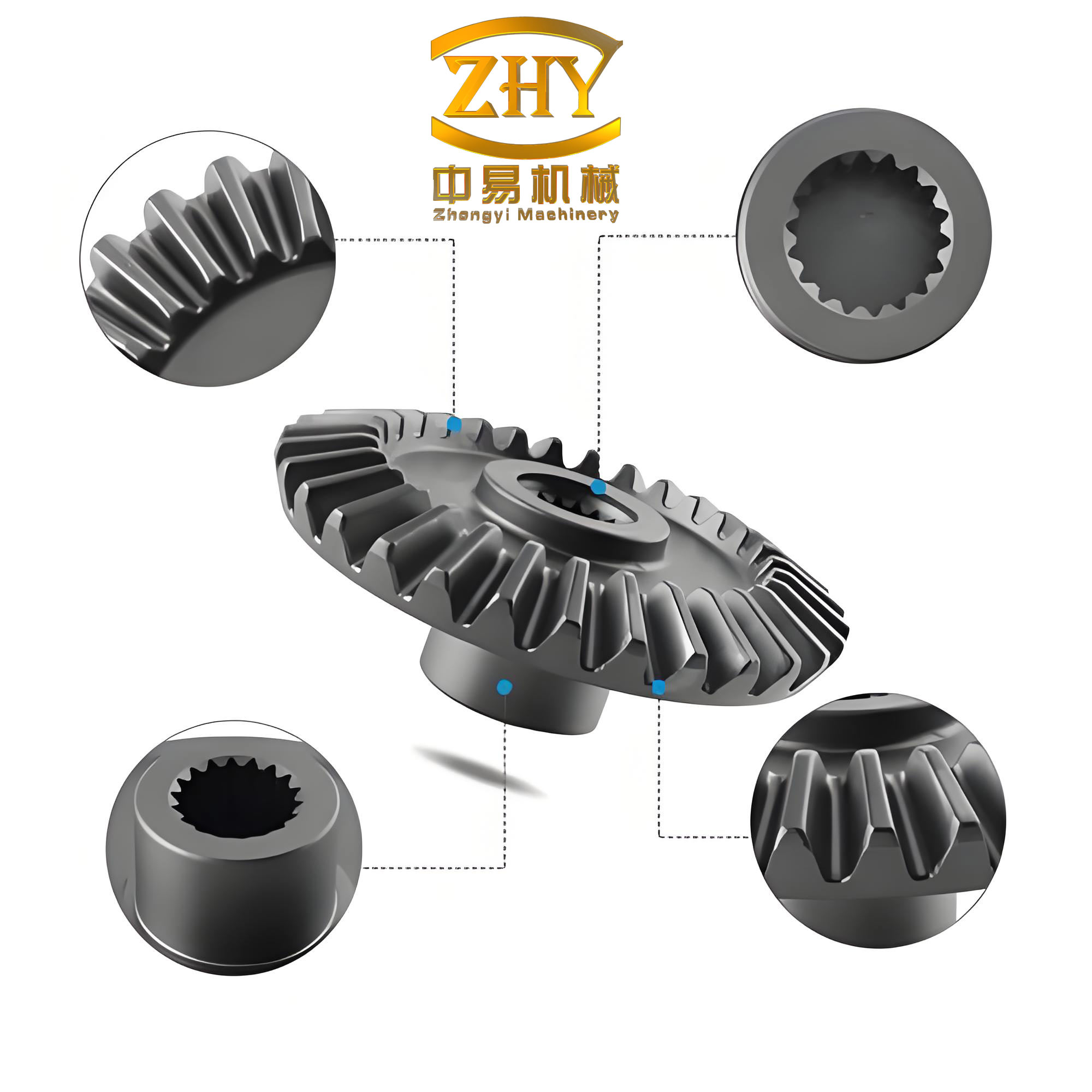
The design of milling cutters is a pivotal aspect of straight bevel gear machining, as it directly affects the contact accuracy, including the size, shape, position, and boundaries of the contact pattern. The dish angle (δ) of the cutter, which is the concave angle of the main cutting edge, determines the crown amount (ΔS) on the gear tooth surface. This crown amount influences the contact pattern size and is derived from the following equations. The radius of curvature (ρ) of the pitch cone tooth line is given by:
$$ \rho \approx \frac{D_u}{2 \sin \delta} $$
where \( D_u \) is the diameter of the milling cutter. The crown amount ΔS can be expressed as:
$$ (\rho – \Delta S)^2 + \left( \frac{B}{2} \right)^2 = \rho^2 $$
Solving for ΔS, we get:
$$ \Delta S \approx \frac{B^2 \sin \delta}{4 D_u} $$
Here, B represents the face width of the gear. From this, it is evident that the crown amount is proportional to the face width and dish angle but inversely proportional to the cutter diameter. A smaller crown amount results in a larger contact area, while a larger crown amount reduces it, allowing for precise control over the contact pattern. The pressure angle of the cutter (a_f) is interrelated with the dish angle and the machine tool’s cutter axis angle (ψ), as shown in the equation:
$$ a_f = \psi – \delta $$
Blade spacing, or the width of the cutter tip, is determined by the slot widths at the large and small ends of the gear. It must satisfy the condition that it is greater than half the large-end slot width and less than the small-end slot width. The calculations for these parameters are as follows:
$$ W_{Li} = \frac{A_0 – B}{A_0} \times (T_{on} – 2 \times b_0 \times \tan a_f) – 0.038 $$
$$ W_{Lo} = (T_{on} – 2 \times b_0 \times \tan a_f) – 0.038 $$
$$ W_{T.\max} = W_{Li} – \text{Stock\_allowance} $$
where \( W_{T.\max} \) is the maximum blade spacing, \( W_{Li} \) is the small-end limit slot width, \( W_{Lo} \) is the large-end limit slot width, \( A_0 \) is the outer cone distance, \( T_{on} \) is the large-end circular tooth thickness of the mating gear, \( b_0 \) is the large-end dedendum, and Stock_allowance is the machining allowance. Initially, Gleason software provided limited tool standardization, leading to a proliferation of cutter specifications. By applying group technology and developing reverse calculation software, we reduced the number of cutter types from seven to two, achieving a 60% optimization rate. Moreover, the shift from powder metallurgy materials like ASP2023 and ASP2030 to carbide-tipped tools, coated with TiN, TiAlN, or AlCrN, has enhanced hardness, wear resistance, and thermal stability. The comparison between the two tool materials is summarized in Table 1.
| Parameter | Powder Metallurgy Tool | Carbide Tool |
|---|---|---|
| Rotational Speed (r/min) | 80–100 | 330–400 |
| Cutting Speed (m/min) | 50–70 | ~200 |
| Straight Bevel Gear Accuracy (GB/T 11365—2019) | Grade 7 | Grade 5 |
| Tooth Profile Accuracy (mm) | 0.01 | 0.005 |
| Surface Roughness (Ra) | 1.1–1.4 | 0.4–0.6 |
| Midpoint Tooth Thickness Tolerance (mm) | 0.140 | 0.025 |
| Tool Life (number of parts) | 15 | 230 |
As shown in the table, the use of carbide tools has dramatically improved the straight bevel gear quality, with accuracy reaching grade 5, tooth profile accuracy enhanced to 0.005 mm, and surface roughness reduced to Ra 0.4–0.6. This results in more precise contact patterns, better consistency across the tooth flank, and clearer boundaries, which collectively reduce sensitivity to installation errors and load deformations, thereby improving fatigue strength. The impact of cutter improvements on the contact pattern is visually apparent, with elliptical patterns covering about 50% of the tooth length and positioned toward the small end, which is ideal for high-load applications in straight bevel gears.
Advanced testing technologies are indispensable for achieving high precision in straight bevel gear manufacturing. The introduction of a master gear, calibrated to grade 5 of GB/T 11365—2019, serves as a reference for subsequent part inspections and adjustments, ensuring interchangeability. Key technical indicators for the master straight bevel gear include unilateral accuracy (e.g., single pitch deviation \( f_{ptA} \leq 0.0059 \) mm, pitch deviation \( F_{pT} \leq 0.0221 \) mm, and radial runout \( F_r \leq 0.0176 \) mm), contact accuracy (50–60% contact area size, centered 65% from the large end in length direction, and centered in height direction), tooth profile accuracy of ±0.005 mm, and surface roughness of Ra 0.4. Various inspection methods are employed to verify these parameters, including CMM tooth profile detection, unidirectional accuracy testing, rolling tests for contact patterns, and midpoint tooth thickness measurement.
CMM tooth profile detection is crucial for controlling the tooth surface shape. According to AGMA 2009-B01, gear measuring centers with specialized software are used to measure the three-dimensional tooth surface and compare it with the theoretical digital model. The evaluation is based on a 5×9 grid of points on the tooth flank, and the deviation between actual and theoretical values is analyzed. The tooth profile tolerance is given by:
$$ (\pm) V_{\Phi T} = 10.75 \times N^{0.154} \times P_d^{-0.589} \times 1.4^{B-8} \times 0.00254 $$
where N is the number of teeth, \( P_d \) is the diametral pitch at the large end, and B is the accuracy grade. For the C919 straight bevel gear, the tooth profile tolerance is ±0.01 mm, but with carbide tools and high-precision CMM, it can be controlled within ±0.005 mm. Unidirectional testing covers parameters like radial runout and pitch deviations, which affect the uniformity and clarity of the contact pattern. Achieving grade 5 accuracy in these areas ensures consistent contact patterns across the gear.
Numerically controlled rolling tests are used to assess the meshing state of straight bevel gear pairs under fixed mounting distances. This method evaluates the actual contact conditions from tooth tip to root and along the tooth length, providing insights into the contact pattern position, size, boundary state, and overall consistency. The high accuracy in tooth profile and unidirectional parameters forms the foundation for ideal contact patterns, which are further refined based on experimental data to shift the contact area toward the small end. This crowning, achieved through profile and lead modifications, results in elliptical contact patterns that enhance the load-bearing capacity of the straight bevel gear. The backlash and midpoint tooth thickness are also critical for proper operation and interchangeability. The backlash at the large end (\( B_{o.cal} \)) is calculated as:
$$ B_{o.cal} = \frac{\pi}{P_d} – d \times \arcsin\left( \frac{A_0 t_{cc.mea}}{d (A_0 – x_0)} \right) – D \times \arcsin\left( \frac{A_0 T_{cc.mea}}{D (A_0 – x_0)} \right) $$
where d is the pinion pitch diameter, D is the gear pitch diameter, \( x_0 \) is the measured distance from the large end to the contact center, \( t_{cc.mea} \) is the measured chordal tooth thickness at the pinion contact center, and \( T_{cc.mea} \) is the measured chordal tooth thickness at the gear contact center. Traditional tooth thickness calipers, with accuracies above 0.1 mm, are insufficient for the tight tolerance of 0.0254 mm required for the midpoint tooth thickness in C919 straight bevel gears. Instead, precision instruments like the Klingelnberg P65 and P40 are used to measure the tooth thickness at the specific dT point (defined by radius R and height Z), achieving an accuracy of 0.001 mm. This high-precision measurement ensures consistent machining and proper backlash control, which are essential for the interchangeability of straight bevel gears.
In conclusion, the integration of optimized milling cutters and advanced testing technologies has revolutionized the manufacturing of straight bevel gears, particularly for high-precision applications like the C919 aircraft. By refining cutter parameters such as dish angle, diameter, pressure angle, and blade spacing, and transitioning to carbide tool materials, the machining accuracy of straight bevel gears has been elevated from GB/T 11365—2019 grade 7 to grade 5. This improvement is characterized by enhanced tooth profile accuracy, superior surface finish, and well-defined elliptical contact patterns positioned toward the small end. Furthermore, the adoption of high-precision inspection methods, including CMM tooth profile detection, unidirectional testing,数控 rolling tests, and midpoint tooth thickness measurement, has ensured consistency and interchangeability. These advancements not only meet the stringent demands of modern aerospace systems but also pave the way for future innovations in straight bevel gear technology, underscoring the critical role of continuous improvement in machining and inspection processes for straight bevel gears.